Pico Laser in Seoul: What It Can Clear, and What It Cannot
The name is about how briefly the light fires — it only works where there is a particle to break
**A pico laser fires light in bursts measured in trillionths of a second, breaking pigment into finer pieces.** The name is not about which light is used. It is about **how briefly the light fires.** Because it works by breaking things apart, it only does something where **there is a particle to break.** - **What lightens** — freckles, shallow spots and dull tone; melasma that reaches deeper; black, blue and green tattoo ink - **What the fractional treatment handles** — enlarged pores and shallow indented marks (regeneration, not pigment being broken) - **What this approach cannot do** — redness from vessels, moles and skin tags raised above the skin, sharply defined sun spots and flat age spots, red, orange and yellow ink **So "a pico laser handles everything" does not hold.** The side it cannot do is handled by an entirely different approach.
"Pico laser comes up for tattoos, for my dark spots, and for acne scars. Is it the same treatment for all three?"
Search pico laser and tattoo removal, for hyperpigmentation and for acne scars follow right behind it. Different concerns sit under one name, and that is where the question comes from. Before you can judge whether it fits what you have, you have to separate what the name actually refers to.
What Does a Pico Laser Break?
A pico laser is not the name of one machine. It covers lasers that fire light for an extremely short time.
A picosecond is a trillionth of a second. Cut the light this short and the firing is over before heat has room to spread around it. Instead, a sudden pressure loads onto the pigment particle, and the particle breaks up as fine as grains of sand. It shatters rather than burns, so there is less heat damage to the healthy tissue around it.
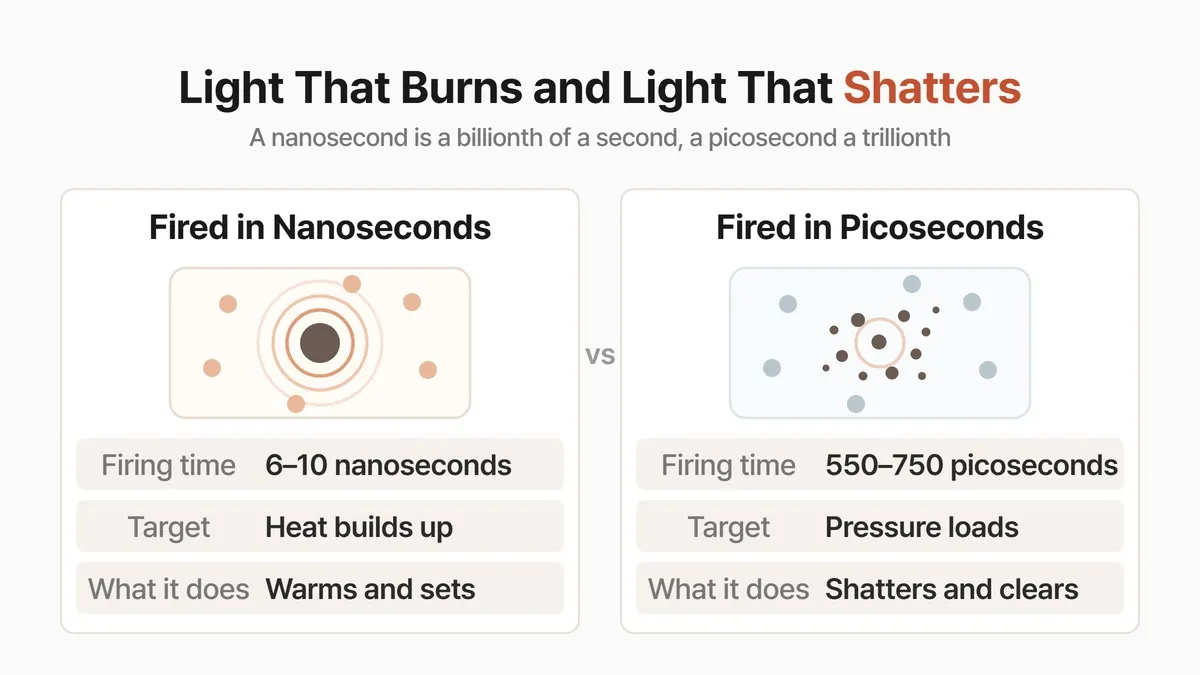
Your body gathers the broken pieces up on its own. Immune cells in the skin take the fragments in and carry them, and they leave the body little by little along the lymph flow. So a pico laser does not make the result on the spot. It breaks the pigment, and then waits for your body to carry it away.
This approach started with tattoos. A systematic review of picosecond lasers notes that they were first used to remove unwanted tattoos, and that the use later widened to benign pigmented lesions, photoaging, melasma and scars (1). That is why so many different concerns sit under one name.
Lifting treatments use several machines side by side, and the pigment side splits into different machines under one name in the same way — what that looks like on the lifting side is covered in HIFU in Seoul: How Ultherapy Prime and Shurink Universe Differ.
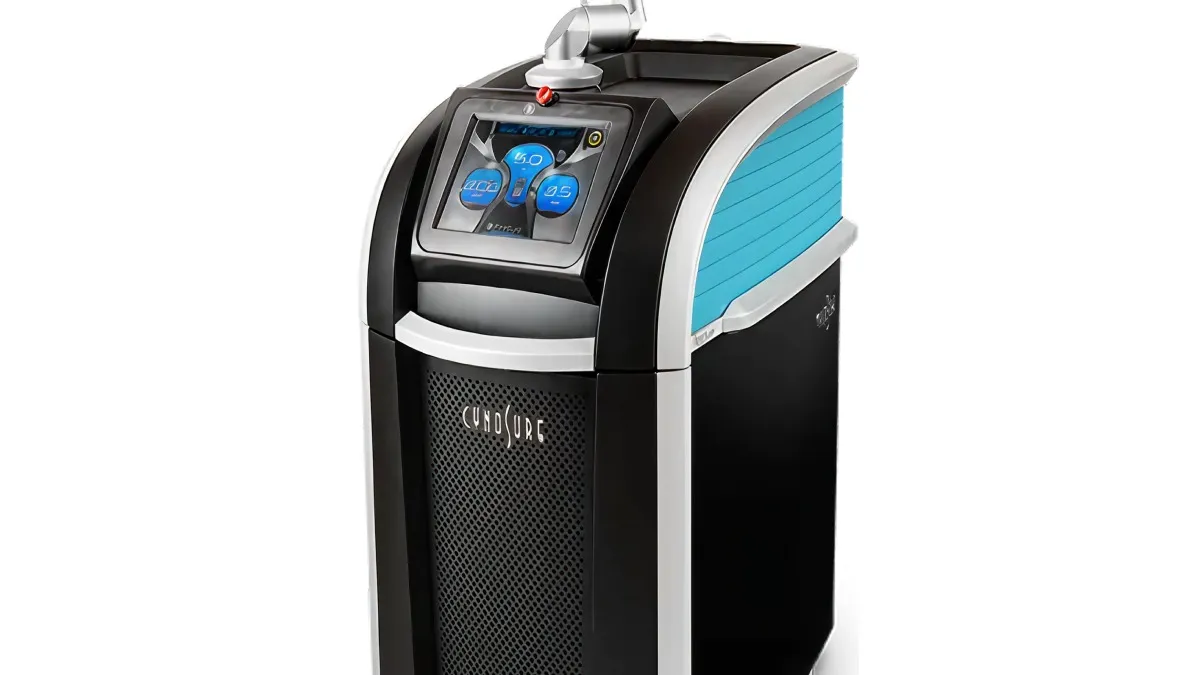
Peche Clinic has two picosecond pigment lasers, PicoSure and PicoLite Black. They use different light, so PicoSure suits shallow pigment and tone, and PicoLite Black suits pigment that reaches deeper. Neither is the better machine. They reach different depths.
How Far Does a Pico Laser Clear?
If there is a particle to break, it works. If there is not, it does not. There are two kinds of particle — pigment your body made, and tattoo ink that came from outside.
| Concern | What this approach does | What to know |
|---|---|---|
| Freckles, shallow spots, dull tone | Lightens them with low energy over repeated passes | No crusting, so you carry on with your day, and it lightens a little with each session |
| Melasma that reaches deeper | Breaks it with light that reaches the deeper layer | It darkens again easily, so sun protection is needed alongside it even after it lightens |
| Tattoos and semi-permanent makeup | Breaks the ink into fine pieces | Black, blue and green respond well; red, orange and yellow can respond weakly |
| Enlarged pores, shallow indented marks | This belongs to the fractional treatment on the same machine | It is not pigment being broken (explained below) |
Melasma is the one concern here that usually needs its own answer, because creams are already part of it — how creams and laser toning split the work is covered in Melasma in Seoul: What Laser Toning Does When Creams Fail.
The same light does a different job depending on how the energy is loaded. Laser toning spreads low energy wide and splits it over repeated passes. Focus that same light into a great many very small points instead, and each point carries high energy — at Peche Clinic this is run separately under the names PicoSure Fractional Laser and PicoLite Fractional Laser. Points carrying high energy leave stimulus points in the outer layer of the skin, too small to see, and while those spots repair, new collagen forms in the dermis below. The dermis sits just below the epidermis, and it is the layer that actually gives skin its firmness and thickness.
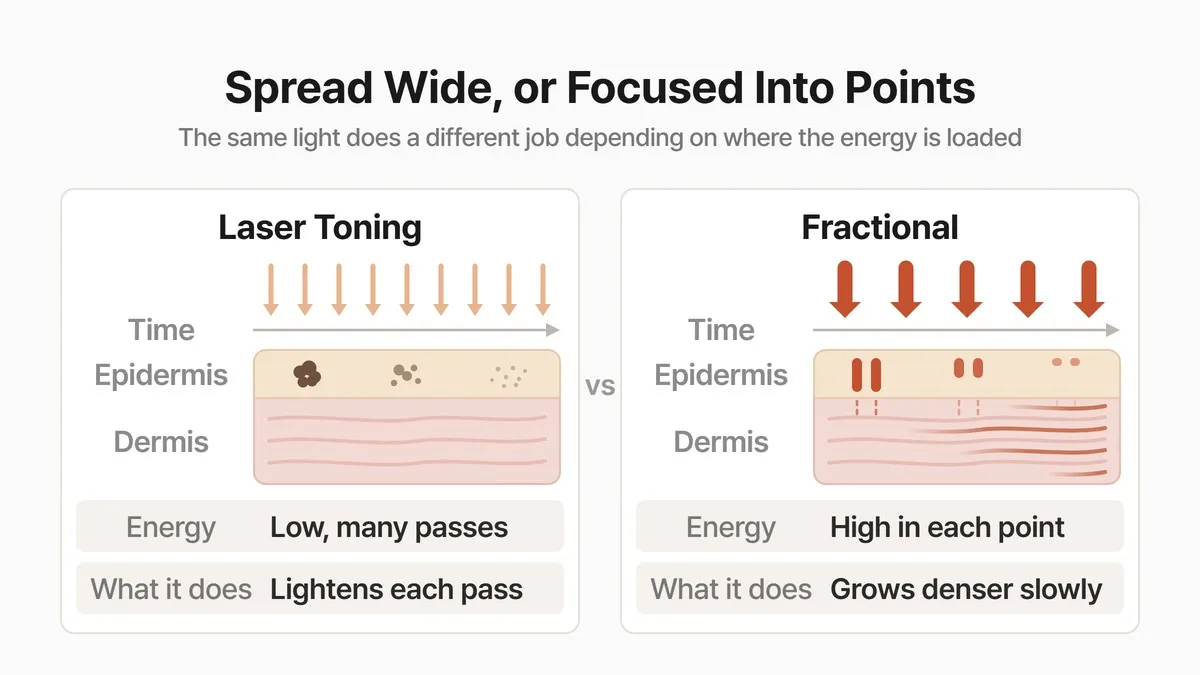
So the fractional treatment is not something that lightens pigment. It is a regeneration treatment, and even on the same machine as toning, it is a separate treatment with a different purpose. The change also appears gradually over two to three months rather than straight away.
What a Pico Laser Can't Treat
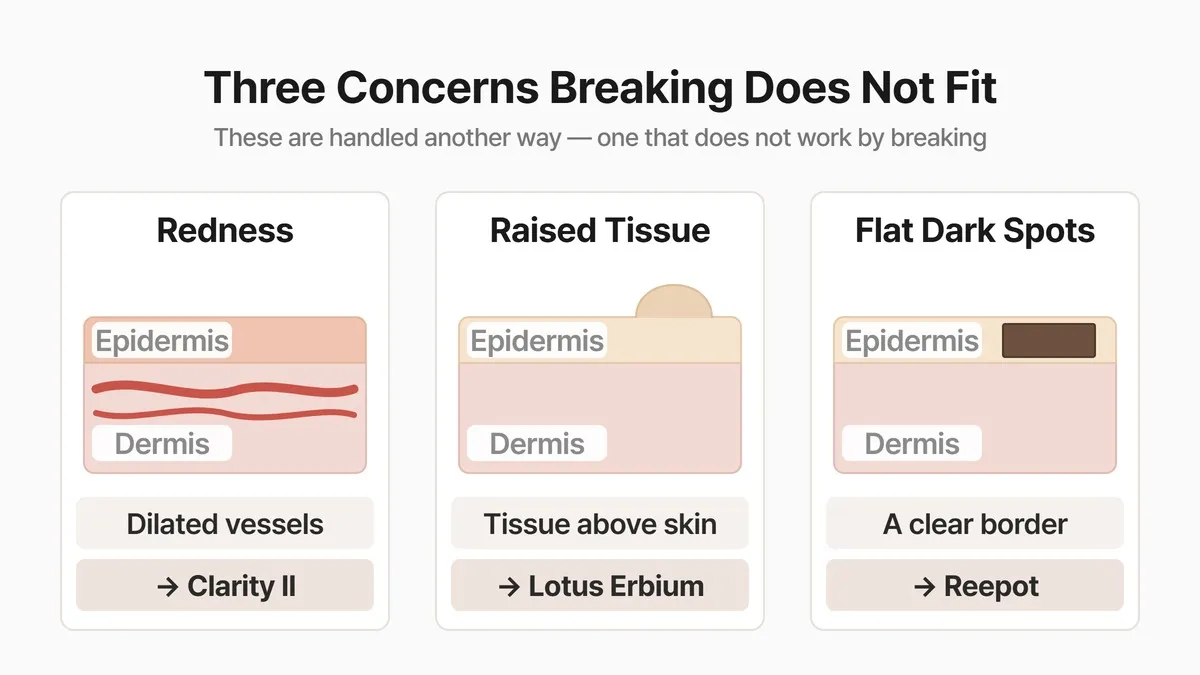
Concerns with no particle to break. They split into three.
1. Redness from vessels Redness and visible capillaries on the face are not pigment. They are dilated vessels showing through. Breaking does not reach vessels. This side is handled by Clarity II, which fires light for a longer time to seal the vessel. Even with the same light, firing in short bursts or firing long changes what the light does — the pico laser in this article is the short-burst side.
2. Things raised above the skin Moles, skin tags, milia and sebaceous hyperplasia sit above the skin, and lightening the color leaves the raised tissue exactly where it was. This side is handled by Lotus Erbium, which flashes off the water inside the tissue and takes it away one thin layer at a time. What differs is that the target is tissue, not pigment.
3. Sharply defined sun spots and flat age spots Pigment that has spread out faintly suits being broken and carried away by the body, but a surface spot with a clear border suits being taken off on the spot. At Peche Clinic this is done with Reepot, which cools the surface below freezing and lifts off only the spot. The treated area rises as a thin crust and comes away by itself. It is sorted in one go instead of being waited out, and the trade-off is a crust that stays a few days.
Indented scars have a border too. When tough fibers hold the floor of the scar down, stimulating regeneration alone does not bring the floor up well. In that case a step that releases what is holding it comes first.
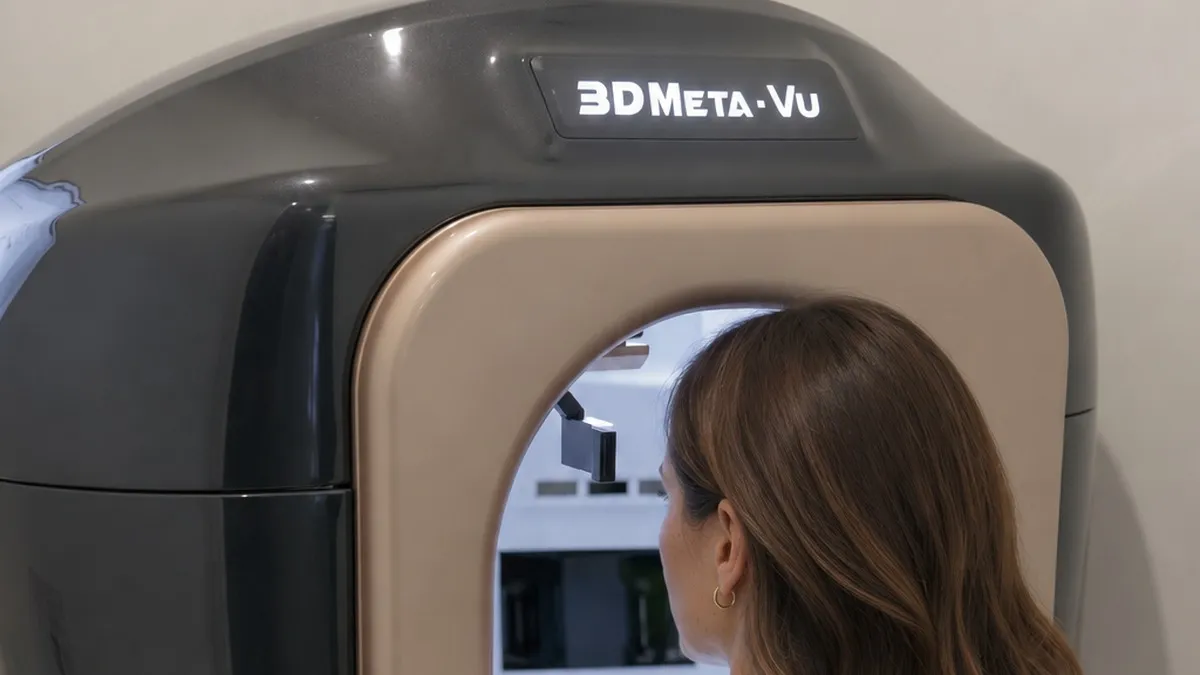
At Peche Clinic, the consultation starts with what this treatment can and cannot do. Having the machine does not mean we recommend it when your concern is not that machine's job. A single pigment concern often mixes something to break, something to lift off and something vascular, so we take one 3D META·Vu scan, look at pigment, pores and fine lines under each light source, and separate them while going through the results with you.
How Many Pico Laser Sessions Do You Need?
There are two reasons it does not all clear in one go.
One is that there is a limit to how much your body can carry away at once. It is your body, not the laser, that clears the broken fragments, and too many fragments can back up and lead to inflammation.
The other is safety. Pushing the energy up to finish in one go makes it more likely that the pigment darkens instead. Raising the energy does not lighten things any faster either, so you gain nothing and only widen the room for pigment to darken. Splitting the work across sessions at low energy is not the slow way. It is the right way.
Intervals depend on what is being treated. For pigment toning the interval is not fixed in advance — it is decided from how quickly the pigment lightens and how your skin responds. Tattoos need more time for the broken ink to leave, so intervals are usually 4 to 8 weeks. The fractional treatment runs 3 to 5 sessions at 3 to 4 week intervals and then widens out.
On a single trip to Korea, this difference shapes the plan. Many people feel their tone change after one session of pigment toning, so having one session this time and continuing on a later trip works. Tattoo removal is the opposite — the sessions and the intervals are long, and it is not something that finishes in one visit. Knowing which side you are on before you come makes the schedule realistic.
What to Sort Out Before a Pico Laser Consultation in Seoul
Having these four ready makes the consultation go quickly.
1. Ask whether your concern is something that can be broken Pigment, a vessel, or raised tissue. This is where the treatment splits. It is enough to note whether what you see in the mirror is flat and brown, a bump you can feel with a finger, or redness that fades when you press it.
2. Check whether they tell you what will not work A place that takes every pigment concern on one machine and a place that separates what works from what does not are having different kinds of consultation. Whether you get to hear "a different approach suits this" is the thing to check.
3. For a tattoo, tell us the colors in advance Response differs by ink color. Tell us the colors, when it was done, and whether it has been covered over, and the guidance on sessions changes with it.
4. Tell us your dates in Korea and your flight home Pigment toning usually lets you carry on with your day without crusting, but treatments that lift tissue off, like Reepot and Lotus Erbium, and tattoo removal leave a crust for a few days to 1 to 2 weeks. With your schedule, we can settle first which side suits this trip.
Peche Clinic is a one-minute walk from Exit 4 of Gangnam Station, on Subway Line 2 and the Shinbundang Line. We are open until 9 PM on weekdays and 6 PM on weekends and public holidays. Pigment toning is done without numbing, and for the fractional treatment and tattoo removal we apply numbing cream and wait before starting. English-speaking staff are on site, and inquiries and bookings are handled through WhatsApp. Our consultations draw on more than 90,000 treatments performed here.
FAQ
Q: What can a pico laser in Seoul clear?
A: Things with a particle to break. Pigment your body made — freckles, shallow spots, tone, melasma — and tattoo ink from outside both fall here. Redness from vessels and tissue raised above the skin cannot be handled by breaking particles, so other treatments take those.
Q: Can a pico laser remove a tattoo in one session?
A: No. Your body clears the broken ink little by little and sends it out, so it lightens over repeated sessions, and the intervals are wide too, usually 4 to 8 weeks. How many sessions it takes varies a lot with color, depth and amount, so it is better to check at a consultation first.
Q: Does a pico laser work on acne scars?
A: The regeneration side handles that — PicoSure Fractional Laser and PicoLite Fractional Laser. It is a separate treatment with a different purpose from toning, which breaks pigment. That said, when tough fibers hold the floor of the scar down, stimulating regeneration alone does not bring it up well, and a step that releases what is holding it can be needed first.
Q: Does a pico laser hurt?
A: It depends on what is being treated. Pigment toning is done without numbing and feels closer to being flicked lightly with a rubber band, and for the fractional treatment and tattoo removal we apply numbing cream and wait before starting. For removing semi-permanent eyeliner, a numbing spray is used.
Q: Will I get a crust after a pico laser?
A: Pigment toning usually does not crust and leaves only temporary redness. Tattoo removal blisters and crusts and then comes away by itself, usually over 1 to 2 weeks, and Reepot, which lifts sharply defined spots off directly, also leaves a thin crust for a few days.
Q: Can pigment lightened by a pico laser come back?
A: It depends on the type of pigment. Melasma reacts to sun and irritation and darkens again easily, so sun protection and maintenance are needed alongside it even after it lightens. Which kind of pigment you have is separated by going through the results from each light source, taken in a single scan, together. What melasma needs alongside the laser is covered in Melasma in Seoul: What Laser Toning Does When Creams Fail.
Q: Can I fly home the same day as a pico laser?
A: What is left behind differs with the treatment you have. Send us your flight date and the treatment you want through WhatsApp beforehand, and we will give you guidance that fits your schedule.
This content is provided for informational medical purposes only. Results and side effects may vary depending on the individual. Please consult a medical professional for an accurate diagnosis and treatment plan.
Some images were generated using AI to assist comprehension and may differ from actual procedure results.