PicoSure Tattoo Removal — PECHE Clinic, Gangnam Station
755nm light fired in trillionths of a second, shattering ink lodged in the dermis by impact · Black and color · Right by Gangnam Station Exit 4
PicoSure Tattoo Removal
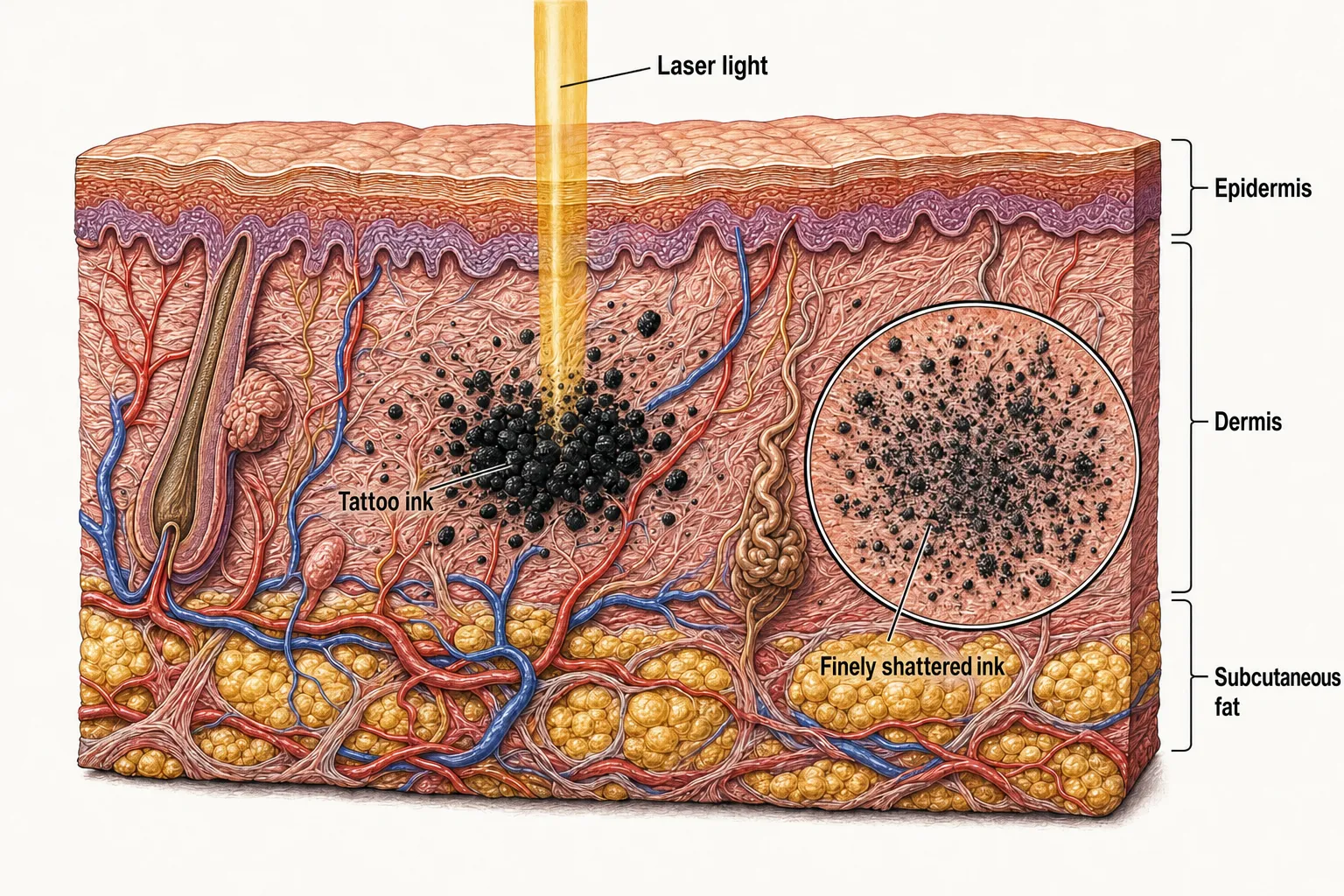
PicoSure is a laser that fires 755nm light in pulses a trillionth of a second long. A tattoo isn't your body's own pigment, like melasma or dark spots — it's ink from outside the body, set into the dermis with a needle. So it can't simply be lightened; it has to be shattered so the body can clear it.
With pulses this short, the ink takes the impact before it can heat up — breaking apart like grains of sand. The body's cleanup cells then swallow the fragments and carry them off through the lymphatic vessels, the channels that drain the body's waste. Compared with methods that burn the ink with heat, less heat tends to be left in the surrounding tissue.
▲ The light lands on the ink cluster in the dermis, and the ink shatters finely in place
When to Consider It
- A tattoo from years ago is one you now want gone
- The shape or color of a semi-permanent brow or eyeliner no longer fits your face
- You want an old tattoo faded to make room for a new design (cover-up preparation)
- You'd like it removed gradually over several sessions, with less heat on the skin
What Changes With Ink Color
| Ink color | Response to 755nm |
|---|---|
| Black, blue, green | Respond well — the colors the manufacturer names as 755nm's targets |
| Red, orange, yellow | Weak responders — they may fade slowly or leave traces, and we tell you this upfront at the consultation |
Each color absorbs a different wavelength of light best, and a mismatched wavelength simply passes the ink by. Even in the same color, deeper and denser ink takes more sessions — so how many it will take is estimated at the consultation, from the state of your ink.
How It's Done
1. Tattoo assessment We look at the ink's color, depth, and amount, and the area — the basis for the session plan.
2. Numbing cream Applied, then about 20 minutes of waiting. On thin, sensitive areas, or when deep, dense ink calls for higher intensity, local anesthetic may be added.
3. Laser passes The light is concentrated into a narrow point and fired where the ink sits. We don't push the intensity to erase everything at once — skin can read that as an injury and respond with post-inflammatory hyperpigmentation, a darkening of the treated spot.
4. Dressing and guidance A moist-healing foam dressing goes on, and we go over scab care and sun protection. The dressing's job is keeping the scab from drying out or tearing away.
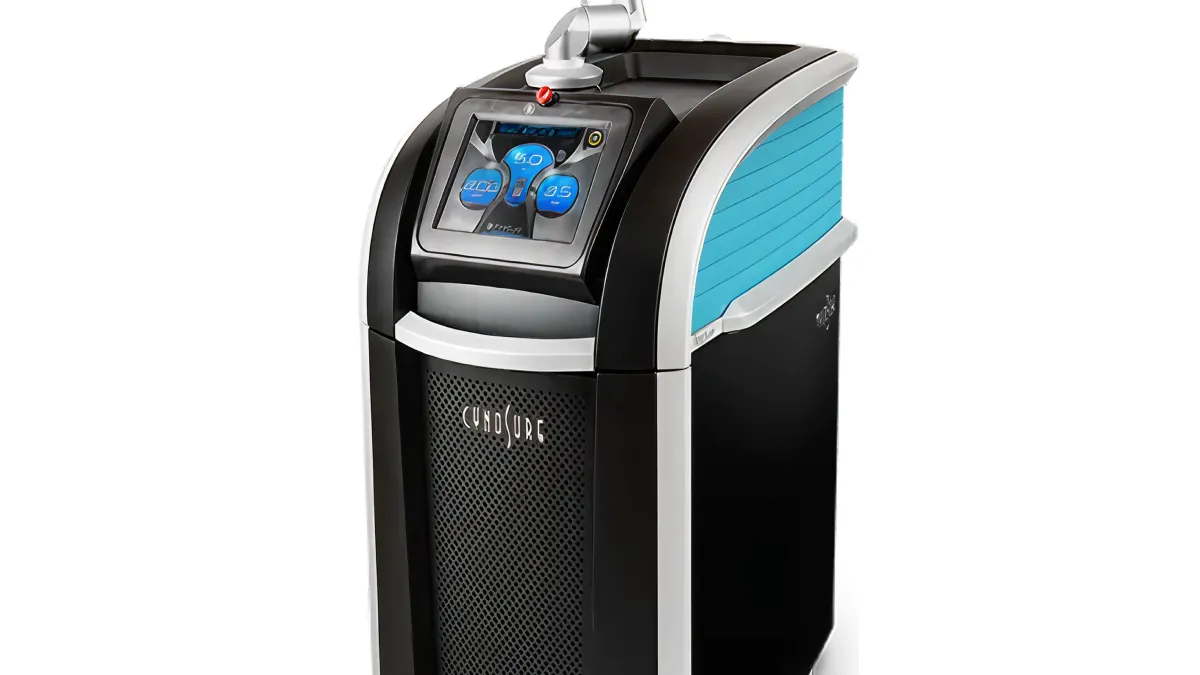
▲ PicoSure — a 755nm picosecond laser
Results and Recovery
| Item | Details |
|---|---|
| Target | Foreign ink particles lodged in the dermis |
| How it works | Instantaneous impact shatters the ink finely → the body's cleanup cells swallow the fragments and clear them through the lymphatic vessels |
| Areas | Face · body |
| When results show | The tattoo fades step by step as sessions accumulate · it doesn't finish in one pass |
| Sessions and spacing | 4–8 weeks apart — the body needs a month or more to clear the shattered fragments · the count depends on the ink's color, depth, and amount, estimated at the consultation |
| Pain | Like a thick rubber band pulled taut and snapped hard against the skin in rapid succession, or hot oil droplets spattering on the skin · the impact and heat are far stronger than ordinary pigment toning |
| Pain control | Numbing cream for about 20 minutes · local anesthetic when needed |
| Downtime | Redness → a blister or thick scab → falls off on its own · blisters, scabs, and redness run 1–2 weeks |
| Aftercare | Leave the scab until it falls off on its own — the key to preventing scars · avoid sun, swimming, and saunas meanwhile — sweat, water, and UV irritate healing skin and raise the risk of pigmentation and infection · keep the moist dressing on, and moisturize |
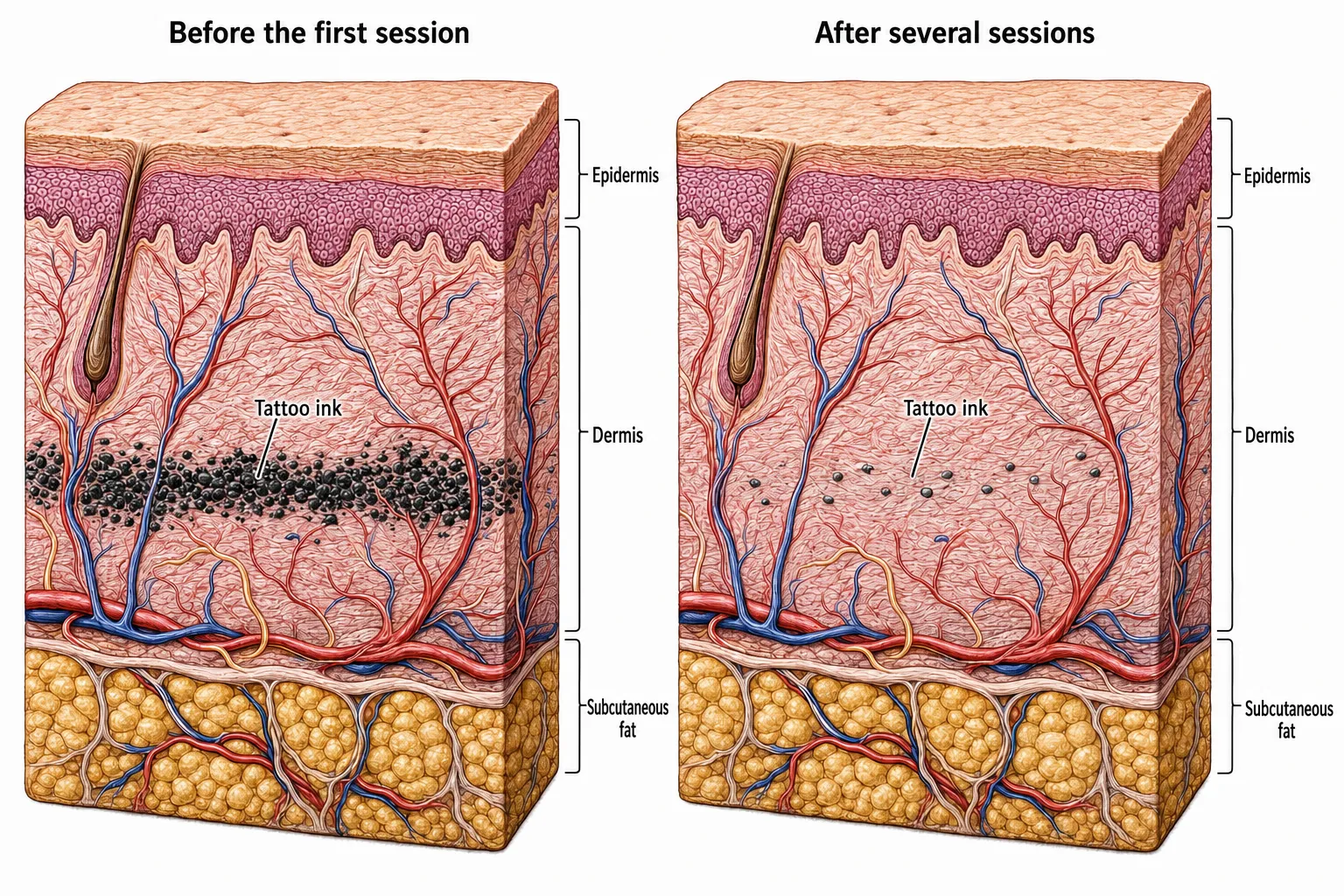
▲ An example of ink diminishing across sessions — how much remains varies with the ink's color, depth, and amount, and this is a concept drawing, not an actual case
The risk of scarring isn't zero. Skin type, keloid tendency, scab care, and infection can each leave a mark — so the moist dressing that protects the scab, and the aftercare guidance, are part of the treatment.
Expected Reactions and Possible Side Effects
Common, temporary reactions — part of the normal healing course:
- Redness, then a blister or thick scab that falls off on its own — running 1–2 weeks
Worth knowing in advance: pushed too hard, treated skin can darken (post-inflammatory hyperpigmentation) — which is why intensity is kept within standards rather than raised to finish faster. Scarring is possible as well, as noted above — which is why scab care matters.
If a reaction lasts longer than expected or worsens, contact us and we'll check it with you.
What We Check Beforehand
If any of these apply to you, let us know during your consultation. We adjust the intensity or the timing.
- A keloid tendency (scars that heal raised)
- Recent strong sun exposure or tanning that has darkened the treatment area — we wait until the pigment settles
- Pregnancy or breastfeeding
- Oral acne medication (isotretinoin and similar) now or within the past 6 months — it affects wound healing
- Inflammation or wounds at the site, or an active cold sore (herpes) around the mouth
- Aspirin or blood thinners (anticoagulants — medications that keep blood from clotting) — small bleeding marks and bruises at the treated spots can linger
- Semi-permanent makeup — if you know what pigment was used, tell us
How PECHE Clinic Does It
We treat by standards built from over 90,000 treatments. Tattoo removal results turn on how high the intensity is set and how the sessions are planned. We work to standards built from over 90,000 treatments, so whichever physician treats you, the same standards apply.
We tell you first what may not come out. Weak-responding colors and deep, dense tattoos can leave faint traces. The plan also changes with the goal — complete removal, or fading for a cover-up — so we set it together before starting.
The prep room is behind a glass wall, in full view. The preparation and hygiene routine is visible through the glass from the waiting area.

▲ The prep room, seen through the glass from the waiting area
We don't push extra sessions. The session count is set by the tattoo's state, not by a contract. We don't push same-day payment or packages — you're welcome to come in just for a consultation.
Pricing
The cost of PicoSure Tattoo Removal depends on the tattoo's size and the number of sessions. Black-and-white and color are priced the same, and the moist-healing foam dressing applied after treatment is included. We check the area to be treated at the consultation and give you a quote then.
Location
PECHE Clinic 3F, 364 Gangnam-daero, Gangnam-gu, Seoul Right in front of Gangnam Station, Exit 4
A treatment you return for every 4–8 weeks — an easy trip makes the sessions easier to keep up.
FAQ
Q1. Who performs the treatment? A: PECHE physicians who all work to the same standards, built from over 90,000 documented treatments. Intensity and sessions are set from your tattoo's color, depth, and area together with these standards, not by feel — and the standards stay the same even if your physician changes.
Q2. What do you look at to build the session plan? A: The ink's color, depth, and amount — and whether your goal is complete removal or cover-up preparation. If a cover-up is the goal, the plan shifts from erasing completely to fading it sufficiently over several sessions.
Q3. I've heard it hurts a lot. How is that managed? A: Numbing cream goes on first, with about 20 minutes of waiting. On thin, sensitive areas, or where deep, dense ink calls for higher intensity, local anesthetic may be added — the pain-control approach is set to the area and the intensity.
Q4. How do the dressing and the next visit work? A: The moist-healing foam dressing applied after treatment is included in the cost, and it keeps the scab from drying out or tearing. The next session is set for 4–8 weeks later — the time the body needs to clear the shattered ink — and if the scab or redness worries you in between, contact us before your visit.
Q5. How should I choose a clinic? A: Three things. First, whether they build the session plan from the ink's color and depth. Second, whether they avoid pushing the intensity — that's largely what decides the risk of pigmentation and scarring. Third, whether the clinic is easy to reach, since you'll be returning every 4–8 weeks.