PicoLite Fractional Laser — PECHE Clinic, Gangnam Station
A fractional laser that uses a lens to divide 1064nm picosecond light into numerous points, leaving regenerative stimulus in the deeper part of the dermis · Face · Right outside Gangnam Station Exit 4
PicoLite Fractional Laser
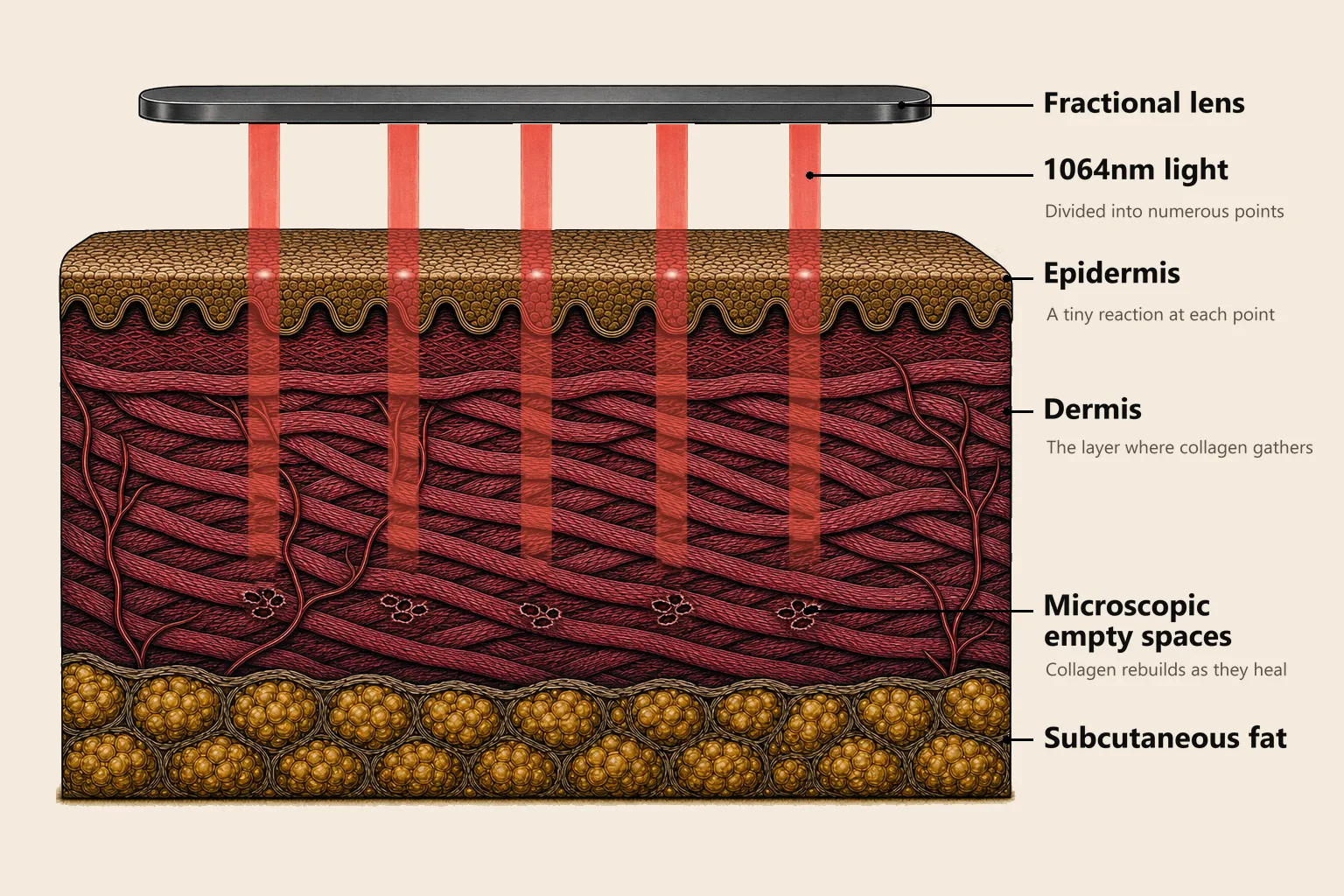
PicoLite Fractional Laser is a fractional regenerative treatment that uses a lens to divide the 1064nm light of the PicoLite Black laser into numerous tiny points, creating microscopic stimulus points inside the skin. PicoLite Black is a laser that fires light at two different wavelengths, 1064nm and 532nm, in pulses measured in trillionths of a second (picoseconds).
Put simply, it divides light that travels deep into the skin into tiny points, creating invisible stimulus points in the dermis (the main body of the skin, beneath the epidermis), and as those spots heal, collagen is rebuilt. It addresses enlarged pores, depressed marks with some depth, and rough skin texture.
▲ Light divided into points leaves tiny reactions in the epidermis and microscopic empty spaces in the deeper part of the dermis
PicoLite Fractional Laser at a Glance
| Item | Details |
|---|---|
| Category | Fractional picosecond laser · regenerative type (non-ablative — does not remove the skin's surface) |
| Light used | The PicoLite Black laser's 1064nm picosecond light, divided into numerous points by a lens |
| Target layer | Reactions occur in both the epidermis and the dermis — the stimulus in the dermis sits relatively deep |
| Concerns it suits | Enlarged pores · depressed marks with some depth · rough skin texture |
| Areas | Face |
| Available options | PicoLite Fractional Laser + Cryo Soothing Care + Modeling Pack · 1, 3, or 5 sessions |
| Numbing | Numbing cream is applied, and treatment begins after a 20-minute wait |
| Pain | A hot, stinging heat crackles across the skin's surface in close succession, like scattering sparks — a different feeling from toning, which feels like a light flick of a rubber band (how strongly you feel it varies from person to person) |
| When results show | Not right after treatment, but gradually over 2–3 months |
| Sessions and maintenance | An initial course of 3–5 sessions at 3–4 week intervals, then maintenance once every 6 months to 1 year (adjusted to the depth and number of your scars and how your skin responds) |
| Recovery | Scabbing usually doesn't occur · temporary redness for a day or two · tiny pinpoint bleeding spots within the skin (petechiae) may appear |
How It Works
1. The light is divided into numerous points As 1064nm picosecond light passes through a fractional lens (a lens that divides light into small points), it is concentrated into numerous tiny points. Because the light is concentrated, the energy carried at each point is higher.
2. Reactions occur in both the epidermis and the dermis At each spot where a point lands, a tiny reaction occurs in the epidermis and a microscopic empty space forms in the dermis. These tiny, invisible injuries are the stimulus points that prompt the skin's repair response.
3. At 1064nm, the stimulus sits deeper Wavelength is a value that describes a type of light by its length (nm, nanometers); within this range, the longer the wavelength, the deeper it travels into the skin. 1064nm is absorbed relatively less by melanin (the brown pigment that gives skin its color), so less of it is used up at the surface and it travels deeper. That is why it is used to place stimulus in the deeper part of the dermis.
4. Collagen rebuilds as the skin heals As these tiny injuries heal, the dermis is understood to produce new collagen. Rather than adding collagen, this approach has the skin make its own.
Expected Results and Why
| Expected result | Why |
|---|---|
| Enlarged pores look less prominent | The dermal collagen that supports the area around each pore is rebuilt, supporting the pore wall from the outside |
| Depressed marks with some depth gradually fill in | New collagen forms in the dermis beneath the sunken area and fills it (how much depends on the condition of the scar) |
| Rough skin texture is refined | Dermal collagen is rebuilt |
Studies that delivered 1064nm light concentrated into small points have reported a reduction in the number and size of enlarged pores (Zhou et al., 2023 review). These are study results only; actual changes vary from person to person.
Why results appear gradually: It takes time for the skin to heal the stimulus points and make collagen to fill them, and there is a limit to how much it can make at once, so treatment is divided into sessions. Not seeing the area fill in right after treatment does not mean it isn't working.
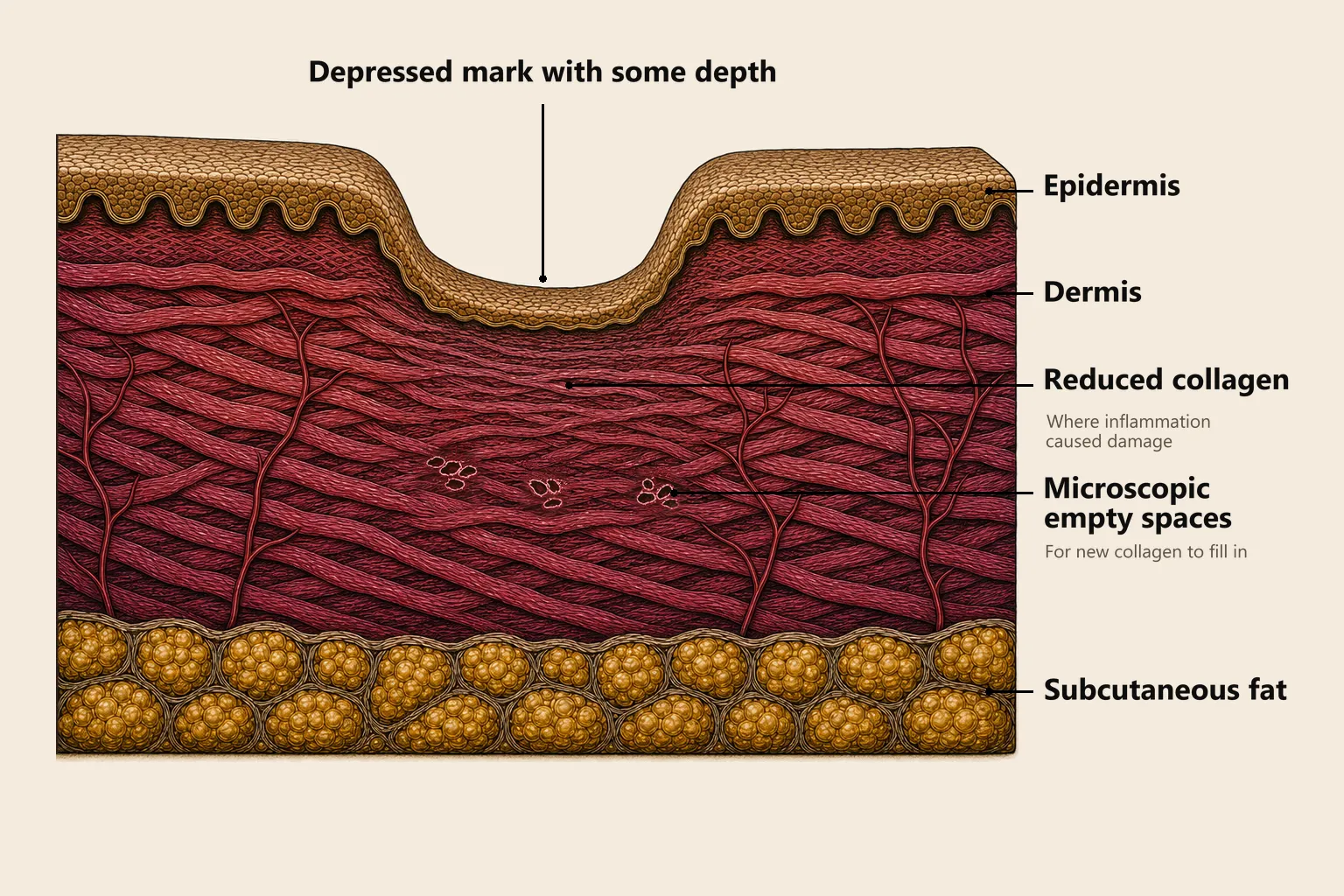
▲ Where collagen has been damaged, the surface sinks — the stimulus points are placed in the dermis beneath it
When to Consider It
- Acne has left depressed marks with some depth where it healed
- Enlarged pores, depressed marks, and rough texture are mixed together on one face
- Your skin tone is on the darker side — the darker your skin tone, the more the pigment in the epidermis absorbs the light first, raising the risk of burns and hyperpigmentation; 1064nm is considered because it is absorbed less by epidermal pigment
When a different approach may be the right fit
- Scars whose base is tethered downward — if a tough band of fibers holds the base of the scar to the tissue below (a fibrous band), stimulating regeneration doesn't readily lift the base, so an approach that first cuts the band is needed
- Color as the main concern, such as red or brown marks left by acne, or melasma and blemishes — this is a matter of color, not depression, so an approach that targets blood vessels or pigment is the right fit
Differences from Other Treatments and Limitations
| Compared approach | What they share | How they differ |
|---|---|---|
| 755nm picosecond fractional | Both use a lens to concentrate picosecond light into points and create regenerative stimulus | 755nm works on the shallow part of the dermis, while the longer 1064nm goes deeper and places stimulation in the deep part of the dermis. So their uses divide between shallow marks and deeper marks — this is not a matter of better or worse but of the depth each one treats |
| Toning on the same device | The same PicoLite Black laser | A way of using the same PicoLite Black without the lens — whether the lens is used makes them separate treatments with different goals |
| Radiofrequency microneedling | Both are regenerative treatments that lead to collagen renewal | Microneedling creates stimulus with radiofrequency heat at the needle tips, while this treatment creates it with light divided into points. The type of energy differs |
| An approach that cuts the scar base with a liquid jet | Both treat depressed scars | That approach cuts the fibrous band holding the base (release), while this treatment fills with collagen (regeneration). They handle different stages |
Limitations: It cannot cut the fibrous bands holding the base of a scar, and it is also difficult to permanently change your natural pore size. A realistic goal is "management" — reducing pores that have widened and keeping them that way over time. Collagen, once made, lasts for a considerable period, but aging and sebum production continue, so if you stop care, pores tend to gradually widen again.
Acne, scar, and pore treatment generally follows an order: ① control active inflammation → ② improve scar structure that is tethered at the base (release) → ③ regeneration → ④ clearing color marks. This is because new scars can form while inflammation keeps flaring up. PicoLite Fractional Laser handles ③ regeneration.
How It's Done
1. Skin assessment and consultation 3D MetaVu imaging photographs your pores, skin texture, and wrinkles under changing light sources, and a physician examines the shape of your scars in person. We review the results together to decide the treatment area and the option.
2. Your physician's name and a final check Before treatment, we let you know the name of the physician treating you, and that physician personally reviews your assessment results and the condition of your skin.
3. Numbing After your makeup is removed so that no leftover product blocks the light, we apply numbing cream and wait 20 minutes. This is because concentrating the light into points creates a stinging sensation.
4. Treatment With the lens fitted, the light is delivered across your face one section at a time. If you tell us how it feels, we adjust the intensity.
5. Cryo Soothing Care We finish with Cryo Soothing Care, which cools the heat in the skin by placing a cold device against it (surface cooling, not a freezing treatment). A Modeling Pack (a mask applied to the face, left to set, then peeled off) is also included in each option.
Recovery, Expected Reactions, and Precautions
Recovery: Scabs usually don't form, and redness usually settles within the period shown in the table above. Pinpoint bleeding (petechiae) is a reaction that has been reported with this method of concentrating 1064nm light into points.
Aftercare: Keep up with sun protection and moisturizing. Brown marks left where the stimulus passed (post-inflammatory hyperpigmentation) are rare, but sunlight can encourage them. Other reactions are uncommon, but everyone responds differently — if a reaction lasts longer than expected or becomes more noticeable, contact us and we'll check it with you.
When we do not perform this treatment
- Pregnancy, possible pregnancy, or breastfeeding
When we postpone treatment
- Recent strong sun exposure or tanning — the pigment in the epidermis increases and absorbs more of the light, raising the risk of burns and hyperpigmentation. We proceed once the pigment has settled
- Taking oral acne medication (isotretinoin) now or recently — your skin is drier and more sensitive, so we adjust the timing of treatment
- Inflammatory acne or a wound in the treatment area — we proceed once it has settled
What to tell us in advance
- Taking a medication that makes your skin sensitive to light (such as some antibiotics) — we take it into account when deciding the timing and intensity
- Keloid-prone skin (scars that heal raised and thickened, beyond the original wound) — this helps us decide whether to treat and at what intensity
- Frequent cold sores around the mouth (herpes virus) — blisters may flare up again after laser stimulation
- Conditions that worsen with cold, such as cold urticaria (hives triggered by cold) or Raynaud's disease — because the Cryo Soothing Care at the end cools the skin
- Other recent treatments — if you've had laser, a peel, filler, a skin booster, or similar treatments, let us know at your consultation
- Whether to have another treatment on the same day is decided together after your assessment
How PECHE Clinic Does It
We follow standards built from more than 90,000 treatments performed across the clinic. From more than 90,000 treatments performed across PECHE Clinic, we have built standards for each area and skin condition, and the same standards apply whichever PECHE physician treats you. With PicoLite Fractional Laser, those standards determine the intensity and treatment area according to the depth of your scars and your skin tone.
We identify the type of scar before we begin. A physician personally reviews your 3D MetaVu imaging results for pores and skin texture and examines the shape of your scars, then checks your skin once more right before treatment. This is because the approach to start with differs depending on whether the base of a scar is tethered or the issue is one of color.
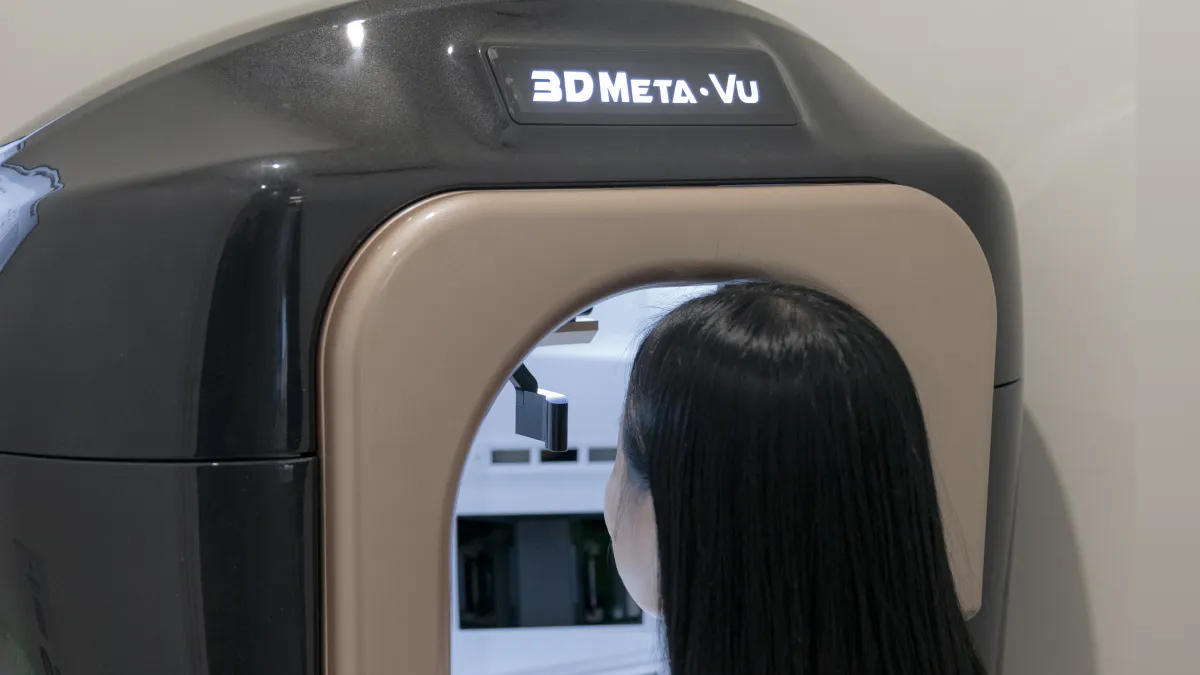
▲ We review your imaging results together
We don't try to cut the number of sessions by raising the intensity. Because there is a limit to how much collagen can be made at once, we don't suggest raising the intensity to reduce the number of sessions; instead, we proceed in sessions at an intensity matched to your skin tone and how your skin responds.
We keep the preparation area in view behind a full glass wall. Treatment preparation takes place in an open-kitchen-style preparation area behind a full glass wall, so from the waiting area you can see the preparation process and hygiene practices for yourself.
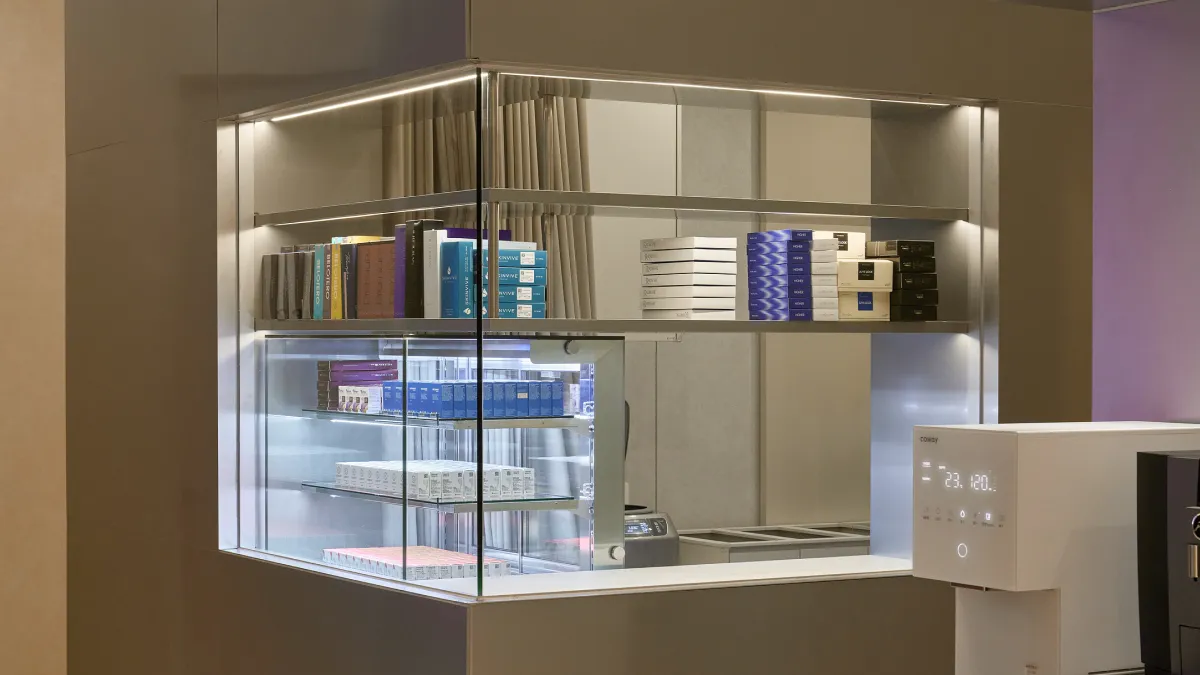
▲ The treatment preparation area, seen through the glass wall from the waiting area
We recommend only the treatments your assessment results call for. We tell you first what this treatment can do (regeneration for pores, depressed marks, and skin texture) and what it can't (cutting fibrous bands, changing natural pore size, or clearing color marks). You're welcome to come in just for a consultation and leave.
Pricing
Prices for PicoLite Fractional Laser are published on our website for every product option. Whichever country you're visiting from and whichever channel you book through, the price is the same as the one published on our website — so there's no need to compare prices from one booking channel to another. Making sure you can come in trusting the price you checked in advance — that is the trust PECHE Clinic puts first.
PicoLite Fractional Laser + Cryo Soothing Care + Modeling Pack comes in 1, 3, or 5 sessions, and we decide on the option you need together after your assessment.
Location and Clinic Hours
PECHE Clinic 3F, 364 Gangnam-daero, Gangnam-gu, Seoul Right outside Gangnam Station Exit 4 — the building entrance is right in front of you as you come out
Clinic Hours (Korea Standard Time, KST)
- Monday–Friday: 10:30 AM – 9:00 PM
- Saturday, Sunday, and public holidays: 10:00 AM – 6:00 PM
- No lunch break — we see patients straight through midday
FAQ
Q1. Who performs the PicoLite Fractional Laser treatment? A: Before treatment, we first let you know the name of the physician treating you, and that physician personally reviews your assessment results and the condition of your skin before starting. Intensity and treatment area follow standards built from more than 90,000 treatments performed across the clinic, so the same standards apply even if a different physician treats you.
Q2. I have both depressed scars and enlarged pores — can they be addressed at the same time? A: Enlarged pores are partly caused by weakening of the collagen that supported the area around them, and depressed marks partly by collagen damaged by deep inflammation — so this treatment addresses both. However, if scars with a tethered base are mixed in, those spots may need the release stage first, so we check the shape of your scars and then explain the order.
Q3. How do I choose between the 1-, 3-, and 5-session options? A: Because the treatment is generally received over several sessions, there are options that bundle sessions together. How many sessions you need is decided together after looking at the depth and number of your scars and how your skin responds.
Q4. Do all fractional lasers remove the skin's surface? A: No. Some fractional methods, such as carbon dioxide (CO2) laser, actually remove the outer layer of skin, but this treatment doesn't remove the surface, so the recovery burden tends to be lighter. There are also reports that post-inflammatory hyperpigmentation occurred less often with picosecond fractional methods than with CO2 fractional methods.
Q5. What should I look for when choosing a clinic for PicoLite Fractional Laser? A: Look at whether they first identify the shape of your scars (whether the base is tethered or the issue is one of color) and explain the order of treatment, whether they avoid claiming that this one treatment will improve every scar, and whether prices are published in advance.