Melasma in Seoul: What Laser Toning Does When Creams Fail
Creams reach one depth and lasers reach another — the first thing to find out is where your pigment actually sits
**Melasma does not lighten with creams alone because the pigment is not only sitting in the surface layer of your skin.** Melasma can reach past the epidermis into the dermis below it, and topical ingredients have a hard time getting that deep. - **What creams do** — they press on the process that makes pigment, so it does not get darker - **What laser toning does** — it breaks pigment that has already settled into small pieces, so your body can clear them - **So the two are not alternatives** — for melasma, the standard is creams, sun protection and treatment used together **Melasma is not pigment that clears in one session.** It lightens gradually over several sessions, and deeper, older melasma takes longer. It also darkens again easily, so sun protection and upkeep go with it.
"I've been using melasma cream for months and it's barely changed. Is a laser in Seoul going to do anything different?"
Search melasma and cream follows it, along with ingredient names. That means people who have already tried creams are looking for the next step. This is not about dropping what you use and switching to a laser. Below, we separate what creams do from where the laser starts.
Why Creams Alone Don't Lighten Melasma
Because the pigment can sit deeper than topical ingredients reach.
Your skin is divided into the epidermis on the outside and the dermis beneath it. Topical ingredients act on the pigment-making process in the epidermis. Melasma, though, does not always stay in the epidermis — it can reach into the dermis, which is also why its edges look blurred rather than sharp.
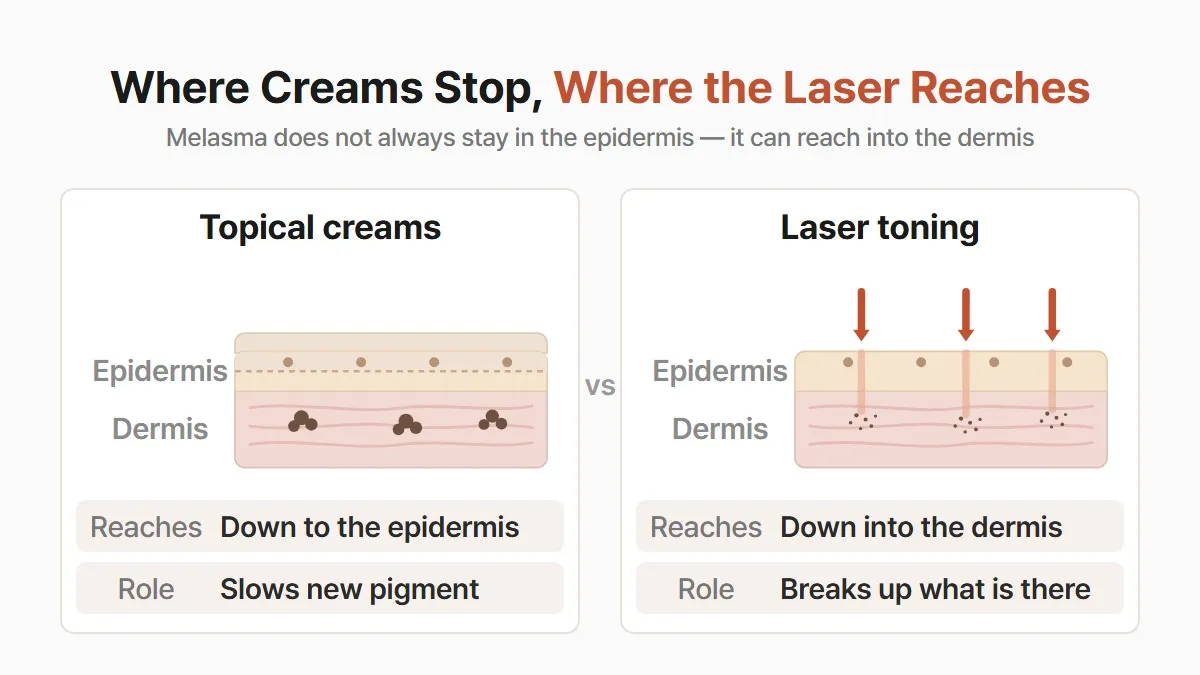
That does not make creams pointless. A review that sets out melasma treatment in steps puts topical agents first, and adds other methods on top when that is not enough (1). The same review treats melasma as pigment that darkens again easily, and takes combining several methods — rather than relying on one — as the standard.
So the order matters. If creams have not changed anything, the next step is to find out where the pigment actually sits. It does not mean nothing works on melasma.
What Laser Toning Does to Melasma
It breaks pigment that has already formed and settled into small pieces, so your body can carry them away.
Laser toning means delivering the laser at low energy over a wide area, split across several passes, to lighten pigment. It does not strip the surface of your skin. PicoLite Black, which Peche Clinic uses for melasma, is a pigment laser that fires in pulses measured in picoseconds — trillionths of a second. What the pico lasers sharing that name can and cannot break apart is set out in Pico Laser in Seoul: What It Can Clear, and What It Cannot.
| Topical ingredients | Laser toning | |
|---|---|---|
| What it acts on | the process that makes pigment | pigment that is already made |
| How deep it reaches | mainly the epidermis | the epidermis or the dermis, depending on the laser |
| How you see it | keeps new pigment from darkening | broken pieces clear and the color fades |
This is not a matter of burning with heat. A pulse that short puts sudden pressure on the pigment particle before heat spreads into the skin around it, and the particle breaks apart like grains of sand. Your skin takes time to carry those pieces away, and the color lightens at that pace. There is a limit to how much can be cleared at once, so the work is done at low energy and split across sessions.
There is a reason this matters in melasma. Melasma responds to heat and irritation by making more pigment, so going in hard in one pass does not suit it. A meta-analysis pooling six randomized controlled trials concluded that 1064nm picosecond lasers are safe and effective for melasma (2). The same analysis notes that the studies varied widely, so it is not a result to read as "the laser alone finishes the job."
How We Decide Which Laser Suits Your Melasma
By first looking at whether the pigment is shallow or deep, and how the two are mixed.
Lasers are sorted by wavelength (nm, nanometers), and within this range, the longer the wavelength, the deeper into the skin it goes. 1064nm is absorbed relatively less by the brown pigment in the epidermis, so less of it is used up at the surface and it reaches deeper melasma in the dermis. 532nm puts its energy into shallow spots and freckles in the epidermis.
We do not always use both wavelengths. When shallow spots and deeper melasma are mixed on one face, the depths can be handled separately — but adding a wavelength that is not needed can add irritation without adding improvement.
Skin tone is part of this as well. The darker the skin, the more the pigment in the epidermis absorbs the laser first, which raises the risk of burns and pigmentation afterwards. 1064nm is considered partly because it is absorbed less by pigment in the epidermis.
At Peche Clinic, a single META·Vu scan returns results under several light sources — standard, polarized and UV. On one screen you can see both the pigment visible on the surface and the hidden melasma that is hard to see from outside. We go through the results with you to decide the wavelength and the strength, and which wavelength at which strength follows standards set by area and skin condition, built from more than 90,000 treatments performed at the clinic. We tell you the name of the doctor who will perform the treatment beforehand.
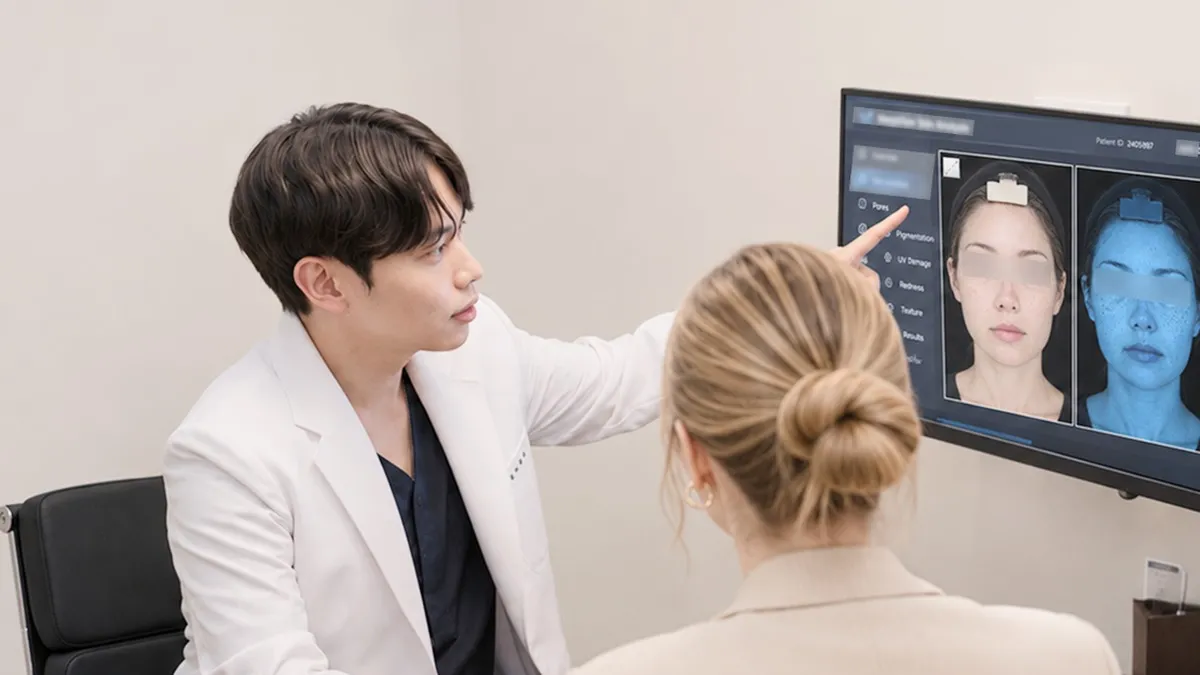
We do not fix the intervals or the number of sessions in advance. They are decided from the depth of the pigment and how your skin responds, and they vary a great deal from person to person. We do not raise the strength to cut the number of sessions.
Why Does Melasma Darken Again?
Because melasma is pigment that responds to irritation and light by making more of itself.
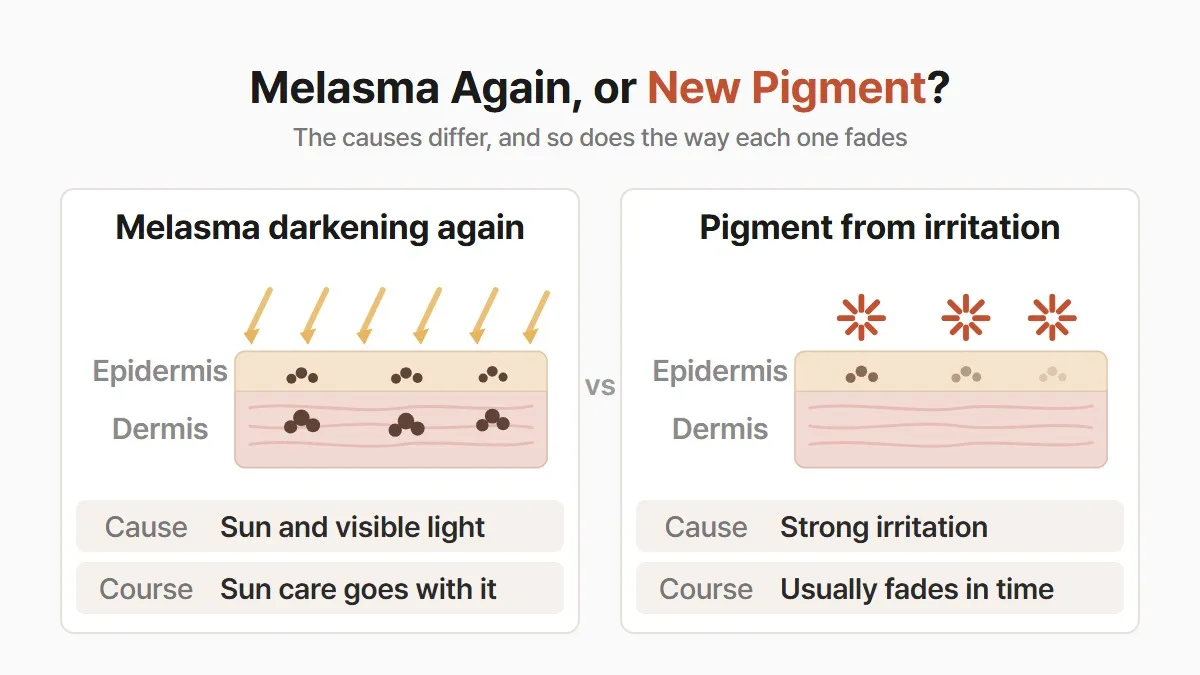
Sunlight darkens melasma that is already there and brings out new patches. Visible light has also been shown to worsen melasma, particularly in people with darker skin. Melasma comes back often after laser treatment, so once it is lighter, that is where the upkeep starts. Reapply sunscreen every two hours when you are outdoors, and again after swimming or sweating.
Pigment can also come up rather than fade. Your skin can read strong irritation as an attack and make more pigment in response. That is not the original melasma returning but pigment created by the irritation, and it usually fades with time. Melasma is more prone to this reaction, which is why the work is done at low energy, split across sessions, watching how your skin responds.
Recovery itself is light. Crusting usually does not form, so you can carry on with your day after a session, and the redness that can appear right afterwards usually settles within a few hours to 1 to 2 days. It is done without anesthetic, and the sensation is like being flicked lightly with a rubber band (how much you feel varies from person to person).
There are also things this treatment does not do. It does not remove melasma permanently, and 1064nm does not clear every melasma. Redness that comes from blood vessels, and raised lesions such as moles and skin tags, keep their shape even when the color is lightened, so those are handled in other ways. Which concerns breaking pigment cannot reach, and what takes those instead, is covered in Pico Laser in Seoul: What It Can Clear, and What It Cannot.
What to Sort Out Before a Melasma Consultation in Seoul
Having these five ready makes the consultation go quickly.
1. Tell us exactly what you have been using What you apply, what you take, and when you stopped. We check together whether anything you use makes skin more sensitive to light. For melasma, creams and treatment work together, so we do not start by telling you to stop everything you use.
2. Ask whether your pigment is shallow or deep Ask whether shallow spots and deeper melasma are mixed on your face, and which wavelength has been chosen. Using only the wavelength that is needed matters especially in melasma.
3. Ask how the strength and the number of sessions are decided Strong irritation can bring up more pigment in melasma, so raising the strength to cut sessions does not suit it. Ask whether the work is split across sessions based on how your skin responds.
4. Tell us about recent treatments and sun exposure Let us know if you have had other pigment lasers, peels or chemical exfoliation, and tell us if you have had strong sun exposure or a tan recently. When pigment in the epidermis is already raised, it is safer to wait.
5. Tell us your dates in Korea and your flight home Melasma is not pigment that finishes in one session, and the intervals and the number of sessions are decided as your skin responds. With your schedule, we can decide together how far to go on this trip and what to continue after you fly home.

If you are still choosing where to go in Seoul, 6 Things to Check Before Booking a Skin Clinic in Seoul covers that part.
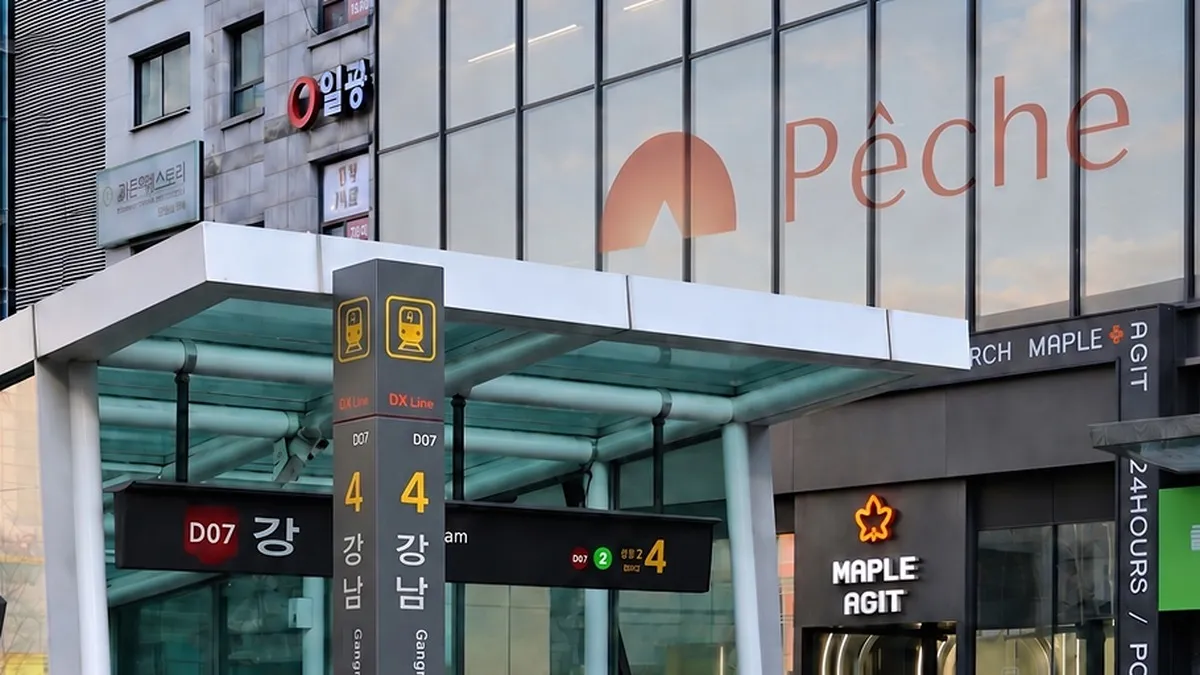
Peche Clinic is a one-minute walk from Exit 4 of Gangnam Station, on Subway Line 2 and the Shinbundang Line. We are open until 9 PM on weekdays and 6 PM on weekends and public holidays. Prices are listed on our website by product, and they are the same whichever country you come from and however you book. The preparation room is glass-walled, so from the waiting area you can see the preparation and the hygiene handling for yourself. English-speaking staff are on site, and you can reach us through WhatsApp for inquiries and bookings. Our consultations draw on more than 90,000 treatments performed here.
FAQ
Q: My melasma cream hasn't changed anything. Should I switch to a laser?
A: It is less about switching and more about adding. Creams press on the process that makes new pigment; laser toning breaks pigment that has already settled so your body can clear it. For melasma, creams, sun protection and treatment used together is the known standard. Tell us at the consultation exactly what you are using.
Q: How many laser toning sessions does melasma take in Seoul?
A: It is not set in advance. It is decided from the depth of the pigment and how your skin responds. There is a limit to how much pigment can be cleared at once, so the work is done at low energy across sessions, and deeper, older melasma takes longer.
Q: Does a melasma laser hurt? Is anesthetic used?
A: It is done without anesthetic. It feels like being flicked lightly with a rubber band, and how much you feel varies from person to person.
Q: Can melasma get darker after a laser?
A: Your skin can read strong irritation as an attack and make more pigment. That is not the original melasma returning but pigment created by the irritation, and it usually fades with time. Melasma is more prone to this reaction, so the work is done at low energy across sessions.
Q: Can I carry on with my plans right after laser toning for melasma?
A: Crusting usually does not form, so you can carry on with your day. Redness can appear right afterwards and last from a few hours to 1 to 2 days.
Q: My skin is on the darker side. Can I still have a melasma laser?
A: The darker the skin, the more the pigment in the epidermis absorbs the laser first, which raises the risk of burns and pigmentation. 1064nm is considered partly because it is absorbed less by pigment in the epidermis, and the wavelength and the strength are decided from your scan results.
Q: Once it lightens, does it stay that way?
A: Melasma is pigment that darkens again easily. Sunlight, and visible light as well, have been shown to worsen it, so sun protection and upkeep are needed after it has lightened.
This content is provided for informational medical purposes only. Results and side effects may vary depending on the individual. Please consult a medical professional for an accurate diagnosis and treatment plan.
Some images were generated using AI to assist comprehension and may differ from actual procedure results.