PicoLite Black Toning — PECHE Clinic, Gangnam Station
Picosecond pigment toning that separately breaks up deep melasma in the dermis with 1064nm and shallow brown blemishes in the epidermis with 532nm · Face and body · Right outside Gangnam Station Exit 4
PicoLite Black Toning
PicoLite Black is a pigment laser that fires light at two different wavelengths, 1064nm and 532nm, in pulses measured in trillionths of a second (picoseconds). PicoLite Black Toning uses this laser at low energy, spread broadly and divided across multiple sessions, to lighten melasma and brown blemishes. It is a toning treatment that does not peel away the outer layer of the skin.
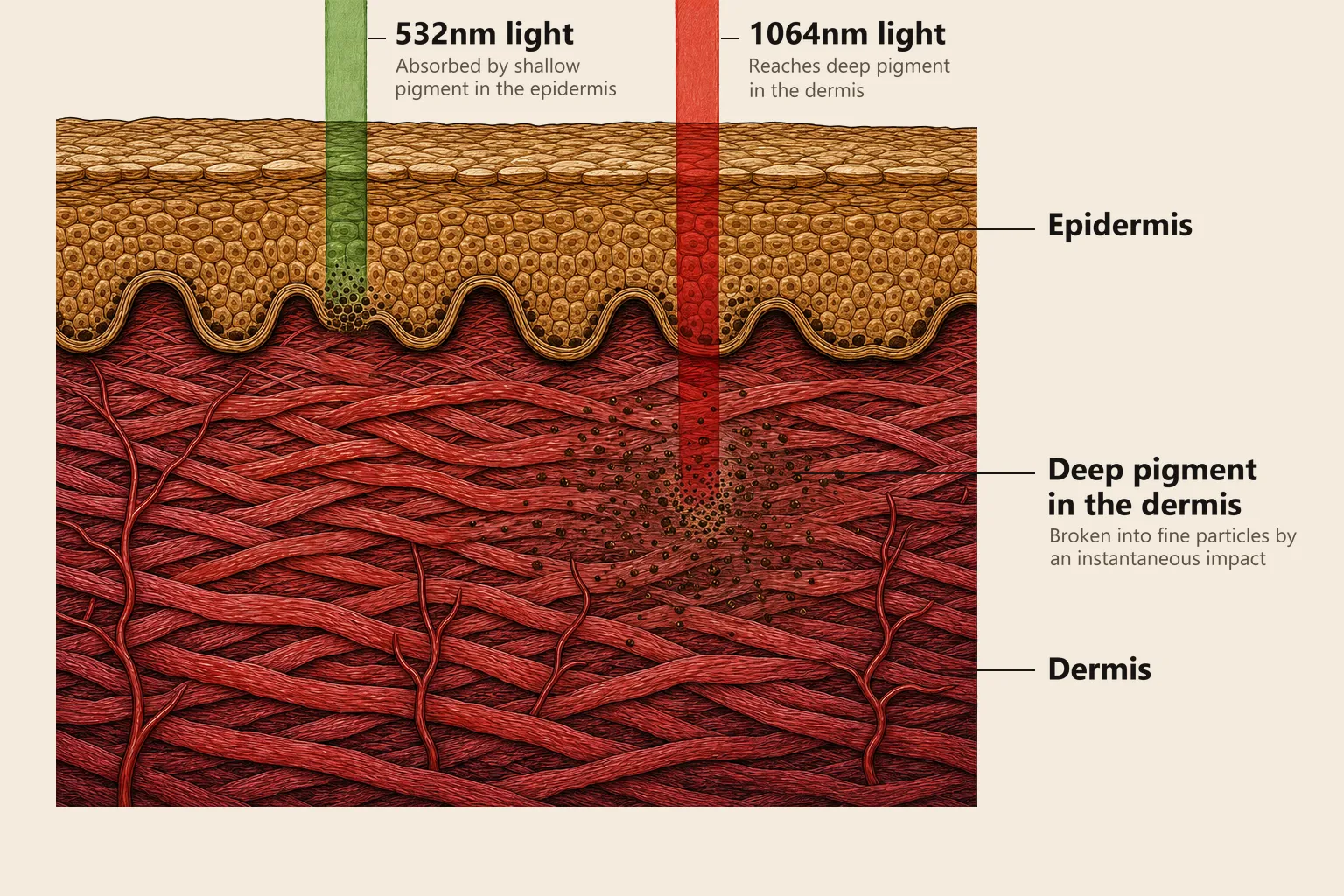
Put simply, it breaks deep melasma and shallow blemishes into fine particles, each with the light that suits it, so the body can gradually clear them away. Wavelength is a value that describes a type of light by its length (nm, nanometers); within this range, the longer the wavelength, the deeper it travels into the skin.
▲ 532nm reaches shallow pigment in the epidermis (the outermost layer of the skin), and 1064nm reaches deep pigment in the dermis (the main layer of skin beneath it) — the pigment is broken up by an instantaneous impact, not burned with heat
PicoLite Black Toning at a Glance
| Item | Details |
|---|---|
| Category | Picosecond pigment laser toning (non-ablative — does not peel away the outer layer of the skin) |
| Mechanism | Ultra-short pulses of light deliver an instantaneous impact to pigment, breaking it into fine particles — not a method that burns it with heat |
| Wavelengths | 1064nm (the base light) · 532nm (light made by converting 1064nm to half its wavelength with a special crystal) — the two are not used together every time |
| Target layer | 1064nm = down to deep pigment in the dermis · 532nm = shallow pigment in the epidermis |
| Concerns it suits | Melasma extending into the dermis and mixed melasma · brown blemishes and freckles · pigment on the body |
| Available options | Face: PicoLite Black Toning+Modeling Pack, 1, 5, or 10 sessions · Body: PicoLite Black Body Toning Laser 1area Both Palm Size (one area about the size of both palms), 1, 5, or 10 sessions (areas that require fully undressing, such as the chest, buttocks, and bikini line, are treated only with Clarity II Body Toning Laser instead of this treatment) |
| Numbing | Performed without numbing (no numbing wait) |
| Pain | Feels like a rubber band lightly snapped against the skin (how strongly you feel it varies by person) |
| How results appear | It doesn't clear in one session — pigment fades gradually as sessions build up · the deeper and longer-standing the melasma, the longer it takes |
| Interval and sessions | Decided by watching the depth of the pigment and how your skin responds (varies widely from person to person) |
| Maintenance | Melasma is pigment that tends to darken again, so even after it has faded, sun protection and ongoing maintenance care are needed |
| Recovery | Scabs usually don't form · redness may appear right afterward and can last from several hours to 1–2 days |
How It Works
1. The light is chosen to match the depth of the pigment 1064nm is absorbed comparatively less by melanin, the brown pigment that gives skin its color, so less of it is used up at the surface and it reaches deep into the dermis. 532nm delivers its energy in the epidermis.
2. It finishes before heat can spread Fired in pulses measured in trillionths of a second, the light puts an instantaneous pressure (impact) on pigment particles before heat can spread to the surroundings, breaking the pigment into fine, sand-like particles. Because it doesn't burn with heat, there is less heat damage to the surrounding tissue. This property matters when treating melasma, which is sensitive to heat and irritation.
3. The body gradually clears the fragments The fragments are understood to be engulfed by scavenger cells (macrophages — cells that swallow and clear away debris in the body) and carried out through the lymphatic vessels (fine vessels through which waste drains). There is a limit to how much can be cleared at one time, so treatment is done at low energy, divided across multiple sessions.
The two wavelengths are not used together every time. When shallow blemishes in the epidermis and melasma in the dermis are mixed, one device can treat them at separate depths — but adding light that isn't needed can increase irritation without adding any improvement.
Expected Results and Why
| Expected result | Why |
|---|---|
| Melasma extending into the dermis fades step by step | 1064nm reaches the deeper layers, and repeating low energy can reduce irritation |
| Brown blemishes and freckles fade | 532nm delivers its energy to shallow pigment in the epidermis |
| Mixed pigment is treated with one device | Shallow and deep pigment are treated separately by switching the light |
Researchers in the Department of Dermatology at Asan Medical Center in Seoul, Korea, applied a picosecond 1064nm laser at low energy to 47 Korean patients with facial pigmentation caused by accumulated sun exposure, 6 times at 2-week intervals. They reported that the pigmentation improved and that no serious side effects were observed during the treatment and follow-up period (2020). These were the conditions set for the study; in practice, the interval and number of sessions are decided by watching how your pigment responds.
When to Consider It
- Melasma extends into the dermis and has spread with blurred edges
- Shallow blemishes and freckles are mixed with deep melasma on the same face
- Your skin tone is on the darker side — the darker your skin tone, the more the pigment in the epidermis absorbs the light first, raising the risk of burns and hyperpigmentation; 1064nm is considered because it is absorbed less by epidermal pigment
- Pigment on the body, such as on the neck or the backs of the hands — this is treated on the same principle as the face
When a different approach may be the right fit
- Redness (flushing or stretched blood vessels) is your main concern — there is a separate approach that treats blood vessels
- Raised lesions such as moles and skin tags — lightening the color leaves the raised shape behind
- Sharply bordered surface spots are your main concern — an approach that removes the spot directly may be the right fit
Differences from Other Treatments and Limitations
| Compared approach | What they share | How they differ |
|---|---|---|
| 755nm picosecond toning | The same picosecond, instantaneous-impact method | 755nm is comparatively suited to shallow pigment and skin tone in the epidermis, and 1064nm to deep melasma in the dermis. This is not a matter of better or worse but of the depth each one treats |
| Long-pulse lasers (pulses in thousandths of a second) | They may use the same wavelengths, such as 755nm and 1064nm | They fire light in long pulses to harden (coagulate) the target with heat — redness caused by blood vessels (flushing) is treated by hardening the vessels with a 1064nm long pulse. Picosecond toning works by breaking up pigment, so it cannot treat blood vessels |
| Lasers that remove spots directly | Both target pigment with very short pulses of light | Sharply bordered surface spots (sun spots — brown spots caused by sun exposure) suit an approach that removes the spot directly; toning is indirect removal — it breaks pigment up for the body to clear — and suits blurred, spreading pigment |
Limitations: This treatment does not eliminate melasma permanently. Nor does 1064nm clear every case of melasma.
Why melasma darkens again Melasma extends not only through the epidermis but into the dermis, and it tends to make more pigment in response to heat and irritation. Sunlight darkens existing melasma and creates new spots, and visible light has also been shown to worsen melasma, particularly in people with darker skin tones. Melasma frequently recurs even after laser treatment, so even after it has faded, it is pigment that needs consistent care, together with sun protection.
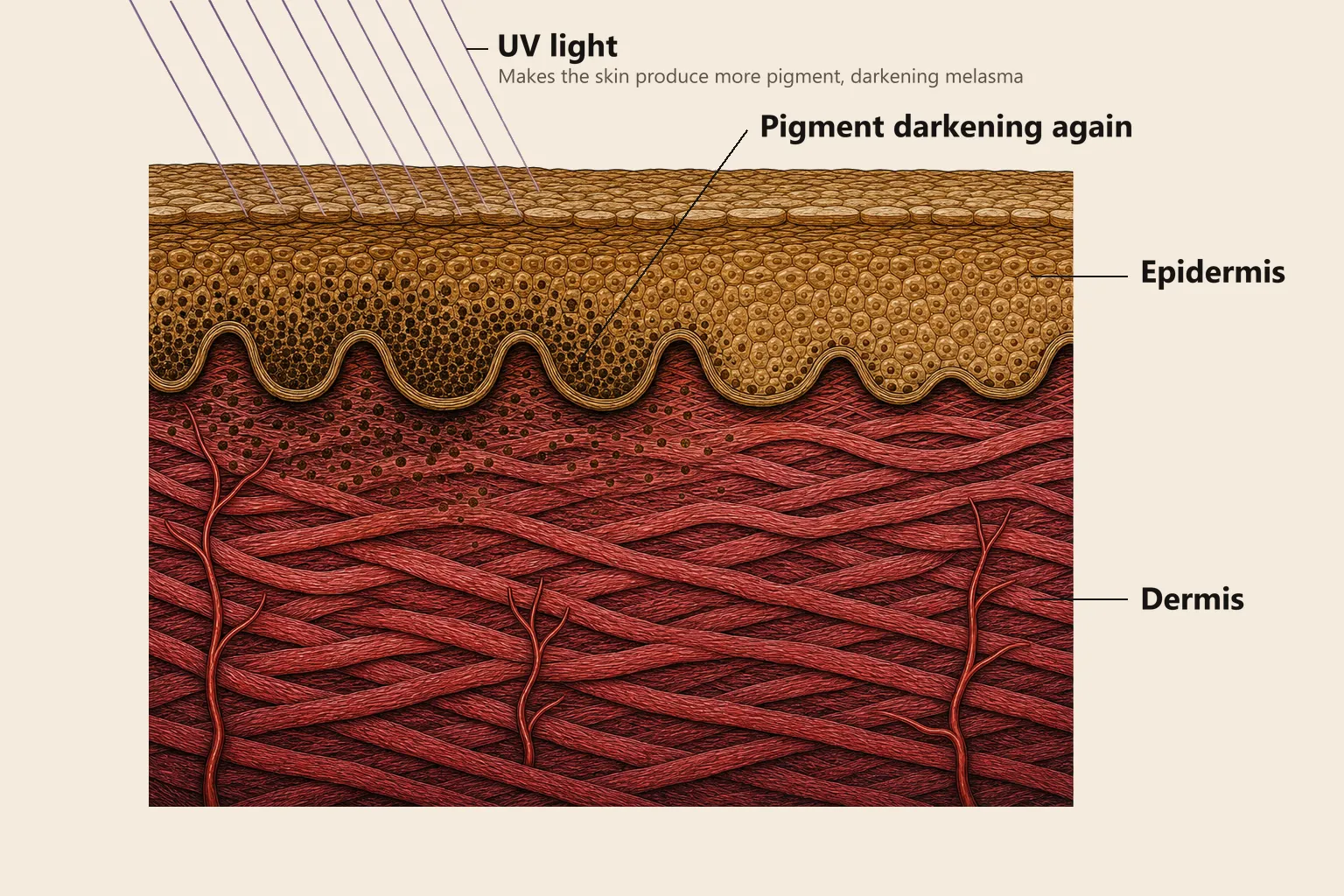
▲ Pigment darkens again on the side that receives light (left) — this is why protection is still needed after you finish your sessions
How It's Done
1. Skin assessment and consultation For the face, 3D MetaVu photographs your skin under changing light sources, such as standard, polarized, and UV light, to show both the pigment you can see and hidden melasma that is hard to see from the surface. For the body, a physician examines the treatment area in person. We review the results together and decide on the light to use and the option.
2. Your physician's name and a final check Before treatment, we let you know the name of the physician treating you, and that physician personally reviews your assessment results and the condition of your skin.
3. Treatment Treatment is performed without numbing, on skin with makeup removed. Makeup is removed so that leftover cosmetics don't block the light.
The face option comes with a Modeling Pack (a mask that is applied to the face, left to set, and then peeled off).
Recovery, Expected Reactions, and Precautions
Recovery: Scabs usually don't form, so you can carry on with daily life after treatment. Any redness that may appear right afterward usually settles within several hours to 1–2 days.
Aftercare: Sun protection matters most. When you're outdoors, it's recommended to reapply sunscreen every two hours, and again after swimming or sweating.
When pigment comes up darker instead: This is a reaction in which the skin treats strong irritation as an attack and makes more pigment (post-inflammatory hyperpigmentation). It isn't the original melasma returning but pigment created by the irritation, and it usually fades over time. Melasma shows this reaction more readily, so treatment is done at low energy, divided across sessions while watching how your skin responds. If it occurs, we focus on sun protection, use an ointment or medication that suppresses pigment production when needed, and continue with low-energy toning. Other reactions are uncommon, but everyone responds differently — if a reaction lasts longer than expected or becomes more noticeable, contact us and we'll check it with you.
When we do not perform this treatment
- Pregnancy, possible pregnancy, or breastfeeding
When we postpone treatment
- Recent strong sun exposure or tanning — the pigment in the epidermis increases and absorbs more of the light, raising the risk of burns and hyperpigmentation. We proceed once the pigment has settled
- Inflammation or a wound in the treatment area — we proceed once it has healed
What to tell us in advance
- Taking a medication that makes your skin sensitive to light (such as some antibiotics) — we take it into account when deciding the timing and intensity
- Other recent treatments — if you've had another pigment laser, skin resurfacing, a chemical peel, or similar treatments, let us know at your consultation
- Whether to have another treatment on the same day is decided together after your assessment
How PECHE Clinic Does It
We follow standards built from more than 90,000 treatments performed across the clinic. From more than 90,000 treatments performed across PECHE Clinic, we have built standards for each area and skin condition, and the same standards apply whichever PECHE physician treats you. With PicoLite Black Toning, those standards determine which light is used and at what intensity, based on your skin tone and the condition of your pigment.
A physician personally reviews your assessment results before we begin. For the face, a physician reviews your 3D MetaVu imaging results; for the body, a physician examines the treatment area in person — and your skin is checked once more right before treatment. This is because the light used differs depending on whether the pigment is shallow or deep, and how the two are mixed. Before we start, we tell you the name of the physician treating you.
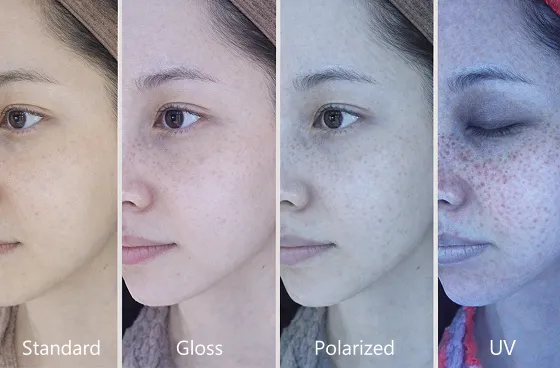
▲ Changing the light source reveals pigment that is hard to see from the surface
We divide treatment across sessions at an intensity your skin tolerates well. Research has found that firing at a stronger setting produced more hyperpigmentation without any benefit in results. The more sensitive the pigment is to irritation, as melasma is, the more we keep to an intensity your skin tolerates well and divide treatment across sessions.
We keep the preparation area in view behind a full glass wall. Treatment preparation takes place in an open-kitchen-style preparation area behind a full glass wall, so from the waiting area you can see the preparation process and hygiene practices for yourself.
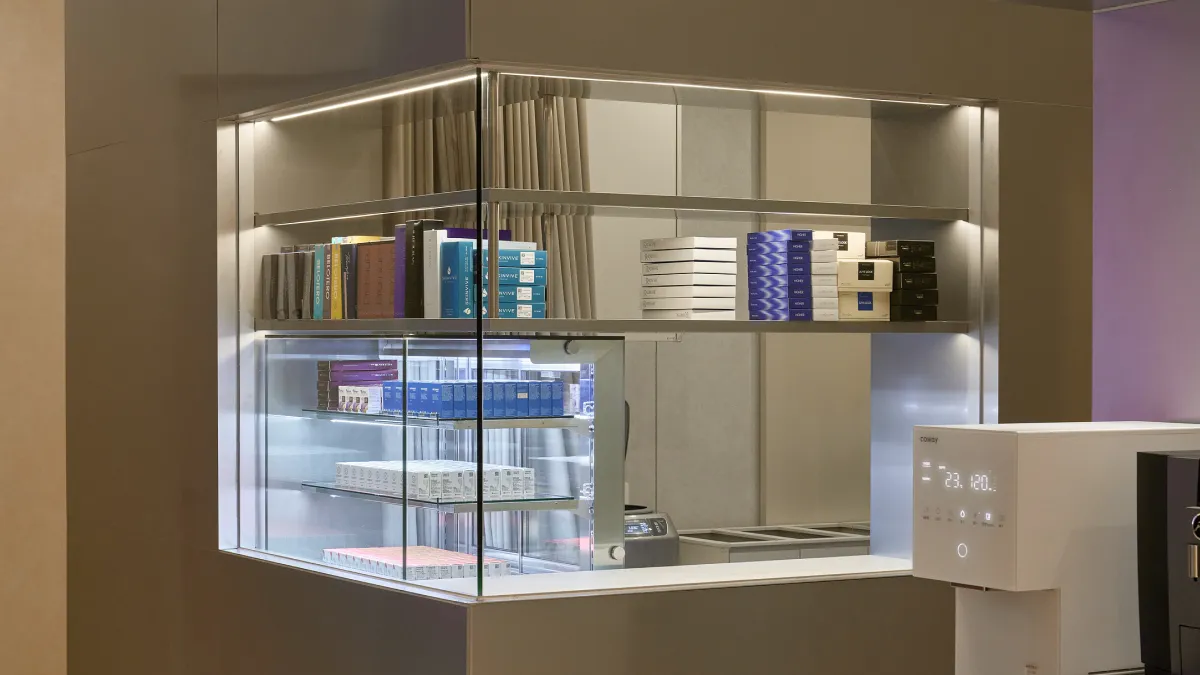
▲ The treatment preparation area, seen through the glass wall from the waiting area
We recommend only the treatments your assessment results call for. We tell you first what this treatment can do (gradually lighten melasma and brown blemishes) and what it can't (keep melasma from coming back, treat redness, or treat raised lesions). You're welcome to come in just for a consultation and leave.
Pricing
Prices for PicoLite Black Toning are published on our website for every product option. Whichever country you're visiting from and whichever channel you book through, the price is the same as the one published on our website — so there's no need to compare prices from one booking channel to another. Making sure you can come in trusting the price you checked in advance — that is the trust PECHE Clinic puts first.
For the face, the options are PicoLite Black Toning+Modeling Pack in 1, 5, or 10 sessions; for the body, PicoLite Black Body Toning Laser 1area Both Palm Size in 1, 5, or 10 sessions. We decide on the option you need together after your assessment.
Location and Clinic Hours
PECHE Clinic 3F, 364 Gangnam-daero, Gangnam-gu, Seoul Right outside Gangnam Station Exit 4 — the building entrance is right in front of you as you come out
Clinic Hours (Korea Standard Time, KST)
- Monday–Friday: 10:30 AM – 9:00 PM
- Saturday, Sunday, and public holidays: 10:00 AM – 6:00 PM
- No lunch break — we see patients straight through midday
FAQ
Q1. Who performs the PicoLite Black Toning treatment? A: Before treatment, we let you know the name of the physician treating you, and that physician personally reviews your assessment results and the condition of your skin before starting. The light and intensity used follow standards built from more than 90,000 treatments performed across the clinic, so the standards are the same even if a different physician treats you.
Q2. Is it all right to use a laser on melasma that is sensitive to heat? A: This method doesn't burn pigment with heat. It fires in pulses of trillionths of a second, breaking pigment with an instantaneous impact before heat can spread — which is why it is used for melasma. That said, melasma is sensitive to irritation, and the reaction in which pigment comes up darker instead can appear more readily, so treatment is done at low energy, divided across sessions while watching how your skin responds.
Q3. Can long-standing melasma fade too? A: It can fade as sessions build up, but the deeper and longer-standing the melasma, the longer it takes. Even though 1064nm reaches deep, it doesn't clear every case of melasma, so we first tell you, based on your assessment results, what range of change you can expect.
Q4. I use a topical medication for melasma. Can I have this treatment alongside it? A: Using sun protection, topical medication, and procedures together is known to be the most effective treatment for melasma. Tell us at your consultation about any medication you use. We'll check together whether it contains an ingredient that makes your skin sensitive to light.
Q5. What should I look for when choosing a clinic for PicoLite Black Toning? A: Three things: whether they choose only the light that's needed rather than using both wavelengths together every time; whether they divide treatment at a low intensity while watching how your skin responds (with melasma, strong irritation can make pigment come up darker); and whether prices are published in advance.