PicoSure Toning — PECHE Clinic, Gangnam Station
Picosecond pigment toning that fires 755nm light in brief pulses measured in trillionths of a second, breaking up the brown pigment of freckles and shallow blemishes · Face and body · Right outside Gangnam Station Exit 4
PicoSure Toning
PicoSure Toning is a pigment toning treatment that uses PicoSure, a 755nm alexandrite picosecond laser (alexandrite is a gemstone crystal that produces the light). Low-energy light is fired many times over to break the brown pigment (melanin) behind blemishes and freckles into fine particles, so the pigment becomes fainter. The device is made by Cynosure, a U.S. company, and has been cleared by the U.S. FDA.
Put simply, it uses extremely short pulses of light to break up the pigment behind shallow blemishes and a dull tone, so your body can gradually clear it away on its own. Because it does not remove the outer layer of skin, you can have it several times without scabbing, and the pigment fades gradually. "Toning" refers to treating faint, spread-out pigment with blurred borders using low energy delivered broadly, divided across many sessions.
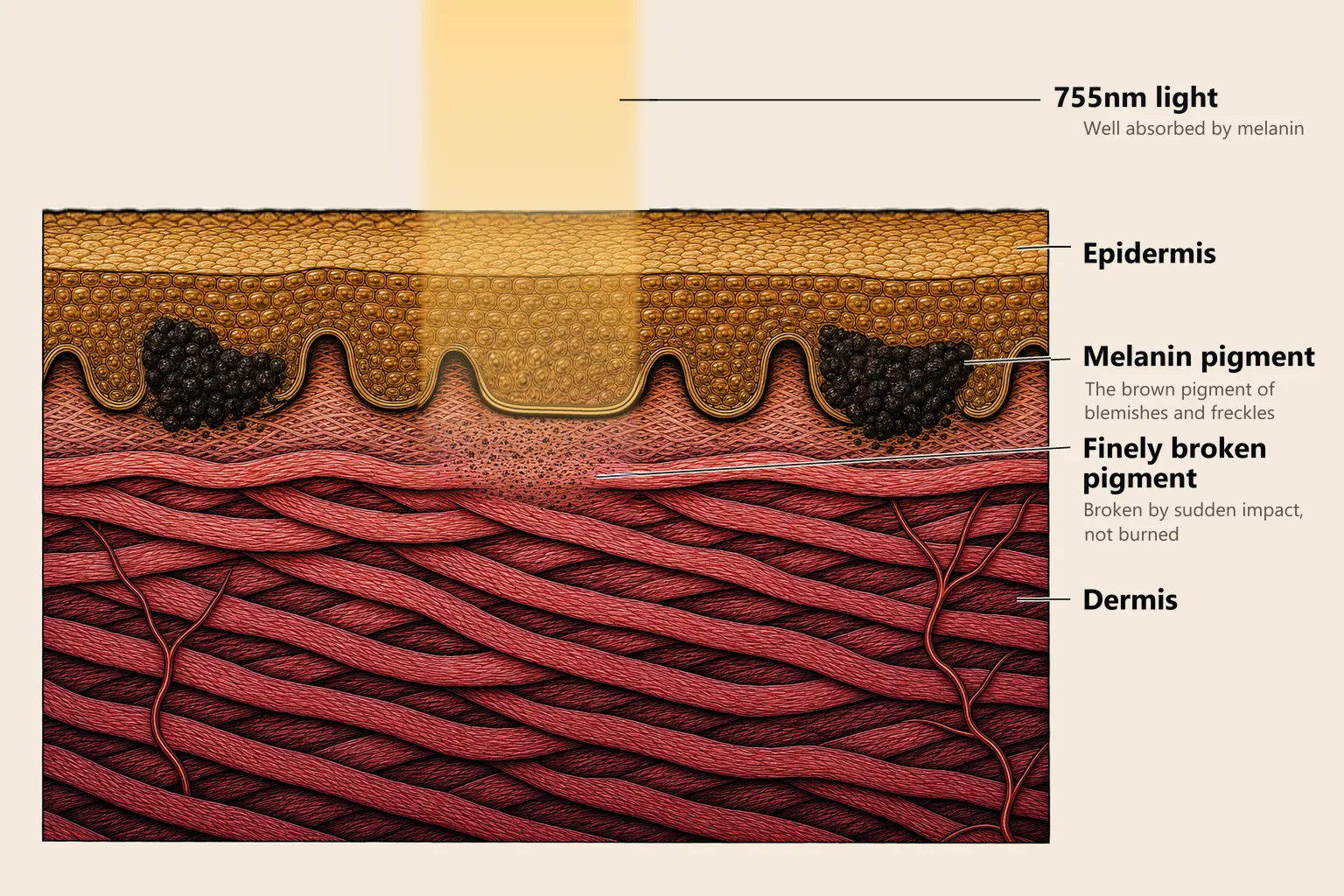
▲ Pigment where the light lands breaks into fine particles — because it isn't burned with heat, there is less heat damage to the surrounding tissue
PicoSure Toning at a Glance
| Item | Details |
|---|---|
| Category | Picosecond pigment laser toning (non-ablative — does not remove the outer layer of skin) |
| Mechanism | 755nm light is absorbed by melanin, and the very short pulse breaks the pigment into fine particles through sudden pressure (photoacoustic) |
| Target layer | Melanin from the epidermis to the upper dermis |
| Pulse length | Picoseconds (trillionths of a second) — 450–900 picoseconds according to U.S. FDA clearance documents |
| Manufacturer and approvals | Cynosure (USA) · cleared by the U.S. FDA |
| Concerns it suits | Freckles · shallow, distinct blemishes · overall dullness across the face · pigment on the body |
| Treatment areas | Face · body |
| Available options | Face: PicoSure Toning+Modeling Pack, 1, 5, or 10 sessions · Body: PicoSure Body Toning Laser 1area Both Palm Size, 1, 5, or 10 sessions |
| Numbing | Performed without numbing (no numbing wait) |
| How results appear | Pigment doesn't clear in one session; it fades subtly as sessions build up |
| Repeat interval | 1–2 weeks apart at first → 2–3 weeks once the pigment fades → widening to 3–4 weeks in the maintenance phase (varies widely with pigment depth and skin condition) |
| Recovery | Usually no scabbing, so daily life carries on · temporary redness |
How It Works
1. 755nm light is absorbed by brown pigment Wavelength is a value that describes a type of light by its length (nm, nanometers), and each wavelength is absorbed by different targets and reaches different depths. 755nm is well absorbed by brown melanin, so pigment from the epidermis to the upper dermis responds even at low energy.
2. The pulse ends before heat can spread The light is fired in extremely short pulses, measured in trillionths of a second (picoseconds). The pulse ends before heat has time to spread to the surroundings, and the pigment particles are hit with sudden pressure (an impact). This way of working, in which light turns into sudden pressure, is called the photoacoustic method.
3. The pigment breaks apart like grains of sand Rather than burning the pigment with heat, it breaks the pigment into fine particles with a sudden impact, so the healthy tissue around it is less likely to be damaged by heat.
4. The body clears it gradually The broken fragments are understood to be engulfed by macrophages (cells that swallow and clear away debris in the body), which then send them out through the lymphatic vessels (fine channels through which the body's waste drains). This process continues as sessions build up.
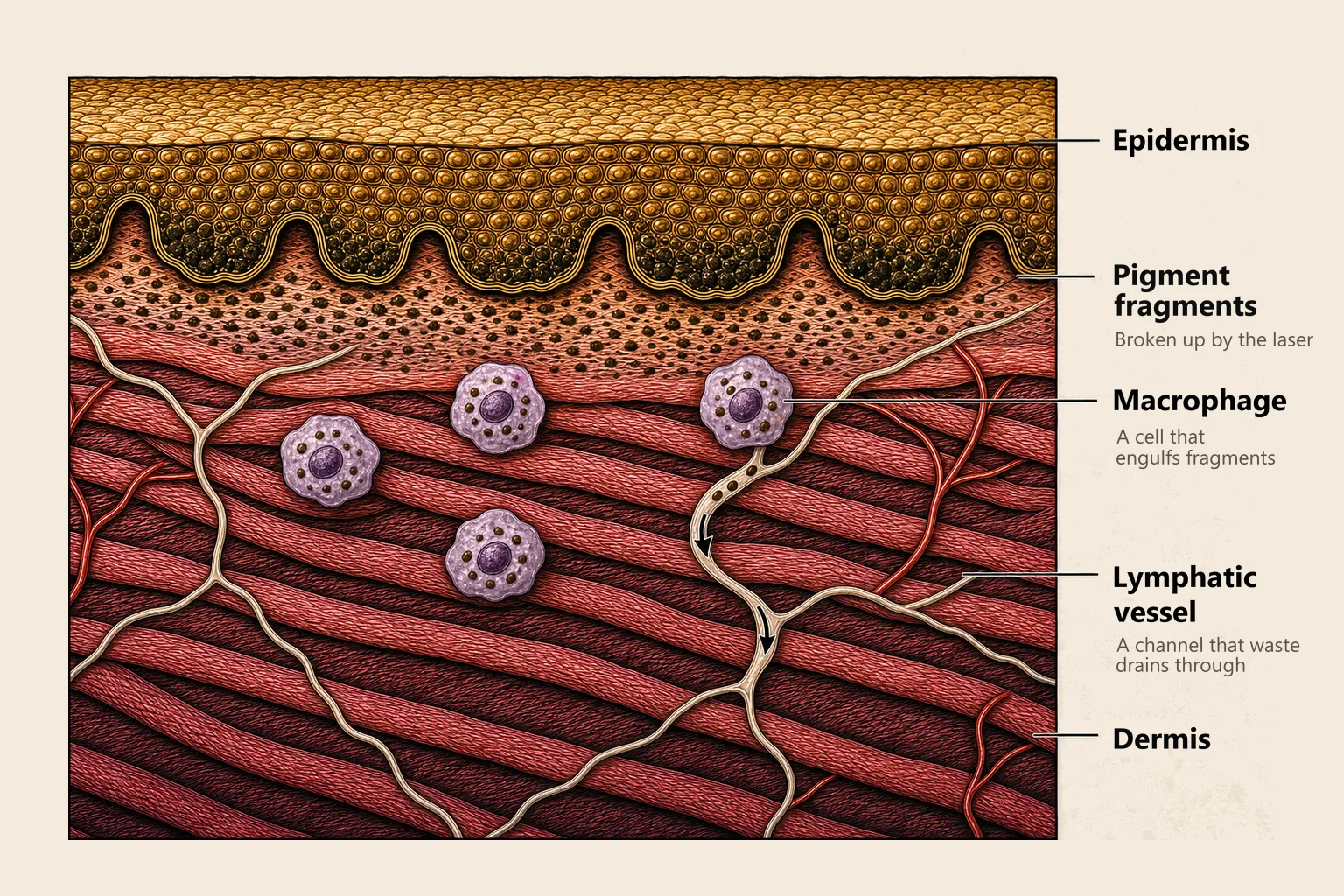
▲ Macrophages engulf the broken fragments and send them out through the lymphatic vessels
Expected Results and Why
| Expected result | Why |
|---|---|
| Freckles and shallow blemishes fade | 755nm is well absorbed by brown melanin, and because this pigment sits close to the surface, the energy reaches it directly |
| The overall tone of the face becomes brighter | Pigment spread faintly across the skin breaks up a little with each session and is cleared away, so the complexion brightens |
| Daily life carries on without scabbing | Because low energy is repeated over sessions, there is little damage to the epidermis |
There are two reasons the treatment is divided into sessions.
- Safety — Pushing the energy too high to break everything up at once makes a reaction in which pigment actually becomes darker (post-inflammatory hyperpigmentation) more likely. A study that compared different intensities also found that the higher-intensity side showed more of this reaction, with no advantage in results.
- How much the body can clear — There is a limit to how much macrophages can clear at one time. If there are too many fragments, clearance can fall behind and lead to inflammation.
A common misconception — "Does one toning session clear all the blemishes?" No. Because the body clears the broken pigment little by little, it fades as sessions build up.
When to Consider It
- Freckles and blemishes show through even when you cover them with makeup
- Rather than distinct spots, your whole face looks dull and your tone is uneven
- Pigment on your body that has darkened from friction or UV exposure bothers you
- You want to clear pigment gradually while carrying on with daily life, without scabbing
When a different approach may be the right fit: Melasma that extends deep into the dermis, raised growths such as moles and skin tags, and redness caused by blood vessels — the reason for each is set out just below in "Differences from Other Treatments and Limitations."
Differences from Other Treatments and Limitations
| Compared approach | What they share | How they differ |
|---|---|---|
| 1064nm picosecond toning | The same picosecond, instantaneous-impact method | 755nm is comparatively suited to shallow pigment and skin tone in the epidermis, and 1064nm to deep melasma in the dermis. This is not a matter of better or worse but of the depth each one treats |
| Long-pulse lasers (pulses in thousandths of a second) | They may use the same wavelengths, such as 755nm and 1064nm | They fire light in long pulses to harden (coagulate) the target with heat — redness caused by blood vessels (flushing) is treated by hardening the vessels with a 1064nm long pulse. Picosecond toning works by breaking up pigment, so it cannot treat blood vessels |
| Lasers that remove spots directly | Both target pigment with very short pulses of light | Sharply bordered surface spots (sun spots — brown spots caused by sun exposure) suit an approach that removes the spot directly; toning is indirect removal — it breaks pigment up for the body to clear — and suits blurred, spreading pigment |
Limitations: With melasma that extends deep into the dermis, more of the 755nm light is absorbed near the surface, so it is difficult for enough of it to reach the deeper pigment. With raised growths such as moles and skin tags, the protruding tissue remains even after the color fades, so they are treated with a method that removes them by evaporating the water in the tissue.
How It's Done
1. Cleansing and makeup removal Leftover makeup keeps the light from reaching the skin evenly, so it is washed off first.
2. Skin assessment and consultation For the face, 3D MetaVu photographs your skin under changing light sources, so we can see both the pigment visible to the eye and how pigment that doesn't readily show on the surface is distributed. For the body, a physician examines the treatment area in person. We review the results together to decide the option and treatment area.
3. Your physician's name and a final check Before treatment, we let you know the name of the physician treating you, and that physician personally reviews your assessment results and the condition of your skin.
4. Treatment This is performed without numbing. Low-energy light is applied evenly across the treatment area.
The face option comes with a Modeling Pack (a mask that is applied to the face, left to set, and then peeled off).
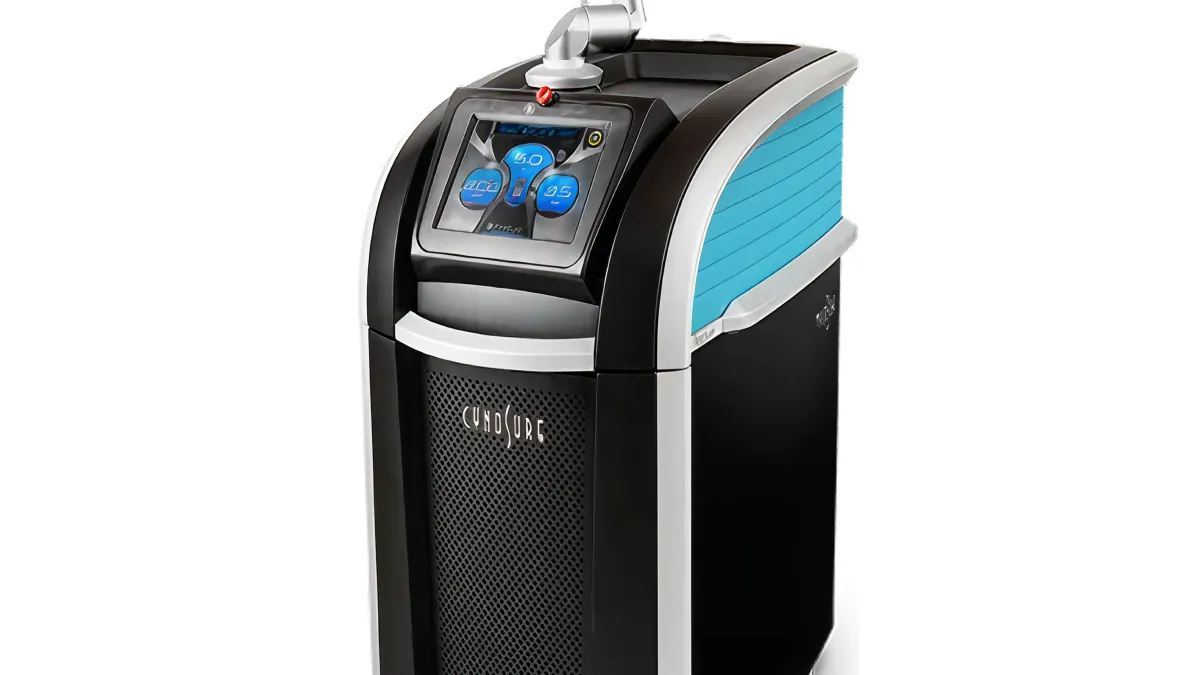
▲ PicoSure — a 755nm picosecond pigment laser
Recovery, Expected Reactions, and Precautions
Recovery: Usually there is no scabbing, and you can go straight back to your daily routine. Redness may appear right after treatment and can last from several hours to 1–2 days.
Sun protection: Pigment is easily produced again when the skin is exposed to UV, so sun protection is the core of care between sessions. When you're outdoors, reapplying sunscreen every two hours, and again after swimming or sweating, is recommended.
When pigment becomes darker instead: Skin that has been irritated can produce more pigment to protect itself (post-inflammatory hyperpigmentation). This is not the original pigment coming back but pigment created by the irritation, and it usually fades over time. If it occurs, the approach is thorough sun protection, an ointment or medication that suppresses pigment production if needed, and continuing with low-energy toning. Other reactions are uncommon, but everyone responds differently — if a reaction lasts longer than expected or becomes more noticeable, contact us and we'll check it with you.
When we do not perform this treatment
- Pregnancy, possible pregnancy, or breastfeeding
When we postpone treatment
- Recent long exposure to strong sunlight, or tanning — melanin in the epidermis increases and absorbs more of the light, raising the risk of burns and hyperpigmentation, so we proceed once the pigment has settled
- Inflammation or a wound in the treatment area — we proceed once it has healed
What to tell us in advance
- A naturally darker skin tone — melanin in the epidermis absorbs more of the light, raising the risk of burns and hyperpigmentation, so the intensity and approach are decided together after your assessment
- Taking a medication that makes your skin sensitive to light (such as some antibiotics) — we take it into account when deciding the timing and intensity
- Other recent treatments — if you've had another laser treatment, a chemical peel, a skin booster, or similar treatments, let us know at your consultation
- Whether to have another treatment on the same day is decided together after your assessment
How PECHE Clinic Does It
We follow standards built from more than 90,000 treatments performed across the clinic. From more than 90,000 treatments performed across PECHE Clinic, we have built standards for each area and skin condition, and the same standards apply whichever PECHE physician treats you. With PicoSure Toning, those standards determine which intensity level is used and how the intervals between sessions are set.
A physician personally reviews your assessment results before we begin. For the face, a physician reviews your 3D MetaVu imaging results; for the body, a physician examines the treatment area in person. Right before treatment, we check your skin condition once more. Even the same brown spot calls for a different approach depending on whether the pigment is shallow, whether deeper pigment is mixed in, or whether there is redness along with it — so depending on the results, we may recommend an approach that uses a different wavelength. Before we start, we tell you the name of the physician treating you.
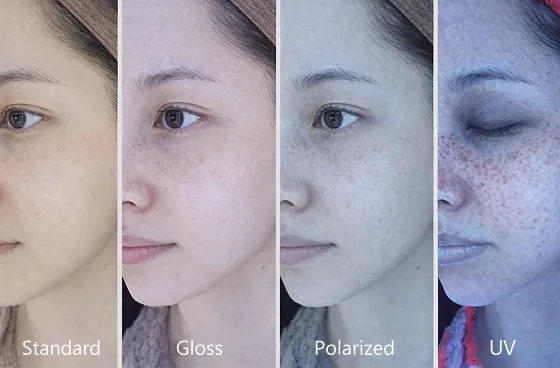
▲ Changing the light source reveals even pigment that looked faint to the naked eye
We keep the preparation area in view behind a full glass wall. Treatment preparation takes place in an open-kitchen-style preparation area behind a full glass wall, so from the waiting area you can see the preparation process and hygiene practices for yourself.
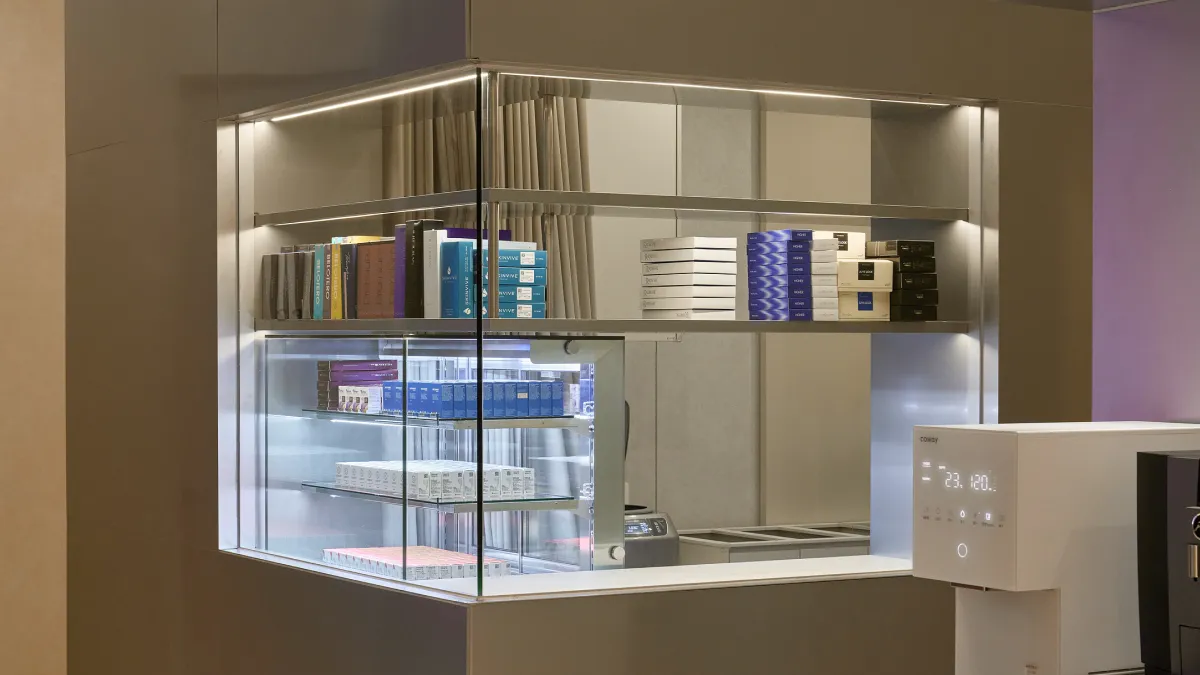
▲ The treatment preparation area, seen through the glass wall from the waiting area
We recommend only the treatments your assessment results call for. We tell you first what this treatment can do (freckles, shallow blemishes, and a dull tone) and what it can't (deep melasma, raised moles, and redness caused by blood vessels). You're welcome to come in just for a consultation and leave.
Pricing
Prices for PicoSure Toning are published on our website for every product option. Whichever country you're visiting from and whichever channel you book through, the price is the same as the one published on our website — so there's no need to compare prices from one booking channel to another. Making sure you can come in trusting the price you checked in advance — that is the trust PECHE Clinic puts first.
For the face, PicoSure Toning+Modeling Pack comes in 1, 5, and 10 sessions; for the body, PicoSure Body Toning Laser 1area Both Palm Size comes in 1, 5, and 10 sessions. We decide on the option you need together after your assessment.
Location and Clinic Hours
PECHE Clinic 3F, 364 Gangnam-daero, Gangnam-gu, Seoul Right outside Gangnam Station Exit 4 — the building entrance is right in front of you as you come out
Clinic Hours (Korea Standard Time, KST)
- Monday–Friday: 10:30 AM – 9:00 PM
- Saturday, Sunday, and public holidays: 10:00 AM – 6:00 PM
- No lunch break — we see patients straight through midday
FAQ
Q1. Who performs the PicoSure Toning treatment? A: Before treatment, we first let you know the name of the physician treating you, and that physician personally reviews your assessment results and the condition of your skin before starting. The intensity and the intervals between sessions follow standards built from more than 90,000 treatments performed across the clinic, so the same standards apply even if a different physician treats you.
Q2. Why is it performed without numbing? A: This is toning that delivers low energy broadly, divided across many passes, so the stimulation isn't strong — which is why it is performed without numbing. It feels like a rubber band lightly snapped against the skin, though this varies from person to person. If a spot feels especially uncomfortable, let us know. We proceed while watching how your skin responds.
Q3. How do I choose between the 1-, 5-, and 10-session options? A: This isn't a treatment that clears pigment in one go; the pigment fades as sessions build up, which is why multi-session options exist. How many sessions you need differs from person to person, depending on the amount and distribution of your pigment and how your skin responds, so we decide together after reviewing your assessment results. You can also start with a single session to see how your skin responds first.
Q4. Can I have it if my face just looks dull, without distinct blemishes? A: Yes. Pigment spread faintly across the whole face is also what this treatment targets, so you can expect a change toward a brighter complexion as sessions build up. However, if the dullness is mixed with redness, an approach that treats blood vessels may also be needed, so we sort this out at your assessment.
Q5. Which body areas can be treated, and how much at a time? A: Pigment on the body is treated on the same principle as the face, and one area is counted as about the size of both palms spread out. We decide together at your assessment how many areas the part you'd like treated counts as. However, areas that require full undressing, such as the chest, buttocks, and bikini line, are not treated with this procedure — they are treated only with Clarity II Body Toning Laser.