Skin Booster in Seoul: The Serum and the Injection Differ
One term, two different meanings — what a skin booster means in Seoul, and the four types within it
"Everyone in Seoul talks about skin boosters, but the ones I can buy at home are serums. Are they the same thing or not?"
This comes up often with people planning a trip to Seoul. The confusion comes from the same term being used for both. Separating the two is the first step before any of the other questions can be answered. Here is how it breaks down.
Why Are Skin Booster Injections Confused With Serums?
The same term is used for a skincare product and for a category of treatment.
In skincare, skin booster often refers to a concentrated serum or another topical you add to a routine you already have.
In Seoul's aesthetic clinics it is a category: the whole set of injections that place ingredients inside the skin. What separates it from filler is that it is not about building contour by filling a hollow. It works on the skin itself — texture and firmness, hydration, thickness.
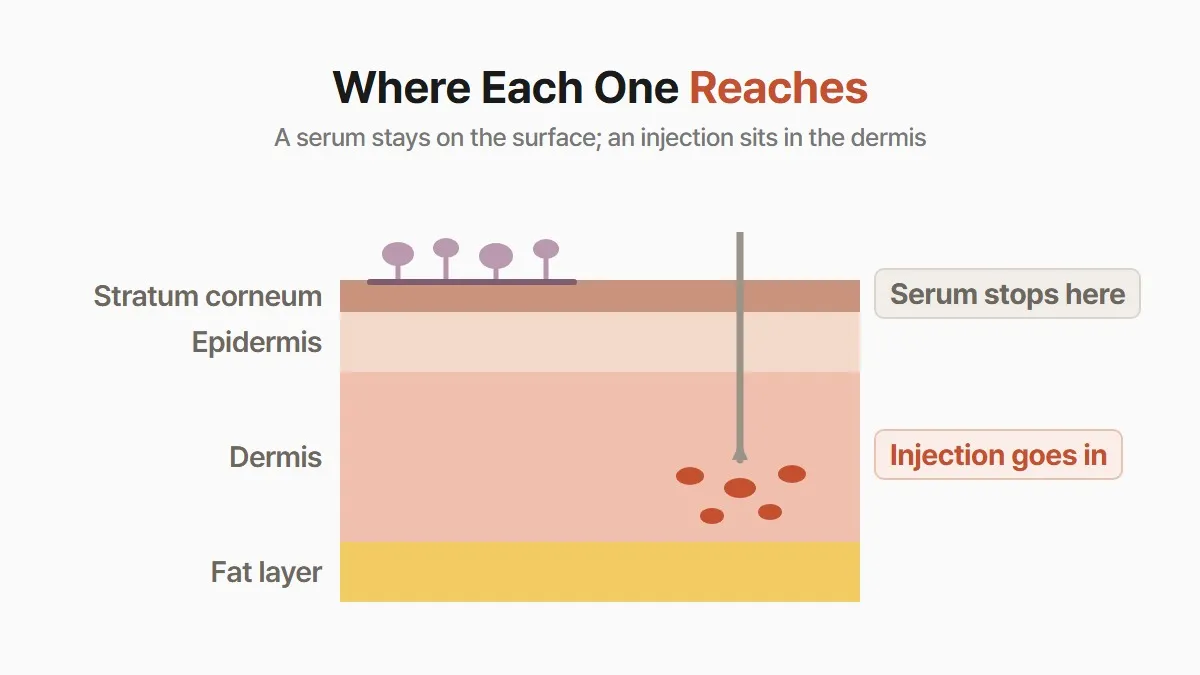
The dividing line is the layer each one reaches. A topical product is limited by the skin barrier in how far it can go. An injection passes that barrier and places the ingredient in the dermis — the deeper layer that gives the skin much of its firmness and thickness.
So the two are not substitutes for each other. They serve different purposes. Surface hydration and the barrier are what daily skincare handles. A barrier that has broken down — tight, flushed, quick to react — is not a problem solved by putting something into the dermis. The reverse is also true: skin becoming thinner and less firm is a change in the dermis, and no amount of careful surface care reaches that layer.
After you have had the injection in Seoul and gone home, your daily routine carries on as it did. Just don't read an ingredient name on a label and expect the same result as the injection — the same ingredient placed at a different depth gives a different result.
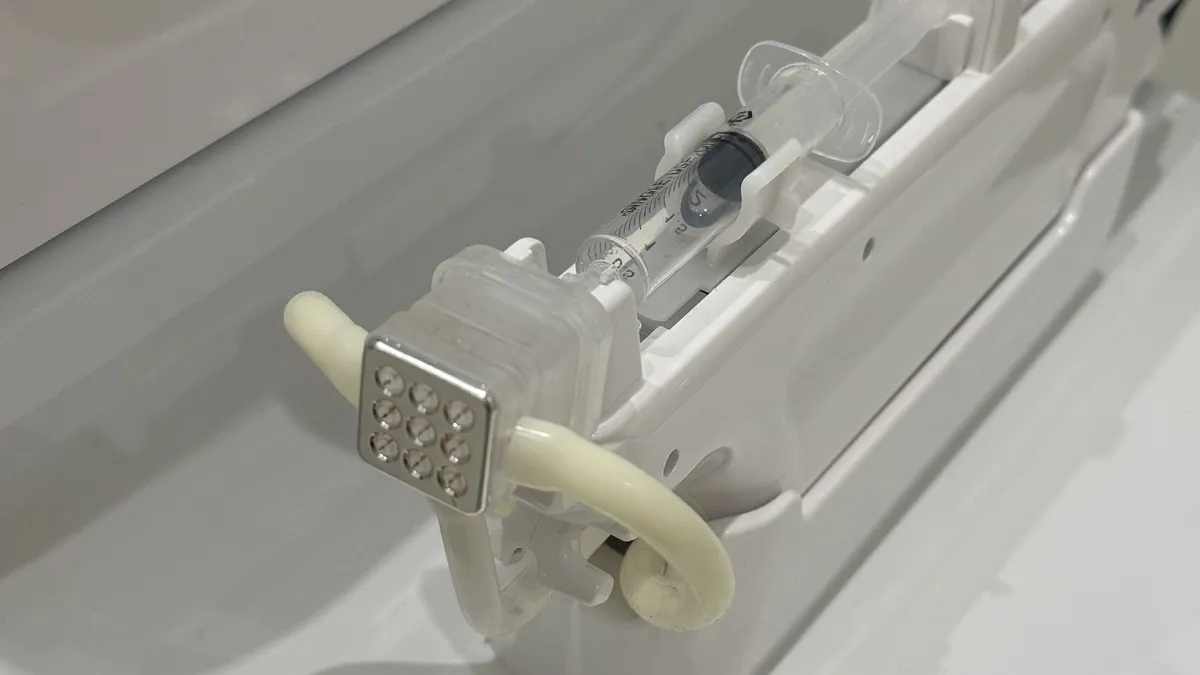
If the needle itself is what kept you on the topical side, there is a choice in how the injection is delivered. A Cooling Low Pain X-Injector chills the plate the needles come through, which is understood to dull the sensation at the surface, and it can be added with some products. It does not remove the sensation entirely, and it is a separate option not included in the base treatment price.
How Are Skin Booster Injections in Seoul Grouped?
Into four. They aim at different things, and the result shows up in different ways.
| Type | Product | Main ingredient | Suited to |
|---|---|---|---|
| Hydration | SkinVive (by Juvéderm) | Cross-linked hyaluronic acid | Texture and fine lines, dryness in the upper layer |
| Belotero Revive | Cross-linked hyaluronic acid + glycerol | For longer-lasting hydration | |
| HiloWave | High- and low-molecular hyaluronic acid, fluid | For hydration with a subtle fullness | |
| Collagen-stimulating | Rejuran | PN (polynucleotide) | Concerns about skin recovery and sensitivity |
| Juvelook | PDLLA | Texture and fine lines, firmness, lost volume | |
| Collagen-based | Laetigen | Type I collagen | For those considering collagen placed directly |
| Tissue-derived | Re2O | Human dermis-derived tissue particles | Concerns about reduced firmness and texture |
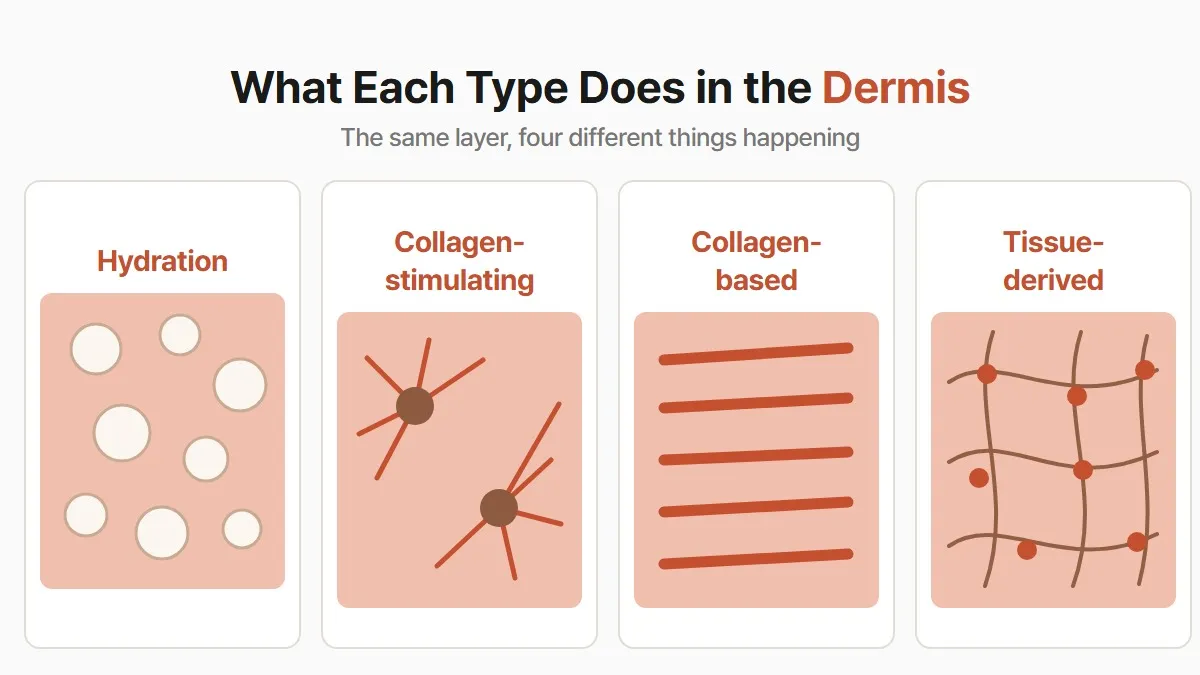
Hydration-focused boosters use the way hyaluronic acid attracts and holds water. Because of that, a change in hydration and texture may be noticeable relatively quickly — within one to two weeks.
Collagen-stimulating boosters work through different mechanisms. The PN in Rejuran is thought to support the processes involved in skin repair, while the PDLLA in Juvelook is understood to promote collagen production. How Rejuran works in detail, and how it differs from the topical sold under the same name, is covered in Rejuran in Seoul: The Ampoule and the Injection Differ.
Collagen-based boosters differ from the ones that rely on stimulating your own collagen: the collagen is placed directly. For the first few days, though, swelling and injection marks can affect how the area looks, so it is better assessed after those settle.
Tissue-derived boosters are different in character from the other three. Re2O is tissue taken from human dermis and processed into fine particles. Where the other three place an ingredient to draw a response from the skin, this one supplies material of the kind the skin is made of. It is not a treatment where the spot fills in the way a filler does. Its purpose is the quality of the skin rather than the volume a filler is chosen for.
Which Type of Skin Booster Is Right for Me?
Start by identifying your main skin concern.
The groups are not ranked against each other. In a randomized, double-blind trial that placed PN on one side of the face and hyaluronic acid on the other and compared the eye area, overall improvement was not meaningfully different, while PN scored a higher rate of improvement on roughness and pores (Lee et al., J Dermatolog Treat, 2022). The question is not which is better but which concern you want to address first.
- Dryness and rough texture → start with the hydration type
- Concerns about recovery, firmness or elasticity → collagen-stimulating
- You would rather have collagen placed directly → collagen-based
- Firmness and texture have changed → tissue-derived
How long it takes to notice a result varies by type. Hydration-focused boosters bring a change in hydration and texture within one to two weeks. Collagen-stimulating boosters take time for collagen to build, so they change from a few weeks on. Tissue-derived boosters need time for collagen to form around the placed particles, so they appear gradually. On a single trip that difference affects the choice — if you want to feel it before you fly home, the hydration type is faster.
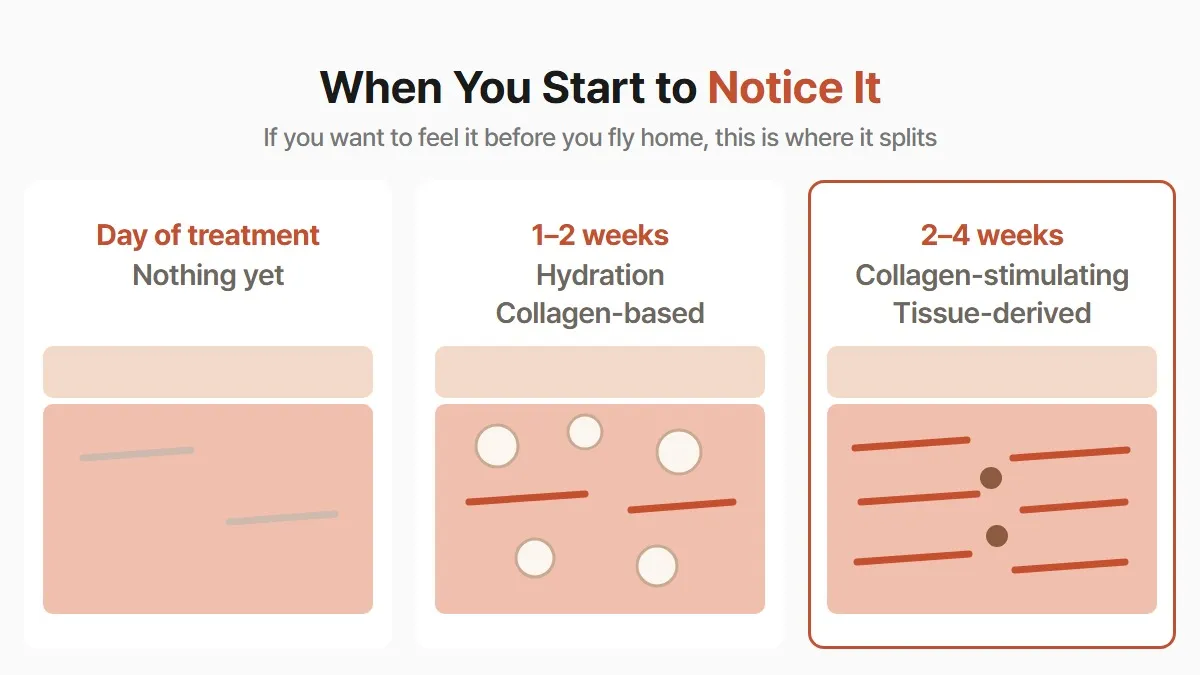
Many people notice a change after a single session with any of the four types, and the effect builds as sessions add up, though how much and how soon varies with the treatment and with your skin. It is not a treatment that only means something if you do it repeatedly, so if you are in Seoul once, having one session now and adding to it on a later trip is a workable plan. How far a single session can go is worth settling in the consultation beforehand.
Some types split once more inside themselves. Juvelook comes as Skin and Volume, placed at different depths; the Volume side has larger particles and is not used where skin is thin. Re2O is used on the face and neck but not under the eyes. A clinic should be able to tell you where a product may be used and where it may not be appropriate — both sides, not just one.
4 Things to Sort Out Before a Skin Booster in Seoul
Sorting out these four beforehand makes the consultation go quickly.
1. Identify your main skin concern Dryness, texture and fine lines, firmness, or a change in density. This is what guides the choice of type. Naming it before your appointment, rather than "my skin isn't good," keeps the consultation focused.
2. Ask how many types the clinic carries A clinic with only the hydration type and a clinic with all four have different conversations. Where there is a choice, you can hear why this type and not another.
3. Check whether they tell you where a product is not used Having options listed for a product does not mean it is used everywhere on the face. A clinic that can explain both where a product may be used and where it may not be appropriate is working from criteria per area.
4. Send your dates and your flight home Types become noticeable at different points, and injection marks and swelling settle on different timelines. Knowing your schedule helps us decide what to do first on this trip.
Peche Clinic is a one-minute walk from Exit 4 of Gangnam Station, on Subway Line 2 and the Shinbundang Line. We are open until 9 PM on weekdays and 6 PM on weekends and public holidays. Payment is by card on the day of treatment, and we give you an itemized receipt afterwards. English-speaking staff are on site, and you can reach us in English through WhatsApp for inquiries and bookings. Our consultations draw on more than 90,000 treatments performed here.

FAQ
Q: Is a skin booster in Seoul the same as the serum I use?
A: No. In English-speaking markets skin booster is often a product name, but in Seoul it is the category name for injections that place ingredients inside the skin. A topical is limited by the skin barrier in how far it can go; the injection passes that barrier and places the ingredient in the dermis.
Q: What are the different types of skin boosters in Seoul? A: They group by main ingredient and by what the ingredient is for — hydration-focused hyaluronic acid, collagen-stimulating, collagen-based, and tissue-derived. Checking the ingredient before the treatment name makes the choice much easier.
Q: How is a skin booster different from filler? A: Filler builds contour by filling a hollow. A skin booster works on the condition of the skin itself. That said, some skin boosters sit closer to volume, so the consultation separates the concern first.
Q: How do I know which skin booster group suits my skin? A: By the nature of the concern. Dryness with texture and fine lines points to the hydration type; wanting texture and firmness back points to collagen-stimulating; preferring collagen placed directly points to collagen-based; a change in firmness and texture points to tissue-derived. We check your skin in the consultation and decide together.
Q: Is one skin booster session enough? A: Many people notice a change after a single session, and the effect builds with repeat sessions, though results vary. It is not a treatment that only means something if repeated. Because the types become noticeable at different points, the hydration type is faster if you want to feel it before you fly home.
Q: Does a skin booster in Seoul hurt? A: Numbing cream is applied and left to take effect before the session starts, and the numbing time can be extended beyond the standard if your skin is sensitive. Some treatments placed in deeper layers use a local anesthetic instead. If the needle is a concern, a Cooling Low Pain X-Injector — which chills the plate the needles come through — can be added with some products, as a separate option not included in the base treatment price. Pain management differs by treatment, so it is worth confirming in the consultation how yours will run.
Q: Can I have two skin boosters on the same day? A: Sometimes they are done on the same day. It depends on your skin, where the injections go and what else you are having that day, so tell us at booking which treatments you want and we will confirm whether they can be combined and in what order they should be done.
Q: Can I fly home right after a skin booster in Seoul? A: How long injection marks and swelling stay visible differs by type and by the amount placed. Send us your flight date and the treatments you want on WhatsApp and we will plan around your schedule.