Laetigen — PECHE Clinic, Gangnam Station
A skin booster that fills finished type I collagen into the dermis in a thin, wide layer to replenish skin density · Face, eye area, and neck · Right outside Gangnam Station Exit 4
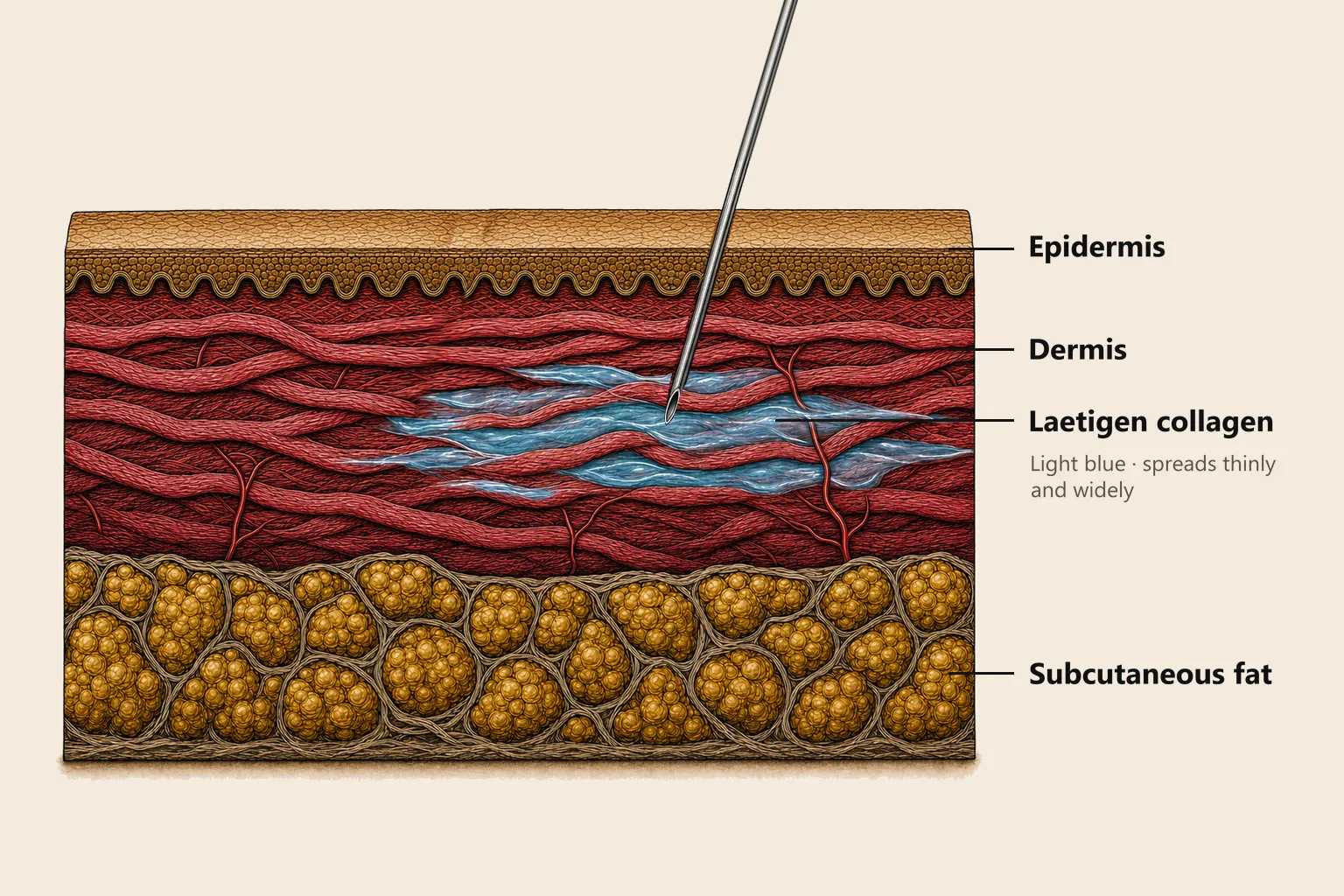
Laetigen
Laetigen is a collagen-replenishing skin booster (an injectable treatment aimed at the quality of the skin itself). It places type I atelocollagen into the dermis in a thin, wide layer to directly refill collagen that has declined. It is made by a Korean company and is a medical device approved by Korea's Ministry of Food and Drug Safety (MFDS).
Put simply, it's an injection that spreads the most abundant type of collagen in skin, in its finished form, in a thin layer inside the skin. It works in the dermis (the layer just beneath the epidermis that actually gives skin its firmness and thickness), adding thickness and elasticity while leaving the shape of your face as it is. It fills density, not volume.
▲ The Laetigen ingredient (light blue) is placed so that it settles thinly and widely among the collagen in the dermis. The color is only there to tell it apart
Laetigen at a Glance
| Item | Details |
|---|---|
| Category | Skin booster in the direct collagen-replenishing group (injection treatment) |
| Main ingredient | Type I atelocollagen — collagen with both ends of the molecule (the telopeptides) cut away |
| Product form | A liquid gel that comes in a syringe — no powder to dissolve |
| Mechanism | Fills in type I collagen, the most abundant collagen in the dermis, in the same form the skin already has, adding to the structure that supports the skin |
| Target layer | Dermis (in a thin, wide layer) |
| Concerns it suits | Skin that has grown thin and lost elasticity · fine lines and uneven texture · collagen loss with aging |
| Treatment areas | Whole face, outer cheeks, neck, and under-eyes · for the eye area, Laetigen Eye Area, a version made specifically for it |
| Available options | Laetigen Eye Area 1cc · Laetigen 2cc / 4cc (2cc and 4cc also come as 3-session packages) |
| Numbing | Numbing cream, then a 20-minute wait |
| When results show | From about 1–2 weeks after treatment (varies by person) |
| How long it lasts | 6–12 months (varies with skin condition) |
| Recommended interval and sessions | A basic course of 3 sessions, 3–4 weeks apart → then maintenance every 3–6 months (decided together after your assessment) |
| Recovery | Raised bumps 1–3 days · injection marks and redness 1–2 days · bruising, if it occurs, 3–7 days |
How It Works
1. It refills lost collagen with the same type of collagen Most of what makes up the dermis is collagen, and the most abundant kind is type I collagen, which supports the skin. With age and long-term sun exposure, this collagen declines, and the skin grows thinner and loses elasticity. Laetigen puts in the same type I collagen in its finished form, directly adding to the structure that supports the skin.
2. The part the body tends to treat as foreign has been cut away in advance The two ends of the collagen molecule (the telopeptides) are where the body's reaction to a substance it recognizes as foreign is mainly directed. Laetigen is atelocollagen with these ends removed, a form designed to lower the burden of an immune response.
3. It supports the skin once in place, then breaks down gradually The collagen that has been filled in adds springiness and a sense of elasticity where it sits. It then breaks down gradually in the body, and that process is understood to create an environment in which the cells that make collagen can produce new collagen. In cell and animal studies (the stage before testing in people), atelocollagen was reported to draw more of collagen's raw material into cells and reduce the enzymes that break down collagen, increasing collagen production — this has not been confirmed in people.
Expected Results and Why
| Expected result | Why |
|---|---|
| Better density and elasticity in skin that was thin and lacked strength | Because collagen itself is put in, adding to the structure that supports the skin |
| Changes from about 1–2 weeks (varies by person) | Because finished collagen is put in, rather than waiting for the body to make new collagen — this is when swelling and marks have cleared and the collagen has settled in. Approaches that stimulate collagen production usually show changes from about 3–4 weeks |
| Your features stay as they are | Because it's spread thinly and widely in the dermis rather than placed as a mass in a deeper layer |
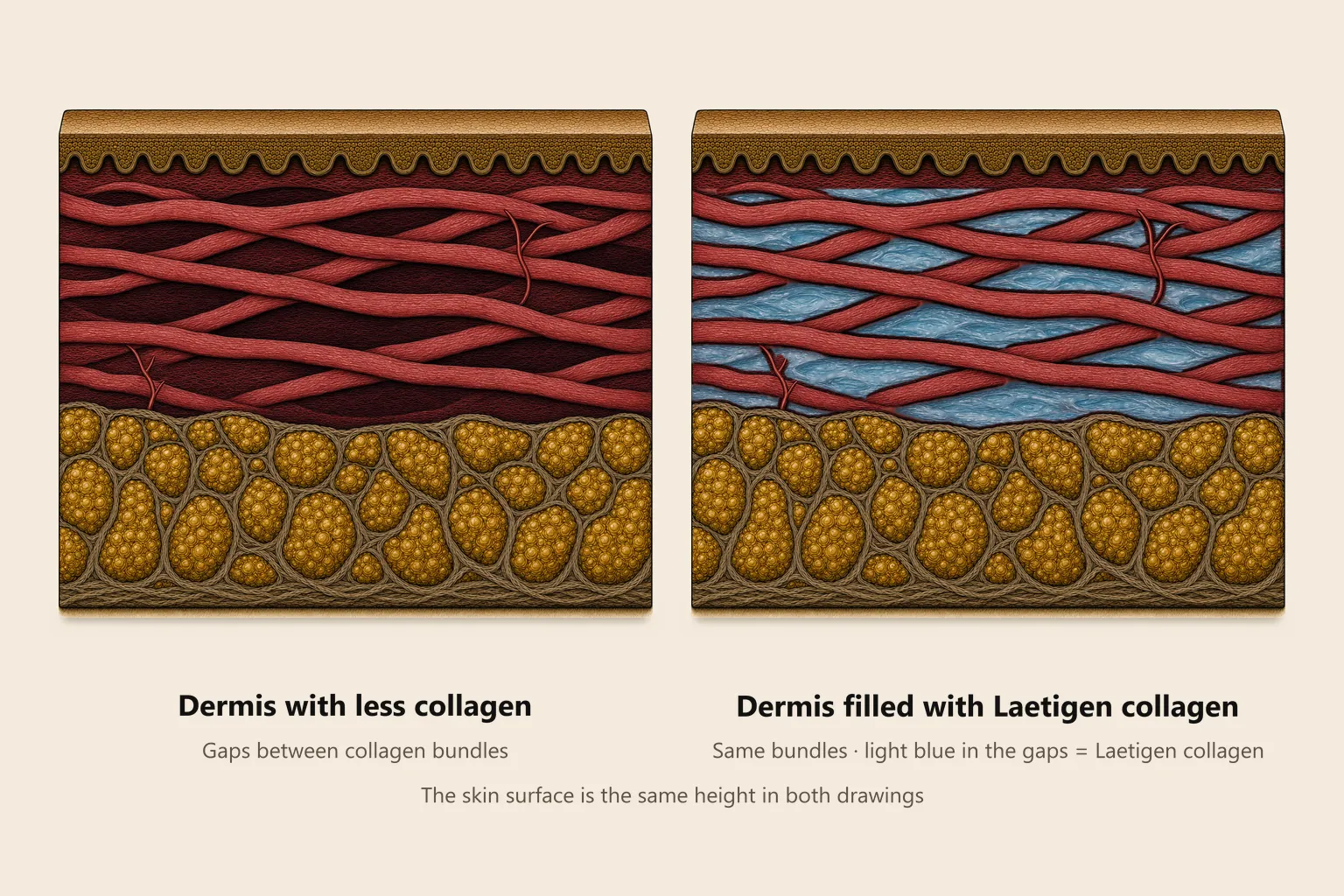
▲ In both drawings, the collagen bundles and the skin surface height are the same; on the right, Laetigen collagen (light blue) fills the gaps between the bundles. This drawing is to aid understanding, and the degree of change varies by person
When to Consider It
| Concern | Matching option | Why |
|---|---|---|
| Skin across the whole face has grown thin and lost its springiness, so it easily looks sunken · fine lines and uneven texture | Laetigen 2cc / 4cc | Because it fills in the lost collagen itself, adding density to a thinned dermis — the wider the area, the more product is used |
| Thin skin around the eyes | Laetigen Eye Area 1cc | Because it's a version made specifically for the thin skin around the eyes |
What these have in common is a lack of density, not a lack of volume.
When a different approach may be the right fit
- Lost volume or contour is your main concern — a volume-filling treatment may be the right fit
- Sagging is your main concern — a lifting treatment that raises sagging tissue may be the right fit
Differences from Other Treatments and Limitations
| Compared approach | What they share | How they differ |
|---|---|---|
| Skin boosters that use microparticles to prompt collagen production | Both aim to increase collagen in the dermis | The particle type gets your own collagen to form anew — through the body recognizing the particles as foreign material, or through the particles acting as a scaffold that cells attach to and build on — while Laetigen replenishes finished collagen itself |
| Skin boosters that fill in the extracellular matrix as a whole | Both directly fill in material | Laetigen fills in finished collagen as a material, while this approach puts in the whole network structure that cells move into, live in, and make collagen in (the extracellular matrix — the network of collagen, elastic fibers, and hyaluronic acid that fills the space outside cells) |
| Skin boosters that send regenerative signals | Both improve the dermal environment | The signal group tells cells to get back to work, while Laetigen fills in the material itself |
| Filler | Both fill by injection | Filler is placed as a mass in a deeper layer to shape contours, while Laetigen is spread thinly and widely in the dermis, adding thickness and elasticity while leaving your features as they are |
Limitations: Laetigen is not a treatment that corrects volume or contours. The injected collagen breaks down gradually in the body, so it isn't a one-time treatment — sessions are continued as a series.
How It's Done
1. 3D skin analysis and consultation 3D MetaVu imaging photographs your skin texture, pores, fine lines, and color under different light sources. We review the results together to decide on the option (Laetigen or Laetigen Eye Area) and the treatment area.
2. Your physician's name and a final check Before treatment, we let you know the name of the physician treating you, and that physician personally reviews your assessment results and the condition of your skin.
3. Numbing We apply numbing cream and wait 20 minutes.
4. Injection The product is injected into the dermis, divided across the area in a thin, wide layer. If you prefer, you can choose a powered injection device that delivers the same set amount with each injection (DermaShine Injector or Cooling Low Pain X-Injector) as an option.
What you feel is a sting as the needle goes in, together with a dull, pressing ache as the product spreads. It's more of a pressure than a burning, raw feeling.
If pain is a concern, you can add Non-Sedation Gas Anesthesia (Air Nox) as an option — you breathe in a mix of oxygen and nitrous oxide that reduces pain and tension while you stay conscious and responsive.
Recovery, Expected Reactions, and Precautions
Recovery: Right after treatment, each injection point rises into a bump, like a mosquito bite. These raised bumps are a normal sign that the product has entered the dermis, so don't press or rub them until they settle. For the first few days, swelling and injection marks are still present, so any change is judged after they have cleared. Other reactions are uncommon, but everyone responds differently — if a reaction lasts longer than expected or becomes more noticeable, contact us and we'll check it with you.
Daily life after treatment: The tiny openings left by the needle need time to close, so a gentle water-only rinse can start 3–4 hours after treatment, and washing with a foaming cleanser and wearing makeup can start gently the next morning. For 3 days to 1 week, avoid saunas, jjimjilbang (Korean bathhouse saunas), and strenuous exercise that makes you sweat. Strong heat and sweat can irritate the widened blood vessels and make redness and swelling worse.
When we do not perform this treatment
- Pregnancy, possible pregnancy, or breastfeeding
When we postpone treatment
- Inflammation or active acne in the treatment area — we proceed once it has settled
What to tell us in advance
- A history of hypersensitivity reactions to collagen or animal-derived ingredients — Laetigen is an animal-derived collagen ingredient
- A history of hypersensitivity reactions to ingredients or of anaphylaxis (a sudden, severe whole-body allergic reaction), or an allergy to lidocaine or other anesthetics
- Taking aspirin or anticoagulants (medications that keep blood from clotting easily) — you may bruise more easily
- Keloid-prone skin (scars that heal raised and thickened)
- Other recent treatments — if you've had filler, another skin booster, laser, lifting, or similar treatments, let us know at your consultation
- Whether to have another treatment on the same day is decided together after your assessment
Although rare, a risk shared by all injection treatments is that the product can enter a blood vessel and block it. If pain keeps getting worse after treatment, or the skin turns white or a dark, dusky red, contact us right away.
How PECHE Clinic Does It
We follow standards built from more than 90,000 treatments performed across the clinic. From more than 90,000 treatments performed across PECHE Clinic, we have built standards for each area and skin condition, and the same standards apply whichever PECHE physician treats you. With Laetigen, those standards set which option goes into which area and how much is divided among the injection points.
A physician personally reviews your assessment results before we begin. A physician reviews your 3D MetaVu imaging results and checks your skin's condition once more just before treatment. That's why, even with the same Laetigen, the options and amounts differ from person to person. Before we begin, we tell you the name of the physician who will treat you.
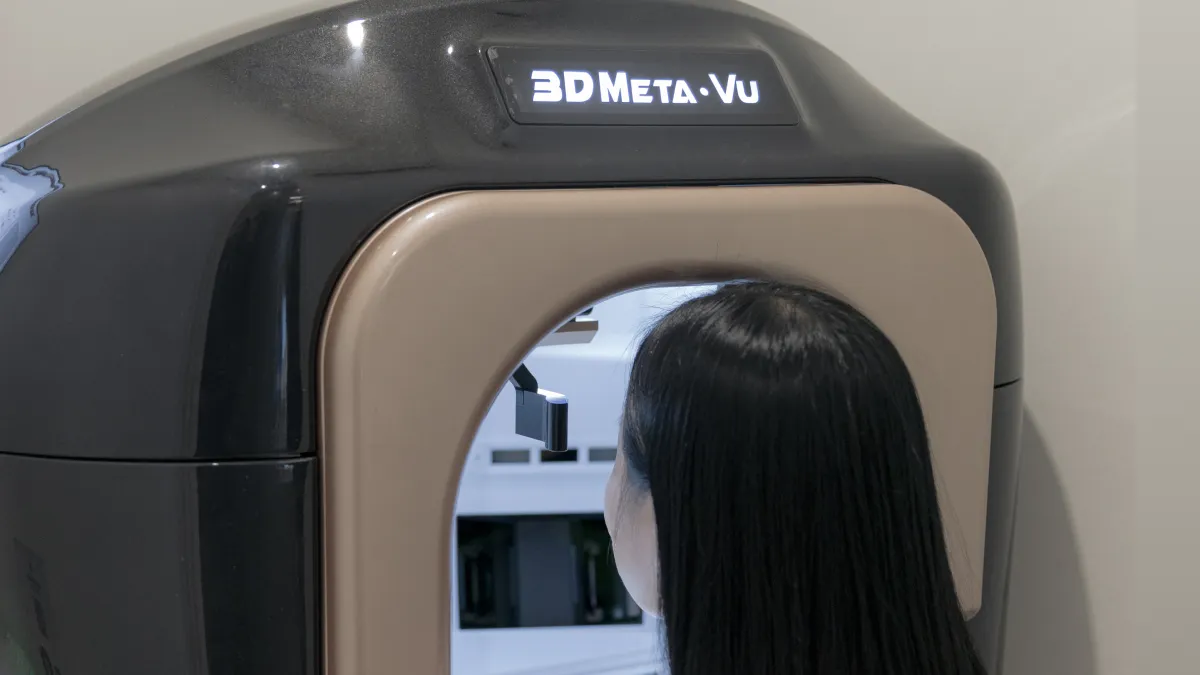
▲ We review your imaging results together
We open genuine products in front of you and keep the preparation area in view behind a full glass wall. The genuine product used in your treatment is opened in front of you. Treatment preparation takes place in an open-kitchen-style preparation area behind a full glass wall, so from the waiting area you can see the genuine product, the preparation process, and hygiene practices for yourself.

▲ The treatment preparation area, seen through the glass wall from the waiting area
We recommend only the treatments your assessment results call for. We tell you up front what this treatment can do (skin density and elasticity) and what it can't (lost volume, contours, sagging). You're welcome to come in just for a consultation and leave.
Pricing
Prices for Laetigen are published on our website for every product option. Whichever country you're visiting from and whichever channel you book through, the price is the same as the one published on our website — so there's no need to compare prices from one booking channel to another. Making sure you can come in trusting the price you checked in advance — that is the trust PECHE Clinic puts first.
Laetigen is offered as Laetigen Eye Area 1cc (1 session), and Laetigen 2cc (1 session), 2cc x 3 sessions, 4cc (1 session), and 4cc x 3 sessions. As options, you can add DermaShine Injector, Cooling Low Pain X-Injector, Low Pain Skin Booster, Mirajet Toning Mode, or Potenza Pumping Tip (1 session each). Mirajet Toning Mode and Potenza Pumping Tip are device treatments added separately from the injections, and the combination you need — including whether to add them — is decided together after your assessment.
Location and Clinic Hours
PECHE Clinic 3F, 364 Gangnam-daero, Gangnam-gu, Seoul Right outside Gangnam Station Exit 4 — the building entrance is right in front of you as you come out
Clinic Hours (Korea Standard Time, KST)
- Monday–Friday: 10:30 AM – 9:00 PM
- Saturday, Sunday, and public holidays: 10:00 AM – 6:00 PM
- No lunch break — we see patients straight through midday
FAQ
Q1. Who performs the Laetigen treatment? A: Before treatment, we first let you know the name of the physician treating you, and that physician personally reviews your assessment results and the condition of your skin before starting. The options and the amount injected follow standards built from more than 90,000 treatments performed across the clinic, so the same standards apply even if a different physician treats you.
Q2. How do I choose between Laetigen Eye Area, Laetigen 2cc / 4cc, and the 3-session packages? A: Laetigen Eye Area is a version made for the thin skin around the eyes, while Laetigen 2cc and 4cc are the same product, divided by the amount injected. A cc is a unit of volume for the product, and the wider the area being treated, the more product is needed. A 3-session package means receiving the same amount (2cc or 4cc) three times. Because the injected collagen breaks down gradually, these packages are for continuing a series, and which option suits you is decided together at your assessment, based on the areas and how much they cover.
Q3. Can Laetigen collagen be reversed with a dissolving injection? A: No. Hyaluronidase, often called a "dissolving injection," is an enzyme that breaks down only hyaluronic acid, so Laetigen, which is collagen, isn't something it acts on. Laetigen is an ingredient the body breaks down gradually over time, and it's spread thinly and widely in the dermis rather than placed as a mass that changes contours. That's why, at your consultation, we first make sure the change you're hoping for is within what this treatment can do (density and elasticity).
Q4. If I've had an allergy to collagen or animal-derived ingredients, can I still have Laetigen? A: It depends on your history. Laetigen is an animal-derived collagen ingredient, so if you've had a hypersensitivity reaction to collagen or animal-derived ingredients, we first ask at your consultation when it happened and what kind of reaction it was. Based on that, we decide together whether to proceed or whether a skin booster from a different group would be a better fit.
Q5. Can I have Laetigen on my neck along with my face? A: Yes. The neck is one of the treatment areas for Laetigen, and it's done the same way as the face — spread thinly and widely in the dermis. If you have both done on the same day, numbing is done once, and the amount is decided together at your assessment, based on the area.