HiloWave — PECHE Clinic, Gangnam Station
A hydration and density skin booster that places two sizes of hyaluronic acid at a few deep points in the dermis so it spreads along the layer · Right outside Gangnam Station Exit 4
HiloWave
HiloWave is a skin booster (an injectable treatment aimed at the quality of the skin itself) that contains both large-molecule and small-molecule hyaluronic acid. Hyaluronic acid (HA) is a substance naturally present in the dermis that holds a great deal of water. The process of linking its molecules together (cross-linking) is kept to a minimum, so its properties fall between unlinked HA and firmly linked HA.
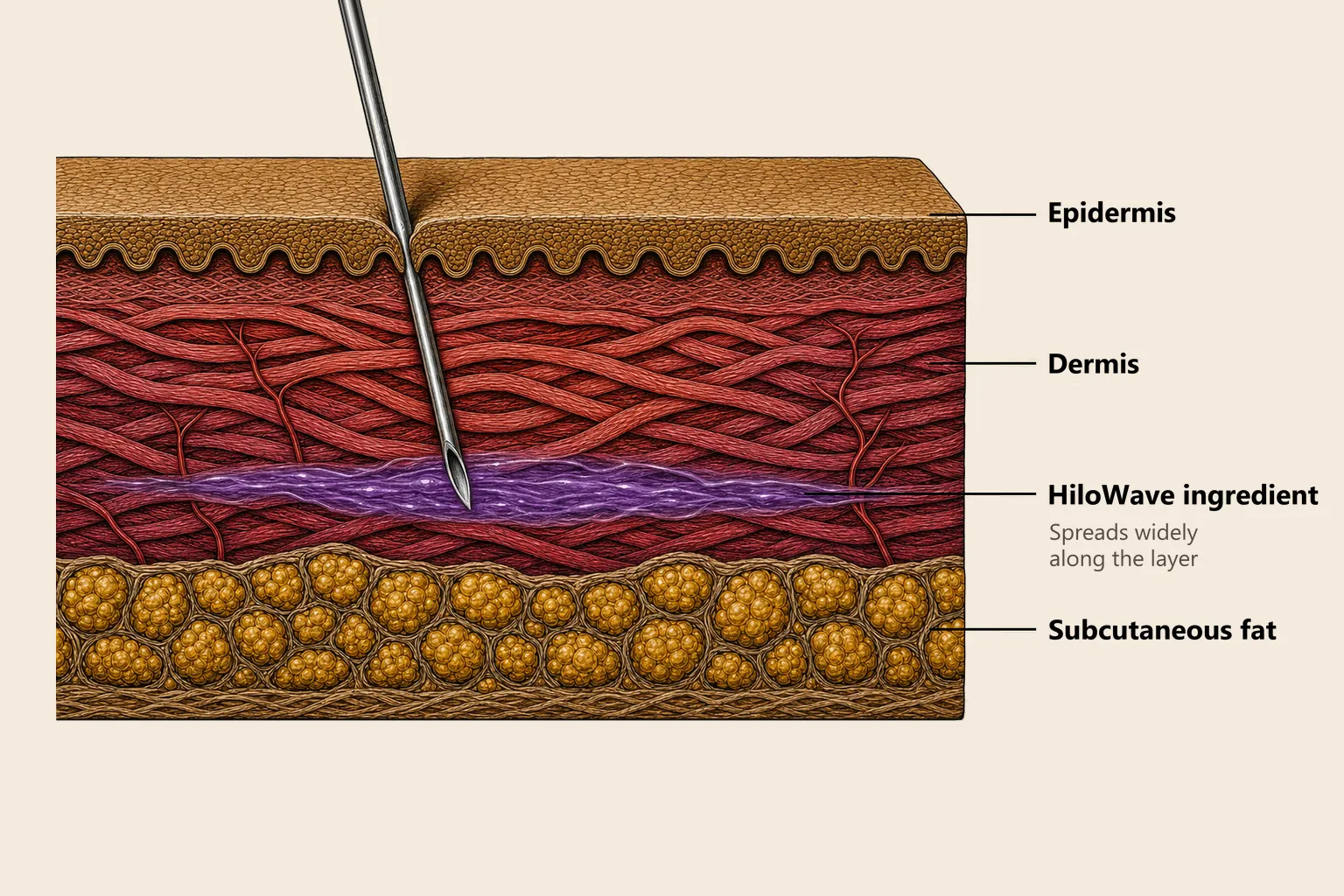
Put simply, it's an injection in which HA placed deep in the dermis at a few points on the face spreads widely inside the skin, replenishing moisture and a subtle density at the same time. It isn't a volume treatment that plumps up one specific area.
▲ The ingredient injected at one point doesn't gather in one place — it spreads along the dermal layer (purple = hyaluronic acid)
HiloWave at a Glance
| Item | Details |
|---|---|
| Category | Skin booster in the hyaluronic acid (HA) hydration-and-texture group (injection treatment) |
| Main ingredient | Dual-molecule hyaluronic acid (high and low molecular weight) · minimal cross-linking agent (BDDE — a substance used to link the molecules together) · raw materials not obtained from animals · no particles |
| Injection method | Injected by hand · at set points, around 5 per side of the face (on the cheekbones and below them) |
| Target layer | Deep in the dermis → spreads widely along the layer |
| Product classification | Classified in Korea as a Class 4 medical device by the Ministry of Food and Drug Safety (MFDS) (because it is placed inside the body, it falls in a higher-risk class that must pass an approval review) |
| Concerns it suits | Dryness, plus thin, slack skin on the front and sides of the cheeks that makes the face look tired · sagging and hollowing in the middle of the face (midface) |
| Available options | HiloWave 2cc · 4cc |
| Numbing | Local anesthesia (numbs only the treatment area) · no separate wait for numbing |
| When results show | Around weeks 1–2, deep-seated dryness, texture, and glow improve first → a subtle density builds gradually as sessions add up |
| How long it lasts | The collagen your skin produces on its own remains for as long as 1 year to 1 year and 6 months · results feel at their peak for about 6 months (varies with skin condition and age) |
| Recommended interval and sessions | A basic course of 3 sessions, 4 weeks apart → after that, one session about every 6 months to keep it going (decided together after your assessment) |
| Recovery | Injection marks, redness, and swelling 1–2 days · bruising, if it occurs, 3–7 days |
How It Works
1. It's placed deep, at set points There are points set in advance, around 5 per side of the face (on the cheekbones and below them). The product is injected by hand deep in the dermis at these points.
2. It spreads widely along the layer The injected HA doesn't remain as a lump; it gradually spreads through the dermis. Because the method uses a few points to spread the product evenly, the needle goes in fewer times.
3. The dermis fills out as it holds water Two sizes of HA are used together because they do different jobs — the large molecules hold onto water for a long time, and the small molecules work their way more easily into the spaces between tissues. Rather than dispersing within a few days, both stay for a long time and hold onto water. The dermis, now holding water, fills out overall, and that support subtly fills in areas that looked hollow.
4. Collagen production continues to be stimulated The HA that settles in the dermis is understood to stimulate collagen production. This is why skin density builds later than moisture does, as sessions add up.
Expected Results and Why
| Expected result | Why |
|---|---|
| Deep-seated dryness eases, and skin texture and glow come back | Because the long-staying HA holds water in the dermis |
| Hollow-looking front and side cheeks are subtly filled | Because the dermis, holding water, gives support |
| The density of thinned skin gradually builds | Because the HA keeps stimulating collagen production |
The volume described here doesn't mean building up one area the way a filler does. It's a change in which the whole dermis holds water and fills out, so hollow areas are gently smoothed over.
Collagen remains for more than a year but gradually decreases over time, so results pass their peak from around 6 months. That's why many people have one more session around then to keep it going. How much your skin changes, and how quickly, varies with your skin's condition and age.
When to Consider It
- Along with dryness, the skin on the front and sides of your cheeks has become thin and slack, so your face looks tired
- The area below your cheekbones looks hollow, but you don't want a change in the shape of your face
- You'd like an approach that injects at fewer points — it tends to feel less burdensome
When a different approach may be the right fit
- Surface dryness, with dull, rough skin and a strong tight feeling after washing, is your main concern — the hydrating-injection family, which focuses on moisture and texture, may be the right fit
- You want volume or contour correction that builds up one specific area — the filler family may be the right fit
- The contour of your face itself has dropped — the lifting family, which raises sagging tissue, may be the right fit
Differences from Other Treatments and Limitations
| Compared approach | What they share | How they differ |
|---|---|---|
| Non-cross-linked HA hydrating injections | Both replenish moisture with HA | The concern each addresses is different — non-cross-linked HA addresses surface dryness (moisture and texture), while HiloWave addresses dryness mixed with sagging and hollowing (moisture plus a subtle density). The injection method also differs with the formulation: a watery hydrating injection is placed evenly at many points in the shallow dermis, while HiloWave goes deep at a few set points |
| Cross-linked HA skin boosters | Both are HA skin boosters that don't build up one area the way a filler does | Special cross-linking lets the injected HA itself stay in the dermis for several months, and it's divided into tiny droplets placed thinly over a wide area. The way duration is measured also differs — for cross-linked HA, it's a period measured by moisture and skin-texture indicators, while HiloWave's 1 year to 1 year and 6 months is how long the collagen your skin produces on its own remains |
| HA volume fillers | The same HA ingredient | Firmly cross-linked HA is placed together in one spot in a deep layer to build up that area. HiloWave spreads widely so that the whole dermis fills out |
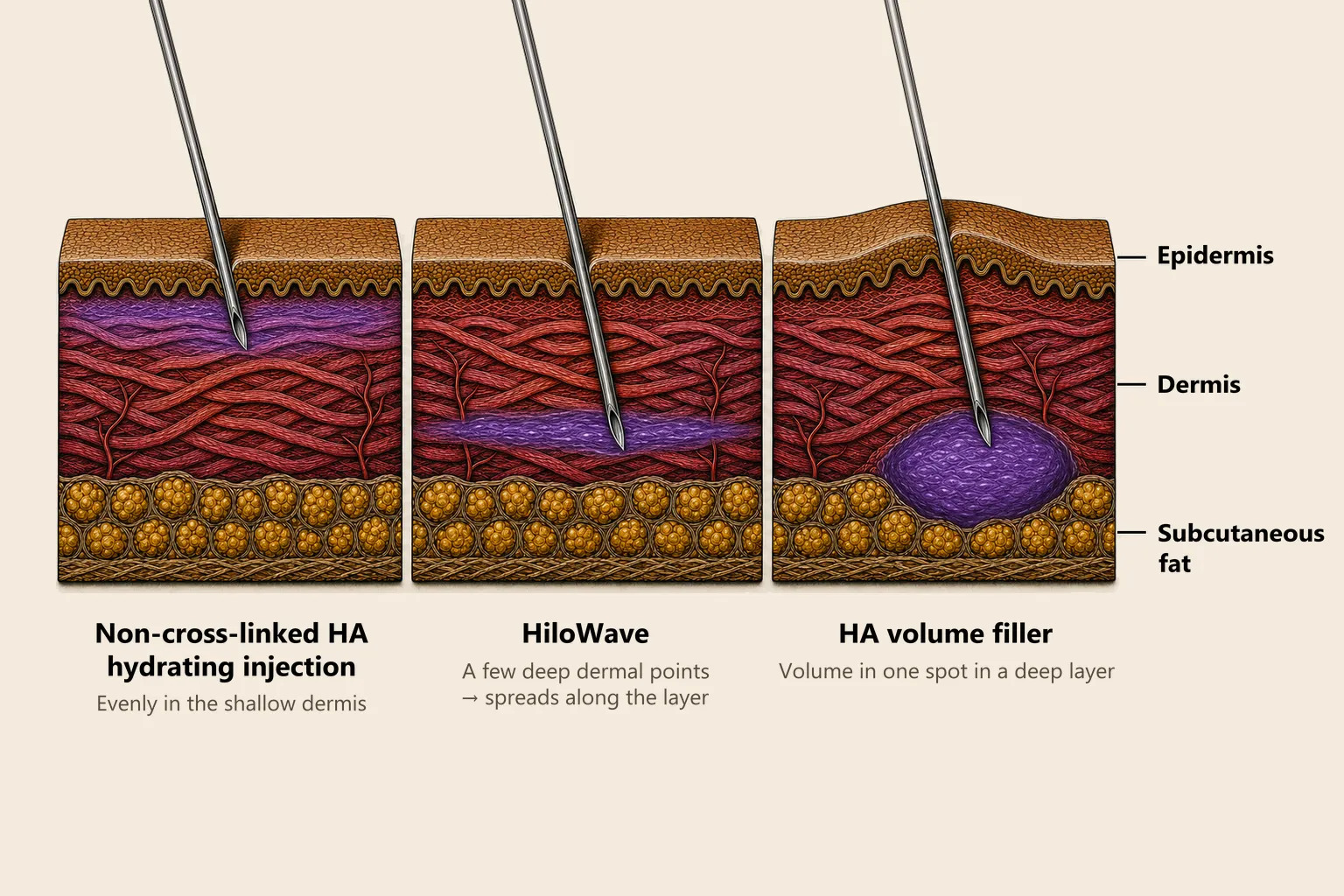
▲ All three are the same hyaluronic acid, so they're drawn in the same color; what differs is how deep it goes and how it spreads. This is not a matter of better or worse but of purpose and injection method
Limitations: Localized volume or contour correction like a filler isn't what it aims for, and it doesn't lift sagging tissue itself.
How It's Done
1. 3D skin analysis and consultation 3D MetaVu imaging photographs your skin texture, pores, fine lines, and color under different light sources, and your facial contours and left–right balance in 3D. We review the results together to decide on the option and treatment area.
2. Your physician's name and a final check Before treatment, we let you know the name of the physician treating you, and that physician personally reviews your assessment results and the condition of your face and skin.
3. Treatment After the genuine product is opened in front of you, treatment proceeds under local anesthesia, so there's no waiting time for numbing. The product is injected by hand deep in the dermis at the set points.
What you feel is a sting as the needle goes in, and a slight dull, pressing ache as the product goes in. If pain and tension are a concern, you can add Non-Sedation Gas Anesthesia (Air Nox) as an option — you breathe in a mix of oxygen and nitrous oxide that reduces pain and tension while you stay conscious and responsive.
Recovery, Expected Reactions, and Precautions
Recovery: Because the product goes in at only a few set points, there tend to be fewer injection marks to begin with. Marks, redness, and swelling appear at the injection sites and then settle, and bruising may occur where a fine blood vessel was touched (for how long these last, see the HiloWave at a Glance table above). Don't press or rub the injection sites. Other reactions are uncommon, but everyone responds differently — if a reaction lasts longer than expected or becomes more noticeable, contact us and we'll check it with you.
Daily life after treatment: The tiny openings left by the needle need time to close, so a gentle water-only rinse can start 3–4 hours after treatment, and washing with a foaming cleanser and wearing makeup can start gently the next morning. For 3 days to 1 week, avoid saunas, jjimjilbang (Korean bathhouse saunas), and strenuous exercise that makes you sweat. Strong heat and sweat can irritate the widened blood vessels and make redness and swelling worse.
Rare but possible effects: As with any injectable product, the product can, in rare cases, enter a blood vessel and block it. If pain keeps getting worse after treatment, or the skin turns white or a dark, dusky red, contact us right away.
When we do not perform this treatment
- Pregnancy, possible pregnancy, or breastfeeding
When we postpone treatment
- Inflammation in the treatment area (including inflamed acne), or a herpes flare-up (cold sores around the mouth) — we proceed once it has settled
What to tell us in advance
- A history of hypersensitivity reactions to ingredients or of anaphylaxis (a sudden, severe whole-body allergic reaction), or an allergy to lidocaine or other anesthetics — because the treatment is done under local anesthesia
- Taking aspirin or anticoagulants (medications that keep blood from clotting easily) — you may bruise more easily
- Keloid-prone skin (scars that heal raised and thickened)
- Other recent treatments — if you've had filler, another skin booster, laser, lifting, or similar treatments, or have heat-based lifting coming up, let us know at your consultation. HiloWave settles by spreading gradually from deep in the dermis, and strong heat reaching it before it has settled can alter the HA, so we plan the timing of the two together
- Whether to have another treatment on the same day is decided together after your assessment
How PECHE Clinic Does It
We follow standards built from more than 90,000 treatments performed across the clinic. From more than 90,000 treatments performed across PECHE Clinic, we have built standards for each area and skin condition, and the same standards apply whichever PECHE physician treats you. With HiloWave, those standards set how much goes into each injection point and how far it covers.
A physician personally reviews your assessment results before we begin. A physician reviews your 3D MetaVu imaging results and checks your face and skin once more just before treatment. That's why, even with the same HiloWave, the amount and the area covered differ from person to person. Before we begin, we tell you the name of the physician who will treat you.
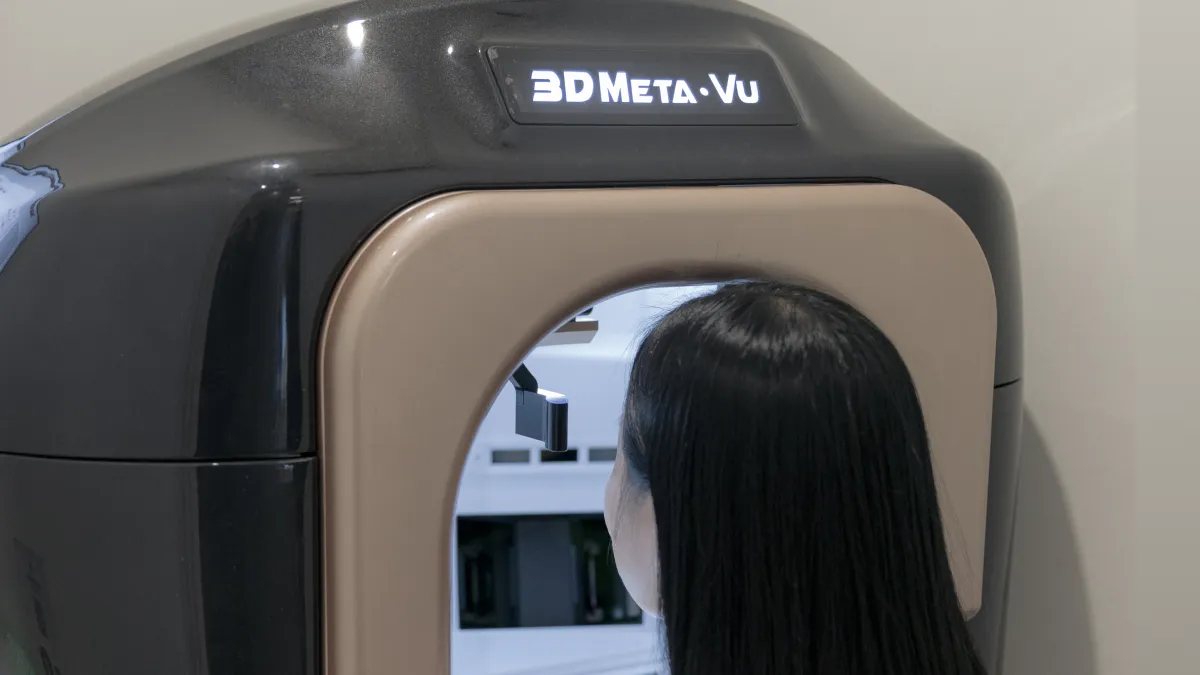
▲ We review your imaging results together
We open genuine products in front of you and keep the preparation area in view behind a full glass wall. The genuine product used in your treatment is opened in front of you. Treatment preparation takes place in an open-kitchen-style preparation area behind a full glass wall, so from the waiting area you can see the genuine product, the preparation process, and hygiene practices for yourself.

▲ The treatment preparation area, seen through the glass wall from the waiting area
We recommend only the treatments your assessment results call for. We tell you up front what this treatment can do (deep-seated dryness, skin texture, and a subtle filling of areas that looked hollow) and what it can't (building up one area with volume, or lifting sagging tissue). You're welcome to come in just for a consultation and leave.
Pricing
Prices for HiloWave are published on our website for every product option. Whichever country you're visiting from and whichever channel you book through, the price is the same as the one published on our website — so there's no need to compare prices from one booking channel to another. Making sure you can come in trusting the price you checked in advance — that is the trust PECHE Clinic puts first.
HiloWave is offered as HiloWave 2cc and HiloWave 4cc, and the option you need is decided together after your assessment.
Location and Clinic Hours
PECHE Clinic 3F, 364 Gangnam-daero, Gangnam-gu, Seoul Right outside Gangnam Station Exit 4 — the building entrance is right in front of you as you come out
Clinic Hours (Korea Standard Time, KST)
- Monday–Friday: 10:30 AM – 9:00 PM
- Saturday, Sunday, and public holidays: 10:00 AM – 6:00 PM
- No lunch break — we see patients straight through midday
FAQ
Q1. Who performs the HiloWave treatment? A: Before treatment, we first let you know the name of the physician treating you, and that physician personally reviews your assessment results and the condition of your face and skin before starting. The amount injected at each point follows standards built from more than 90,000 treatments performed across the clinic, so the same standards apply even if a different physician treats you.
Q2. The name includes "wave" — is it a device-based treatment? A: No. The "wave" in the product name has nothing to do with technologies such as sound waves or ultrasound. HiloWave is a skin booster in which hyaluronic acid is injected, and there is no step where a device delivers energy.
Q3. Sagging is my concern — does it lift the skin the way a lifting treatment does? A: It isn't a treatment that lifts sagging tissue itself. The sagging HiloWave addresses is skin that looks slack because it has grown thin and lost moisture; as the dermis fills out with water, the skin looks firmer. If the facial contour itself has dropped, the lifting family is the right fit, and if you have both concerns, we decide together based on your assessment results.
Q4. I've heard it builds collagen — is it the same type of treatment as collagen-stimulating injections? A: No. The main ingredient is hyaluronic acid, and it contains no particles. Particle-type collagen-stimulating injections work by the body reacting to the injected particles so that collagen forms around them. With HiloWave, the hyaluronic acid that has spread through the dermis holds onto water while also continuing to stimulate collagen production. That's why it's classed in the hyaluronic acid hydration-and-texture group.
Q5. How do HiloWave 2cc and 4cc differ? A: They're the same product; the difference is the amount injected in one session. A cc is a unit for measuring the product's volume (1cc = 1mL). The standard for one full-face session is 2cc, and because the amount needed depends on the area being treated and your skin's condition, it's decided together after your assessment.