THE CHAEUM Hyaluronic Acid Filler — PECHE Clinic, Gangnam Station
A body filler that fills the shoulder line and the hollow at the side of the hips (hip dips) with cross-linked hyaluronic acid gel placed in the fat layer beneath the skin · Made by Hugel, a Korean manufacturer · Right outside Gangnam Station Exit 4
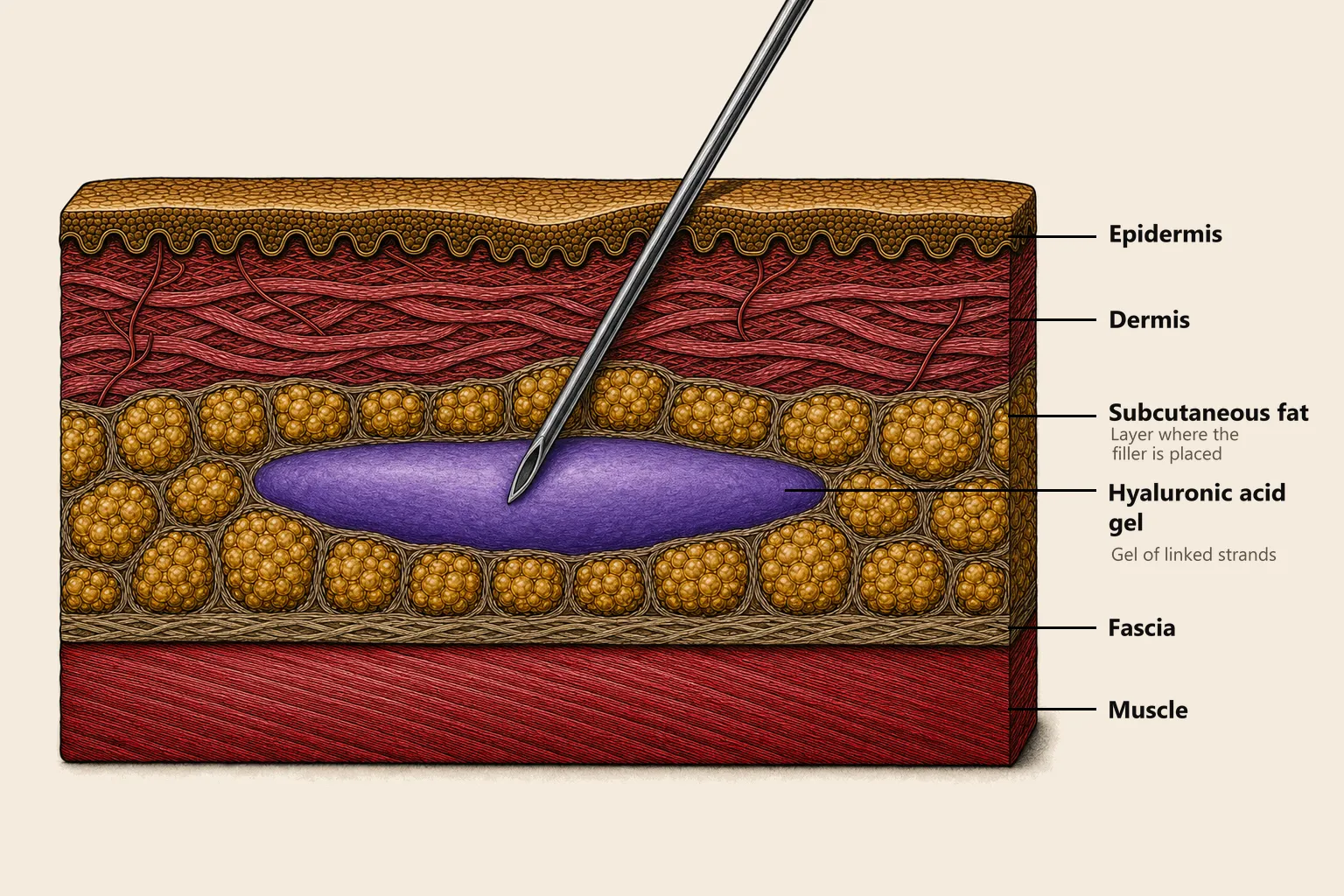
THE CHAEUM Hyaluronic Acid Filler
THE CHAEUM Hyaluronic Acid Filler is a treatment that places THE CHAEUM, a hyaluronic acid (HA) filler made by the Korean manufacturer Hugel, not in the face but along the shoulder line and in the hip dips (the area around the spot where the top of the thighbone juts out at the side of the pelvis, where the side contour looks indented). It goes in 10cc at a time to fill body contours that look sunken.
Put simply, it uses the same type of filler used in the face, placed in a larger amount into sunken areas across the broader surfaces of the body. It's done by injection without incisions, volume appears right after it goes in, and if needed, it can be dissolved to reverse it.
▲ The filler being placed in the fat layer beneath the skin — the purple is a color added to make the injected hyaluronic acid gel easy to see
THE CHAEUM Hyaluronic Acid Filler at a Glance
| Item | Details |
|---|---|
| Category | Hyaluronic acid (HA) filler · body volume |
| Manufacturer | Hugel (Korea) |
| Ingredient | Cross-linked hyaluronic acid — hyaluronic acid whose strands are linked to one another to form a gel |
| Injection layer | The fat layer beneath the skin (subcutaneous) |
| Treatment areas | Shoulder line · hip dips (the hollow at the side of the hips) |
| Available options | THE CHAEUM Hyaluronic Acid Filler Shoulder or Hip Dips 10cc |
| Numbing | Local anesthesia (numbs only the area being treated) · no separate wait for numbing · more numbing can be added depending on the situation |
| When results show | Volume appears right after injection → the actual shape is judged 2–4 weeks later, once the swelling has gone down and the gel has settled |
| How long it lasts | Not permanent · the body gradually breaks it down and absorbs it, and absorption tends to be faster in areas with more movement and pressure · varies from person to person |
| Reversibility | Can be broken down and reversed with a dissolving injection (hyaluronidase) |
| Approved uses | Body volume is a use outside the purposes HA fillers are approved for (see "Differences from Other Treatments and Limitations" below) |
| Recovery (typical range) | Swelling about 3–7 days · bruising, if it occurs, fades over 1–2 weeks |
How It Works
1. Cross-linking makes a gel that stays in place longer Hyaluronic acid is a substance naturally present in the skin, where it holds water. Left as it is, it flows like a liquid, so its strands are linked to one another (cross-linking) to form a gel. That's why it isn't easily dissolved by the body's enzymes and holds its shape for several months or longer.
2. The gel takes up the sunken space and pushes it up A large amount of gel is placed at one time into sunken spaces of the body (the shoulders, the sides of the hips), where the skin is thick and the area is broad. As the gel takes up that space, it pushes the hollowed surface outward, so the contour flows smoothly.
3. It is gradually absorbed over time The injected gel is gradually broken down and absorbed by the body's own enzyme (hyaluronidase). That's why the result isn't permanent.
Expected Results and Why
| Expected result | Why |
|---|---|
| The shoulder line and the contour at the side of the hips flow smoothly | The gel physically fills the hollowed space |
| Volume you can see on the day of treatment | The gel itself creates volume |
| Done without incisions | It's placed by injection, not surgery |
The look right after treatment includes swelling. The shape once the swelling has gone down and the gel has settled is closer to the actual result, and at that point it's common to review how it looks and decide whether to top up any shortfall.
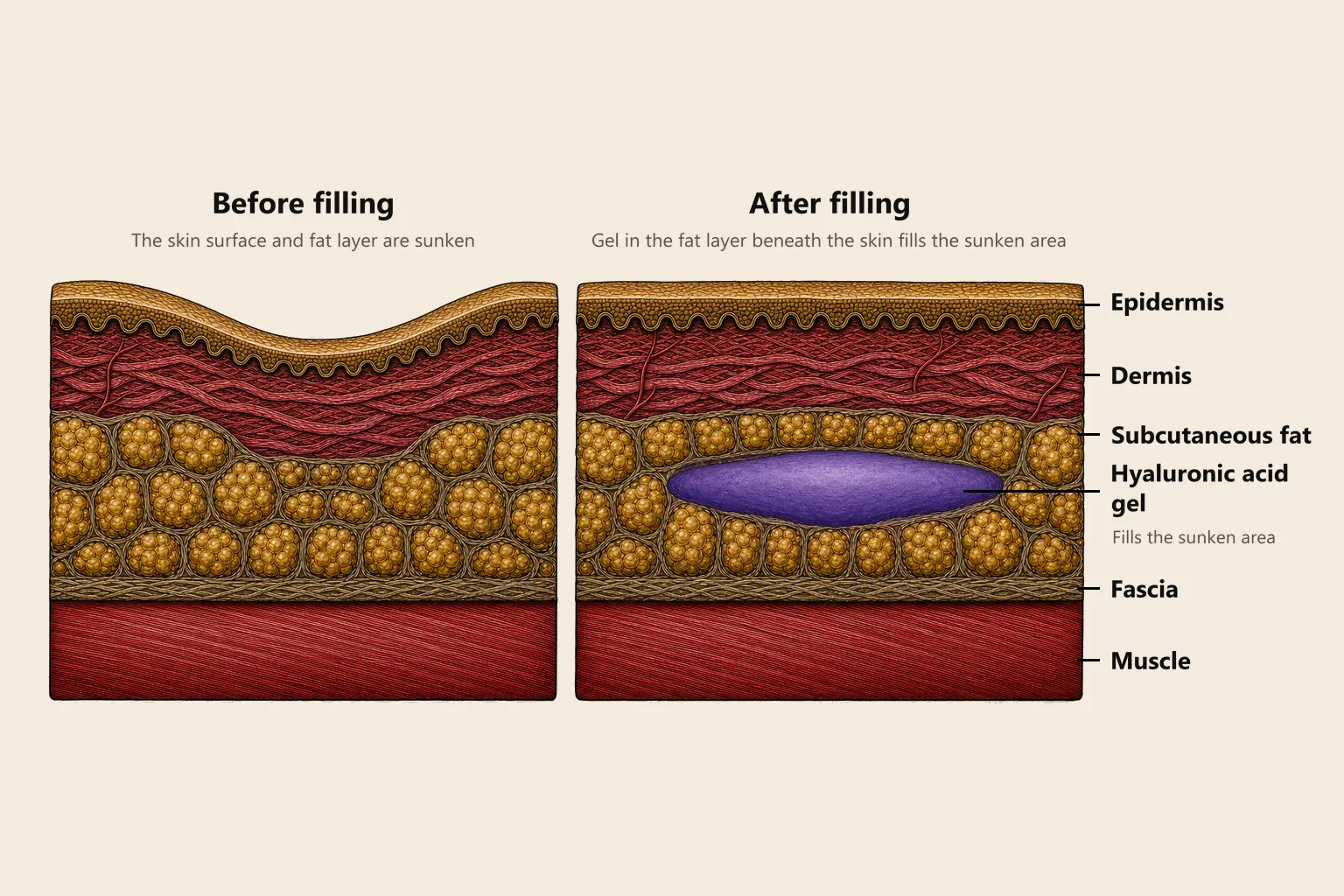
▲ Left: before filling · Right: after filling — how much the area fills and how long it lasts vary from person to person
When to Consider It
- Your shoulder line looks hollow or droopy, so the shoulder contour isn't smooth
- The side of your hips dips inward (hip dips), so the side contour looks broken in the middle
- The hollow is relatively confined to one spot and isn't deep
- You want to fill the contour with injections rather than surgery
When a different approach may be the right fit
- You want to change your body shape substantially over a wide area — that exceeds the amount filler can handle
- The difference in contour comes from muscle mass or bone structure itself — filler can't change muscle mass or bone structure
Differences from Other Treatments and Limitations
| Compared approach | What they share | How they differ |
|---|---|---|
| HA filler placed in the face | The same cross-linked hyaluronic acid gel creates volume where it's placed | The body has a broader surface to fill, so the amount used is several to dozens of times that used in the face |
| Surgery (fat grafting · implants) | Both fill sunken areas to shape the contour | Filler is done by injection without incisions and can be dissolved to reverse it, but the body absorbs it, so it has to be repeated. Fat grafting, which moves your own fat, lasts a long time once the transferred fat settles in and survives (engraftment), but how well it settles varies from person to person, and it involves a procedure to harvest the fat |
This is not a matter of better or worse but of a different approach.
Limitations: It isn't permanent, so it's absorbed over time. Differences in muscle mass or bone structure and large changes in body shape are as described above under "When a different approach may be the right fit."
Approved uses: Body volume, such as in the shoulders or buttocks, is not among the purposes HA fillers are approved for (their approved indications), so both in Korea and in other countries it is off-label use — use outside the approved indications, based on a physician's judgment. The U.S. FDA advises against injecting fillers for body contouring purposes such as buttock augmentation. This means the effectiveness and safety of placing them in the body have not been separately confirmed through the approval process.
How It's Done
1. Assessment and consultation A physician examines in person how sunken your shoulders or the sides of your hips are and the left–right balance, looks together with you at whether the sunken look comes from a lack of volume, and then decides which areas to fill.
2. Your physician's name and a final check Before treatment, we let you know the name of the physician treating you, and that physician checks your assessment results and the treatment area once more.
3. Treatment The genuine product is opened in front of you, and treatment is done under local anesthesia. There's no separate wait for numbing, and more numbing can be added depending on the situation. The filler is placed in portions into the fat layer beneath the skin, with the amount adjusted while checking the left–right balance.
What you feel is a sting as the needle goes in. After that, rather than pain, what you mainly feel is a heavy sense of pressure and of something foreign pushing in beneath the skin.
Recovery, Expected Reactions, and Precautions
Recovery: Swelling, bruising, redness, and tenderness when pressed can occur where the filler was placed, and most of these settle down over time (see the table above for how long). Other reactions are uncommon, but everyone responds differently — if a reaction lasts longer than expected or becomes more noticeable, contact us and we'll check it with you.
Aftercare instructions
- For 1–2 weeks, avoid saunas, strenuous exercise, and anything that presses hard on the treated area (vigorous massage, lying on the treated side for a long time, tight clothing) — the shoulders and the sides of the hips get pressed every time you sit, lie down, or get dressed, so this keeps the shape from changing before the gel has settled
Rare but possible effects
- Although rare, a risk shared by all injection treatments is that the product can enter a blood vessel and block it. If pain keeps getting worse after treatment, or the skin turns white or a dark, dusky red, contact us right away.
- The filler moving from where it was placed to another area (migration), permanent hard lumps (nodules), and infection are rare risks, but they call for more attention the larger the amount placed (per U.S. FDA guidance).
When we do not perform this treatment
- Pregnancy, possible pregnancy, or breastfeeding
- A past sudden, severe whole-body allergic reaction (anaphylaxis), or a history of multiple severe allergies
- Allergy to anesthetics (such as lidocaine) — because the treatment is done under local anesthesia
- Allergy to bacterial proteins in the filler's raw material (gram-positive bacterial proteins) — the hyaluronic acid raw material is made by bacterial fermentation, so very small amounts of those proteins may remain
When we postpone treatment
- Inflammation or infection where the treatment will be done (acne, a rash, hives, and the like) — we proceed once it has settled
What to tell us in advance
- Medications that increase bleeding, such as aspirin, anti-inflammatory pain relievers (NSAIDs), or warfarin — you may have more bruising and bleeding
- Keloid-prone skin (a tendency for wounds to heal raised and larger than the original wound) — safety in people with this tendency has not been studied
- Currently receiving treatment that deliberately lowers the immune response (immunosuppressive therapy) — HA filler manufacturers' instructions list this as a situation requiring caution
- Filler received in the past year (including in the face), or earlier filler that still remains — some HA filler manufacturers limit the amount placed in one year to 20 mL or less per 60 kg of body weight. This is because the safety of larger amounts has not been established, and a body treatment that places 10cc (10 mL) at one time takes up a substantial part of that limit
- Other recent treatments — if you've had body botulinum toxin injections, fat-reduction treatments, heat-based treatments, or similar treatments, let us know at your consultation
- Whether to have another treatment on the same day is decided together after your assessment
How PECHE Clinic Does It
We follow standards built from more than 90,000 treatments performed across the clinic. From more than 90,000 treatments performed across PECHE Clinic, we have built standards for each area and skin condition, and the same standards apply whichever PECHE physician treats you. With THE CHAEUM Hyaluronic Acid Filler, those standards set the injection depth and how the amount is divided between the left and right sides.
A physician examines the treatment area in person before we begin. A physician examines the line of your shoulders and the sides of your hips in person, and looks again just before treatment. That's why, even with the same 10cc, where the filler goes and how much goes on each side differ from person to person. Before we begin, we tell you the name of the physician who will treat you.
We open genuine products in front of you and keep the preparation area in view behind a full glass wall. The genuine product is opened in front of you. Treatment preparation takes place in an open-kitchen-style preparation area behind a full glass wall, so from the waiting area you can see the genuine product, the preparation process, and hygiene practices for yourself.

▲ The treatment preparation area, seen through the glass wall from the waiting area
We recommend only the treatments your assessment results call for. We tell you up front what this treatment can do (filling a hollow confined to one area so the contour connects) and what it can't (differences in muscle mass or bone structure, large changes in body shape). You're welcome to come in just for a consultation and leave.
Pricing
Prices for THE CHAEUM Hyaluronic Acid Filler are published on our website for every product option. Whichever country you're visiting from and whichever channel you book through, the price is the same as the one published on our website — so there's no need to compare prices from one booking channel to another. Making sure you can come in trusting the price you checked in advance — that is the trust PECHE Clinic puts first.
It is offered as THE CHAEUM Hyaluronic Acid Filler Shoulder or Hip Dips 10cc, and whether to fill the shoulders or the hip dips is decided together after your assessment.
Location and Clinic Hours
PECHE Clinic 3F, 364 Gangnam-daero, Gangnam-gu, Seoul Right outside Gangnam Station Exit 4 — the building entrance is right in front of you as you come out
Clinic Hours (Korea Standard Time, KST)
- Monday–Friday: 10:30 AM – 9:00 PM
- Saturday, Sunday, and public holidays: 10:00 AM – 6:00 PM
- No lunch break — we see patients straight through midday
FAQ
Q1. Who performs THE CHAEUM Hyaluronic Acid Filler treatment? A: Before treatment, we first let you know the name of the physician treating you, and that physician personally reviews your assessment results and the treatment area before starting. The injection depth and how the amount is divided between the left and right sides follow standards built from more than 90,000 treatments performed across the clinic, so the same standards apply even if a different physician treats you.
Q2. It's a Korean-made filler — is there a quality difference compared with imported fillers? A: The hyaluronic acid raw material and its basic properties are regarded as having risen to a similar level in Korean-made and imported fillers, without a large gap. Where they differ is in each company's patented cross-linking technology and in how many years of long-term clinical data have been built up. That's why it's more accurate to choose by the properties the area needs than by the country of origin.
Q3. If it can be dissolved, does that mean even a large amount is easy to reverse? A: It can be reversed, but it's hard to call it easy. The more that was placed, the more is needed to dissolve it, and it may not all dissolve at once, so it may need to be dissolved over several sessions. That's why the amount to place is decided carefully from the start.
Q4. Hip dips get pressed every time I sit — does that affect how long the filler lasts? A: Yes, it does. Absorption of the gel tends to be faster in areas with more movement and pressure, so it's hard to give how long it lasts as a single number. In particular, before the gel has settled, strong pressure can change its shape, so it's a good idea to avoid positions that press on the area for a long time right after treatment.
Q5. Can I also get facial filler with THE CHAEUM? A: At PECHE Clinic, THE CHAEUM is offered only for the body — the shoulders and hip dips. The face is treated with other fillers; because each area needs a different firmness and a different ability to hold its shape, which product suits you is decided together during your assessment.