Temporalis Botox — PECHE Clinic, Gangnam Station
A muscle injection that reduces the bulk of the chewing muscle covering your temples, softening temples that bulge out to the sides · 50-unit configuration · Right outside Gangnam Station Exit 4
Temporalis Botox
Temporalis Botox is a treatment that injects botulinum toxin (a medication made by purifying a protein produced by botulinum bacteria) into the temporalis — the chewing muscle that covers your temples — to reduce the muscle's bulk and soften the look of temples that bulge out to the sides. PECHE Clinic uses four products for this treatment: Newlux, Coretox, Xeomin, and Allergan.
Put simply, it's an injection that makes the chewing muscle at your temples work less, so that its bulk decreases.
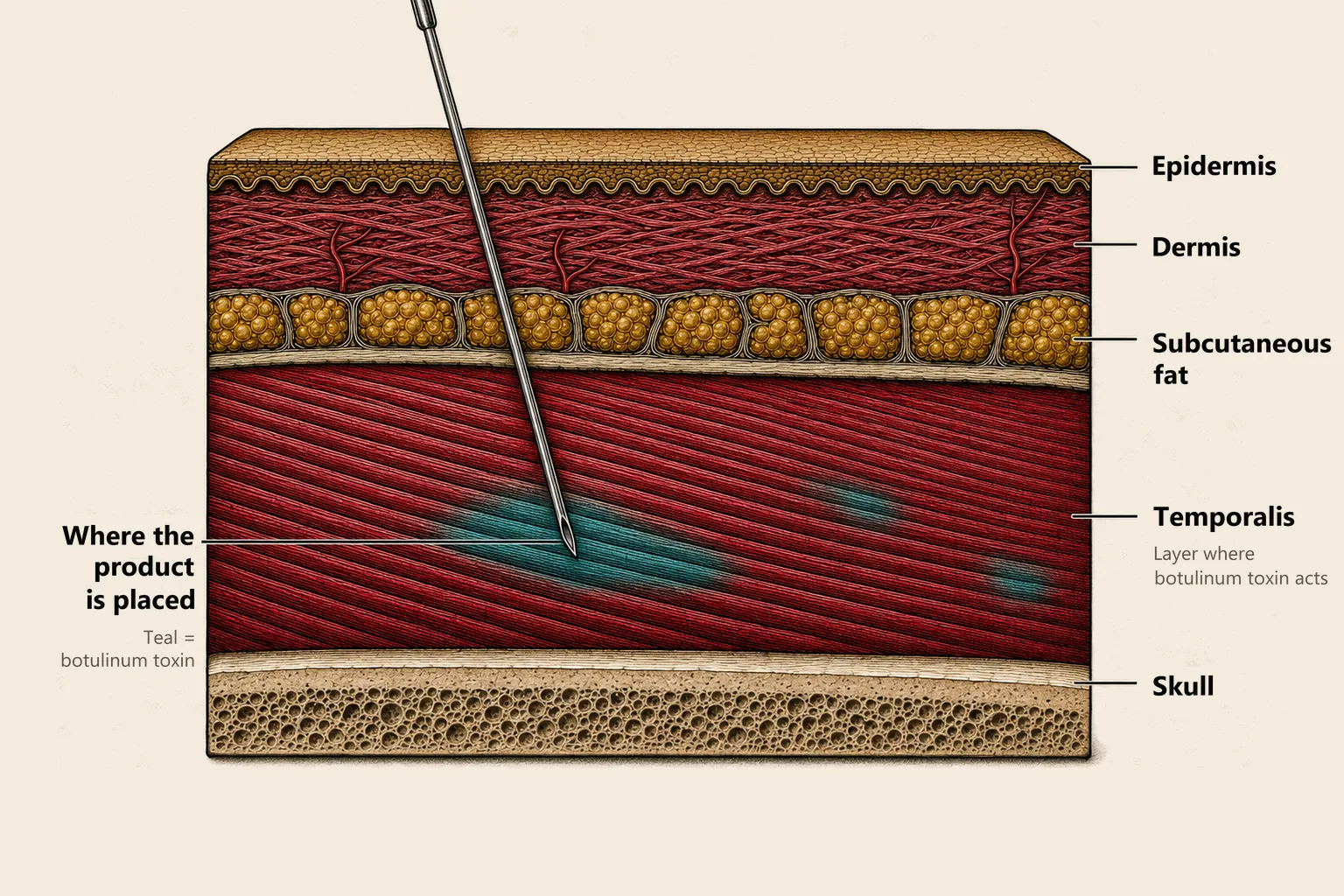
▲ The product (teal) is placed inside the thick temporalis covering the skull, divided across several points
Temporalis Botox at a Glance
| Item | Details |
|---|---|
| Target layer | The temporalis (a deep muscle), beneath the skin and subcutaneous fat, lying directly over the skull |
| Treatment area | Temples |
| Configuration | 50 units (50U) for all four products |
| Numbing | Ice roller for about 5 minutes |
| When results show | Chewing force starts to decrease within about 2 weeks → the temple contour changes gradually over weeks to months |
| How long it lasts | Varies by person · how long it lasts and the repeat interval (5–6 months or more) are separate things |
| Repeat interval | 5–6 months or longer |
A unit is a measure of the product's potency. Each product measures it differently, so unit numbers can be compared only within the same product.
How It Works
The temporalis is a fan-shaped muscle. It begins in a fan shape at the hollow of the temple and at the tough sheet of tissue covering the muscle (the temporal fascia), passes under the arch-shaped bone that runs from the cheekbone toward the ear (the zygomatic arch), and attaches to a projection that rises at the front top of the lower jawbone. Its front fibers run almost vertically and raise the lower jaw (closing the mouth), while its back fibers run almost horizontally and pull the lower jaw backward. When this muscle becomes enlarged, the temple area can bulge out to the sides, making the head and upper face look wider.
1. It temporarily blocks the signal nerves send to muscles The moment you go to bite down on your molars, the nerve ending releases acetylcholine (a chemical that carries the "move" message to the muscle), and the muscle contracts. Botulinum toxin doesn't paralyze the muscle or cut the nerve — it temporarily blocks the release of this chemical.
2. While the muscle is used less, it shrinks in size A muscle that contracts with less force gets used less, and a muscle that isn't used becomes thinner. It's the same principle as the muscles of an arm getting thinner after a long time in a cast.
3. So the change in temple contour appears later, over several weeks Muscle doesn't shrink all at once — it thins little by little, so chewing force decreases first and the change in contour shows afterward. A 2025 review in an international journal, which pooled studies on the chewing muscle at the corner of the lower jaw (the masseter) — a muscle that shrinks by the same principle — also found that the strength of that muscle decreased the most at around 10–12 weeks, and that its thickness was reduced when measured at around 3 months. As the nerve grows new branches and reconnects with the muscle, chewing force and bulk also gradually return.
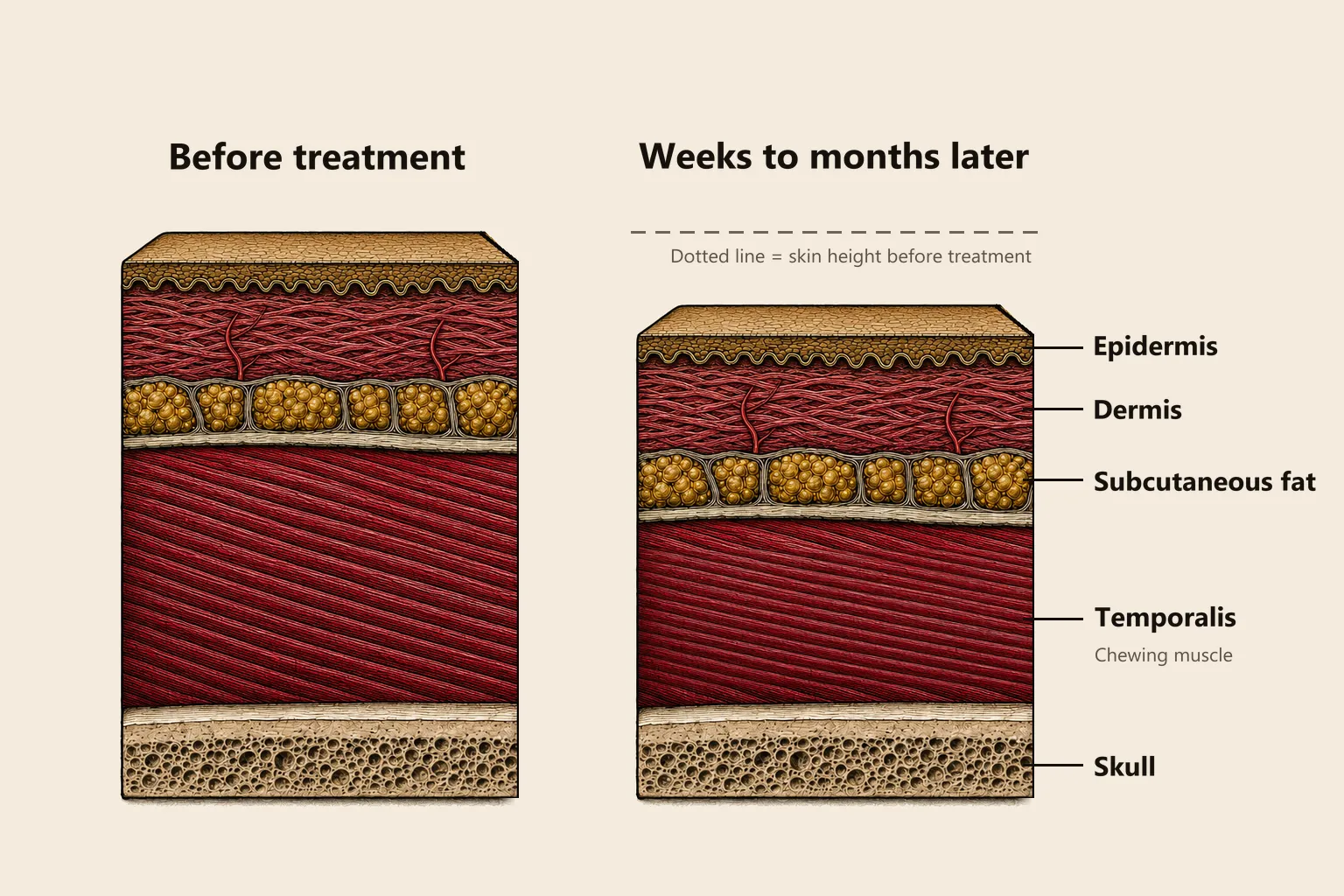
▲ What decreases is the thickness of the temporalis — the skull stays as it is (dotted line = skin height before treatment)
Expected Results and Why
The temples bulge less, so the width of the upper face looks more balanced. This is because the bulk of the temporalis covering the temples itself decreases. In one case report of an enlarged temporalis, imaging after two treatments confirmed that the muscle's bulk had decreased, and the temple contour also returned to a normal shape.
How much changes depends on how developed the muscle is. When the effect wears off, you simply return to how you were before treatment — the muscle doesn't become larger than it was before. A muscle that has been treated over several rounds may not grow back to its former size, or may regain its bulk more slowly. This is thought to be because, with repeated treatment, the muscle may not rebuild all the way each time — and it isn't a side effect but a change toward the result lasting longer.
When to Consider It
- Your temples bulge out to the sides, making your head and upper face look wide (when the cause is a well-developed temporalis)
- You have a teeth-clenching habit, and your temples look like they bulge
When a different approach may be the right fit
- Temples that look hollow — reducing the muscle can make them look more hollow, so an approach that fills the area may be the right fit
- A wide look caused by the shape of the skull — an injection doesn't change the shape of the bone
Differences from Other Treatments and Limitations
| Compared approach | How they differ |
|---|---|
| Filler that fills hollow temples | Temporalis Botox reduces the bulk of a muscle that has developed and bulges, while filler adds volume where the area has sunken. |
| An approach that targets the chewing muscle at the corner of the lower jaw (the masseter) | Both are chewing muscles that raise the lower jaw, but they sit in different places. This treatment addresses the muscle at the temples. |
Limitations: What changes is the bulk of the muscle covering the temples, so if muscle isn't the cause, very little changes.
How It's Done
1. 3D skin analysis and consultation 3D MetaVu imaging captures your facial contours and left–right balance, and we review the results together to decide on the product you'll receive.
2. Your physician's name and a final check Before treatment, we let you know the name of the physician treating you, and that physician personally reviews your assessment results and the condition of your face and skin.
3. Muscle check, mapping, and marking You bite down on your molars and release a few times while we check how far the muscle swells up at your temples, and we mark the points where the product will be placed.
4. Numbing An ice roller cools the area for about 5 minutes to dull the sensation.
5. Injection A fine needle places the product in divided amounts at several points across the temporalis. Because this goes into a deep muscle, you'll feel a light sting as the needle goes in, and as the product goes into the muscle you'll feel a heavy, tingling ache deep inside.
Recovery, Expected Reactions, and Precautions
Recovery: Injection marks settle within 1–2 hours, and bruising, if it occurs, fades within 3–7 days. You can wash your face and wear makeup starting 2–3 hours after treatment.
On the day of treatment: Don't lie down for 4–6 hours, and avoid saunas, strenuous exercise, and massaging the treated area. This is to reduce the chance of the product spreading into muscles it wasn't meant to reach.
When chewing: For the first 1–2 weeks, you may feel a loss of strength or a tingling sensation when chewing tough foods — this is a normal reaction. Other muscles are also used in chewing, so you usually get used to it as you go about daily life.
Temple area: This is an anatomically complex area, so the need for a standardized injection technique is emphasized.
Although rare, a risk shared by all botulinum toxin products is that the effect can spread beyond where it was injected, causing weakness throughout the body, double vision, drooping eyelids, or difficulty swallowing, speaking, or breathing. These symptoms can appear anywhere from a few hours to a few weeks after treatment — if you notice any of them, contact the clinic or seek medical care right away.
Other reactions are uncommon, but everyone responds differently — if a reaction lasts longer than expected or becomes more noticeable, contact us and we'll check it with you.
When we do not perform this treatment
- A past allergic reaction to botulinum toxin or to an ingredient of the product to be used (such as human albumin)
- Pregnancy, possible pregnancy, or breastfeeding
When we postpone treatment
- Infection or inflammation at the injection site — we proceed once it has settled
What to tell us in advance
- Conditions in which the nerves' ability to move the muscles is already weakened, such as myasthenia gravis or ALS (Lou Gehrig's disease) — the risk of symptoms such as difficulty swallowing or breathing increases
- Taking muscle relaxants or certain antibiotics — the product's effect may become too strong
- Taking aspirin or anticoagulants (medications that keep blood from clotting easily) — you may bruise more easily
- Botulinum toxin received elsewhere recently — tell us when, which product, and how much (we need this to set the interval and the dose)
- Other recent treatments — if you've had filler, a skin booster, lifting, or similar treatments, let us know at your consultation
- Whether to have another treatment on the same day is decided together after your assessment
How PECHE Clinic Does It
We follow standards built from more than 90,000 treatments performed across the clinic. From more than 90,000 treatments performed across PECHE Clinic, we have built standards for each area and skin condition, and the same standards apply whichever PECHE physician treats you. For Temporalis Botox, which points across this broad, fan-shaped muscle receive the product, and how much goes to each, are set according to those standards. You're welcome to come in just for a consultation and leave.
A physician personally reviews your assessment results before we begin. A physician reviews the results captured with 3D MetaVu and takes one more look at your face and skin right before treatment. That's why, even with the same Temporalis Botox, the injection points and amounts differ from person to person. We let you know by name who will treat you before we begin.
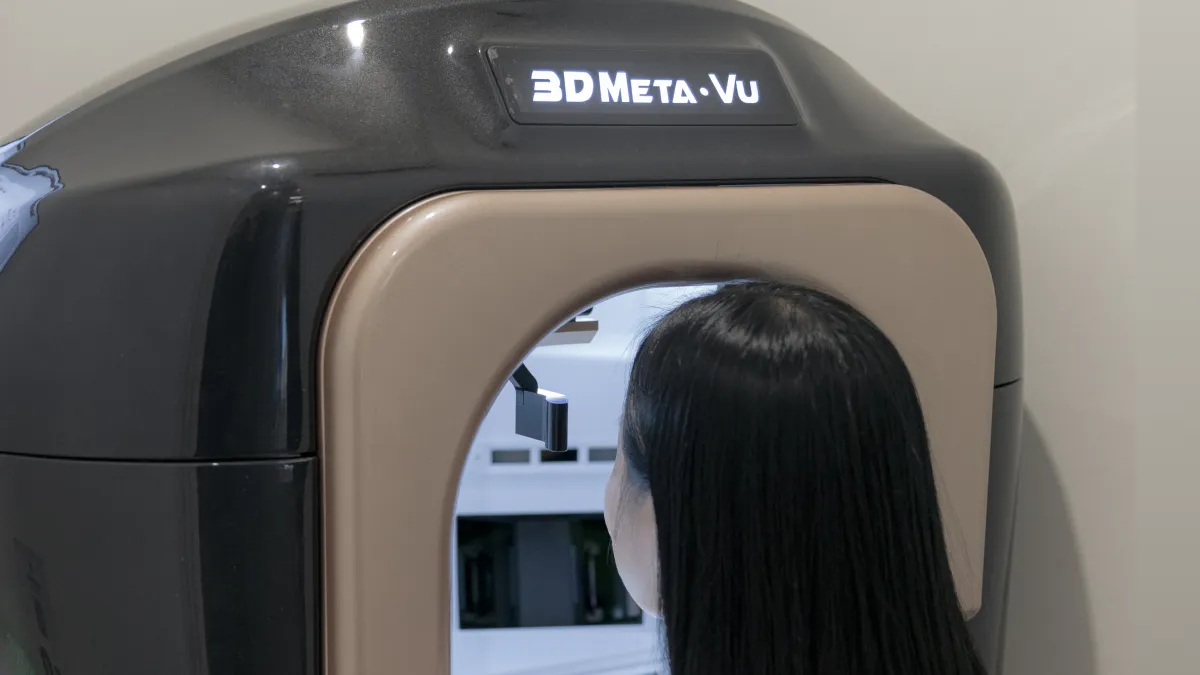
▲ We review your imaging results together
We offer four botulinum toxin products. Botulinum bacteria make the active ingredient — the part that creates the effect — wrapped in other proteins that protect it. That active ingredient is the same in all four products. What differs is whether the wrapping proteins were left in, whether human albumin (a protein naturally present in human blood) was added to help with storage, and the manufacturer and what each product is approved for. These are differences in composition, not in quality.
| Product | Made by | Wrapping proteins | Human albumin |
|---|---|---|---|
| Newlux | Korea · approval held by Numeco (a Medytox affiliate), manufactured by Medytox | Kept | Added |
| Coretox | Korea · Medytox | Removed | Not added (uses a synthetic stabilizer) |
| Xeomin | Germany · Merz | Removed | Added |
| Allergan | USA · AbbVie (which acquired Allergan) | Kept | Added |
When the wrapping proteins enter the body along with the active ingredient, the body can more easily recognize the product as foreign and may form antibodies — and then a later dose of the same amount may not work as well as it once did (known as resistance). This is uncommon, and it is generally understood that products with the wrapping removed may carry a lower chance of it. The factors that raise the risk are repeat injections at short intervals or extra injections to boost the effect, a large amount at one time, and the total amount of protein entering the body — so the principles for prevention are a dose suited to the area and an interval of at least 5–6 months. Products with the wrapping removed include both a Korean-made product (Coretox) and an imported one (Xeomin), so whether the wrapping is removed does not depend on whether a product is Korean-made or imported. If you have had a hypersensitivity reaction to an added ingredient (such as human albumin), products containing that ingredient are not used, so the albumin column is also considered when choosing a product.
We open genuine products in front of you and keep the preparation area in view behind a full glass wall. All four products are stored as a powder and dissolved in saline before use. This is because the product instructions specify that, once dissolved, the product is to be used without being stored for long. The genuine product is opened in front of you, and treatment preparation takes place in an open-kitchen-style preparation area behind a full glass wall, so from the waiting area you can see the genuine product, the dissolving process, and hygiene practices for yourself.

▲ The treatment preparation area, seen through the glass wall from the waiting area
Pricing
Prices for Temporalis Botox are published on our website for every product option. Whichever country you're visiting from and whichever channel you book through, the price is the same as the one published on our website — so there's no need to compare prices from one booking channel to another. Making sure you can come in trusting the price you checked in advance — that is the trust PECHE Clinic puts first.
Temporalis Botox (Korean/Newlux), Temporalis Botox (Korean Premium/Coretox), Temporalis Botox (Imported/Xeomin), and Temporalis Botox (Imported/Allergan), each in a 50-unit configuration, are the options, and we decide together on the option you need after your assessment.
Location and Clinic Hours
PECHE Clinic 3F, 364 Gangnam-daero, Gangnam-gu, Seoul Right outside Gangnam Station Exit 4 — the building entrance is right in front of you as you come out
Clinic Hours (Korea Standard Time, KST)
- Monday–Friday: 10:30 AM – 9:00 PM
- Saturday, Sunday, and public holidays: 10:00 AM – 6:00 PM
- No lunch break — we see patients straight through midday
FAQ
Q1. Who performs Temporalis Botox? A: Before treatment, we first let you know the name of the physician treating you, and that physician personally reviews your assessment results and the condition of your face and skin before starting. The injection points and the amount used follow standards built from more than 90,000 treatments performed across the clinic, so the same standards apply even if a different physician treats you.
Q2. Where can I feel the temporalis muscle? A: Place your fingers on your temples and clench your molars firmly — the muscle that hardens and swells up there is the temporalis. Before treatment, we also have you clench and release like this to check how far it swells, because that range marks the muscle where the product will be divided across several points.
Q3. It's an injection on the side of the head — could the product get inside the head? A: The product is placed into the temporalis, which covers the outside of the skull — this isn't a treatment that places anything inside the skull. Rarely, the effect can spread beyond where it was placed; this applies to botulinum toxin in any area, so please follow the day-of-treatment precautions.
Q4. Why is the repeat interval on the longer side? A: Unlike botulinum toxin for wrinkles, which works by reducing movement, treatments that reduce muscle bulk set the interval by when the shrunken muscle fills back out. Another reason is that repeat injections at short intervals are a risk factor for resistance.
Q5. Will Temporalis Botox make my whole face smaller? A: No. Only the muscle covering the temples decreases, so the size of other areas, such as the jawline or cheeks, isn't changed by this treatment.