Non-Sedation Gas Anesthesia (Air Nox) — PECHE Clinic, Gangnam Station
A blend of oxygen and nitrous oxide breathed through a mouthpiece — you remain conscious while pain and tension ease · An add-on for lifting and skin booster treatments · Right by Gangnam Station Exit 4
Air Nox
Air Nox is not sleep sedation — you do not go under. You breathe a blend of oxygen (O₂) and nitrous oxide (N₂O — the gas often called laughing gas) through a mouthpiece, which eases pain and tension while you remain conscious and responsive. It is a non-sleep pain-control option.
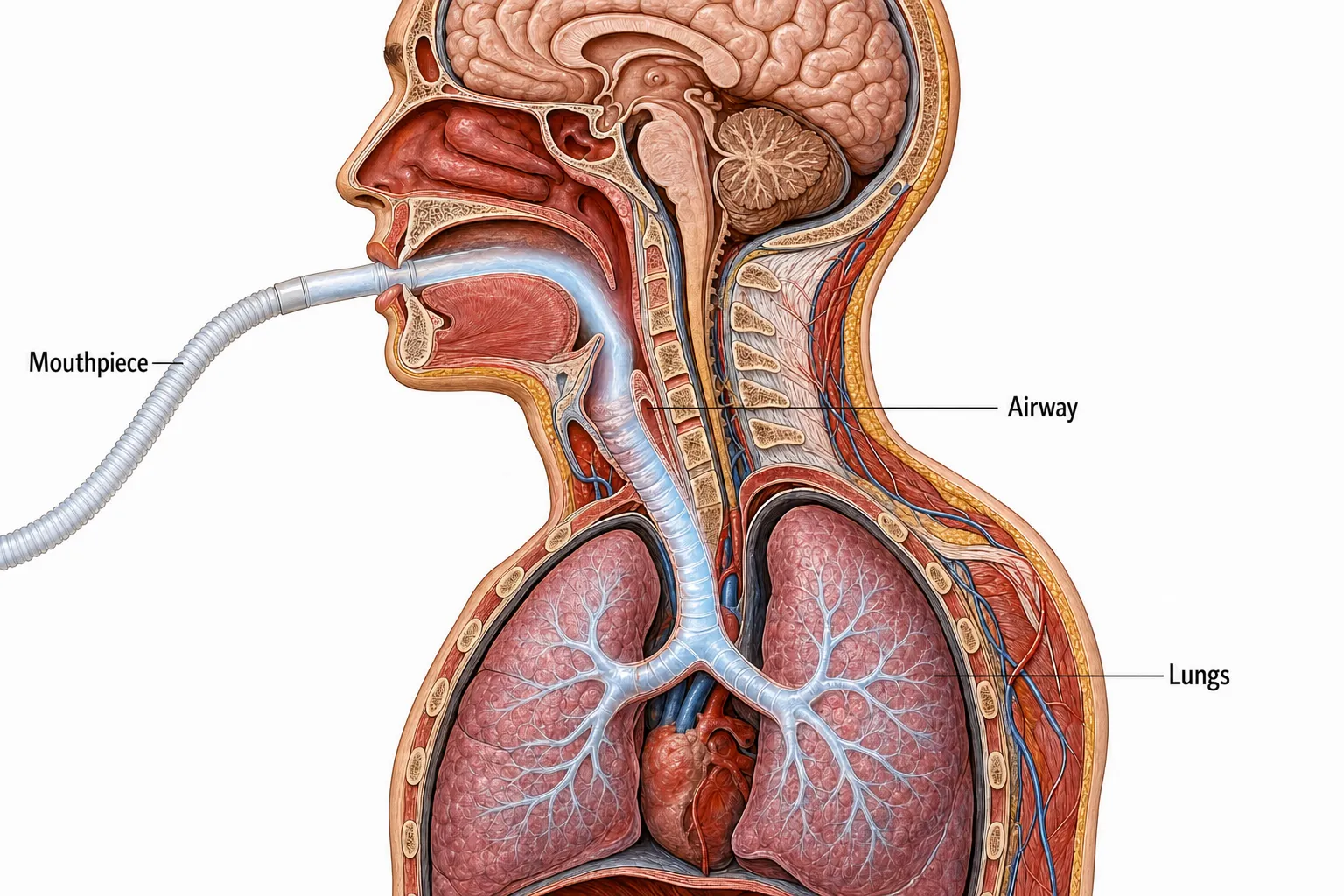
Nitrous oxide barely dissolves in blood, so it doesn't build up in the body. When you breathe it in, it rises quickly from the lungs to the brain, briefly calming the nerves — dulling pain and easing anxiety. The effect begins within seconds and lasts only while you're breathing it. Oxygen is blended in to keep you from running short of oxygen while you inhale. When you stop and breathe oxygen instead, the remaining gas leaves through your breath, and you're usually back to normal within a minute or two.
▲ Gas breathed in through the mouthpiece travels down the airway into the lungs, then passes into the blood
When to Add It
- Fear of needles has made you put off treatment
- The repeated pinpricks of a full-face skin booster feel like too much
- The sharp pulses and deep heat of ultrasound or radiofrequency lifting worry you
- During treatment, the "when will this end" tension is harder than the pain itself
- You'd rather not mix anesthetic into the treatment product — this is inhaled, so it touches nothing in the syringe
How It Differs from Sleep Sedation
| Item | Sleep sedation | Air Nox |
|---|---|---|
| Consciousness | Asleep or heavily sedated | Conscious and responsive — able to communicate with the clinician |
| Pain feedback | Hard to give during treatment | You can flag an uncomfortable spot right away |
| Energy control | No feedback, so intensity is hard to gauge | Adjusted on your feedback — enough to work, without raising the risk of side effects |
| Pain | Little to no sensation | Reduced, but some sensation remains — this is not painless |
| Preparation | Fasting and other prep required | No fasting needed |
| Recovery | Needs separate monitoring and discharge criteria | Stop inhaling, breathe oxygen — usually 1–2 minutes · you leave after we confirm no dizziness or nausea |
Staying conscious keeps your feedback in place. In lifting and skin booster treatments, each area feels different — and that feedback is the information used to adjust intensity. Intensity has to stay in the range where it works without raising the risk of side effects (the effective range), and under sleep sedation that information is hard to get. Sleep sedation also requires its own safety protocols and monitoring — for both reasons, we don't offer it as a standard option. That's not to say sleep sedation is a bad option — for aesthetic treatments, we prefer to keep real-time feedback with you, and that means keeping you conscious.
How It's Done
1. Screening and consent We check for respiratory conditions, a history of collapsed lung, recent ear surgery, possible pregnancy, and past episodes of severe dizziness or nausea, then take your consent.

▲ We first check whether anything applies to you
2. Mouthpiece and inhalation Before the treatment starts, you hold the mouthpiece in your mouth and breathe the gas while we watch how you respond. The clinician selects a concentration suited to your build, breathing volume, and sensitivity, then fine-tunes it while monitoring your breathing — the device adjusts in 1% steps. The goal is a drowsy, loosened feeling without sleep; treatment begins in that state.
3. During treatment We monitor consciousness, breathing, dizziness, and area-by-area pain as we go. If any spot feels uncomfortable, tell us right away.
4. Stopping and recovery The gas is switched off and you breathe pure oxygen to clear what remains. Most people are back to normal within 1–2 minutes; you head home once we've confirmed you're steady on your feet, with no dizziness or nausea.
What It Relieves — and What You'll Still Feel
| Item | Details |
|---|---|
| The feeling | Slightly floaty; pain feels distant and faint rather than close · you stay conscious and can communicate with the clinician |
| What it reduces | The intensity of the pain itself · anxiety and tension about pain · the fatigue of repeated injections · needle fear |
| What remains | The sharp pulse sensation of ultrasound lifting · the deep heat of radiofrequency · the pressure of skin booster injections · the sensation of the needle going in · pain in sensitive areas may remain — this is not painless |
| Effect on your treatment | It's inhaled — nothing mixes into the product or stays on the skin, so it doesn't weaken the energy or the ingredients |
| What it's used with | It does not replace local anesthesia — it works in the brain, not at the treatment site, so it's combined with numbing cream, cooling, and small amounts of local anesthetic that numb the area itself · along with vibration and injection-speed control |
| Recovery | Stop inhaling, breathe oxygen — usually back to normal in 1–2 minutes · no separate recovery room · if dizziness or fogginess lingers, rest until it passes before leaving |
| Afterward | Skip alcohol that day · if any dizziness remains, hold off on driving |
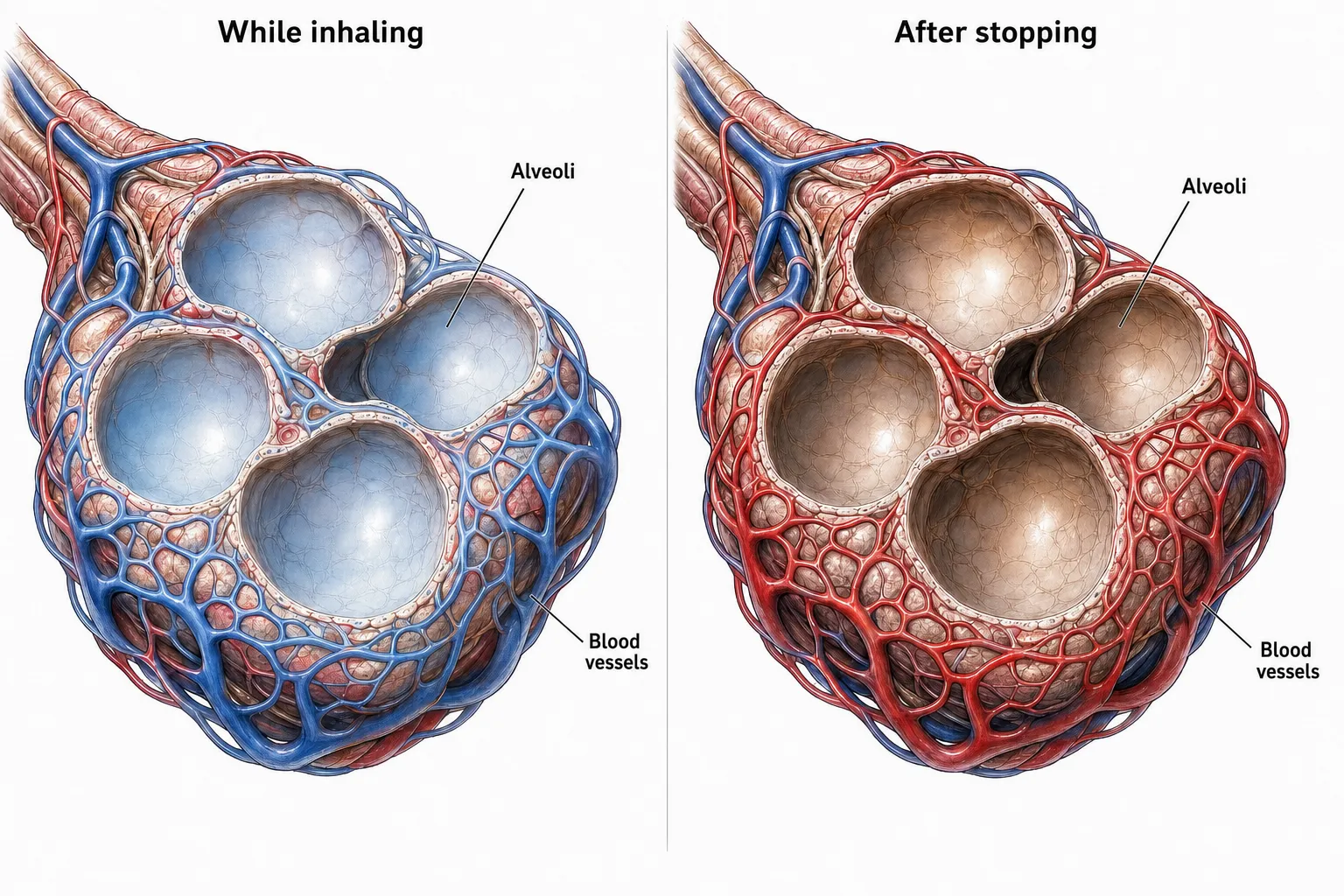
▲ The gas enters the blood in the lungs, then exits by the same route once you stop inhaling — which is why recovery is quick (blue marks where the gas is carried)
Expected Reactions and Possible Side Effects
Common, temporary reactions — these clear as the gas leaves your body:
- A floaty, drowsy feeling while inhaling, fading within minutes of stopping
- A brief foggy feeling afterward in some people
- In some people, dizziness or nausea — we have you rest until it passes before you leave
Anything beyond this is uncommon. If discomfort continues after you've left, contact us and we'll check it with you.
What We Check Beforehand
If any of these apply to you, let us know during your consultation. We'll consider a different pain-control approach.
- Pregnancy or possible pregnancy
- Severe respiratory disease, uncontrolled asthma, COPD, or a history of collapsed lung (air leaking from the lung) — nitrous oxide can expand air trapped in a closed space, which puts strain on the lungs
- Middle-ear conditions or recent ear surgery — the gas can expand the air inside the middle ear and raise its pressure
- A bowel obstruction or severely bloated abdomen — the gas can expand air trapped in the body · a recent head injury — it can raise pressure inside the skull
- High blood pressure in the lung's vessels (pulmonary hypertension), vitamin B12 deficiency or related metabolic conditions — this gas can interfere with how B12 works
- Past episodes of severe dizziness or nausea, or alcohol that day — combined with alcohol, dizziness and nausea get worse
- Anyone who finds breathing through a mouthpiece too stifling to tolerate
How PECHE Clinic Does It
We lower the pain and keep the feedback. Pain control comes in steps. Numbing cream and cooling are the baseline; when that isn't enough, we add options that don't touch the product — Air Nox, vibration, a multi-needle injector that places even doses. Pain that still remains is handled with small amounts of local anesthetic by area. Sleep sedation is not part of our standard practice.
We don't call it painless. We explain honestly which sensations may remain, before we start. Knowing what's coming makes the same stimulus less startling.
The breathing filter is single-use. Each patient gets a new filter, individually packaged and sterile. No one shares a breathing line.
Our prep room is behind glass. You can watch preparation and hygiene management from the waiting area.
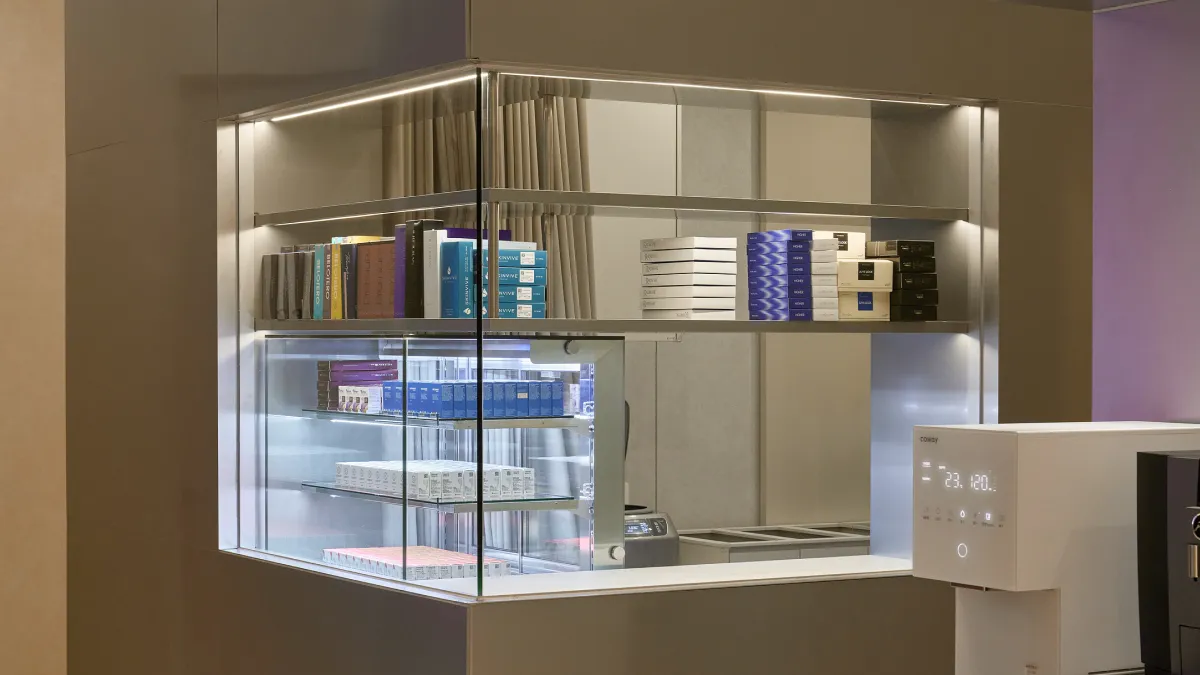
▲ The prep room, seen through the glass from the waiting area
Only when it's needed. Most treatments are finished with numbing cream alone. Air Nox is an add-on for when fear of the heat or pain weighs unusually heavy — not something we recommend by default. You're welcome to come in just for a consultation.
Pricing
Air Nox is an add-on to your treatment. Its cost is quoted separately from the treatment itself during consultation.
Location
PECHE Clinic 3F, 364 Gangnam-daero, Gangnam-gu, Seoul Right in front of Gangnam Station, Exit 4
A brief foggy feeling can linger after the gas clears, so a short trip home is a plus.
FAQ
Q1. Will I fall asleep? A: No. You remain conscious and responsive, and can communicate with the clinician. You'll feel drowsy and loosened, and you can flag any uncomfortable spot during treatment.
Q2. Will it hurt at all? A: It is not painless. It lowers the intensity of the pain and the anxiety around it — it doesn't switch sensation off. The sharp pulses of ultrasound, the deep heat of radiofrequency, and the feeling of the needle going in can remain. We explain what to expect before you start.
Q3. Will it weaken my treatment results? A: No. Because it's inhaled, nothing mixes into the product or stays on the skin, so nothing weakens the energy or the ingredients. If anything, less tension means less movement during treatment — which makes the procedure steadier.
Q4. Can I get on with my day afterward? Can I drive? A: Once you stop inhaling and breathe oxygen, you're usually back to normal within 1–2 minutes, with no separate recovery-room wait. You leave after we confirm there's no dizziness or nausea. If any dizziness lingers, wait until it passes before driving — and skip alcohol that day.
Q5. Which treatments can it be added to? A: Ultrasound and radiofrequency lifting, and skin boosters injected across the whole face. Whether to add it is decided together, based on the treatment and your pain sensitivity.