Non-Sedation Gas Anesthesia (Air Nox) — PECHE Clinic, Gangnam Station
A blend of oxygen and nitrous oxide breathed through a mouthpiece — a non-sleep gas option that eases pain and tension while you stay conscious and responsive · For lifting and skin booster treatments · Right outside Gangnam Station Exit 4
Non-Sedation Gas Anesthesia (Air Nox)
Non-Sedation Gas Anesthesia (Air Nox) is an inhaled sedation option: you breathe a blend of oxygen (O₂) and nitrous oxide (N₂O) through a mouthpiece — a hose you hold in your mouth — and it lowers pain, anxiety, and tension while you remain conscious and responsive. It is not sleep sedation; you do not go under. Nitrous oxide is the gas commonly known as laughing gas.
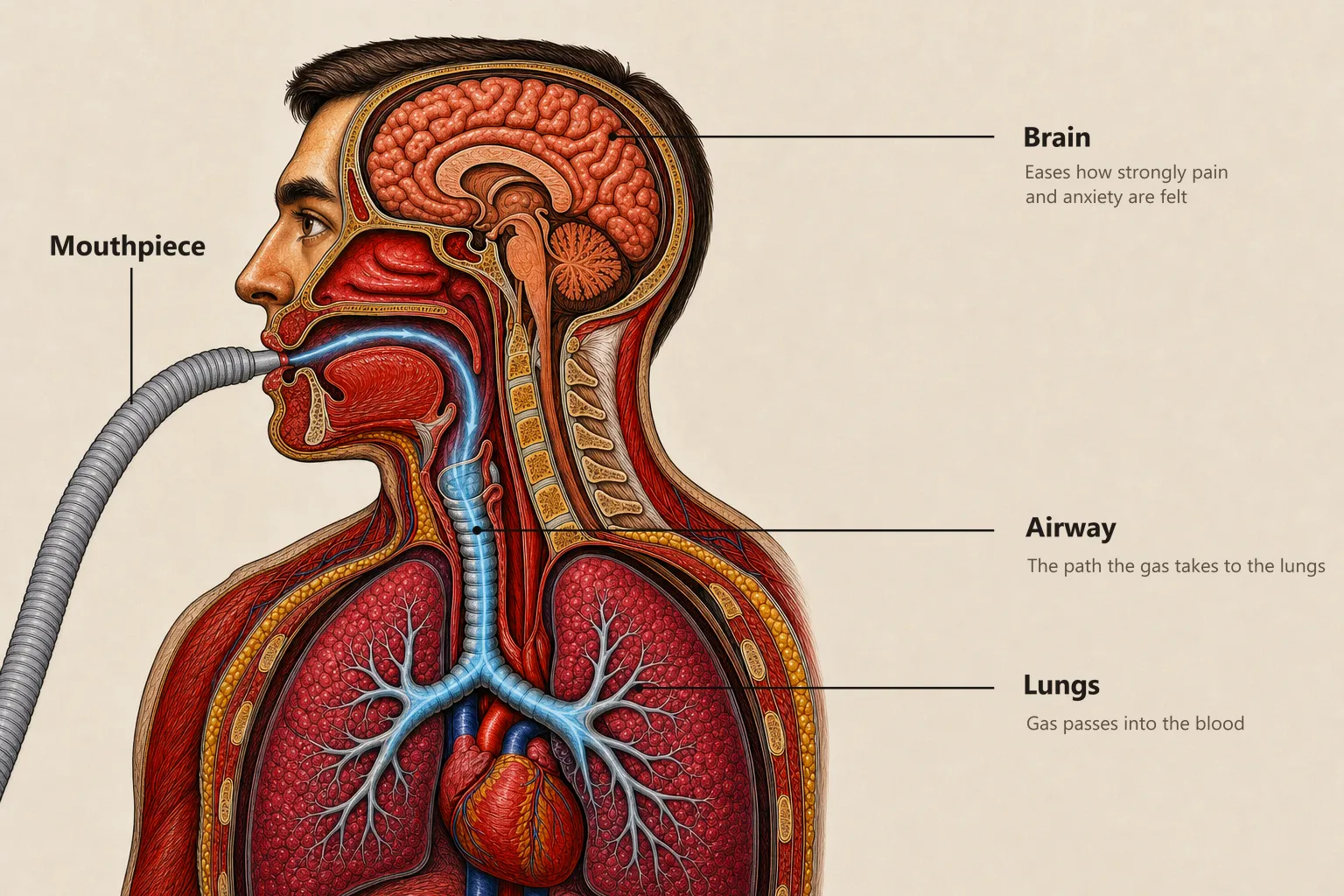
Put simply, it doesn't block sensation at the treatment area — it eases how strongly the brain takes in pain. That's why it doesn't replace the standard pain control for each treatment. It's an option added on top of it when needed.
▲ You breathe it in through a mouthpiece while you stay conscious and responsive. The gas travels with your breath down the airway, passes into the blood in the lungs, and in the brain eases how strongly you feel pain and anxiety
Non-Sedation Gas Anesthesia (Air Nox) at a Glance
| Item | Details |
|---|---|
| Category | Non-sleep inhaled sedation — not a treatment itself, but a pain-control option added to a treatment |
| Composition | A blend of oxygen and nitrous oxide |
| Method | Breathed in through a mouthpiece while you breathe normally |
| Where it acts | The brain — lowers how strongly pain registers, and eases anxiety |
| Consciousness | Conscious and responsive — you can communicate with the physician |
| When it takes effect | Builds over about 2–5 minutes after you start inhaling, and continues while you keep inhaling |
| Wait time | None — it's given alongside the treatment |
| Recovery | Leaves the body relatively quickly once you stop inhaling · the manufacturer states that with oxygen, you usually return to your normal state within 1–2 minutes · if dizziness lingers, driving waits until it passes (see Recovery below) |
| Treatments it can be added to | Lifting and skin booster treatments (this varies by treatment and is decided together at your consultation) |
| Limitation | Not painless — pain is reduced, but some sensation may remain |
How It Works
1. It eases pain and anxiety in the brain Nitrous oxide is understood to temporarily dampen the nerve activity in the brain that takes in pain signals, and to support the body's own pain-relief system, so pain feels weaker. It also lowers anxiety and tension about pain.
2. It comes on quickly and leaves quickly Nitrous oxide dissolves poorly in blood. Because of this, the blood fills up with the gas quickly and it reaches the brain fast; when you stop inhaling, it follows the same path in reverse and leaves quickly through your breath. That's why the effect appears relatively quickly, and why you return to your normal state quickly afterward.
3. You don't fall asleep Among the anesthetic gases used by inhalation, nitrous oxide is the least potent. That's why its effect stops at calming you and you stay conscious, so you can tell us right away during treatment if an area feels uncomfortable.
4. It's given only together with oxygen It's breathed in mixed with oxygen, because breathing the gas alone would leave too little oxygen in each breath. Also, when it's stopped after use at a high concentration, the gas can rush out into the lungs all at once and dilute the oxygen in them — so after you finish, you breathe oxygen to clear the remaining gas.
5. It doesn't mix with treatment products or devices Because it works through your breath, it doesn't dilute the products being injected, and it doesn't affect a device's energy output.
What It Relieves — and What You'll Still Feel
| Item | Details | Why |
|---|---|---|
| The feeling | Slightly floaty; pain feels distant and faint rather than close (manufacturer's description) | It leaves your consciousness in place and lowers only how strongly pain registers |
| What it reduces | The intensity of the pain · anxiety and tension about pain · the fatigue of repeated injections · needle fear | It acts on both pain perception and anxiety in the brain |
| What may remain | The sharp pulse sensation of ultrasound lifting · the deep heat of radiofrequency · the pressure of skin booster injections · the sensation of the needle going in · pain in sensitive areas | It doesn't directly block the nerves at the treatment area |
| Effect on your treatment results | It doesn't dilute the product or weaken the energy | It works through your breath |
Some sensations, such as deep heat or pressure, are hard to block with any single method.
When to Add It
- Fear of needles is strong enough that you've been putting off treatment
- The repeated stimulation of a skin booster injected many times across the whole face feels like too much
- You're very anxious about the deep heat or sharp pulses of lifting
- You're already tense before treatment, and the tension is harder than the pain itself
- You want to lower pain without mixing an anesthetic into the product — because it's inhaled, it doesn't mix into the product
When a different approach may be the right fit
- Your main worry is a surface sensation at the treatment area, such as the sting of a needle going in — Air Nox doesn't directly block sensation at that spot, so it acts at a different site than methods that reduce surface sensation
- Any of the cases under "When to avoid it or take extra care" in Recovery, Expected Reactions, and Precautions below apply to you
Differences from Other Pain-Control Methods and Limitations
| Method | Where it acts | What it mainly reduces |
|---|---|---|
| Numbing cream | Nerve endings in the shallow layers of the skin | Surface stinging |
| Local anesthetic injection (lidocaine) | The nerves in the injected area | Sensation in that area |
| Cooling | The temperature of the skin surface | Dulls surface sensation |
| Air Nox (inhaled sedation) | Pain perception and anxiety in the brain | The intensity of pain, and tension |
Because they act at different sites, one can't stand in for another — and none of them makes a treatment pain-free.
| Item | Sleep sedation (deep sedation) | Air Nox (non-sleep inhaled sedation) |
|---|---|---|
| Consciousness | Asleep, or consciousness drops significantly | Conscious and responsive — able to communicate |
| Pain feedback | Hard to give in real time during treatment | You can tell us area by area |
| Basis for adjusting intensity | Pain signals are hard to use | Adjusted as we hear your feedback, within the range where it works |
| Recovery | Recovery observation and criteria for going home are important | Relatively quick (we check for dizziness and nausea) |
Why staying conscious matters: During treatment, strong pain is a signal that points to areas near a nerve, close to bone, or where the skin is thin. Hearing that signal is what lets us adjust the intensity for that area. Sleep sedation can affect consciousness, breathing, and blood oxygen, so it is an area that needs its own monitoring equipment and personnel, plus recovery management. This doesn't mean sleep sedation is a bad approach — it means the difference in principle lies in consciousness and feedback.
Limitations: It is not painless, and it doesn't directly block sensation at the treatment area. Depending on your health, there are cases where it should be avoided.
How It's Done
1. Screening and consent We check whether any of the cases below — where it should be avoided or needs extra care — apply to you, and then ask for your consent.

▲ We first check whether anything applies to you
2. Your physician's name and a final check Before we begin, we let you know the name of the physician in charge, and that physician personally reviews your screening answers and your condition once more.
3. Inhaling alongside the treatment As the treatment begins, you hold the mouthpiece in your mouth and breathe normally. There's no separate wait for Air Nox. The effect builds over a few minutes while you inhale — if anything feels uncomfortable in the meantime, tell us right away.
4. Stopping and recovery The gas is switched off and you breathe oxygen to clear what remains. You head home after we've confirmed there's no dizziness or nausea and that you're steady on your feet.
Recovery, Expected Reactions, and Precautions
Recovery: When you stop inhaling, the gas leaves through your breath and you return to your normal state relatively quickly. A brief dizzy or foggy feeling, or nausea, may linger, so you head home once it has settled. If any dizziness remains, hold off on driving, and avoid alcohol that day. Other reactions are uncommon, but everyone responds differently — if a reaction lasts longer than expected or becomes more noticeable, contact us and we'll check it with you.
When we do not perform this treatment
- Pregnancy, possible pregnancy, or breastfeeding
When to avoid it or take extra care — Let us know in advance, and we'll look at a different pain-control approach with you.
- A past or recent collapsed lung (pneumothorax — air collects outside the lung and the lung collapses), a middle-ear condition (the air-filled space behind the eardrum) or recent ear surgery, a blocked bowel or a severely bloated abdomen, or a recent head injury — this gas tends not to dissolve well in blood, but it dissolves far more readily than nitrogen, the main component of the air inside the body. So it moves into closed, air-filled spaces faster than nitrogen can move out, which can expand those spaces and raise the pressure inside them
- Vitamin B12 deficiency or a related metabolic condition — this gas damages vitamin B12 in a way that can't be reversed, and nerve problems have been reported in people who were already deficient
- High pressure in the blood vessels leading to the lungs (pulmonary hypertension) — it is recognized as a condition that calls for caution, so we check for it first
- A past experience of severe dizziness or nausea — this gas is known to raise the risk of nausea and vomiting after a procedure
- Severe respiratory disease, uncontrolled asthma, COPD (chronic obstructive pulmonary disease — a long-term lung condition in which the airways narrow and you become short of breath), or alcohol that day — a physician needs to check these first
- Difficulty communicating — this approach depends on your being conscious and able to tell us when something is uncomfortable
- Finding it too stifling to breathe with a mouthpiece in your mouth
What to tell us in advance
- Any medical conditions you have and medications you take — we need these to judge whether any of the items above apply to you
- Any past episode of severe dizziness or nausea after gas anesthesia or inhaled sedation
How PECHE Clinic Does It
We use pain control that keeps you conscious, instead of sleep sedation. Sleep sedation is an area that needs its own safety system to monitor consciousness and breathing, so we don't offer it as a standard option. Staying conscious lets you tell us about discomfort area by area, and what you tell us becomes the basis for adjusting the intensity.
We tell you your physician's name and check again right before we begin. Before we start, we let you know by name who will be treating you, and that physician personally reviews your screening answers and your condition before inhalation begins.
We don't call it painless. We tell you up front which sensations may remain. When the gap between what you expect and what you actually feel is smaller, the same stimulus is easier to handle.
The filter that touches your mouth is single-use, and we keep the preparation area in view behind a full glass wall. The filter that touches your mouth is single-use. Treatment preparation takes place in an open-kitchen-style preparation area behind a full glass wall, so from the waiting area you can see the preparation process and hygiene practices for yourself.

▲ The treatment preparation area, seen through the glass wall from the waiting area
We recommend only the treatments your assessment results call for. Air Nox is an option added when pain or tension weighs unusually heavily, so we don't recommend it to everyone. You're welcome to come in just for a consultation and leave.
Pricing
Prices for Non-Sedation Gas Anesthesia (Air Nox) are published on our website for every product option. Whichever country you're visiting from and whichever channel you book through, the price is the same as the one published on our website — so there's no need to compare prices from one booking channel to another. Making sure you can come in trusting the price you checked in advance — that is the trust PECHE Clinic puts first.
Air Nox is offered as a single product — Non-Sedation Gas Anesthesia (Air Nox), 1 session — and is an option you choose in addition to the treatment you're having.
Location and Clinic Hours
PECHE Clinic 3F, 364 Gangnam-daero, Gangnam-gu, Seoul Right outside Gangnam Station Exit 4 — the building entrance is right in front of you as you come out
Clinic Hours (Korea Standard Time, KST)
- Monday–Friday: 10:30 AM – 9:00 PM
- Saturday, Sunday, and public holidays: 10:00 AM – 6:00 PM
- No lunch break — we see patients straight through midday
FAQ
Q1. If I add Air Nox, will I feel no pain at all? A: No. Air Nox lowers how strongly the brain takes in pain, and eases anxiety — it doesn't remove sensation at the treatment area itself. Numbing cream, local anesthetic, and inhaled sedation each work at a different site, so whichever you use, sensations such as deep heat or pressure can remain.
Q2. Does adding Air Nox make things take longer? A: There's no separate numbing wait. You start inhaling as the treatment begins, and when it's over you breathe oxygen to clear the remaining gas before heading home.
Q3. Will it weaken my treatment results? A: Because it works through your breath, it doesn't dilute the injected product or weaken the device's energy.
Q4. Can I drive afterward? A: The gas leaves relatively quickly, but if any dizziness remains, you should hold off on driving until it passes. Before you head home, we check together that there's no dizziness or nausea and that you're steady on your feet.
Q5. Which treatments can it be added to? A: It's an option added to lifting and skin booster treatments. Because the type of pain differs from treatment to treatment, we decide together whether to add it based on the treatment you're having, how sensitive you are to pain, and the screening items above.