Cheekbone Botox — PECHE Clinic, Gangnam Station
A muscle injection that reduces the movement of the expression muscles that push the cheekbone area upward when you smile, so the cheekbone area looks less prominent · The cheekbone itself stays as it is · Right outside Gangnam Station Exit 4
Cheekbone Botox
Cheekbone Botox is a treatment that injects small amounts of botulinum toxin (a medication made by purifying a protein produced by botulinum bacteria) into the muscles of facial expression in the cheekbone area to reduce the movement that pushes the cheekbone area upward when you smile. How much the cheekbone area stands out when you smile is softened, so it looks less prominent — the cheekbone itself, the bone, does not change. PECHE Clinic uses four products for this treatment: Newlux, Coretox, Xeomin, and Allergan.
Put simply, it's an injection that slightly reduces the force of the muscles that push the cheekbone area up when you smile.
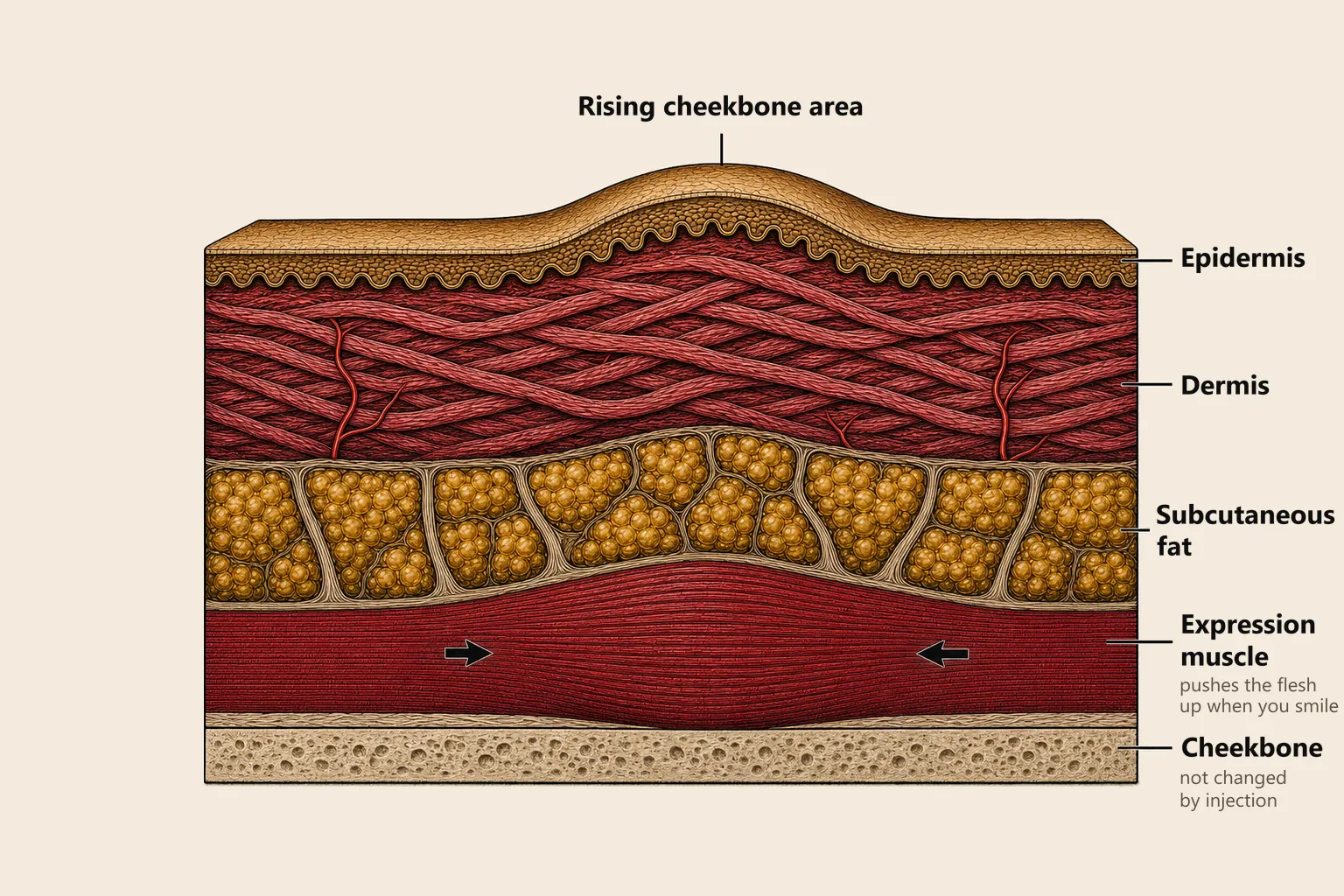
▲ When you smile and the expression muscle contracts (arrows), the flesh above is pushed up and the cheekbone area rises — the cheekbone itself stays as it is
Cheekbone Botox at a Glance
| Item | Details |
|---|---|
| Target layer | The muscles of facial expression in the cheekbone area, beneath the skin and subcutaneous fat |
| Numbing | Ice roller for about 5 minutes |
| When results show | Gradually from days 3–7 → clearest at around week 2 |
| How long it lasts | 3–6 months |
| Repeat interval | 3–4 months (at least 3 months apart) |
How It Works
1. It temporarily blocks the signal nerves send to muscles The moment you go to smile, the nerve ending releases acetylcholine (a chemical that carries the "move" message to the muscle), and the muscle contracts. Botulinum toxin doesn't paralyze the muscle — it temporarily blocks the release of this chemical.
2. Several expression muscles run through the cheekbone area They include the zygomaticus major and minor, which run diagonally from the cheekbone down toward the corners of the mouth and the upper lip and pull them up when you smile. Another is the orbicularis oculi, which circles the eye and tightens the eye area when you close your eyes or smile. Reducing the force of the muscles among these that push the cheekbone area upward when you smile means the cheekbone area rises less. Which muscles the product goes into, and how much, is decided by looking directly at your smile.
3. Over several months, things return to how they were As the nerve grows new branches and reconnects with the muscle, movement gradually returns.
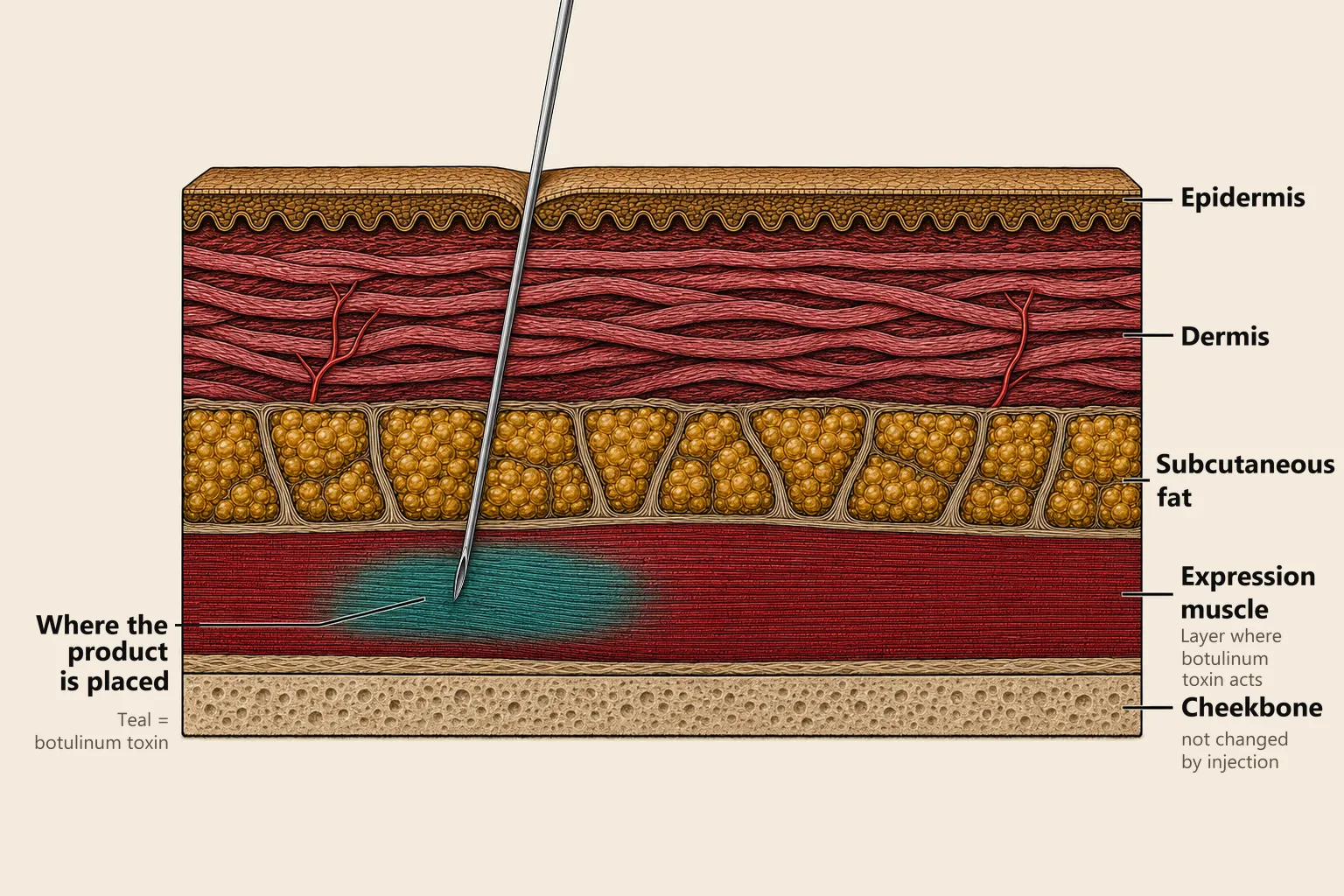
▲ The product (teal) is placed in the expression muscle beneath the fat layer — as the muscle's force lessens, so does the force pushing the flesh up when you smile, and the product does not act on the cheekbone itself
Expected Results and Why
Your cheekbone area looks less prominent when you smile. This is because the contraction of the muscles that were pushing the cheekbone area up is reduced. That's why the change shows in your smiling face rather than when your face is at rest, and how much it changes depends on the strength of the muscles and differs from person to person. When the effect wears off, you simply return to how you were before treatment — the cheekbone area doesn't become more prominent than it was before.
When to Consider It
- Your cheekbone area looks fine when your face is at rest, but stands out noticeably only when you smile
- When you smile, the flesh of the cheekbone area is pulled upward, so the cheekbone area looks like it juts out to the side or front
When a different approach may be the right fit
- Your cheekbone area looks wide or high even at rest — if the cheekbone itself is the cause, an injection won't change it
- Hollow cheeks make the cheekbone area look more prominent by contrast — an approach that fills in the sunken area may be the right fit
Differences from Other Treatments and Limitations
A common misconception: Cheekbone Botox is sometimes explained as working on the same principle as botulinum toxin used to reduce the size of a muscle, but Cheekbone Botox reduces the movement when you smile, not the size of the muscle. It's the same medication, but the goal is different.
| Compared approach | How they differ |
|---|---|
| Filler that fills sunken areas | Botulinum toxin addresses movement when you smile; filler addresses the shadows and uneven contours formed where volume has sunk. When the cause is different, the approach you choose is different too |
Limitations: The width or projection of the cheekbone itself, cheekbone-area prominence at rest, and hollow cheeks are not goals of this treatment.
How It's Done
1. 3D skin analysis and consultation 3D MetaVu imaging captures your facial contours and left–right balance, and we review the results together to decide on the product you'll receive.
2. Your physician's name and a final check Before treatment, we let you know the name of the physician treating you, and that physician personally reviews your assessment results and the condition of your face and skin.
3. Expression check, mapping, and marking You smile broadly so we can identify the muscles pushing the cheekbone area up, and we mark the points where the product will be placed.
4. Numbing An ice roller cools the area for about 5 minutes to dull the sensation.
5. Injection A fine needle places small, divided amounts into the expression muscles of the cheekbone area. Because these spots are shallower than deep muscles such as the jaw's chewing muscle, it feels like a sharp, hot sting — without the heavy, pressing sensation of filler.
Recovery, Expected Reactions, and Precautions
Recovery: Injection marks settle within 1–2 hours, and bruising, if it occurs, fades within 3–7 days. You can wash your face and wear makeup starting 2–3 hours after treatment.
On the day of treatment: Don't lie down for 4–6 hours, and avoid saunas, strenuous exercise, and massaging the treated area. This is to reduce the chance of the product spreading into muscles it wasn't meant to reach.
Possible effects by area
- Cheekbone area — the zygomaticus major and minor are important muscles for creating your smile, and the muscles that run down from the cheekbone area to the mouth are intertwined with the muscles around the mouth. So if the amount or placement is off, or the product spreads to surrounding muscles and these muscles become too weak, your smile may look awkward or the two sides of your smile may differ
Although rare, a risk shared by all botulinum toxin products is that the effect can spread beyond where it was injected, causing weakness throughout the body, double vision, drooping eyelids, or difficulty swallowing, speaking, or breathing. These symptoms can appear anywhere from a few hours to a few weeks after treatment — if you notice any of them, contact the clinic or seek medical care right away.
Other reactions are uncommon, but everyone responds differently — if a reaction lasts longer than expected or becomes more noticeable, contact us and we'll check it with you.
When we do not perform this treatment
- A past allergic reaction to botulinum toxin or to an ingredient of the product to be used (such as human albumin)
- Pregnancy, possible pregnancy, or breastfeeding
When we postpone treatment
- Infection or inflammation at the injection site — we proceed once it has settled
What to tell us in advance
- Conditions in which the nerves' ability to move the muscles is already weakened, such as myasthenia gravis or ALS (Lou Gehrig's disease) — the risk of symptoms such as difficulty swallowing or breathing increases
- Taking muscle relaxants or certain antibiotics — the product's effect may become too strong
- Taking aspirin or anticoagulants (medications that keep blood from clotting easily) — you may bruise more easily
- Botulinum toxin received elsewhere recently — tell us when, which product, and how much (we need this to set the interval and the dose)
- Other recent treatments — if you've had filler, a skin booster, lifting, or similar treatments, let us know at your consultation
- Whether to have another treatment on the same day is decided together after your assessment
How PECHE Clinic Does It
We follow standards built from more than 90,000 treatments performed across the clinic. From more than 90,000 treatments performed across PECHE Clinic, we have built standards for each area and skin condition, and the same standards apply whichever PECHE physician treats you. For Cheekbone Botox, which muscles it goes into, which points it's divided across, and how much goes to each point are set according to those standards.
A physician personally reviews your assessment results before we begin. A physician reviews the results captured with 3D MetaVu and takes one more look at your face and skin right before treatment. That's why, even with the same Cheekbone Botox, the injection points and amounts differ from person to person. We let you know by name who will treat you before we begin.
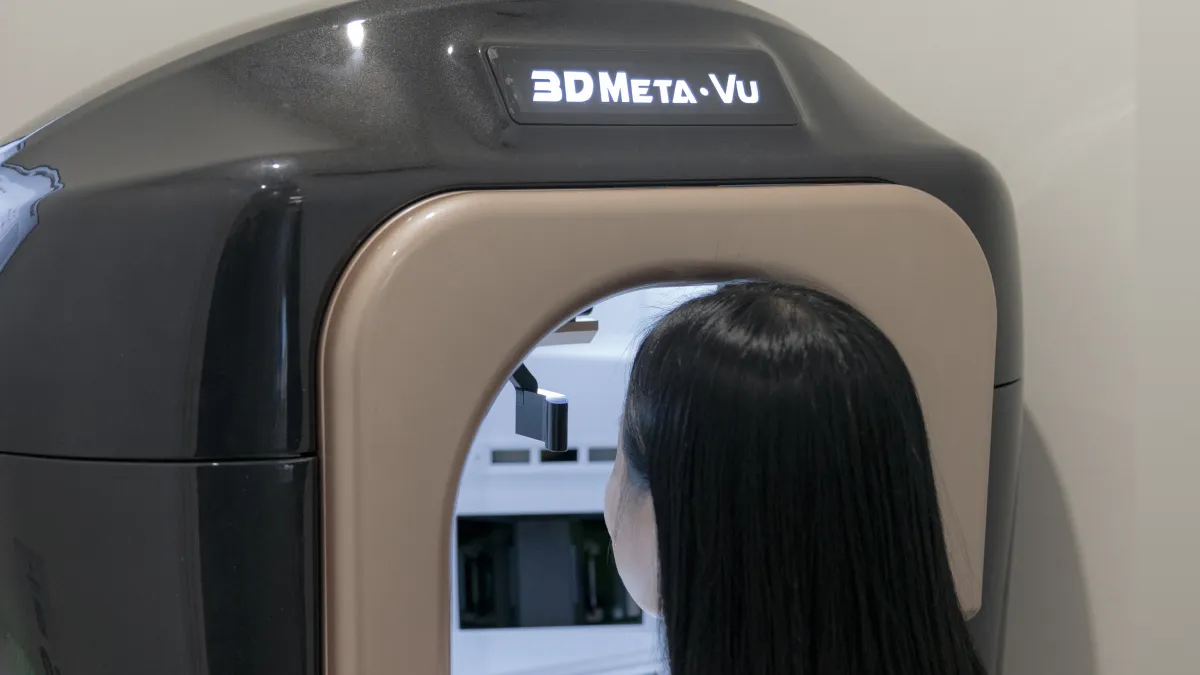
▲ We review your imaging results together
We offer four botulinum toxin products. Botulinum bacteria make the active ingredient — the part that creates the effect — wrapped in other proteins that protect it. That active ingredient is the same in all four products. What differs is whether the wrapping proteins were left in, whether human albumin (a protein naturally present in human blood) was added to help with storage, and the manufacturer and what each product is approved for. These are differences in composition, not in quality.
| Product | Made by | Wrapping proteins | Human albumin |
|---|---|---|---|
| Newlux | Korea · approval held by Numeco (a Medytox affiliate), manufactured by Medytox | Kept | Added |
| Coretox | Korea · Medytox | Removed | Not added (uses a synthetic stabilizer) |
| Xeomin | Germany · Merz | Removed | Added |
| Allergan | USA · AbbVie (which acquired Allergan) | Kept | Added |
When the wrapping proteins enter the body along with the active ingredient, the body can more easily recognize the product as foreign and may form antibodies — and then a later dose of the same amount may not work as well as it once did (known as resistance). This is uncommon, and it is generally understood that products with the wrapping removed may carry a lower chance of it. The factors that raise the risk are repeat injections at short intervals or extra injections to boost the effect, a large amount at one time, and the total amount of protein entering the body — so the principles for prevention are a dose suited to the area and an interval of at least 3 months. Products with the wrapping removed include both a Korean-made product (Coretox) and an imported one (Xeomin), so whether the wrapping is removed does not depend on whether a product is Korean-made or imported. If you have had a hypersensitivity reaction to an added ingredient (such as human albumin), products containing that ingredient are not used, so the albumin column is also considered when choosing a product.
We open genuine products in front of you and keep the preparation area in view behind a full glass wall. All four products are stored as a powder and dissolved in saline before use. This is because the product instructions specify that, once dissolved, the product is to be used without being stored for long. The genuine product is opened in front of you, and treatment preparation takes place in an open-kitchen-style preparation area behind a full glass wall, so from the waiting area you can see the genuine product, the dissolving process, and hygiene practices for yourself.
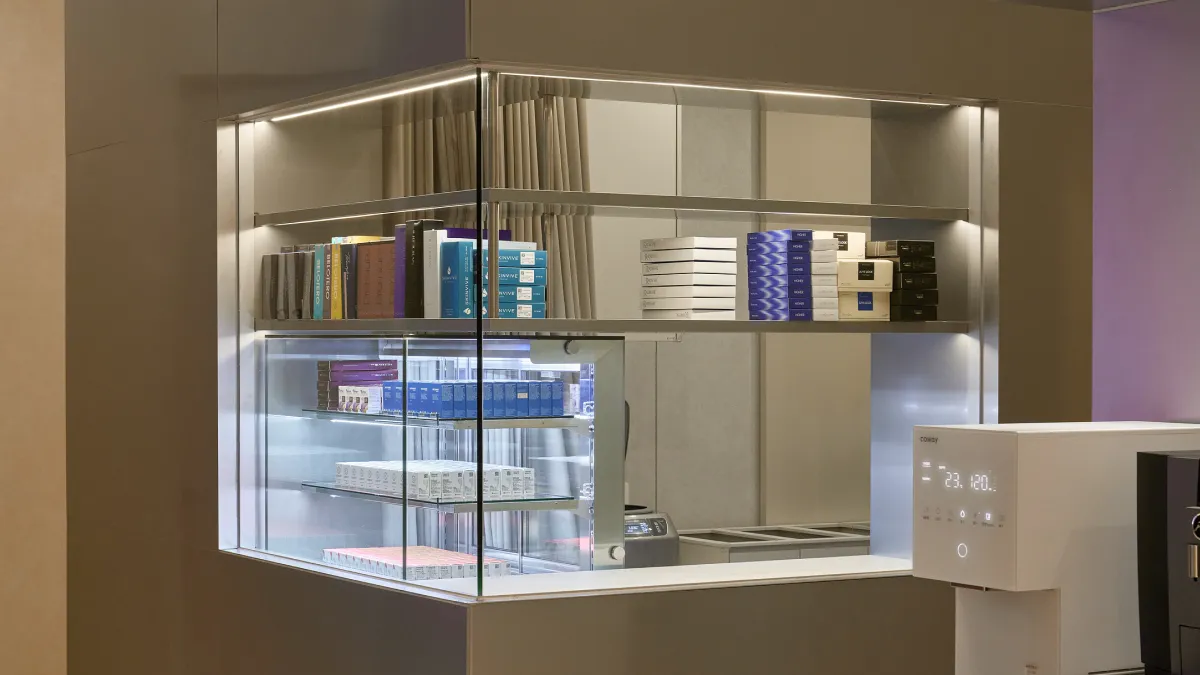
▲ The treatment preparation area, seen through the glass wall from the waiting area
We recommend only the treatments your assessment results call for. We tell you first what this treatment can do (the movement that makes the cheekbone area rise when you smile) and what it can't (the cheekbone itself, prominence at rest, hollow cheeks). You're welcome to come in just for a consultation and leave.
Pricing
Prices for Cheekbone Botox are published on our website for every product option. Whichever country you're visiting from and whichever channel you book through, the price is the same as the one published on our website — so there's no need to compare prices from one booking channel to another. Making sure you can come in trusting the price you checked in advance — that is the trust PECHE Clinic puts first.
Cheekbone Botox (Korean/Newlux), Cheekbone Botox (Korean Premium/Coretox), Cheekbone Botox (Imported/Xeomin), and Cheekbone Botox (Imported/Allergan) are the four options, and we decide together on the option you need after your assessment.
Location and Clinic Hours
PECHE Clinic 3F, 364 Gangnam-daero, Gangnam-gu, Seoul Right outside Gangnam Station Exit 4 — the building entrance is right in front of you as you come out
Clinic Hours (Korea Standard Time, KST)
- Monday–Friday: 10:30 AM – 9:00 PM
- Saturday, Sunday, and public holidays: 10:00 AM – 6:00 PM
- No lunch break — we see patients straight through midday
FAQ
Q1. Who performs Cheekbone Botox? A: Before treatment, we first let you know the name of the physician treating you, and that physician personally reviews your assessment results and the condition of your face and skin before starting. The injection points and the amount used follow standards built from more than 90,000 treatments performed across the clinic, so the same standards apply even if a different physician treats you.
Q2. Does the cheekbone itself get smaller? A: No. Botulinum toxin is a medication that blocks the signal nerves send to muscles, so it doesn't act on bone — what changes is how much the muscles push the cheekbone area up when you smile.
Q3. If these are the muscles that lift the mouth corners, won't my mouth corners lift less when I smile? A: Because this treatment slightly reduces the muscles' force, the force that pulls your mouth corners up can weaken along with it to that degree. These muscles are important for creating your smile, so if they become too weak, your smile may look awkward or the two sides of your smile may differ.
Q4. How can I tell whether my cheekbone area stands out only when I smile, or my cheekbones are simply large to begin with? A: We look at your face at rest and when you smile, separately. If it stands out noticeably only when you smile, movement is the cause and this treatment addresses it; what stands out even at rest won't change with an injection, so we look at other approaches together.
Q5. Cheekbone Botox — what should I look for when choosing a clinic? A: This is where the muscles that create your smile come together, so even with the same medication, the shape of your smile can change depending on which muscles it goes into and how much goes to each. Look for whether the clinic explains the standards it uses to decide the amount and the placement. It also helps to see whether prices are published in advance, and whether you can see how the medication is prepared.