Capri Laser — PECHE Clinic, Gangnam Station
A 1450nm laser that heats the area around the sebaceous glands and a blue-light laser that targets acne bacteria — a laser that addresses the causes of recurring acne · Full face · Right outside Gangnam Station Exit 4
Capri Laser
The Capri Laser is a non-ablative laser (one that doesn't remove the skin's outer surface) that uses two kinds of light together. A 1450nm diode laser targets the sebaceous glands (glands in the skin that make oil), and a blue-light laser targets acne bacteria — together they act on two causes of acne: sebum and bacteria. It is made by the Korean company ORO Laser and is approved by Korea's Ministry of Food and Drug Safety (MFDS).
Put simply, one light delivers heat to the oil-making glands and is understood to reduce sebum, while the other, blue light, reduces acne bacteria. Rather than clearing the breakouts you have now right away, it works over repeated sessions to make breakouts come back less often.
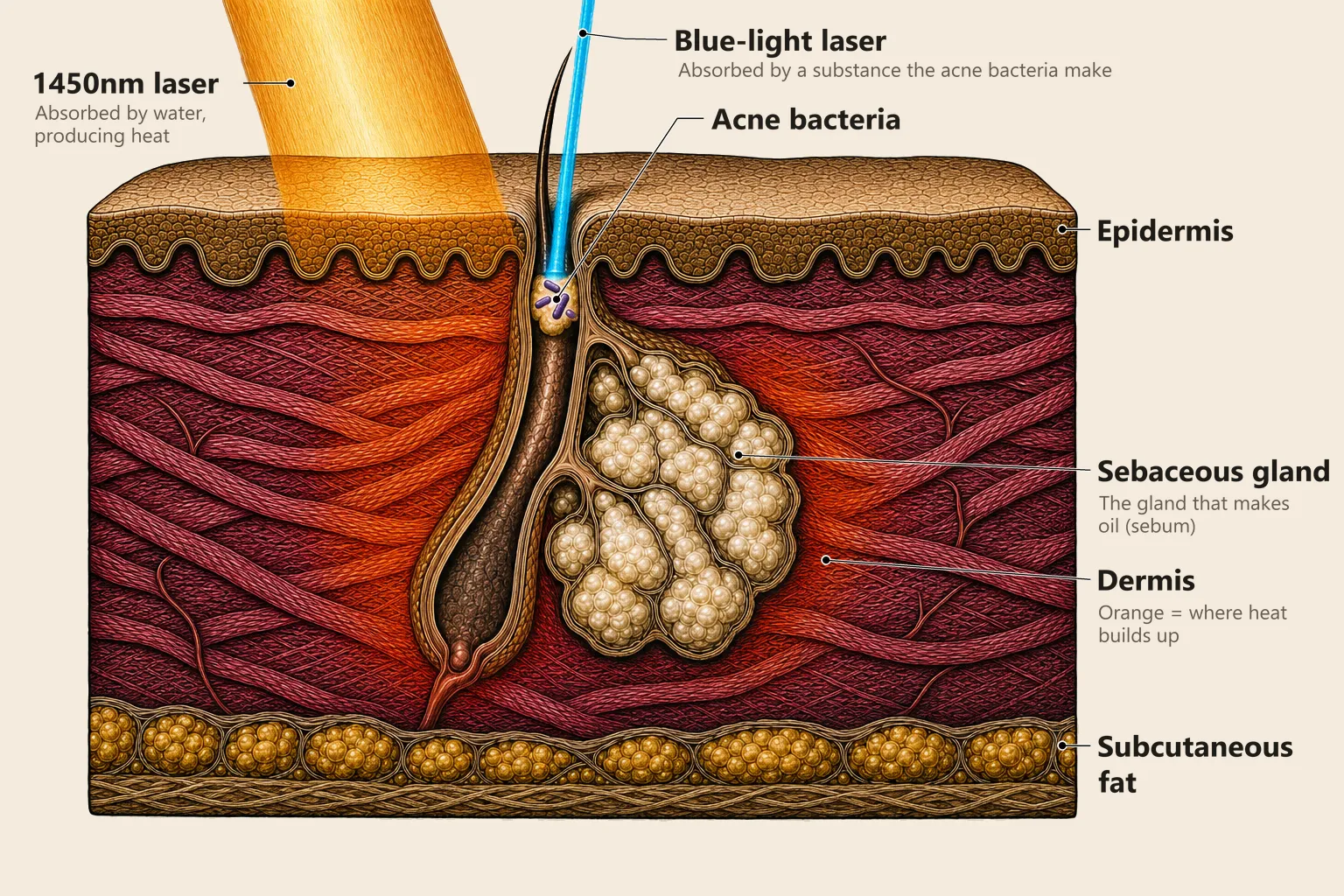
▲ The 1450nm light concentrates heat at the depth where the sebaceous glands sit (orange), while the blue light reaches the acne bacteria at the follicle opening — two lights with different targets
Capri Laser at a Glance
| Item | Details |
|---|---|
| Category | Non-ablative laser · converts light into heat to act on the sebaceous glands + uses blue light to reduce bacteria |
| Mechanism | 1450nm light is absorbed by water in the dermis and produces heat around the sebaceous glands · blue light activates a substance inside acne bacteria, damaging the bacteria |
| Where it acts | Sebaceous glands at mid-depth in the dermis · acne bacteria inside the follicles |
| Concerns it suits | Recurring acne (inflammatory and non-inflammatory) · oily, shiny skin with heavy sebum |
| Manufacturer and approvals | ORO Laser (Korea) · approved by Korea's MFDS |
| Option | Capri Laser (Acne Extraction not included) + Sheet Mask, 1 session — full face |
| Numbing | Performed without numbing (no numbing wait) |
| Recommended interval and sessions | Usually 3–5 sessions at 1–2 week intervals |
| How results appear | Rather than being complete after one session, results build over repeated sessions as breakouts recur less often |
| Recovery | Temporary redness and swelling · the redness usually settles the same day, and you can generally return to your daily routine right away |
How It Works
1. 1450nm light — it delivers heat to the depth where the sebaceous glands sit 1450nm is invisible infrared light that is readily absorbed by water in the dermis (the deeper layer of skin responsible for elasticity). That is how it delivers heat to the mid-depth of the dermis, where the sebaceous glands are located, and the heated glands are understood to shrink (atrophy), reducing the amount of sebum released. This wavelength has been reported to selectively damage the sebaceous glands.
2. Blue light — the substance the bacteria make ends up attacking them Acne bacteria produce their own light-sensitive pigment (porphyrin). When this substance absorbs blue light, it creates unstable oxygen molecules that damage cells — so the bacteria end up being attacked by a substance they made themselves.
3. It is a laser that works through heat The 1450nm laser releases light over a relatively long pulse and works through heat (a long-pulse laser). It is a different kind of laser from pigment lasers, which fire light in extremely short bursts to break pigment into tiny pieces. In other words, it isn't a laser for lightening the color of acne marks — it treats the sebaceous glands with heat.
Expected Results and Why
| Expected result | Why |
|---|---|
| Less sebum and less shine | The heated sebaceous glands shrink, so less sebum is produced |
| Fewer pus-filled breakouts recurring in the same spot | Blue light reduces the acne bacteria inside the follicles |
| New breakouts recur less often | It addresses two causes — sebum and bacteria — at the same time |
With less sebum, there is less pressure pushing out from inside the pores, so you can also expect pores to look less prominent as a side benefit. However, it doesn't change the structure of pores that have already widened.
In a small pilot study (published in a U.S. dermatologic surgery journal in 2004) that treated 19 patients with inflammatory facial acne using a diode laser of the same 1450nm wavelength — not the Capri Laser device itself — lesion counts fell by 37% after one session, 58% after two, and 83% after three, and the only adverse effects were temporary redness and swelling. It was a small study, and individual results vary.
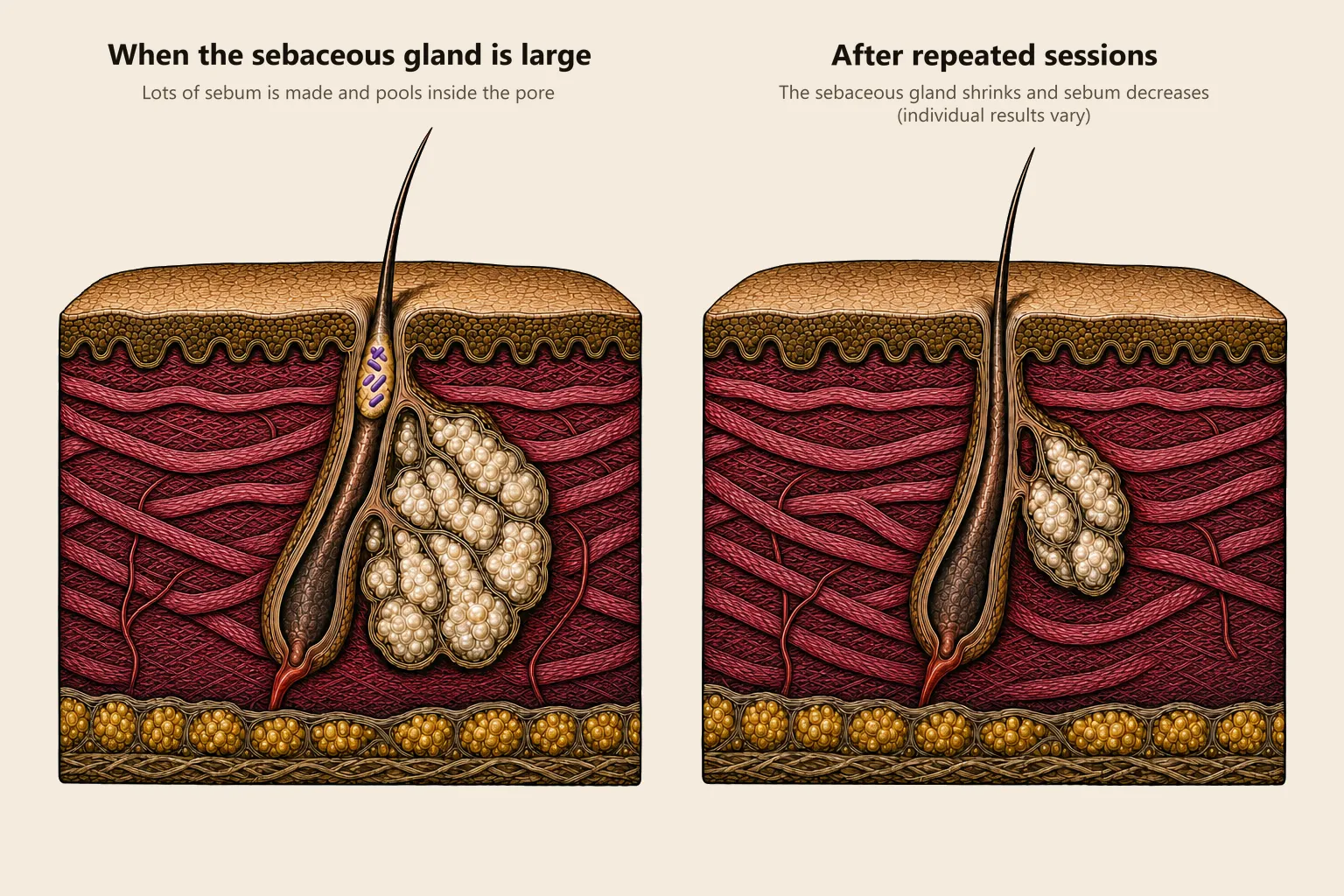
▲ As the sebaceous gland shrinks, less sebum pools inside the pore — the change appears over repeated sessions (individual results vary)
When to Consider It
- Breakouts keep coming back across your face, not just one or two
- Even with careful cleansing and skincare, heavy sebum leaves your skin shiny and breakouts keep coming
- You often get small, clogged bumps (non-inflammatory acne), even if they don't turn red and pus-filled
- You're looking for an acne treatment that doesn't demand much recovery time
When a different approach may be the right fit
- A few large, firm, swollen breakouts right now — an injection that quickly calms the inflammation in that spot may be the right first step
- Depressed scars or enlarged pores are your main concern — depending on the type of scar, this is the role of treatments that release the bands tethering the scar's base or that regenerate the dermis
- Red or brown marks left behind by acne — these are a matter of color, not depressions, so they're approached with treatments that address color
The order of treatment Acne, scar, and pore treatment generally follows an order: ① control active inflammation → ② improve scar structure that is tethered at the base (release) → ③ regeneration → ④ clearing color marks. This is because new scars can form while inflammation keeps flaring up. The Capri Laser belongs to stage ①, but rather than calming swollen inflammation right away, its role is to reduce the causes of recurring breakouts (sebum and bacteria) so that breakouts settle down before scar treatment (②–④).
Differences from Other Treatments and Limitations
| Compared approach | What they share | How they differ |
|---|---|---|
| An injection that calms inflammation | Both treat acne | The injection calms a currently swollen lesion on the spot, while the Capri Laser controls the causes of recurrence — sebum and bacteria |
| Radiofrequency delivered by placing a needle in each lesion (insulated single microneedle) | Both can act on the sebaceous glands | The Capri Laser uses light to act on the sebaceous glands across a broad area without needles, while a single microneedle delivers radiofrequency heat directly into each lesion, one at a time. This is not a matter of better or worse but of the area each one covers and the method it uses |
| Light therapy that supports recovery (photobiomodulation) | Both use light | That approach helps cells produce energy more efficiently to support recovery, while the Capri Laser's blue light activates a substance inside the bacteria to reduce the bacteria directly (photodynamic action) |
Limitations: It cannot change the structure of depressed scars that have already formed or of enlarged pores.
How It's Done
1. 3D skin analysis and consultation 3D MetaVu imaging captures the current condition of your sebum and pores under different light sources, and a physician personally examines the areas where acne has appeared. During the consultation, we ask how your breakouts tend to recur and use that to decide how many sessions to divide treatment into.
2. Your physician's name and a final check Before treatment, we let you know the name of the physician treating you, and that physician personally reviews your assessment results and the condition of your face and skin.
3. Cleansing Treatment starts after makeup and sebum are washed off.
4. Treatment This is performed without numbing, over the full face. The device has a built-in cooling function and the discomfort tends to be mild, so numbing cream is not applied.
It feels like a gentle warmth — not hot — passing smoothly over the skin, and you may feel a light sting where the sebaceous glands are concentrated.
5. Finishing A Sheet Mask soothes the skin to finish the session.
Recovery, Expected Reactions, and Precautions
Recovery: Temporary redness and swelling may occur, and the redness usually settles the same day. Other reactions are uncommon, but everyone responds differently — if a reaction lasts longer than expected or becomes more noticeable, contact us and we'll check it with you.
Aftercare: Use sun protection and keep your skin moisturized. This is basic care that keeps laser-treated skin from becoming sensitive.
When we do not perform this treatment
- Pregnancy, possible pregnancy, or breastfeeding
When we postpone treatment
- Taking oral acne medication (isotretinoin) now or recently — your skin is drier and more sensitive, so we adjust the timing of treatment
What to tell us in advance
- Acne medications you've used recently (oral or topical) — we need this to judge your skin's condition and the timing of treatment
- Other recent treatments — if you've had laser, a chemical peel, radiofrequency microneedling, or similar treatments, let us know at your consultation
- Whether to have another treatment on the same day is decided together after your assessment
How PECHE Clinic Does It
We follow standards built from more than 90,000 treatments performed across the clinic. From more than 90,000 treatments performed across PECHE Clinic, we have built standards for each area and skin condition, and the same standards apply whichever PECHE physician treats you. With the Capri Laser, those standards determine how many sessions treatment is divided into, based on how your breakouts tend to appear.
A physician personally reviews your assessment results before we begin. A physician reviews your 3D MetaVu imaging results for sebum and pores, and checks your face and skin once more right before treatment. Before we start, we tell you the name of the physician treating you.
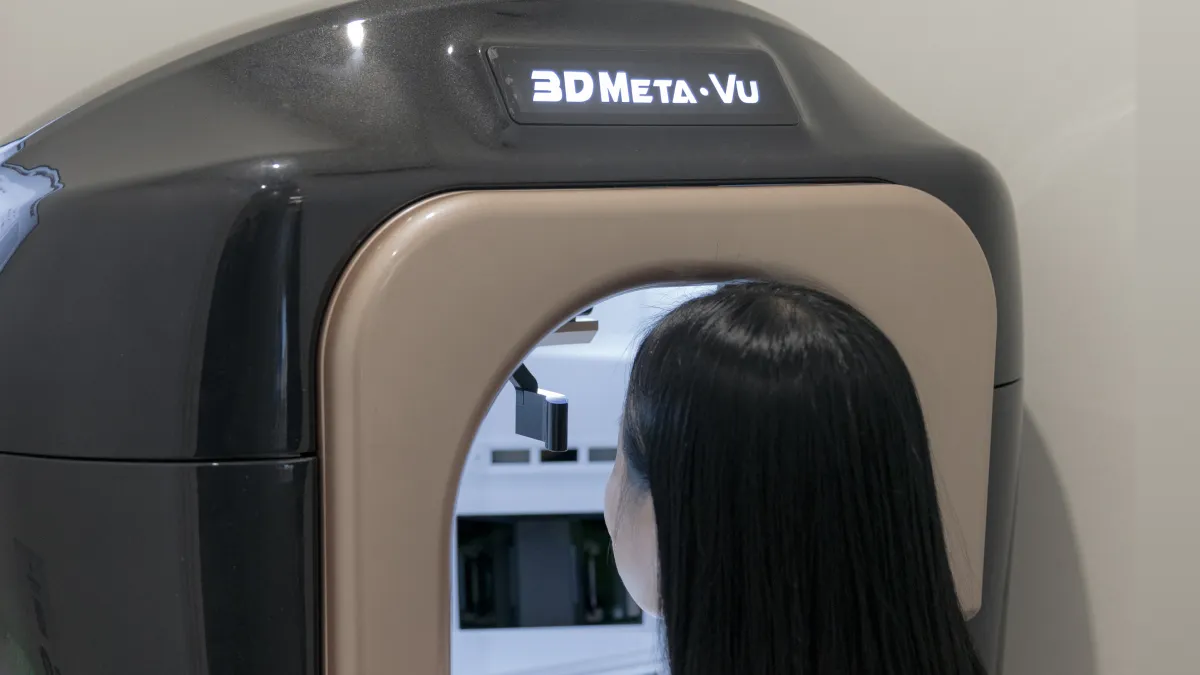
▲ We review your imaging results together
We keep the preparation area in view behind a full glass wall. Treatment preparation takes place in an open-kitchen-style preparation area behind a full glass wall, so from the waiting area you can see the preparation process and hygiene practices for yourself.
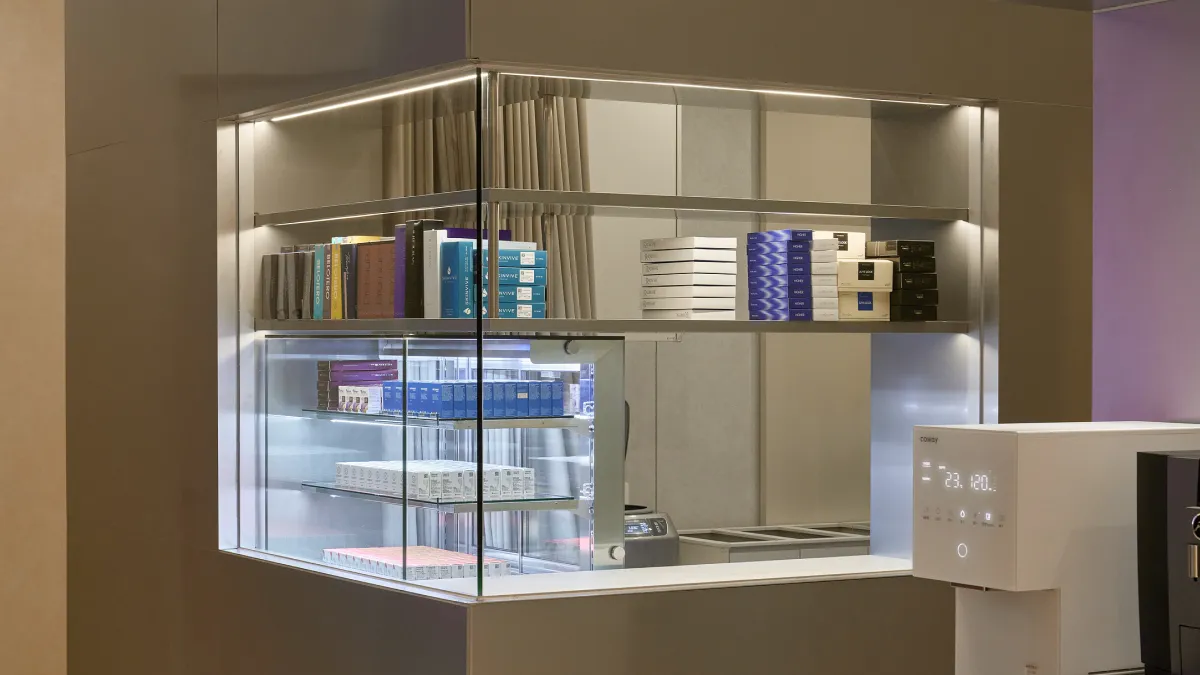
▲ The treatment preparation area, seen through the glass wall from the waiting area
We recommend only the treatments your assessment results call for. We tell you first what this treatment can do (controlling sebum and bacteria, the causes behind recurring breakouts) and what it can't (depressed scars that have already formed, or the structure of enlarged pores). You're welcome to come in just for a consultation and leave.
Pricing
Prices for Capri Laser are published on our website for every product option. Whichever country you're visiting from and whichever channel you book through, the price is the same as the one published on our website — so there's no need to compare prices from one booking channel to another. Making sure you can come in trusting the price you checked in advance — that is the trust PECHE Clinic puts first.
It is offered as Capri Laser (Acne Extraction not included) + Sheet Mask, a single session covering the full face. As the name says, extraction is not included; acne extraction is offered separately on our skincare menu.
Location and Clinic Hours
PECHE Clinic 3F, 364 Gangnam-daero, Gangnam-gu, Seoul Right outside Gangnam Station Exit 4 — the building entrance is right in front of you as you come out
Clinic Hours (Korea Standard Time, KST)
- Monday–Friday: 10:30 AM – 9:00 PM
- Saturday, Sunday, and public holidays: 10:00 AM – 6:00 PM
- No lunch break — we see patients straight through midday
FAQ
Q1. Who performs the Capri Laser treatment? A: Before treatment, we first let you know the name of the physician treating you, and that physician personally reviews your assessment results and the condition of your face and skin before starting. How many sessions treatment is divided into follows standards built from more than 90,000 treatments performed across the clinic, so the same standards apply even if a different physician treats you.
Q2. Will the Capri Laser quickly calm acne that's swollen right now? A: The Capri Laser isn't a treatment that calms breakouts right away. It reduces sebum and bacteria so that fewer breakouts appear going forward, so a large, swollen inflamed spot you have now may need a separate method that calms that spot. At your examination, we look at your current condition and decide together what to do first.
Q3. Is extraction included with the Capri Laser? A: No. The Capri Laser uses light to act on the sebaceous glands and bacteria, while extraction — squeezing out clogged sebum — is offered separately on our skincare menu. Whether your skin needs extraction is something we look at together during your examination.
Q4. Can I have the Capri Laser if my skin is simply oily and shiny? A: Yes. Excess sebum and shine, as well as small, clogged non-inflammatory acne bumps, are also concerns it suits. Because it acts on the sebaceous glands that make sebum, it works to reduce shine caused by heavy sebum even if you don't have pus-filled breakouts.
Q5. Will the Capri Laser improve depressed scars? A: That isn't what this treatment does. Depressed scars aren't a sebum or bacteria problem but a change in the structure of the dermis, so depending on the type of scar, they're handled by treatments that release the bands tethering the scar's base or that regenerate the dermis. While breakouts keep recurring, though, new scars can form, so reducing recurrence and treating scars follow one after the other, in that order.