Clarity II — PECHE Clinic, Gangnam Station
Two-wavelength laser hair removal with a 1ms pulse for very fine hair and a function that automatically overlaps each treated spot · Fine facial hair, underarms, arms, and legs · Right outside Gangnam Station Exit 4
Clarity II
Clarity II is a long-pulse laser that combines two lasers in one device: a 755nm alexandrite laser and a 1064nm Nd:YAG laser. Long-pulse means the light is delivered in relatively long pulses, measured in milliseconds (1/1,000 of a second) — instead of shattering the target with a split-second impact, it heats the target gradually until it hardens. It is made by the Korean company Lutronic (now Cynosure Lutronic) and has been cleared by the U.S. FDA.
Put simply, it's laser hair removal that delivers light absorbed by the dark pigment in hair and uses heat to firm up the root the hair grows from (the follicle), so that hairs become fewer and finer. It has a 1ms (1/1,000 of a second) pulse designated for very fine hair, and a function that automatically overlaps each treated spot.
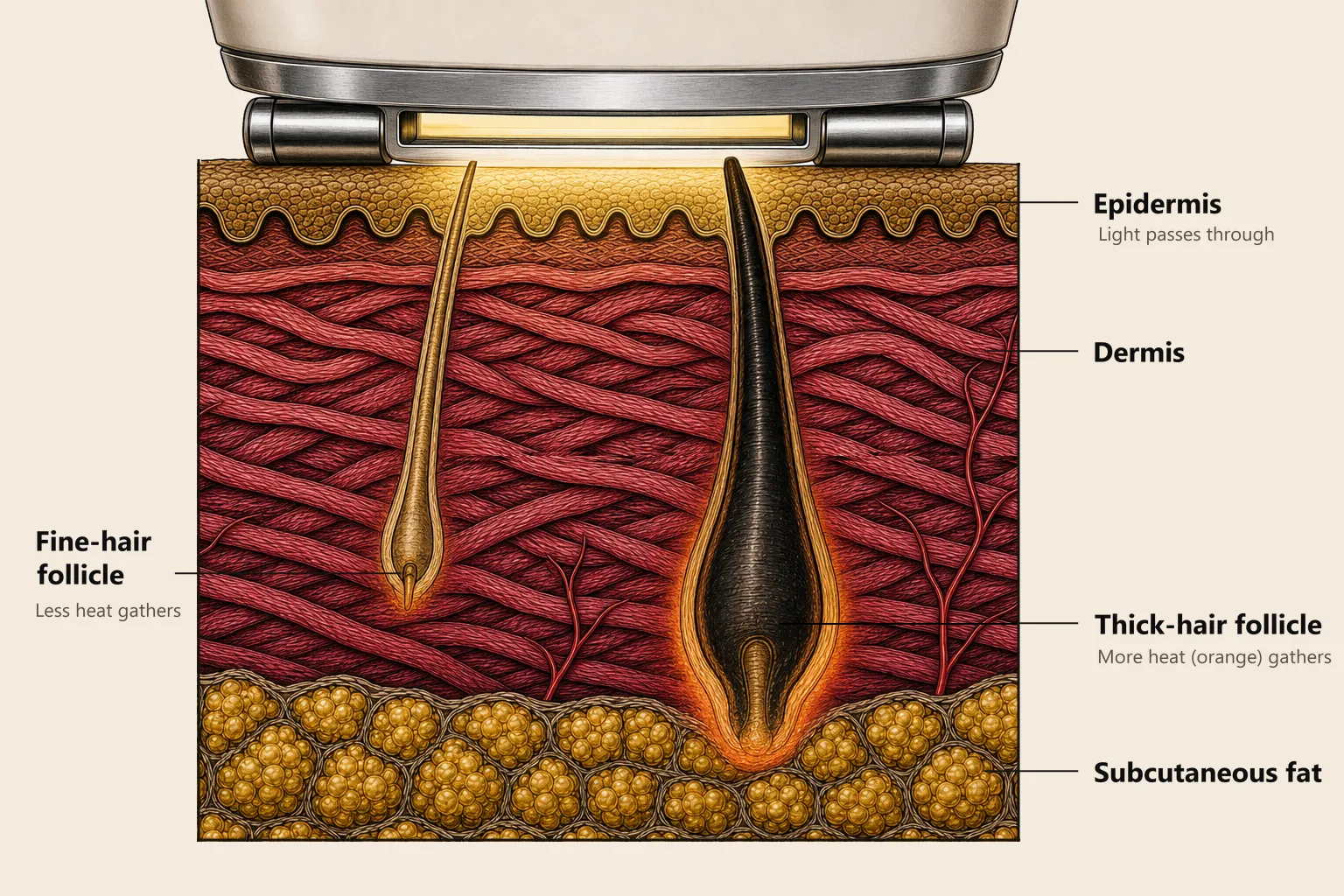
▲ The thicker the hair and the more pigment it has, the more heat gathers in its follicle; fine hair has less pigment, so less heat gathers
Clarity II at a Glance
| Item | Details |
|---|---|
| Category | Long-pulse laser hair removal · two wavelengths · does not abrade or puncture the skin |
| Mechanism | The dark pigment in hair (melanin) absorbs the light → heat travels along the hair to the follicle root, and the structures that make hair firm up |
| Wavelengths | Two lasers, 755nm and 1064nm — chosen to suit your skin tone and follicle depth |
| Manufacturer and approvals | Lutronic (Korea · now Cynosure Lutronic) · cleared by the U.S. FDA |
| Hair it suits | Facial and body hair of ordinary thickness · fine hair, such as facial peach fuzz |
| Treatment areas | Face and neck · underarms · arms · legs (every option is a 5-session package — see Pricing) |
| Numbing | Performed without numbing (no numbing wait) |
| Pain | A brief jolt of heat that travels down to the depth of the follicles · tends to feel stronger where follicles are deep and nerves are concentrated, such as the upper lip and chin |
| Pain control | Tell us how it feels during treatment and we adjust the intensity · the device has a surface cooling function |
| When hairs shed | Over several weeks after treatment, the treated hairs fall out naturally |
| Sessions | In most cases, 2–6 sessions (per the American Academy of Dermatology) · hair influenced by hormones may need more |
| Interval | In most cases, 4–6 weeks · treatment starts at 4–8 week intervals, which are gradually lengthened as the hair growth cycle slows |
| How long it lasts | In most cases, months to years without hair · when hair grows back, it tends to be less · maintenance sessions if needed |
How It Works
1. The pigment in hair absorbs the light and produces heat What the laser targets isn't the hair outside the skin, but the follicle inside the skin that makes the hair. The light passes through the skin relatively easily and is absorbed by the melanin in the hair, then turns into heat that travels along the hair deep into the follicle.
2. The structures that make hair firm up Just as egg white firms up when it's heated, the proteins at the follicle root firm up (coagulate) and lose the ability to make hair. The body then absorbs and clears away the coagulated tissue.
3. It works well on hair in its growing phase Hair cycles through a growing phase → a phase when growth stops → a resting phase. The laser works well on hairs in the growing phase, which are richest in pigment, and hairs that were resting are treated in a later session once they start growing again. This is why treatment is given several times, spaced apart.
4. Fine hair gets shorter pulses Fine hair is a small target, so it loses the heat it receives quickly. When the firing time (the pulse) is short, heat builds up before it can escape. With Clarity II, the firing time can be chosen across a wide range measured in milliseconds (1/1,000 of a second), and within that range, the 1ms pulse is the one the manufacturer designates for very fine hair.
5. The wavelength is chosen to suit your skin tone and follicle depth nm (nanometer) is the unit used to measure the wavelength of light; different wavelengths are absorbed by different targets and penetrate to different depths. 755nm is readily absorbed by melanin, so it suits lighter skin and shallow follicles; 1064nm affects the melanin at the skin's surface less and penetrates deeper, so it suits darker skin and deep follicles.
The device has functions that widen the spot size (the diameter of the light delivered in one pulse) up to 25mm and, as a roller senses the handpiece's movement, automatically overlap each treated spot by 18% — these are used to cover broad areas evenly. It also measures the skin's surface temperature in real time during treatment and shows it on screen, and it has a surface cooling function. Because the intensity can be adjusted before the surface gets too hot, this helps reduce the risk of burns to the epidermis (the outer skin).
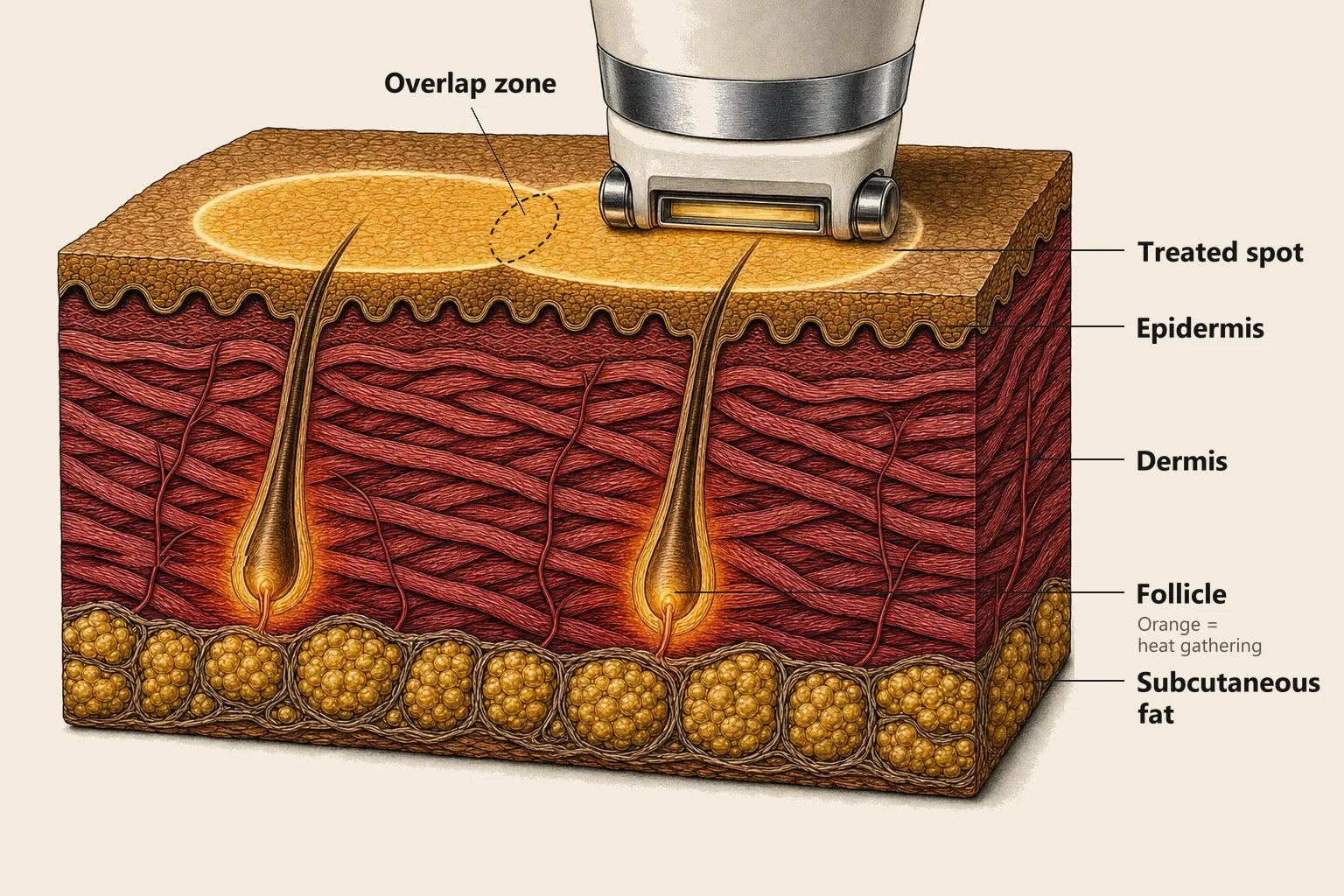
▲ Treated spots overlap by about 18% at their edges as they connect — the dotted lines mark the overlap zone
Expected Results and Why
| Expected result | Why |
|---|---|
| Fewer, finer hairs | Each session coagulates the follicles that are in their growing phase at that point, and follicles that have started growing again are treated in the next session |
| Fine hair can also be treated | The 1ms pulse for very fine hair lets heat build up even in a small target |
| Broad areas treated evenly | Automatic overlapping and real-time surface temperature display |
"Permanent hair removal" doesn't mean that not a single hair will ever grow again. Coagulated follicles can't make hair again, but some new hairs may come in from follicles that were resting or because of hormonal changes — so it is closer to hair being greatly reduced and staying that way for a long time (permanent hair reduction).
When to Consider It
- Your fine facial hair and peach fuzz (vellus hair) are so fine and faint that you wonder whether hair removal will work
- You're bothered by makeup that lifts and looks patchy over peach fuzz
- You want to cut down on repeated shaving and waxing of your underarms, arms, and legs
- You plan to have other skin treatments on your face, such as laser or radiofrequency — hair can absorb the light first or get in the way of the device making contact with the skin, so planning hair removal alongside them improves the conditions for those treatments
When a different approach may be the right fit
- White, blond, or red hair — there's little or no pigment to target, so it usually doesn't respond
- Your main concern is thick, deep hair driven by hormones — another hair removal device may be the right fit, so we decide together after looking at your hair
- Torso areas other than the underarms (chest, abdomen, back, bikini line, and so on) — these aren't among this device's hair removal options, so we consult with you about another hair removal device
Differences from Other Treatments and Limitations
| Compared approach | How they differ |
|---|---|
| Shaving, depilatory cream | Only tidies up the hair outside the skin and leaves the follicle as it is, so hair grows back |
| Waxing, tweezing | Pulls the hair out, but the follicle remains and makes hair again |
| Other hair removal lasers that use the same two wavelengths | The two wavelengths are the same; what differs are functions such as spot size, the range of pulse durations, and automatic overlapping. This is not a matter of better or worse but of differences in function, and the choice depends on the area, your skin tone, and the nature of your hair |
Limitations: This is not a treatment that removes every single hair forever; hair influenced by hormones needs more sessions, and some of it may grow back afterward.
How It's Done
1. Shaving the day before treatment The day before treatment, shave the treatment area carefully so you don't nick your skin, then come in. In-clinic shaving isn't offered, because of the risk of skin injury. The reason for shaving: if hair above the skin absorbs much of the light first, less energy reaches the root, and the surface can become irritated.
2. Consultation and treatment-area check A physician checks your hair's thickness and color, your skin tone, and any recent sun exposure in person, and we decide together which areas and options you'll have.
3. Your physician's name and a final check Before treatment, we let you know the name of the physician treating you, and the physician checks the treatment area and your skin condition once more.
4. Treatment This is performed without numbing. The handpiece is held against the skin as it fires, and on broad areas it is moved across the skin to keep firing in sequence. Areas close to the eyes, such as the glabella (between the brows) and above the eyebrows, are treated with your eyes protected from the light.
Recovery, Expected Reactions, and Precautions
Recovery: Redness and swelling may last 1–3 days in the treated area. Skin that has been heated darkens more easily (pigmentation) when exposed to sunlight, so protect treated areas from the sun and don't use tanning devices such as tanning beds. Other reactions are uncommon, but everyone responds differently — if a reaction lasts longer than expected or becomes more noticeable, contact us and we'll check it with you.
Rare but possible effects
- Blistering, lightening or darkening of the skin (which can be permanent in some cases), and scarring
- Fine, dark hair growing, paradoxically, in untreated areas near the treated area (paradoxical hypertrichosis) — proposed causes include insufficient energy stimulating follicles that were resting
Hair care between sessions: Pulling hair out by waxing or tweezing removes the hair inside the follicle that the next session needs to target. Shaving is fine, because it leaves the hair inside the follicle in place.
When we do not perform this treatment
- Pregnancy, possible pregnancy, or breastfeeding
When we postpone treatment
- Recent tanning or strong sun exposure — the pigment at the skin's surface absorbs more of the light, raising the risk of burns and pigment changes, so we proceed once the color has settled
- Inflammation or a wound in the treatment area — we proceed once it has healed
What to tell us in advance
- Keloid-prone skin (scars that swell up larger than the original wound)
- Taking medications that make your skin more sensitive to light (photosensitizing medications)
- Tattoos or semi-permanent makeup (cosmetic tattooing, such as on the eyebrows or eyeliner) in the treatment area — heat concentrates in the ink pigment, creating a risk of burns, so we check its location
- Other recent treatments — if you've had laser, a chemical peel, or similar treatments, let us know at your consultation
- Whether to have another treatment on the same day is decided together after your assessment
How PECHE Clinic Does It
We follow standards built from more than 90,000 treatments performed across the clinic. From more than 90,000 treatments performed across PECHE Clinic, we have built standards for each area, hair type, and skin condition, and the same standards apply whichever PECHE physician treats you. Even on the same person, fine facial hair and underarm hair call for different settings, so wavelength and intensity are set according to those standards.
A physician examines the treatment area in person before we begin. A physician checks your hair's thickness and color and your skin tone in person, and looks once more right before treatment.
We keep the preparation area in view behind a full glass wall. Treatment preparation takes place in an open-kitchen-style preparation area behind a full glass wall, so from the waiting area you can see the preparation process and hygiene practices for yourself.

▲ The treatment preparation area, seen through the glass wall from the waiting area
We recommend only the treatments your assessment results call for. We tell you first what this treatment can do (greatly reduce hair and make it finer) and what it can't (keep every single hair from ever growing back, or work on white hair). You're welcome to come in just for a consultation and leave.
Pricing
Prices for Clarity II are published on our website for every product option. Whichever country you're visiting from and whichever channel you book through, the price is the same as the one published on our website — so there's no need to compare prices from one booking channel to another. Making sure you can come in trusting the price you checked in advance — that is the trust PECHE Clinic puts first.
Every product name follows the format Clarity II [area] 5sessions, and we decide on the options you need together after your assessment.
| Group | Areas |
|---|---|
| Face and neck | Upper Lip Area or Front Chin · Glabella or Eyebrow (Upper) · T-zone (Glabella+Eyebrow (Upper)) · M-shaped hairline · Hairline (Including Sideburns) · Full Face (Including Forehead) · Back of Neck |
| Body | Axilla |
| Arms | Back of Hand+Fingers · Upper Arm · Forearm · Full Arms (Including Back of Hand+Fingers) |
| Legs | Top of Foot+Toes · Calves (including Knee) · Thighs · Full Legs (including Top of Foot+Toes) |
Location and Clinic Hours
PECHE Clinic 3F, 364 Gangnam-daero, Gangnam-gu, Seoul Right outside Gangnam Station Exit 4 — the building entrance is right in front of you as you come out
Clinic Hours (Korea Standard Time, KST)
- Monday–Friday: 10:30 AM – 9:00 PM
- Saturday, Sunday, and public holidays: 10:00 AM – 6:00 PM
- No lunch break — we see patients straight through midday
FAQ
Q1. Who performs Clarity II women's hair removal? A: Before treatment, we first let you know the name of the physician treating you, and that physician personally checks the treatment area and the condition of your hair and skin before starting. Wavelength and intensity follow standards built from more than 90,000 treatments performed across the clinic, so the same standards apply even if a different physician treats you.
Q2. Does it work on hair as fine and faint as facial peach fuzz? A: Fine hair has less pigment and loses heat quickly, so it responds more weakly than thick hair. The 1ms pulse for very fine hair is a setting meant to let heat build up even in this kind of hair, but the change may feel slower to come.
Q3. Can facial areas be treated separately? A: Yes. For the face and neck, there are options for individual areas — such as the upper lip, the glabella, the M-shaped hairline, the hairline, and the back of the neck — as well as a Full Face option. If hair stands out only in certain spots, just those areas may suit you; if peach fuzz covers your whole face, the Full Face option may be the right fit — so we decide together after looking at where your hair grows.
Q4. Is the treatment finished after 5 sessions? A: Five sessions is how the package is structured; it doesn't necessarily mean the treatment will be finished within them. The number of sessions you need varies with the area, the thickness of your hair, and hormonal influence, and if some new hairs come in after you finish, you can continue with maintenance sessions. We decide on the next plan together by looking at the hair that remains.
Q5. Can I have treatment on areas where the skin is darker, such as the underarms? A: Yes, you can. However, on areas with darker skin, the color contrast between hair and skin is smaller, so the skin's surface absorbs more of the light. That's why 1064nm — which affects the melanin at the skin's surface less — and conservative energy settings are considered, and more sessions may be needed as a result. Which wavelength to use is decided after looking at your skin tone in person.