Wrinkle Botox — PECHE Clinic, Gangnam Station
A muscle injection that softens expression lines by reducing the force of the muscles that pull on your skin when you make expressions · 8 areas, including the forehead, glabella, and eye area · Right outside Gangnam Station Exit 4
Wrinkle Botox
Wrinkle Botox is a treatment that injects small amounts of botulinum toxin (a medication made by purifying a protein produced by botulinum bacteria) into the muscles of facial expression to temporarily reduce their movement, softening the lines that form when you make expressions (expression lines). PECHE Clinic uses four products for this treatment: Newlux, Coretox, Xeomin, and Allergan.
Put simply, it's an injection that makes the muscles creating your lines pull on the skin less.
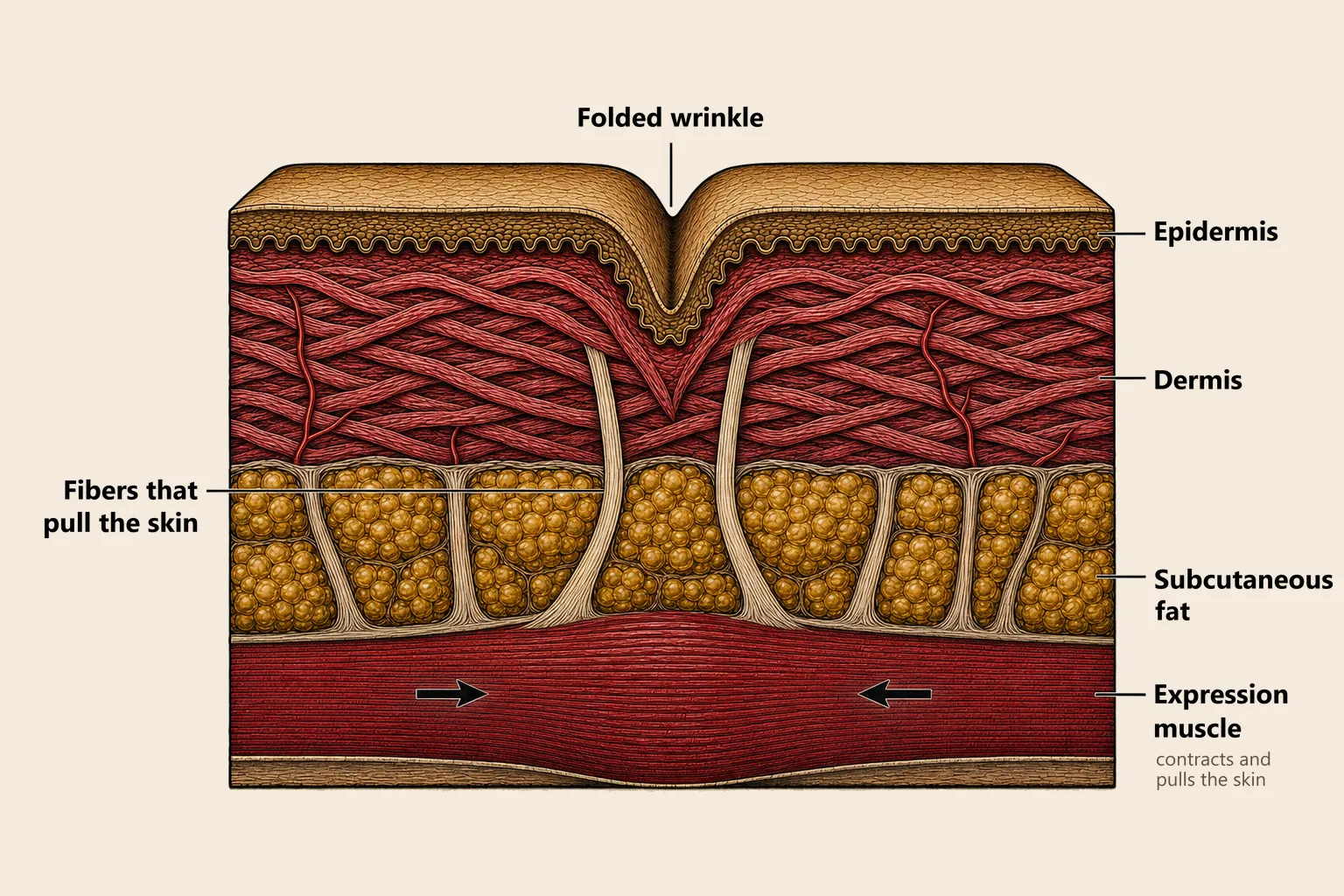
▲ When the expression muscle contracts (arrows), the fiber bundles connected to it pull on the skin and fold it into a wrinkle
Wrinkle Botox at a Glance
| Item | Details |
|---|---|
| Target layer | The muscles of facial expression, beneath the skin and subcutaneous fat |
| Treatment areas | Forehead · glabella (between the brows) · eye area · under-eye area · bunny lines (nose bridge) · alar (nostril wings) · pebble chin · eyebrow arch |
| Amount per area | Glabella and eye area 10–15 units, forehead around 10–20 units (the usual clinical range in Korea · varies with muscle mass) |
| Numbing | Ice roller for about 5 minutes |
| When results show | Gradually from days 3–7 → clearest at around week 2 |
| How long it lasts | 3–6 months |
| Repeat interval | 3–4 months (at least 3 months apart) |
A unit is a measure of the product's potency. Each product measures it differently, so unit numbers can be compared only within the same product. The doses recommended in product labeling are based on clinical trials in Western patients. If that amount is put as-is into smaller, thinner expression muscles, the brows can drop or the forehead can stiffen — so the dose is matched to each person's muscle mass.
How It Works
1. It temporarily blocks the signal nerves send to muscles The moment you go to make an expression, the nerve ending releases acetylcholine (a chemical that carries the "move" message to the muscle), and the muscle contracts. Botulinum toxin doesn't paralyze the muscle or cut the nerve — it temporarily blocks the release of this chemical.
2. When the muscle pulls less, lines soften Muscle and skin are connected by fine fiber bundles, so every time the muscle contracts, these bundles pull the skin inward and a line forms. As the pulling force lessens, the line softens too.
3. Over several months, things return to how they were As the nerve grows new branches and reconnects with the muscle, movement gradually returns.
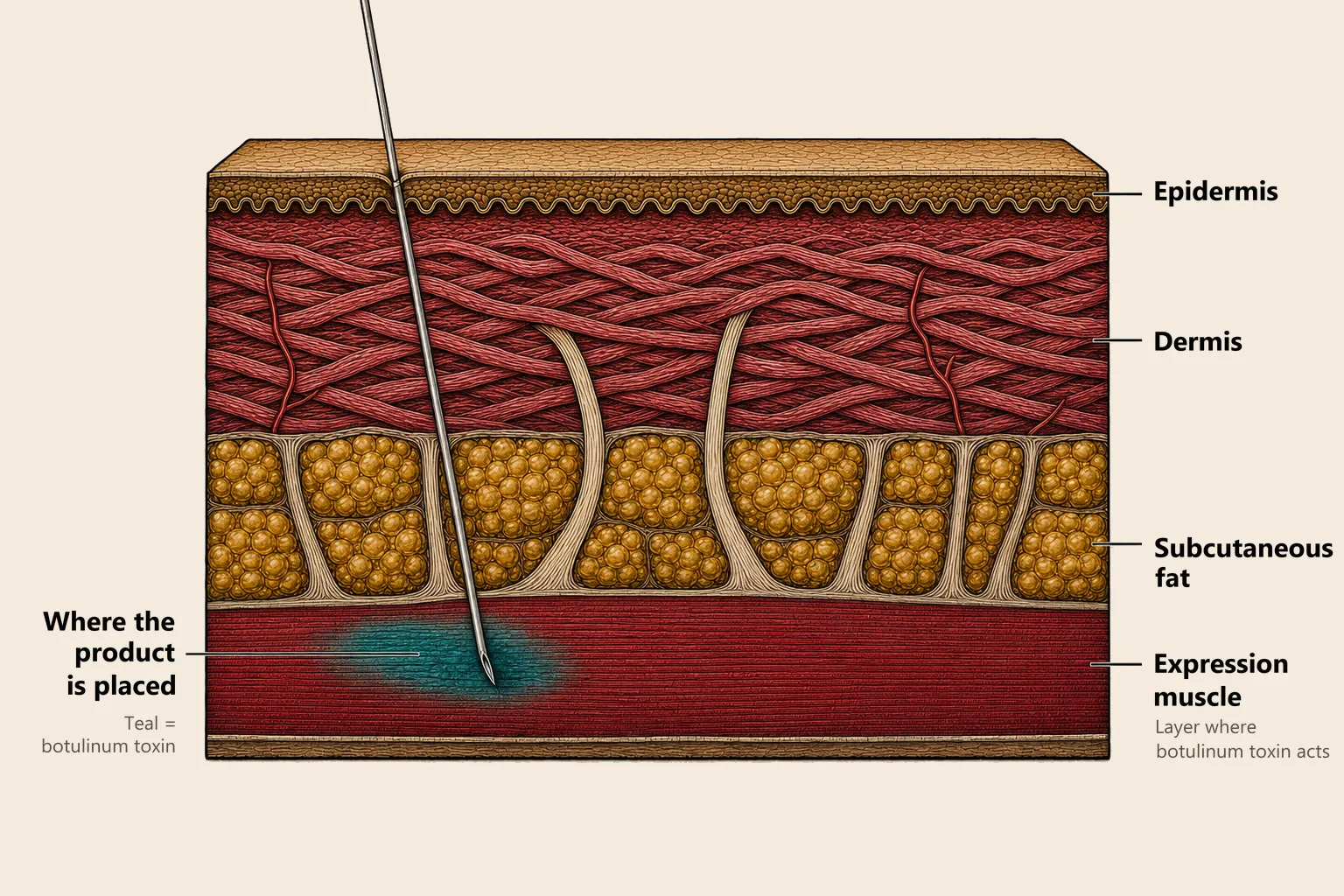
▲ The product (teal) is placed in the muscle layer beneath the skin — as the muscle relaxes, the pulling force lessens and the surface smooths out
Brow height is set by a tug-of-war between muscles. The forehead muscle raises the brows, while the muscles of the glabella and eye area pull them down. Relaxing the outer eye-area muscle that pulls the brow tail down lets the brow tail look lifted (eyebrow arch), while relaxing the forehead too much can make the brows droop — so we look at the forehead and glabella doses together.
Expected Results and Why
| Expected result | Why |
|---|---|
| Lines that form with expressions soften or smooth out | The contraction of the muscles creating the lines is itself reduced |
| The brow tails look lifted (eyebrow arch) | The muscle that was pulling the brow tails down relaxes |
| Less nostril flaring when you smile and less bumpiness at the tip of the chin | Movement of the muscle that flares the nostrils and of the chin muscle is reduced |
How much changes depends on the strength of the muscle and the depth of the line. When the effect wears off, you simply return to how you were before treatment — the lines don't become deeper than they were before.
When to Consider It
| Concern | Area |
|---|---|
| Horizontal lines when you raise your brows | Forehead |
| Vertical lines when you frown | Glabella |
| Lines that fan out from the corners of your eyes when you smile | Eye area |
| Fine diagonal lines beside the nose bridge when you smile or frown | Bunny lines (nose bridge) |
| Nostrils that flare when you smile | Alar (nostril wings) |
| A chin tip that turns bumpy when you close your mouth | Pebble chin |
| Brow tails that look droopy | Eyebrow arch |
| Fine lines under the eyes | Under-eye area (may not be suitable, depending on lower-eyelid elasticity) |
When a different approach may be the right fit
- Deep grooves that remain even when your face is relaxed (static wrinkles) — an approach that fills in the sunken area may be the right fit
- Sagging skin or loss of firmness — the cause is different, so an approach that tightens and lifts may be the right fit
Differences from Other Treatments and Limitations
| Compared approach | How they differ |
|---|---|
| Botulinum toxin placed diluted and close together in the shallow layer of the skin | It's the same medication, but Wrinkle Botox places it deep, at a few points in the expression muscles, to address "lines," while this approach places it widely across the shallow layer of the skin (the dermis) to address "surfaces" such as skin texture, oil, and fine lines |
| Filler that fills sunken grooves | Botulinum toxin addresses lines made by movement; filler addresses grooves formed where volume has sunk. Where movement lines and sunken grooves overlap, both treatments are sometimes used so the filler isn't pushed out of place by your expressions |
Limitations: It's often assumed that botulinum toxin can smooth out any wrinkle, but its target is lines made by movement — and sunken areas and pigmentation aren't its goal either.
How It's Done
1. 3D skin analysis and consultation 3D MetaVu imaging captures your lines and facial left–right balance, and we review the results together to decide on the areas and the product you'll receive.
2. Your physician's name and a final check Before treatment, we let you know the name of the physician treating you, and that physician personally reviews your assessment results and the condition of your face and skin.
3. Expression check, mapping, and marking You frown, raise your brows, and smile so we can see which muscles are pulling, and we mark the points where the product will be placed.
4. Numbing An ice roller cools the area for about 5 minutes to dull the sensation.
5. Injection A fine needle places small, divided amounts into the expression muscles. Because these spots are shallower than deep muscles such as the jaw's chewing muscle, it feels like a sharp, hot sting — without the heavy, pressing sensation of filler.
Recovery, Expected Reactions, and Precautions
Recovery: Injection marks settle within 1–2 hours, and bruising, if it occurs, fades within 3–7 days. You can wash your face and wear makeup starting 2–3 hours after treatment.
On the day of treatment: Don't lie down for 4–6 hours, and avoid saunas, strenuous exercise, and massaging the treated area. This is to reduce the chance of the product spreading into muscles it wasn't meant to reach.
Possible effects by area
- Glabella, eye area, forehead — the upper eyelids or brows may feel heavy and droop, the eyelids may swell, and forehead treatment may bring on a headache (common reactions listed in the product labeling)
- Under-eye area — too much product can make blinking uncomfortable or make the lower eyelid droop, so it isn't suitable when the lower eyelid is lax (when it doesn't spring right back into place after being gently pulled and released). Because repeated treatment can make under-eye fat more prominent, a different approach is often chosen instead
- Bunny lines (nose bridge) — if the amount is too large or the placement is off, the nostril wings may droop or the lips may become asymmetric
- Pebble chin — if the product spreads to the muscle around the mouth, you may have trouble closing your mouth all the way, or your smile may become asymmetric
Although rare, a risk shared by all botulinum toxin products is that the effect can spread beyond where it was injected, causing weakness throughout the body, double vision, drooping eyelids, or difficulty swallowing, speaking, or breathing. These symptoms can appear anywhere from a few hours to a few weeks after treatment — if you notice any of them, contact the clinic or seek medical care right away.
Other reactions are uncommon, but everyone responds differently — if a reaction lasts longer than expected or becomes more noticeable, contact us and we'll check it with you.
When we do not perform this treatment
- A past allergic reaction to botulinum toxin or to an ingredient of the product to be used (such as human albumin)
- Pregnancy, possible pregnancy, or breastfeeding
When we postpone treatment
- Infection or inflammation at the injection site — we proceed once it has settled
What to tell us in advance
- Conditions in which the nerves' ability to move the muscles is already weakened, such as myasthenia gravis or ALS (Lou Gehrig's disease) — the risk of symptoms such as difficulty swallowing or breathing increases
- Taking muscle relaxants or certain antibiotics — the product's effect may become too strong
- Taking aspirin or anticoagulants (medications that keep blood from clotting easily) — you may bruise more easily
- Botulinum toxin received elsewhere recently — tell us when, which product, and how much (we need this to set the interval and the dose)
- Other recent treatments — if you've had filler, a skin booster, lifting, or similar treatments, let us know at your consultation
- Whether to have another treatment on the same day is decided together after your assessment
How PECHE Clinic Does It
We follow standards built from more than 90,000 treatments performed across the clinic. From more than 90,000 treatments performed across PECHE Clinic, we have built standards for each area and skin condition, and the same standards apply whichever PECHE physician treats you. For Wrinkle Botox, which muscles it goes into, how many points it's divided across, and how much goes to each point are set according to those standards.
A physician personally reviews your assessment results before we begin. A physician reviews the results captured with 3D MetaVu and takes one more look at your face and skin right before treatment. That's why, even with the same Wrinkle Botox, the injection points and amounts differ from person to person. We let you know by name who will treat you before we begin.
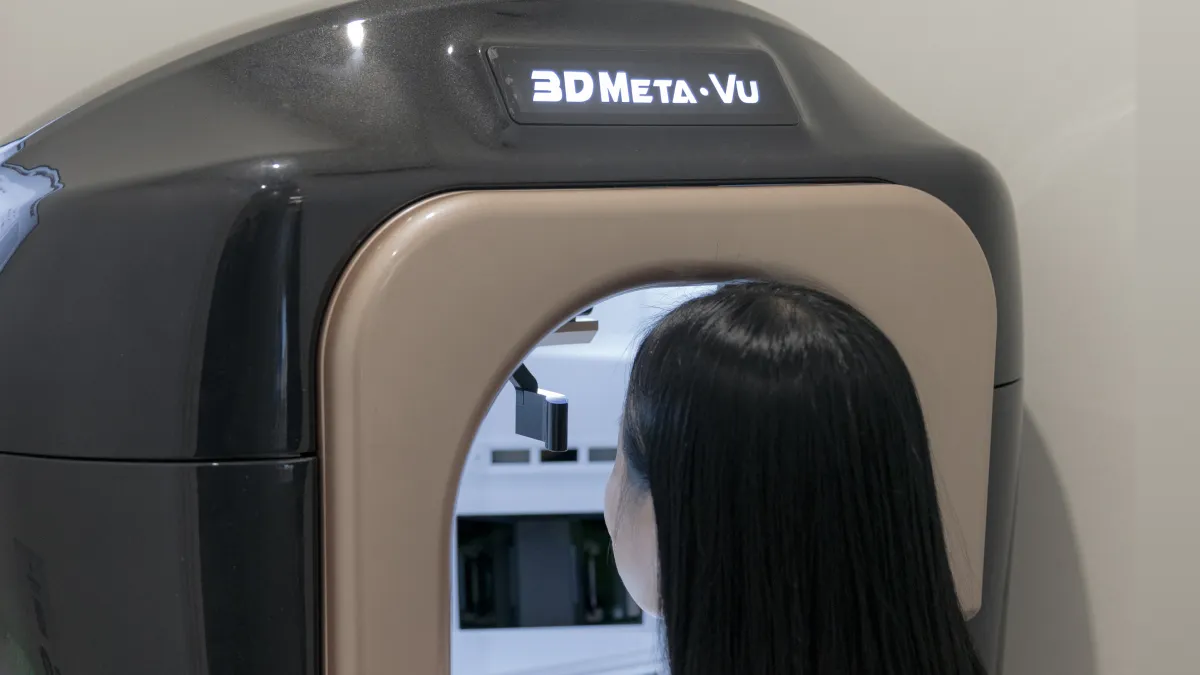
▲ We review your imaging results together
We offer four botulinum toxin products. Botulinum bacteria make the active ingredient — the part that creates the effect — wrapped in other proteins that protect it. That active ingredient is the same in all four products. What differs is whether the wrapping proteins were left in, whether human albumin (a protein naturally present in human blood) was added to help with storage, and the manufacturer and what each product is approved for. These are differences in composition, not in quality.
| Product | Made by | Wrapping proteins | Human albumin |
|---|---|---|---|
| Newlux | Korea · approval held by Numeco (a Medytox affiliate), manufactured by Medytox | Kept | Added |
| Coretox | Korea · Medytox | Removed | Not added (uses a synthetic stabilizer) |
| Xeomin | Germany · Merz | Removed | Added |
| Allergan | USA · AbbVie (which acquired Allergan) | Kept | Added |
When the wrapping proteins enter the body along with the active ingredient, the body can more easily recognize the product as foreign and may form antibodies — and then a later dose of the same amount may not work as well as it once did (known as resistance). This is uncommon, and it is generally understood that products with the wrapping removed may carry a lower chance of it. The factors that raise the risk are repeat injections at short intervals or extra injections to boost the effect, a large amount at one time, and the total amount of protein entering the body — so the principles for prevention are a dose suited to the area and an interval of at least 3 months. Products with the wrapping removed include both a Korean-made product (Coretox) and an imported one (Xeomin), so whether the wrapping is removed does not depend on whether a product is Korean-made or imported. If you have had a hypersensitivity reaction to an added ingredient (such as human albumin), products containing that ingredient are not used, so the albumin column is also considered when choosing a product.
We open genuine products in front of you and keep the preparation area in view behind a full glass wall. All four products are stored as a powder and dissolved in saline before use. This is because the product instructions specify that, once dissolved, the product is to be used without being stored for long. The genuine product is opened in front of you, and treatment preparation takes place in an open-kitchen-style preparation area behind a full glass wall, so from the waiting area you can see the genuine product, the dissolving process, and hygiene practices for yourself.

▲ The treatment preparation area, seen through the glass wall from the waiting area
We recommend only the treatments your assessment results call for. We tell you first what this treatment can do (lines made by movement) and what it can't (grooves that have already set in, sagging, hollowness). You're welcome to come in just for a consultation and leave.
Pricing
Prices for Wrinkle Botox are published on our website for every product option. Whichever country you're visiting from and whichever channel you book through, the price is the same as the one published on our website — so there's no need to compare prices from one booking channel to another. Making sure you can come in trusting the price you checked in advance — that is the trust PECHE Clinic puts first.
Wrinkle Botox (Korean/Newlux), Wrinkle Botox (Korean Premium/Coretox), Wrinkle Botox (Imported/Xeomin), and Wrinkle Botox (Imported/Allergan) each come in 1-area and 3-area options, and we decide together on the option you need after your assessment.
Location and Clinic Hours
PECHE Clinic 3F, 364 Gangnam-daero, Gangnam-gu, Seoul Right outside Gangnam Station Exit 4 — the building entrance is right in front of you as you come out
Clinic Hours (Korea Standard Time, KST)
- Monday–Friday: 10:30 AM – 9:00 PM
- Saturday, Sunday, and public holidays: 10:00 AM – 6:00 PM
- No lunch break — we see patients straight through midday
FAQ
Q1. Who performs Wrinkle Botox? A: Before treatment, we first let you know the name of the physician treating you, and that physician personally reviews your assessment results and the condition of your face and skin before starting. The injection points and the amount used follow standards built from more than 90,000 treatments performed across the clinic, so the same standards apply even if a different physician treats you.
Q2. What's the difference between the 1-area and 3-area options? A: They differ by how many of the eight areas you receive treatment in. We look at the muscles creating your lines during the assessment and decide together on only the areas you truly need.
Q3. Is the same treatment used for concerns that aren't wrinkles, like the nostrils or the tip of the chin? A: Yes. Because this treatment works by reducing muscle movement, nostrils that flare when you smile and a chin tip that turns bumpy when you close your mouth are also among the areas included in the same options.
Q4. Should I get it again as soon as the effect starts to fade? A: No. Getting extra injections at short intervals to boost the effect is a risk factor for resistance, and once resistance develops, it is difficult to reverse.
Q5. Wrinkle Botox — what should I look for when choosing a clinic? A: The same medication can give different results depending on which muscles it goes into, how many points it's divided across, and how much goes to each — so look for whether the clinic checks your expressions directly and explains those standards. It also helps to see whether they tell you the product and price in advance, and whether you can see how the medication is prepared.