Revix — PECHE Clinic, Gangnam Station
A skin booster that replenishes the dermis, in liquid form, with the substance that fills the space between cells (the extracellular matrix, ECM) · Face and neck · Right outside Gangnam Station Exit 4
Revix
Revix is a skin booster (an injectable treatment aimed at the quality of the skin itself) made from donated human dermis: the cells are removed, leaving only the substance that filled the space between them (the extracellular matrix), and this material is made into a liquid. It is injected by hand into the dermis (the layer beneath the epidermis that gives skin its firmness and thickness), where it is understood to fill in the environment in which skin cells attach and do their work.
Put simply, it isn't an injection that plumps up hollow areas — it fills in skin that has become thin and parched from the inside, working on texture, firmness, and density.
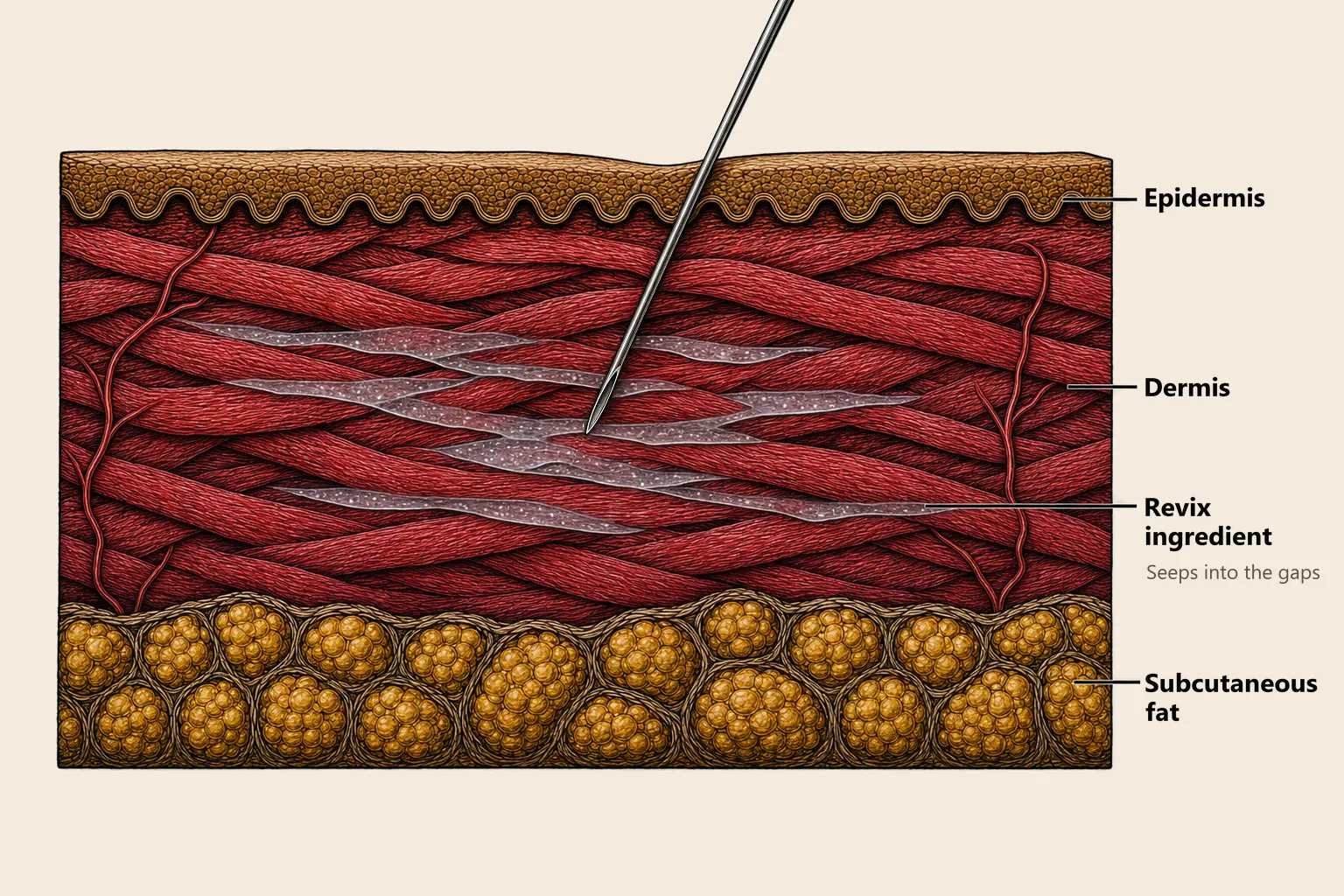
▲ The Revix liquid (translucent white) seeps thinly between the collagen fibers
Revix at a Glance
| Item | Details |
|---|---|
| Category | Injectable skin booster that directly replenishes the extracellular matrix (ECM) |
| Main ingredient | Human acellular dermal matrix (hADM) — material made by removing the cells from donated human dermis, leaving only the extracellular matrix |
| Mechanism | Replenishes the extracellular matrix in the dermis, filling in the environment where cells attach and do their work |
| Target layer | Dermis |
| Concerns and areas it suits | Thin skin lacking firmness · parched texture · fine lines and loss of inner firmness / Outer cheeks, smile lines, jawline, and neck · areas where the skin is thin, such as under the eyes |
| Available options | Revix Skin Booster 6cc · Revix Volumizing 4cc |
| Injection method | Hand injection |
| Numbing | Local anesthesia (numbs only the treatment area) · no separate waiting time |
| When results show | Changes in texture, fine lines, parchedness, and inner firmness gradually noticeable from weeks 2–4 |
| How long it lasts | Not set as a number — varies widely from person to person with skin thickness, aging, sun exposure, sleep, smoking, and other treatments you have alongside it |
| Recommended interval and sessions | A basic course of 3 sessions, 3–4 weeks apart → then maintenance every 3–6 months (decided together after your assessment) |
| Recovery | Swelling 1–2 days · small raised bumps (the injection spots rise slightly) a few hours to 1 day · injection marks and redness 1–2 days · bruising, if it occurs, 3–7 days |
| Donor tissue safety | Only donor tissue judged suitable after screening for infectious diseases such as HIV, hepatitis B and C, and syphilis — in line with Korean law and the standards of Korea's Ministry of Food and Drug Safety (MFDS) — is used |
How It Works
1. The extracellular matrix — the substance that fills the space outside cells The spaces between cells are filled with a mesh of collagen (the fibers that form the skin's framework), elastin (elastic fibers that let skin stretch and spring back), and hyaluronic acid (an ingredient that holds water); together, these are called the extracellular matrix (ECM). It gives skin its firmness and thickness, and fibroblasts — the cells that make collagen — live and work attached within it.
2. When it declines, there are fewer places for cells to attach As the extracellular matrix declines with age, sun exposure, and repeated treatments, the gaps between fibers widen, and there are fewer places for cells to attach and work. This is where the feeling that "my skin has gotten thinner" or "my makeup won't sit smoothly" comes from.
3. The same material is placed into the dermis When the cells are removed from human dermis, only the extracellular matrix remains. This is called human acellular dermal matrix (hADM) — "acellular" meaning the cells have been removed, and "human" meaning it comes from another person, a donor. The cells are removed because the components that trigger an immune response are in the cells. Revix is this material ground into fine microparticles and suspended in water in advance, so it is injected as-is, with no powder to dissolve.
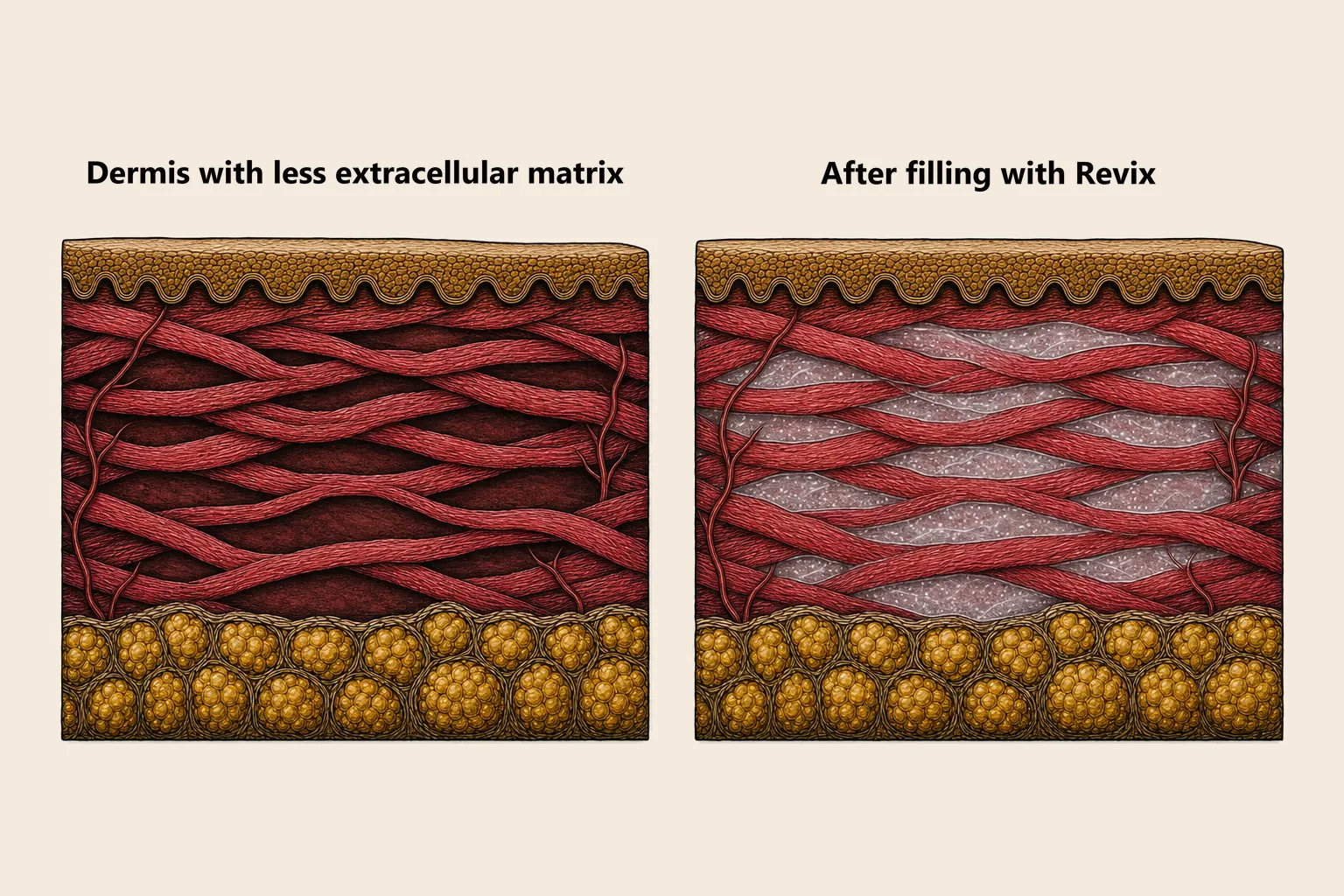
4. Cells move in and get to work This material has a sponge-like structure full of tiny pores, so fibroblasts attach to the surface of the particles and then move into the pores, settle, and multiply. As the extracellular matrix becomes more orderly, the cells' work of making and organizing collagen and elastin is understood to continue more steadily.
▲ Dermis with widened gaps between its fibers (left) and dermis where Revix has filled those gaps (right). New collagen then forms over several weeks to several months (conceptual illustration · results vary by person)
Expected Results and Why
| Expected result | Why |
|---|---|
| Smoother texture and less parchedness | Because the extracellular matrix is replenished, settling the dermal environment |
| Inner firmness and a sense of density | Because cells attach again and make and organize collagen and elastin |
| Softer fine lines and tidier skin around pores | For the same reason — the dermal environment settles |
Hydration you notice within the first week may simply be the surface settling, from moisture and slight swelling, so it isn't the main change yet. The main change appears after cells attach to the replenished extracellular matrix and get to work, so it takes a few weeks, and with repeated sessions, firmness and density build up over 1–3 months. How much your skin changes, and how quickly, varies from person to person.
When to Consider It
| Concern | Why |
|---|---|
| Thin, weak skin that flushes easily and makeup that won't sit smoothly | It replenishes the extracellular matrix first |
| Rough, parched texture · you'd rather avoid an overly dewy, glassy finish | It fills in the structure where moisture and collagen settle |
| Pores, fine lines, and loss of firmness together, but collagen-stimulating treatments feel like too much | It fills in the environment where collagen is made |
| Improving skin quality after lifting (ultrasound or radiofrequency) | It works on something different from what lifting does |
| Areas where the skin is thin, such as under the eyes | Because it's a liquid, the amount and depth are easy to adjust |
When a different approach may be the right fit
- Significant hollowness — filler or a volume-type collagen-stimulating treatment comes first
- Sagging is your main concern — lifting comes first, and Revix is planned alongside it
- Deep acne scars — scar treatments such as scar lasers or microneedle radiofrequency come first
- You're expecting a big, immediate change — this treatment works by filling in the skin's environment, so it isn't the right fit
Differences from Other Treatments and Limitations
| Compared approach | What they share | How they differ |
|---|---|---|
| Filler | Both are injected | Filler takes up space in the deep dermis, under the skin, or on top of the bone to create volume and contour, while Revix mainly replenishes the skin environment and density within the dermis |
| PN regenerative-signal skin boosters | Both improve the dermal environment | PN (DNA fragments obtained from salmon) sends cells a repair signal, while Revix fills in the structure cells work in |
| Skin boosters that use microparticles to prompt collagen production | Both help your own collagen increase | That approach prompts collagen production, while Revix fills in the environment where collagen is made |
| Hyaluronic acid hydrating skin boosters | Both refine skin texture | Hyaluronic acid holds onto water, while Revix fills in the structure where moisture and collagen settle |
| Skin boosters that directly supply ready-made collagen | Both fill in from the outside | That approach replenishes collagen as a material, while Revix places in the entire mesh structure that cells move into to make collagen |
| Skin boosters made from the same material in powder-particle form | Both belong to the same extracellular-matrix-replenishing group | This is not a matter of better or worse but of form and how it is injected — because Revix is a liquid, the amount and depth are easy to adjust even in thin areas |
Limitations: Revix is not a volume treatment that fills hollow areas, and it doesn't change the skin's structure in a single session or make the skin permanently thicker.
How It's Done
1. 3D skin analysis and consultation 3D MetaVu imaging photographs your skin texture, pores, fine lines, and color under different light sources, and we use the imaging results and your consultation to decide on the option and the treatment area.
2. Your physician's name and a final check Before treatment, we let you know the name of the physician treating you, and that physician personally reviews your assessment results and the condition of your skin.
3. Opening the genuine product, and numbing The genuine product is opened in front of you, and the treatment is then done under local anesthesia, with no separate waiting time.
4. Hand injection The product is injected by hand, divided across the dermis. Hand injection is a method that lets the physician adjust the depth and amount for each area directly.
What you feel is a sting as the needle goes in and a sense of pressure as the product spreads. Because Revix is a thin liquid that seeps in gently, this pressure tends to be milder than with more viscous skin boosters.
If pain is a concern, you can add Non-Sedation Gas Anesthesia (Air Nox) as an option — you breathe in a mix of oxygen and nitrous oxide that reduces pain and tension while you stay conscious and responsive.
Recovery, Expected Reactions, and Precautions
Recovery: The raised bumps are a normal sign that the product has gone into the dermis, and they settle as it seeps in — until then, don't press or rub them. Other reactions are uncommon, but everyone responds differently — if a reaction lasts longer than expected or becomes more noticeable, contact us and we'll check it with you.
Daily life after treatment: The needle openings need time to close, so a gentle water-only rinse can start 3–4 hours after treatment, and washing with a foaming cleanser and wearing makeup can start gently the next morning. Until redness and swelling have settled, avoid saunas, jjimjilbang (Korean bathhouse saunas), and strenuous exercise. Strong heat and sweat can irritate the widened blood vessels and make redness and swelling worse.
When we do not perform this treatment
- Pregnancy, possible pregnancy, or breastfeeding
- A past hypersensitivity reaction to the ingredients, or a past sudden, severe whole-body allergic reaction (anaphylaxis)
- An allergy to lidocaine or other local anesthetics — because the treatment is done under local anesthesia
When we postpone treatment
- Inflammation or active acne in the treatment area, or a herpes flare-up (cold sores around the mouth) — we proceed once it has settled
What to tell us in advance
- Taking aspirin or anticoagulants (medications that keep blood from clotting easily) — you may bruise more easily
- Keloid-prone skin (scars that heal raised and thickened)
- Other recent treatments — if you've had lifting, laser, filler, another skin booster, or similar treatments, let us know at your consultation
- Whether to have another treatment on the same day is decided together after your assessment
As with any injection treatment, an infection or allergic reaction can rarely occur, as can the product entering a blood vessel and blocking it. If pain keeps getting worse after treatment, or the skin turns white or a dark, dusky red, contact us right away.
How PECHE Clinic Does It
We follow standards built from more than 90,000 treatments performed across the clinic. From more than 90,000 treatments performed across PECHE Clinic, we have built standards for each area and skin condition, and the same standards apply whichever PECHE physician treats you. With Revix, those standards set which areas the product goes into and how much is divided among them.
A physician personally reviews your assessment results before we begin. A physician reviews your 3D MetaVu imaging results and checks your skin's condition once more just before treatment. That's why, even with the same Revix, the option and amount differ from person to person.
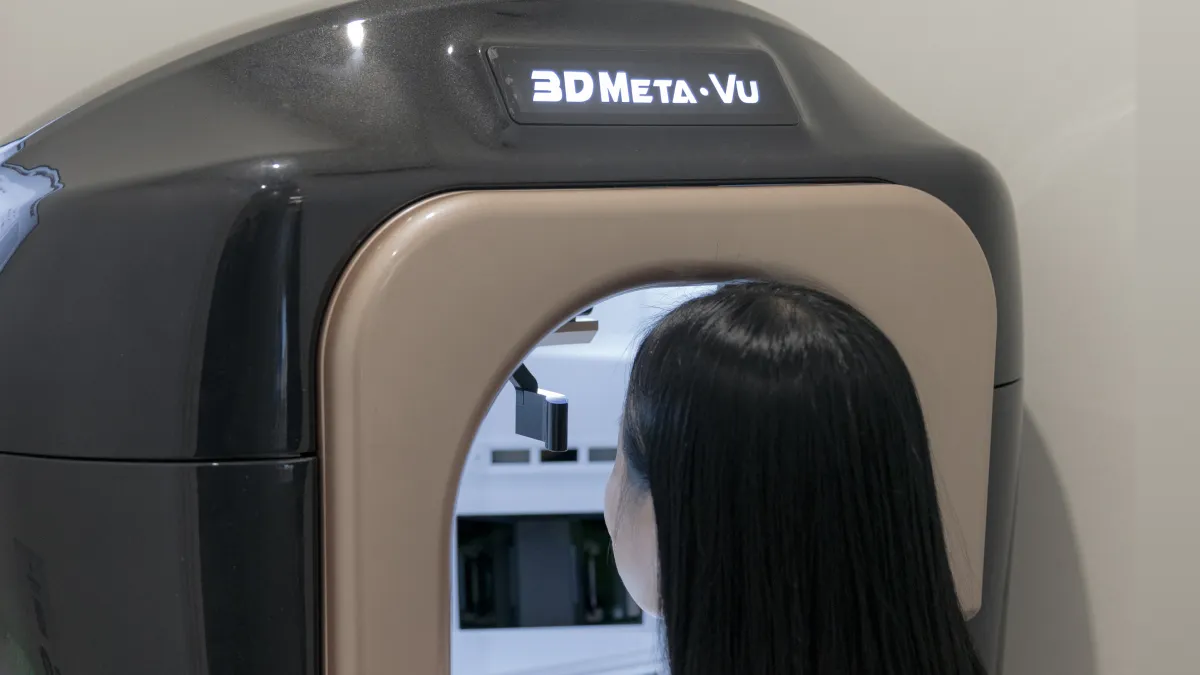
▲ We review your imaging results together
We open genuine products in front of you and keep the preparation area in view behind a full glass wall. The genuine product used in your treatment is opened in front of you. Treatment preparation takes place in an open-kitchen-style preparation area behind a full glass wall, so from the waiting area you can see the genuine product, the preparation process, and hygiene practices for yourself.

▲ The treatment preparation area, seen through the glass wall from the waiting area
We recommend only the treatments your assessment results call for. We tell you up front what this treatment can do (texture, inner firmness, density) and what it can't (lost volume, sagging itself, a big immediate change). You're welcome to come in just for a consultation and leave.
Pricing
Prices for Revix are published on our website for every product option. Whichever country you're visiting from and whichever channel you book through, the price is the same as the one published on our website — so there's no need to compare prices from one booking channel to another. Making sure you can come in trusting the price you checked in advance — that is the trust PECHE Clinic puts first.
Revix is offered as Revix Skin Booster 6cc and Revix Volumizing 4cc, and the option you need is decided together after your assessment.
Location and Clinic Hours
PECHE Clinic 3F, 364 Gangnam-daero, Gangnam-gu, Seoul Right outside Gangnam Station Exit 4 — the building entrance is right in front of you as you come out
Clinic Hours (Korea Standard Time, KST)
- Monday–Friday: 10:30 AM – 9:00 PM
- Saturday, Sunday, and public holidays: 10:00 AM – 6:00 PM
- No lunch break — we see patients straight through midday
FAQ
Q1. Who performs the Revix treatment? A: Before treatment, we first let you know the name of the physician treating you, and that physician personally reviews your assessment results and the condition of your skin before starting. Because this treatment is injected by hand, the depth and how the amount is divided affect the result — and these are set by standards built from more than 90,000 treatments performed across the clinic, so the same standards apply even if a different physician treats you.
Q2. How do Revix Skin Booster and Revix Volumizing differ? A: Both are Revix, in two formats with different uses. Revix Skin Booster works on the skin environment and density across the whole face, while Revix Volumizing is a format that supports volume in areas that have lost firmness, such as the outer cheeks, smile lines, and jawline. That said, Revix Volumizing isn't intended to create filler-level volume either, so it isn't a treatment for filling hollow areas. Which one suits you is decided together at your assessment.
Q3. I've had lifting treatments, but my skin itself still feels weak. Why is that? A: Lifting pulls up deeper layers or stimulates collagen production, so if the extracellular matrix has declined and there simply aren't enough places for cells to attach and work, the skin can still feel thin and weak. Revix fills in those places, so its role is different, and it is used alongside lifting to improve skin quality afterward. Whether to have both on the same day is decided based on the type of lifting and your skin's condition.
Q4. My skin is thin and flushes easily — can I have Revix? A: This is one of the typical cases where Revix is considered. If strong heat or stimulation feels like too much for your skin, replenishing the extracellular matrix within the skin first may be the right approach. Since it is an injection treatment, though, injection marks and redness do occur.