Potenza — PECHE Clinic, Gangnam Station
Radiofrequency microneedling that produces heat at the dermal depth the fine needles reach · Pores, depressed scars, skin texture, and raised lesions · Right outside Gangnam Station Exit 4
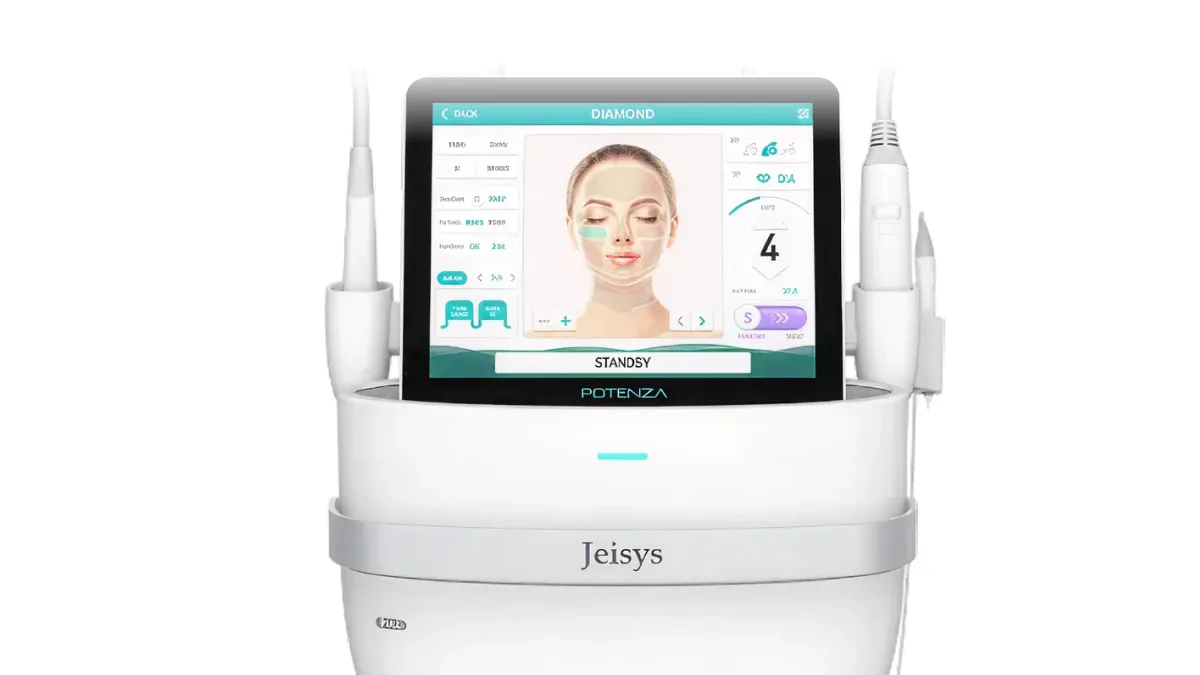
Potenza
Potenza is a radiofrequency microneedling device: several fine microneedles enter the skin down to the dermis, and heat from radiofrequency (RF — current passing through tissue generates heat) is released at the depth the needles reach. It is made by the Korean company Jeisys Medical.
Put simply, it leaves the skin's surface intact and delivers heat stimulation beneath it, which is understood to prompt the skin to make new collagen. Concerns spread across an area — pores, depressed scars, and skin texture — are treated with the multi-needle Pore Tip, and raised lesions that form one spot at a time are treated with the single-needle Potenza Agnes Acne (Agnes for short).
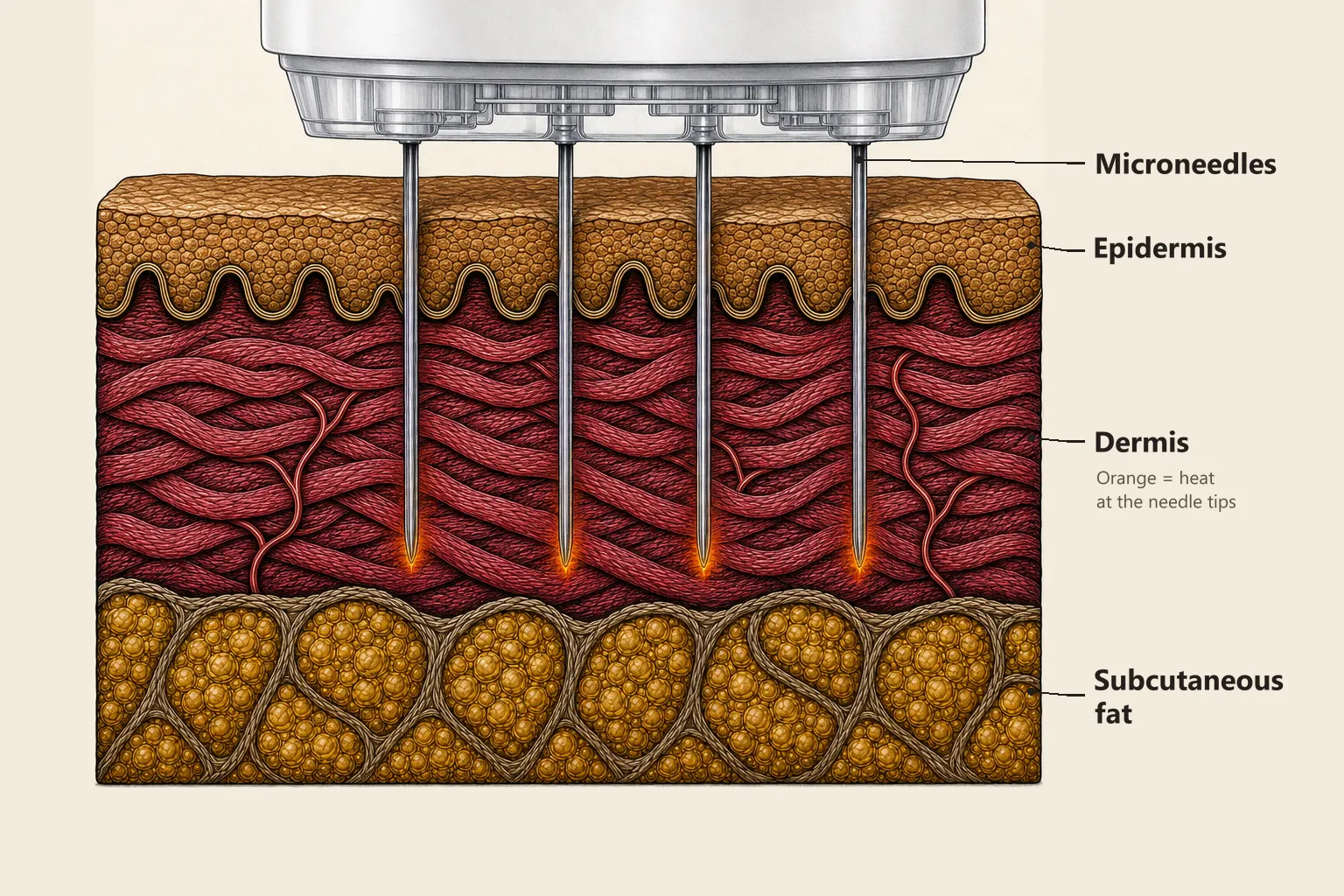
▲ The heat comes not from the skin's surface but from the depth the needles reach
Potenza at a Glance
| Item | Details |
|---|---|
| Category | Radiofrequency microneedling (RF microneedling) — in scar treatment, it handles "regeneration," filling in with new collagen |
| Target layer | Dermis — heat is delivered to the dermis while the epidermis is left intact |
| Available options | Pore Tip (multiple needles) = pores, depressed scars, skin texture / Agnes (single needle) = recurring acne, syringoma, sebaceous hyperplasia, milia |
| Numbing | Numbing cream, then a 20-minute wait (same for the Pore Tip and Agnes) |
| When results show | Pores, scars, and skin texture = gradually, over the 2–3 months it takes new collagen to build up |
| Recommended sessions and interval (Pore Tip) | An intensive course of 3–5 sessions at 3–4 week intervals → then maintenance once every 6 months–1 year (adjusted after your assessment) |
| Recommended sessions (Agnes) | Shallow milia often clear in 1–2 sessions · for deeper syringoma, sebaceous hyperplasia, and recurring acne, treatment is divided into 3–5 sessions at 3–4 week intervals to reduce the risk of scarring |
| Recovery | Pore Tip = redness and swelling, usually 1–3 days · Agnes = temporary redness and small scabs |
How It Works
1. Heat comes out at the depth the needles reach The microneedles pass through the outer layer of skin (epidermis) into the layer where collagen gathers to support the skin (dermis), and the radiofrequency produces heat not at the skin's surface but at the depth the needles reach. This reduces heat damage to the epidermis while placing heat at the intended depth.
2. New collagen is made as the skin heals As the heat-stimulated areas heal, the cells that make collagen (fibroblasts) are understood to produce new collagen. New collagen around a pore supports the stretched pore from the outside, and depressed scars fill in around their edges and base.
3. The Pore Tip works down to the lower dermis With the Pore Tip, the needles reach the lower part of the dermis, and the radiofrequency is used more strongly than with the ingredient-delivery tip (Pumping Tip), so stimulation for pores and deep depressions tends to be stronger.
4. Agnes places one needle in each lesion A single insulated needle (a needle coated so that electricity comes out only at its tip) is placed inside the lesion, and radiofrequency is released only at the tip. That heat is used to coagulate (firm up) the tissue that forms the lesion — such as an enlarged oil (sebaceous) gland or clustered sweat ducts — while the epidermis is left in place.
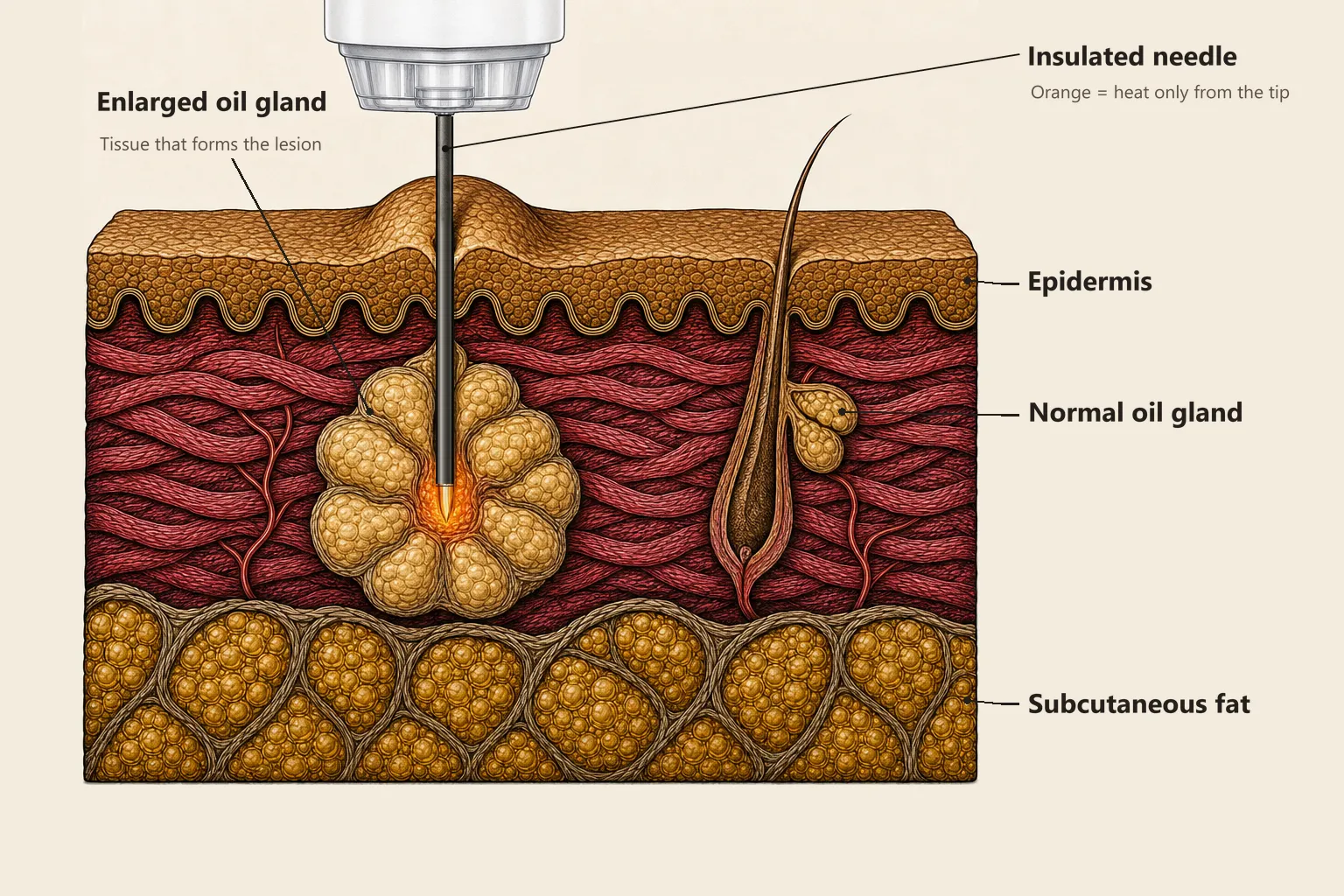
▲ Heat comes out only at the tip of the coated needle and coagulates the lesion tissue (an enlarged oil gland shown as the example)
Expected Results and Why
| Expected result | Why |
|---|---|
| Pores look less prominent | New collagen builds up around the pore and supports the stretched channel from the outside |
| Depressed scars fill in | New collagen fills the dermis around and beneath the scar |
| Rough skin texture becomes smoother | Dermal collagen is rebuilt and supports the surface more evenly |
| Raised lesions shrink (Agnes) | Heat from the needle tip coagulates the tissue that forms the lesion — removal rates tend to increase with repeated sessions |
Rather than adding collagen, this approach has your skin make its own, so changes appear gradually, and because there is a limit to how much can be made at one time, treatment is divided into sessions. In a 2022 study that looked back at the records of 75 people with enlarged pores, improvement rates rose as the number of sessions increased. In a 2021 study that treated syringoma around the eyes in 55 people with insulated single-needle radiofrequency, about half (50.9%) showed clear improvement after one session. Individual results vary.
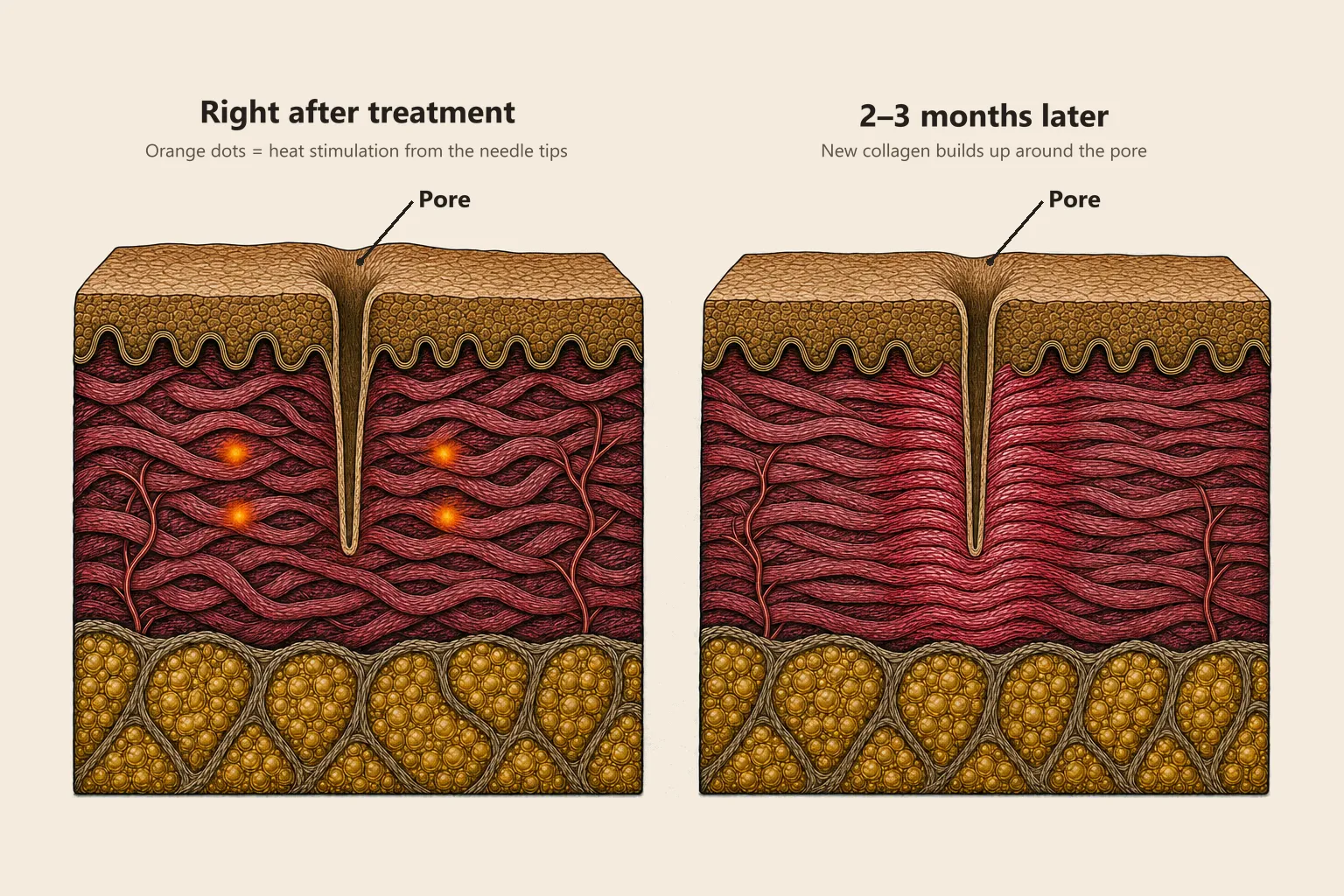
▲ New collagen builds up where the heat stimulation was delivered and supports the pore from the outside
When to Consider It
- Enlarged pores or rough skin texture that makeup can't cover
- Depressed acne scars that stand out depending on the lighting
- Acne that keeps coming back in the same spot — Agnes
- Small sweat-duct bumps around the eyes (syringoma), small yellowish bumps from an enlarged oil gland (sebaceous hyperplasia), or tiny white grains of keratin trapped under the skin (milia) — Agnes
When a different approach may be the right fit
- When the main cause is excess oil and clogged pores — oil control and exfoliation care are needed as well
The order of treatment Acne, scar, and pore treatment generally follows an order: ① control active inflammation → ② improve scar structure that is tethered at the base (release) → ③ regeneration → ④ clearing color marks. This is because new scars can form while inflammation keeps flaring up. Potenza (Pore Tip) handles ③ regeneration. Agnes treats lesions one at a time, so it is considered separately from this order.
Differences from Other Treatments and Limitations
| Compared approach | What they share | How they differ |
|---|---|---|
| A method that cuts the fibers holding down the base of a scar (subcision) | Both treat depressed scars | The cutting method cuts the tough fibrous bands pulling the scar's base down, making room for it to rise; Potenza fills in around and beneath it with new collagen — heat is a stimulus that prompts tissue to rebuild, not a force that cuts |
| Fractional laser that delivers light in tiny dots | Both stimulate the dermis to make new collagen | The difference is whether the stimulus comes as tiny injury points from light or as heat from current at the needle tips |
| Ablative laser that removes thin layers starting from the surface | Both treat small lesions such as sebaceous hyperplasia and milia one by one | An ablative laser works its way down from the surface, while an insulated needle leaves the epidermis in place and coagulates the lesion with heat from the needle tip. This is not a matter of better or worse but of how each one works |
Limitations: Potenza is not a lifting treatment that raises sagging contours. It also cannot permanently change your natural pore size, so the tendency for pores to widen again with aging and oil production is managed with maintenance sessions.
Other tips and combinations on the same device Potenza also has the Pumping Tip, a tip for delivering ingredients. The Pumping Tip also produces radiofrequency heat at the needle tips, but uses gentler heat at a shallower depth, and as the needles withdraw, air pressure pushes the applied ingredient down into the dermis. The Klardie product is performed with the Pore Tip, and the Celexo Black Label product with the Pumping Tip. The Potenza Pumping Tip can be added as an option to Rejuran, Juvelook, Belotero Revive, NewArti, and Laetigen.
How It's Done
1. 3D skin analysis and consultation 3D MetaVu imaging captures the condition of your pores, sebum, and skin texture under different light sources, and we review the results together to decide on the option and the intensity for each area. For Agnes, a physician examines the lesions in person to confirm what type they are.
2. Your physician's name and a final check Before treatment, we let you know the name of the physician treating you, and that physician personally reviews your assessment results and the condition of your face and skin.
3. Numbing We apply numbing cream and wait 20 minutes.
4. Treatment With the Pore Tip, the tip is pressed onto the skin and moved along, one stamp at a time. Several fine needles touch the skin at once, so it stings like a hot stamp being pressed down firmly, and right afterward a burning warmth spreads briefly beneath the skin.
With Agnes, one needle is placed into each lesion. There is a shallow sting as the needle goes in, and the moment the heat reaches the lesion, a sharp, tingling sensation and a heavy warmth pass briefly.
Tell us how it feels, and we adjust the intensity.
5. Finishing care Pore Tip sessions finish with Cryo Soothing Care (care that uses a cold device to cool skin that has warmed up — it is not a freezing treatment) and a Sheet Mask; Agnes sessions finish with a Soothing Gauze Mask.
▲ Potenza, a radiofrequency microneedling device
Recovery, Expected Reactions, and Precautions
Recovery: With the Pore Tip, redness and swelling usually last 1–3 days and can last a little longer when the needle depth and energy are stronger. Occasionally, small acne-like bumps may appear. With Agnes, temporary redness and small scabs may form where the lesions were treated. Other reactions are uncommon, but everyone responds differently — if a reaction lasts longer than expected or becomes more noticeable, contact us and we'll check it with you.
Aftercare (Pore Tip)
- Water-only rinsing from 3–4 hours after treatment — the time the channels made by the needles take to close
- Cleanser and makeup: from the next morning
- Saunas and exercise that makes you sweat: put off for 3 days to 1 week — heat and sweat can increase redness and swelling
After Agnes, the scabs act as a protective cover while new skin fills in underneath, so don't pick them off.
When we do not perform this treatment
- Pregnancy, possible pregnancy, or breastfeeding
When we postpone treatment
- Pus-filled acne spread widely across the face — the needles could burst infected spots and spread bacteria, so the inflammation is calmed first
- Taking acne medication (isotretinoin), or less than 6 months since you stopped — your skin is drier and more sensitive, so we adjust the timing
What to tell us in advance
- Allergy to lidocaine or other anesthetics — because numbing cream is applied before treatment
- An electronic device in the body, such as a pacemaker, or metal implants in the face — because current passes through the tissue, we check in advance
- A cold sore (herpes) flare-up around the mouth — needle stimulation could spread it
- Recent tanning — skin that has been heated up by the sun is more sensitive
- Keloid-prone skin (scars that heal raised and thickened) — needle marks may heal raised
- Taking aspirin or anticoagulants (medications that keep blood from clotting easily) — needle marks and bruising may be darker or last longer
- Conditions that worsen with cold, such as cold urticaria (hives triggered by cold) or Raynaud's disease — because the Cryo Soothing Care at the end of a Pore Tip session cools the skin
- Other recent treatments — if you've had filler, a skin booster, laser, or similar treatments, let us know at your consultation
- Whether to have another treatment on the same day is decided together after your assessment
How PECHE Clinic Does It
We follow standards built from more than 90,000 treatments performed across the clinic. From more than 90,000 treatments performed across PECHE Clinic, we have built standards for each area and skin condition, and the same standards apply whichever PECHE physician treats you. With Potenza, the needle depth and intensity are set according to those standards.
A physician personally reviews your assessment results before we begin. A physician reviews your 3D MetaVu imaging results and checks your face and skin once more right before treatment. Before we start, we tell you the name of the physician treating you.
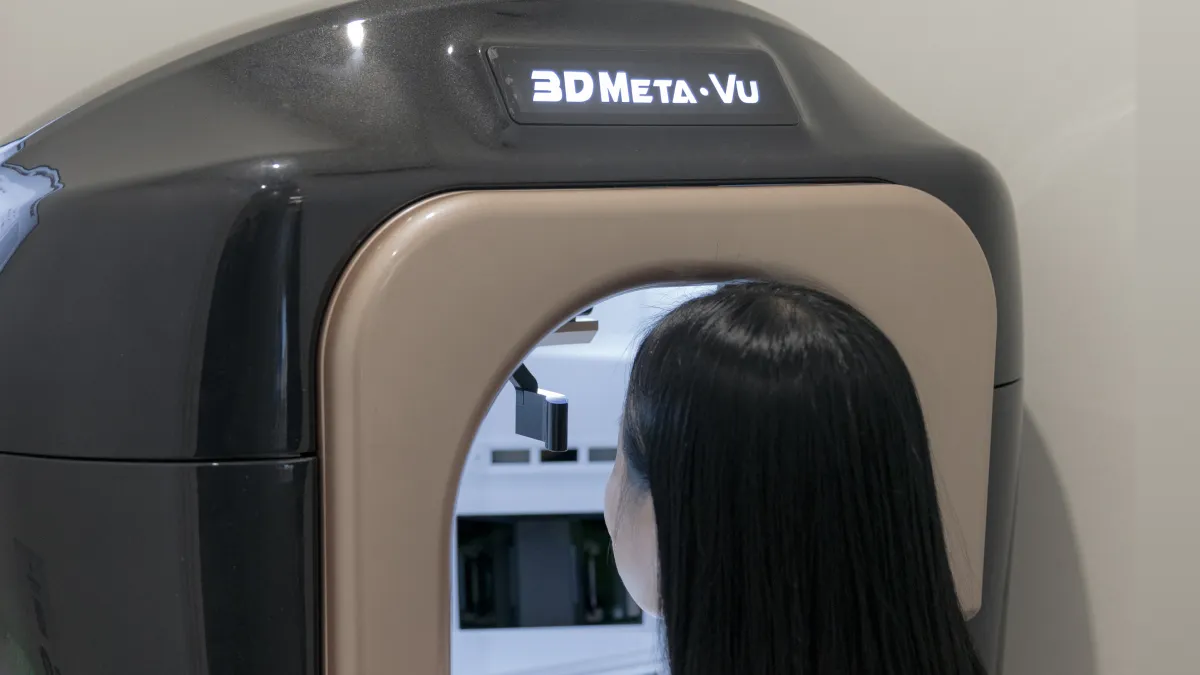
▲ We review your imaging results together
We use only genuine tips and keep the preparation area in view behind a full glass wall. We use only genuine tips. Treatment preparation takes place in an open-kitchen-style preparation area behind a full glass wall, so from the waiting area you can see the preparation process and hygiene practices for yourself.
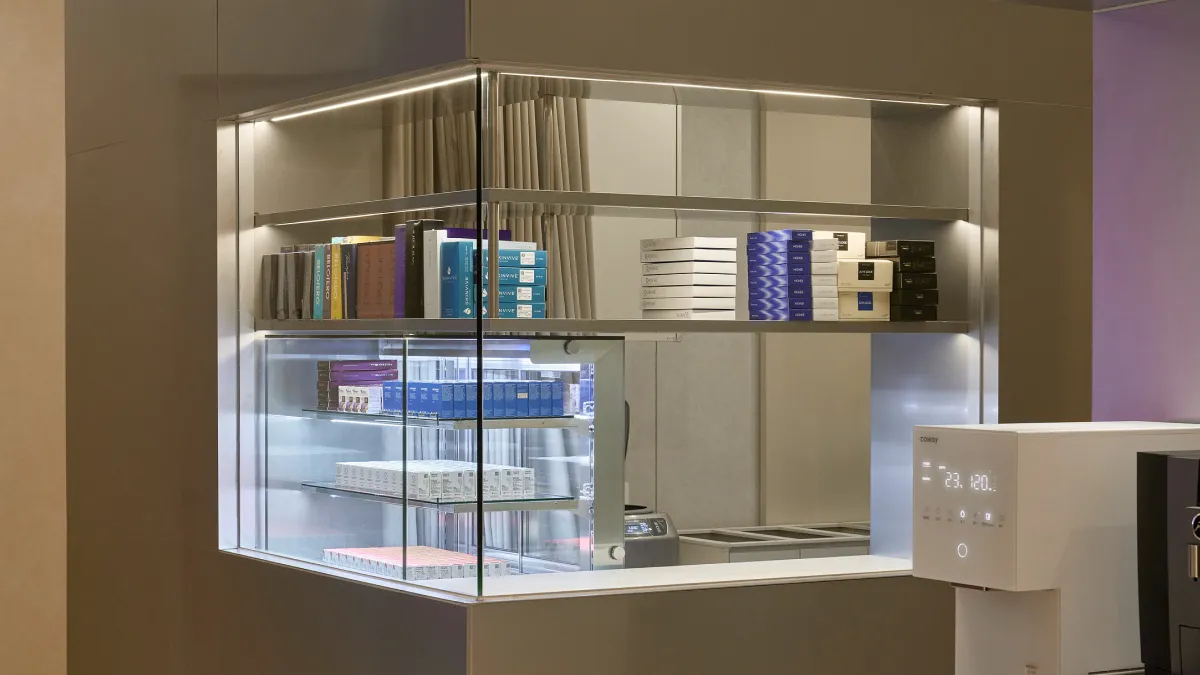
▲ The treatment preparation area, seen through the glass wall from the waiting area
We recommend only the treatments your assessment results call for. We tell you first what this treatment can do (pores, depressed scars, skin texture, and raised lesions) and what it can't (sagging contours or your natural pore size). You're welcome to come in just for a consultation and leave.
Pricing
Prices for Potenza are published on our website for every product option. Whichever country you're visiting from and whichever channel you book through, the price is the same as the one published on our website — so there's no need to compare prices from one booking channel to another. Making sure you can come in trusting the price you checked in advance — that is the trust PECHE Clinic puts first.
For pores, scars, and skin texture, the options are Potenza (Pore Tip) + Cryo Soothing Care + Sheet Mask in 1 or 3 sessions; for lesions, Potenza Agnes Acne+Soothing Gauze Mask for 15 units or less (up to 15 spots) or the full face. We decide on the option you need together after your assessment.
Location and Clinic Hours
PECHE Clinic 3F, 364 Gangnam-daero, Gangnam-gu, Seoul Right outside Gangnam Station Exit 4 — the building entrance is right in front of you as you come out
Clinic Hours (Korea Standard Time, KST)
- Monday–Friday: 10:30 AM – 9:00 PM
- Saturday, Sunday, and public holidays: 10:00 AM – 6:00 PM
- No lunch break — we see patients straight through midday
FAQ
Q1. Who performs the Potenza treatment? A: Before treatment, we first let you know the name of the physician treating you, and that physician personally reviews your assessment results and the condition of your face and skin before starting. The needle depth and intensity follow standards built from more than 90,000 treatments performed across the clinic, so the same standards apply even if a different physician treats you.
Q2. How is it decided between the Pore Tip and Agnes? A: It depends on whether your concern is spread across an area or is raised lesions that form one spot at a time. Pores, depressed scars, and rough texture suit the Pore Tip, where multiple needles cover a broad area; raised lesions that form one spot at a time suit Agnes, which places a single needle only inside each lesion.
Q3. It uses radiofrequency heat — can it burn the outer skin? A: The heat comes not from the skin's surface but from the dermal depth the needles reach, a method that reduces heat damage to the epidermis. The burning warmth and redness right afterward are the skin's response to the heat stimulation delivered to the dermis.
Q4. Can lesions treated with Agnes come back? A: It depends on the lesion. With sebaceous hyperplasia, the tendency for oil glands to enlarge remains, so bumps may become noticeable again in the same spot or nearby; acne can also form anew if oil production and clogging continue.
Q5. Can Potenza help pores that have widened from excess oil? A: Enlarged pores come from oil continually pushing them wider, a weakening of the collagen that supported their edges, or hardened blackheads lodged inside. What Potenza rebuilds is the collagen support around the pore, so if oil and clogging are also involved, oil control and exfoliation care need to be done alongside it.