GentleMax Pro Plus Women's Hair Removal — PECHE Clinic, Gangnam Station
Women's laser hair removal aimed at hormonal hair on the upper lip, chin, and bikini line — sessions continuing at about 4-week intervals · Numbing cream for the face, about 10 minutes · Face & neck / body · Right by Gangnam Station Exit 4
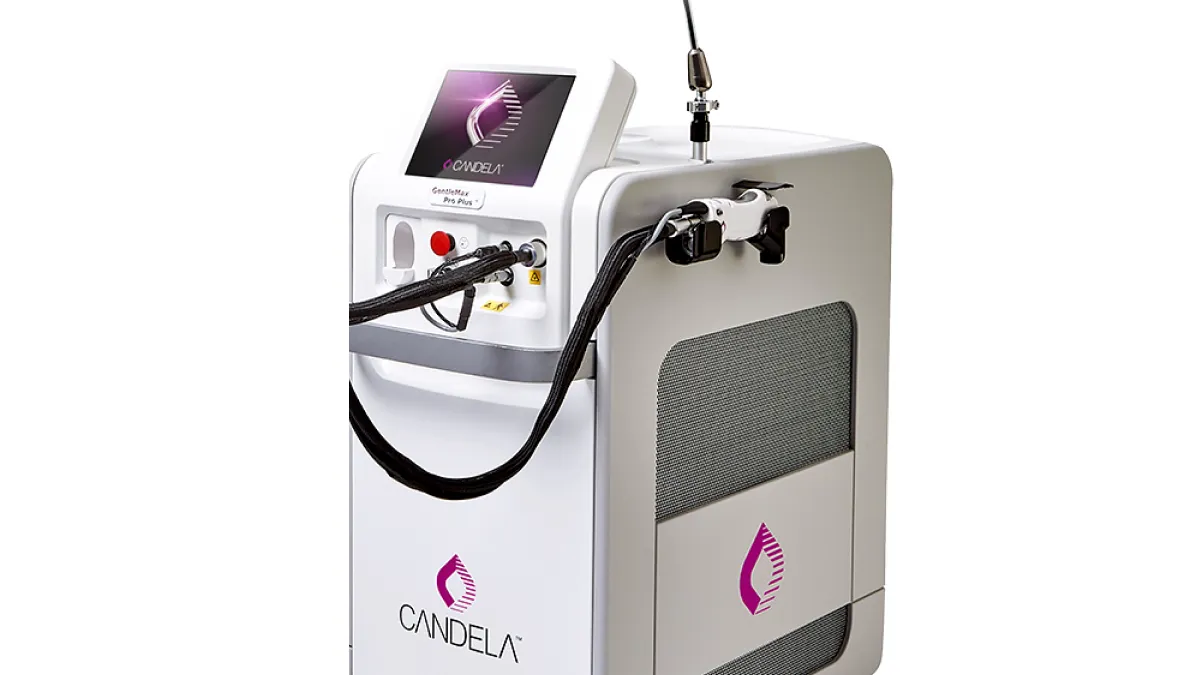
GentleMax Pro Plus Women's Hair Removal
GentleMax Pro Plus is a laser hair removal device that runs two wavelengths — 755nm and 1064nm — in one platform. A woman's upper lip, chin, and bikini line grow hair under hormonal influence: thicker, more deeply rooted, and more darkly pigmented than elsewhere. Since the method works by hair pigment absorbing light and gathering heat at the root, the deeper the follicle, the harder that heat is to deliver — calling for a deeper-reaching wavelength and more energy.
When to Consider It
- Upper lip and chin hair is thick and dark, back soon after every shave
- Thick bikini-line hair keeps regrowing and is a chore to manage
- You've had hair removal several times, but those areas are slow to clear
- You want the thick-haired areas handled along with the body
- Your skin tone is darker, or you've tanned, and you've hesitated over laser hair removal
Women's Hair Removal Configurations
| Configuration | Areas |
|---|---|
| Face & neck | Upper lip · cheeks · jawline · neck |
| Body | Underarms · bikini · arms · legs · back, and more |
Why It's Used on Thick, Deep Hair
| Feature | What it does | What it means for thick, deep hair |
|---|---|---|
| 1064nm wavelength | Caught less by surface pigment, travels deeper | Heat reaches deep follicle roots |
| Up to 26mm spot | A larger firing diameter per pulse | Less of the light scatters and weakens at the edges, so more energy survives to depth |
| Air cooling | Cold air streams from the device, continuously chilling the surface | With the surface kept cool, more energy can be loaded within the safe range |
Conversely, fine, faint facial vellus hair holds little pigment, and the little heat it takes cools fast. For hair like that, a different device we run — one that cuts the firing time to a thousandth of a second to load energy before the heat escapes — may be the better fit. Neither is better — they simply target different hair. Even in one person this varies by area, so we decide area by area at the consultation.
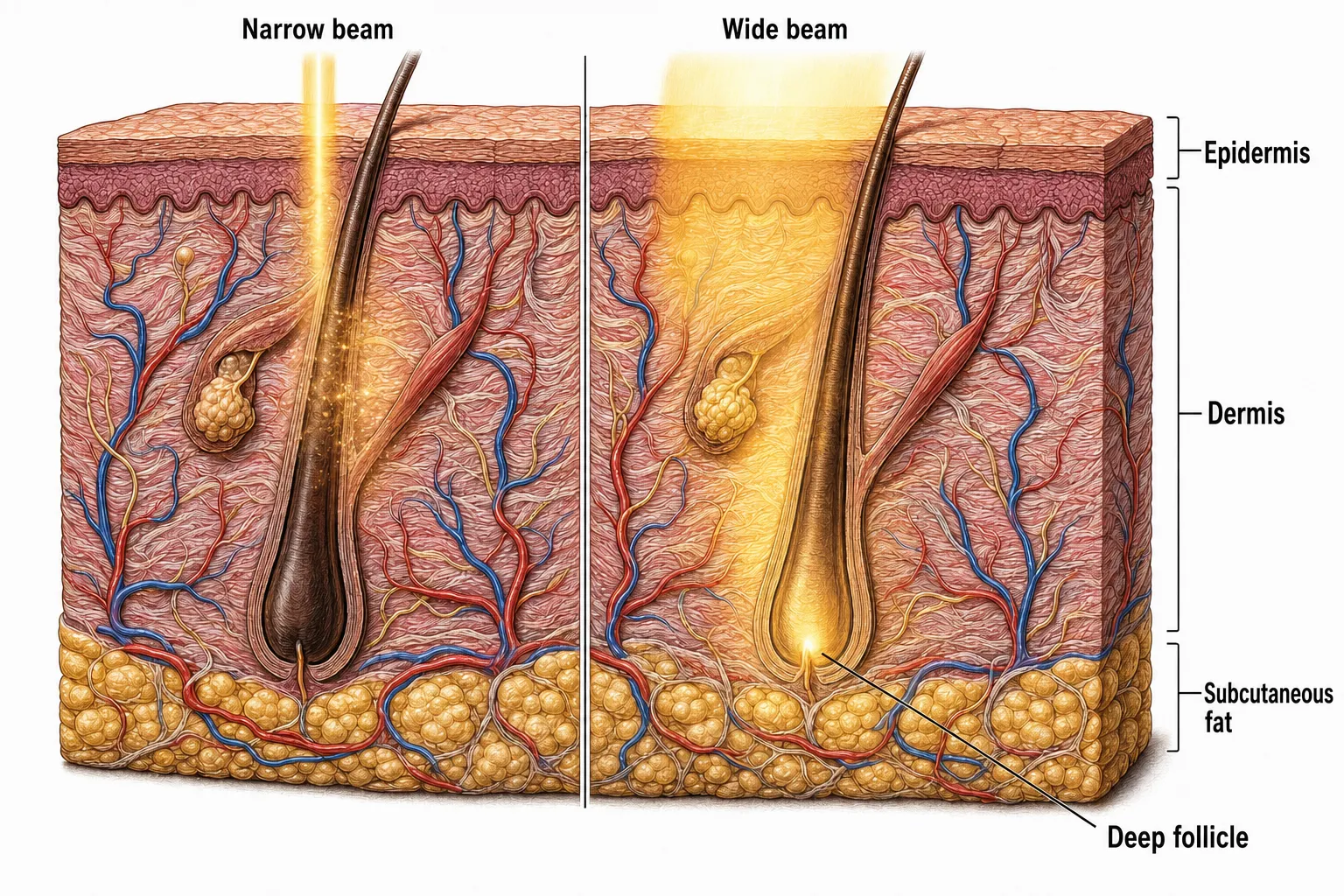
▲ The larger the firing diameter, the less leaks away sideways and the more energy survives to depth — this is what matters when targeting thick, deeply rooted hair
How It's Done
1. Consultation and skin check Hair thickness and color by area, skin tone, and recent tanning are checked — this sets the wavelength and energy.
2. Pre-treatment prep Shave the area short 1–2 days before you come. Waxing or tweezing pulls out the dark hair the laser would target and weakens the effect, so between sessions, shaving only.
3. Numbing cream The face (upper lip, cheeks, jawline) gets numbing cream for about 10 minutes before starting. Arms, legs, and body usually proceed without numbing.
4. Treatment Each area is treated at its set wavelength and intensity. Throughout the session, air cooling (cold air) chills the surface, and with up to a 26mm spot per pulse, broad areas are covered quickly.
5. Soothing and guidance After soothing, we go over sun protection and the care between sessions.
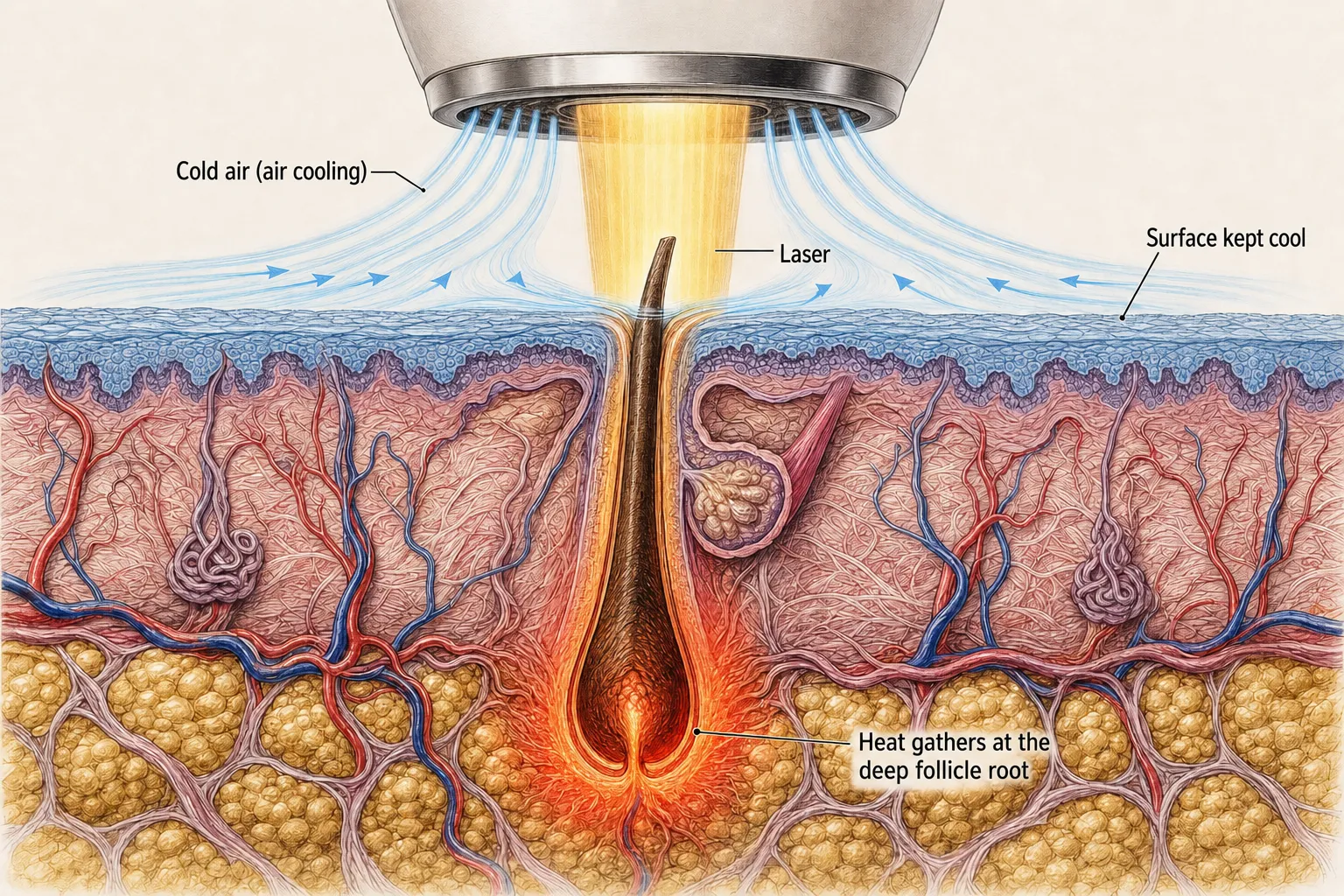
▲ While cold air from the device cools the surface, the heat gathers at the deep follicle root
Results and Recovery
| Item | Details |
|---|---|
| How it works | Pigment in the hair absorbs the light and turns it to heat, which seals the follicle root · acts only on follicles currently growing |
| Wavelengths | 755nm for shallow follicles and lighter skin · 1064nm for deep, thick hair and darker skin — chosen by area and tone |
| Spot and cooling | Up to a 26mm spot per pulse · air cooling (cold air) chills the surface throughout the session |
| When results show | Hairs from sealed follicles shed within 1–2 weeks, and each session reduces that area's hair by about 10–25% |
| Sessions | Hormonal areas: 6–12 sessions at about 4-week intervals, cumulative · growth slows from sessions 3–4 |
| Interval by area | Upper lip and chin about 4 weeks · underarms and bikini 4–6 weeks · back about 6 weeks · arms and legs 6–8 weeks |
| Maintenance | Once every 1–2 years after the course — hormonally influenced areas can see some follicles return |
| Pain | A jolt of heat reaching follicle depth — strongest on the upper lip and chin, moderate on underarms and bikini, light on outer arms and legs |
| Pain control | Face: numbing cream for about 10 minutes, plus air cooling (cold air) throughout — the two act separately, so together the sting drops further · body: air cooling |
| Downtime | Redness and slight swelling for 1–2 hours right after · back to routine the next day · skip saunas, hard exercise, and strong sun for 24 hours |
The reason hormonal areas run on tighter intervals is that their follicles reactivate quickly. The laser acts only on follicles currently growing, and at any point only about 10–20% of all hairs are growing — so the sessions follow that cycle.
Expected Reactions and Possible Side Effects
Common, temporary reactions — part of the normal response:
- Redness and slight swelling at the treated area for 1–2 hours
- Hairs from sealed follicles shedding over the following 1–2 weeks — part of the intended course
Anything beyond this is uncommon. If a reaction lasts longer than expected or worsens, contact us and we'll check it with you.
What We Check Beforehand
Hormonal areas sometimes do better with adjusted timing depending on your condition. If any of these apply, tell us at the consultation.
- Recent tanning or strong sun — surface pigment is heightened, so we start after it settles
- Acne or wounds at the treatment area — postponed until healed
- A keloid tendency (scars that heal raised)
- Medications that increase light sensitivity (such as some antibiotics or diuretics)
- Tattoos or semi-permanent makeup in the area — the ink absorbs light strongly, risking burns and color change, so that spot is skipped
- Waxing, tweezing, or depilatory cream between sessions — the next session loses effect (shaving is fine)
How PECHE Clinic Does It
We treat by standards built from over 90,000 treatments. With hormonal hair, too little energy seals too few follicles and the session count just grows; simply turning the energy up raises the risk of burns and pigmentation. Per-area standards built from over 90,000 documented treatments hold that middle ground — so whichever physician treats you, the same standards apply.
Each area gets its own settings. Even within one face, hormonal hair on the upper lip and chin differs from cheek vellus in thickness and pigment. We don't carry one area's settings across the whole face — each area is set separately.
The prep room is behind a glass wall, in full view. The prep room's wall is glass, so while you wait, the preparation and hygiene routine is visible from the waiting area.
We're honest about what to expect. Hormonal hair can need more sessions than other areas, and even after the course, hormonal shifts can bring some of it back. The goal isn't "not a single hair" — it's greatly reduced regrowth, and we tell you that up front. We don't push same-day payment or session packages.
Pricing
Women's hair removal cost depends on which areas you choose (face & neck or body), how much of each area is covered, and how many sessions you plan. We go over it at the consultation.
Location
PECHE Clinic 3F, 364 Gangnam-daero, Gangnam-gu, Seoul Right in front of Gangnam Station, Exit 4
Sessions for hormonal areas like the upper lip and chin come around about every 4 weeks. The shorter the trip, the easier it is to keep that rhythm without missing a session.
FAQ
Q1. Who performs the treatment? A: PECHE physicians who all work to the same per-area standards, built from over 90,000 documented treatments. Hormonal areas are where the right intensity can easily be judged differently — the standards hold it steady, so even if your physician changes, the treatment stays within the same range.
Q2. If I can't make it exactly every 4 weeks, does it lose effect? A: Running a little late doesn't erase the effect. But hormonal areas reactivate quickly — the longer the gap, the more hairs pass through their growth phase (the only window the laser can catch) untreated, which can add sessions. If scheduling is hard, we shift the interval slightly either way and keep going.
Q3. I've had several sessions, but my upper lip and chin are slow to clear. A: That's the hormonal influence. These areas have deep, thick follicles, and resting follicles nearby keep newly activating — so the same number of sessions feels slower than elsewhere. The baseline is tight intervals of about 4 weeks with the deeper-reaching wavelength, and these areas need periodic maintenance even after the course.
Q4. I've tanned, or my skin is darker — can I still get treated? A: Of the two wavelengths, 1064nm is caught less by surface pigment while traveling deep — so for darker tones, that's the baseline. If you've tanned recently, though, we postpone until the pigment settles.
Q5. Can I just have a consultation and decide later? A: Yes. You can hear the expected number of sessions per area and the limits, and you don't need to decide that day. It's not a consultation where session packages or same-day payment get pushed.