Stem Cell — PECHE Clinic, Gangnam Station
A regenerative treatment using your own blood: the buffy coat, collected with the TriCell kit, is injected into the skin of the face or into a vein · Right outside Gangnam Station Exit 4
Stem Cell
PECHE Clinic's Stem Cell treatment concentrates the buffy coat from your own blood: your blood is spun twice in a dedicated kit (centrifugation — spinning it rapidly so it separates into layers by weight), only the thin middle layer called the buffy coat is collected, and it is returned to you by injection into the skin of the face or into a vein. The separation uses TriCell PRP, a single-use kit made by Blue Medical Technology; the kit holds safety certification from Korea's Ministry of Food and Drug Safety (MFDS) and carries the European CE mark.
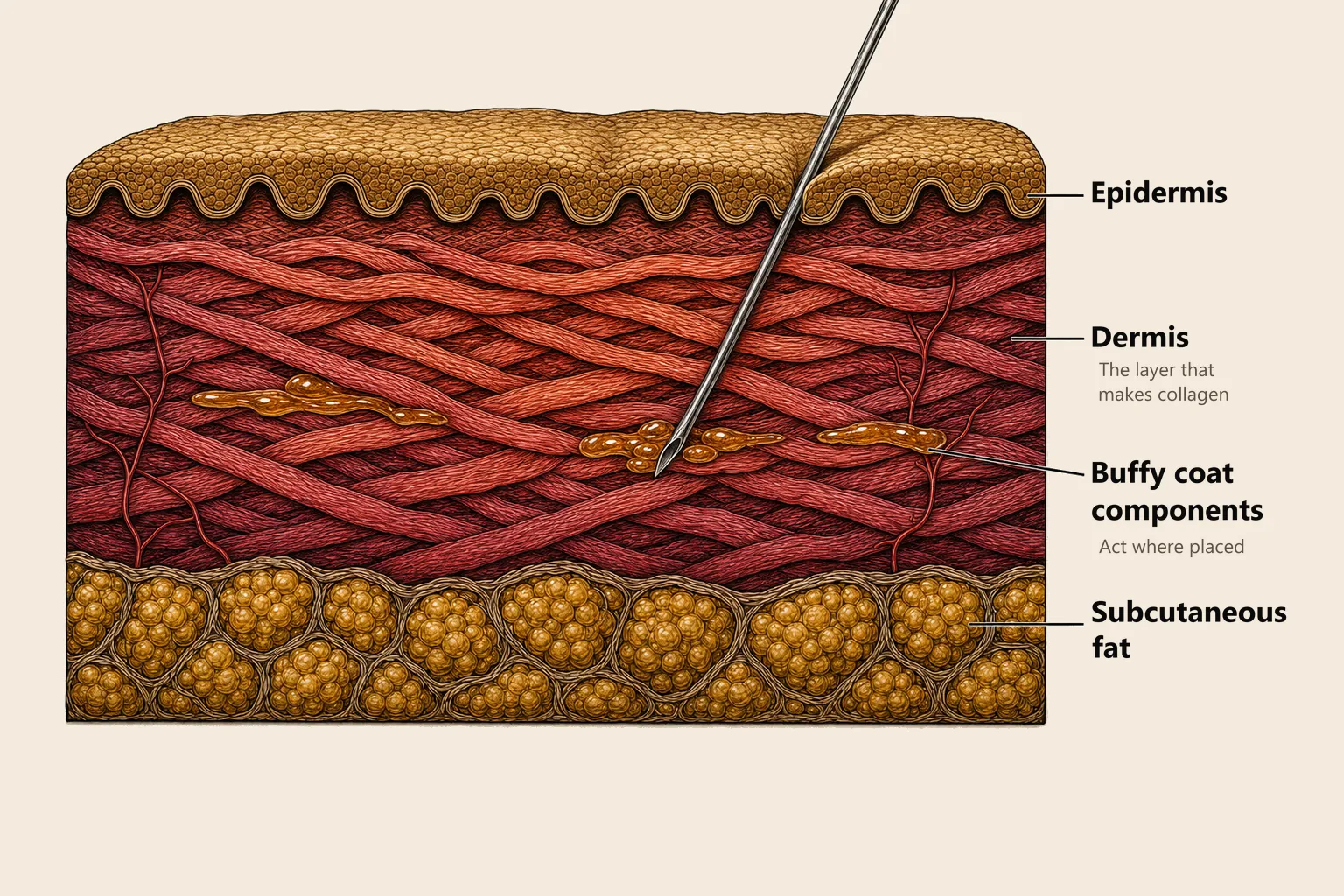
▲ Facial skin injection — buffy coat components are placed in small, divided amounts in the dermis, the layer inside the skin that gives it elasticity (gold = the injected components)
Stem Cell at a Glance
| Item | Details |
|---|---|
| Category | A regenerative treatment derived from your own blood (centrifuged only — the cells are not cultured) |
| Injection route | Skin injection (facial dermis, scalp) · IV injection |
| Kit | TriCell — 30cc of blood per kit · closed, single-use |
| Available options | 2 kits (60cc) = IV injection or skin injection · 4 kits (120cc) = both · each is also offered as an option with plasma application (applying the remaining plasma through tiny channels made by the Potenza Pumping Tip), Cryo Soothing Care, and a sheet mask added |
| Numbing | Skin injection and plasma application = numbing cream, 20 minutes · IV injection = none · with the 2-kit options, more numbing can be added depending on pain |
| When results show | Gradually over time, not right after treatment |
| How long it lasts | Not permanent · varies widely with the amount and quality of your own cells and with age |
| Repeat interval | Results build up when sessions are repeated at regular intervals before the effect fades · the interval and number of sessions are decided together after your assessment |
| Recovery | Skin injection = needle marks, swelling, and bruising for 1–3 days · IV injection = almost none apart from the injection site |
How It Works
1. The blood is spun twice to collect only the thin middle layer When blood is spun rapidly, red blood cells move to the bottom and plasma rises to the top, and between them a thin band forms that makes up about 1% of the total (the buffy coat). The first spin separates out the red blood cells, and the second spin precisely separates the buffy coat. The inside of the kit is divided into three chambers, so the layers mix less with each other, and because it isn't opened to outside air, the risk of contamination is reduced.
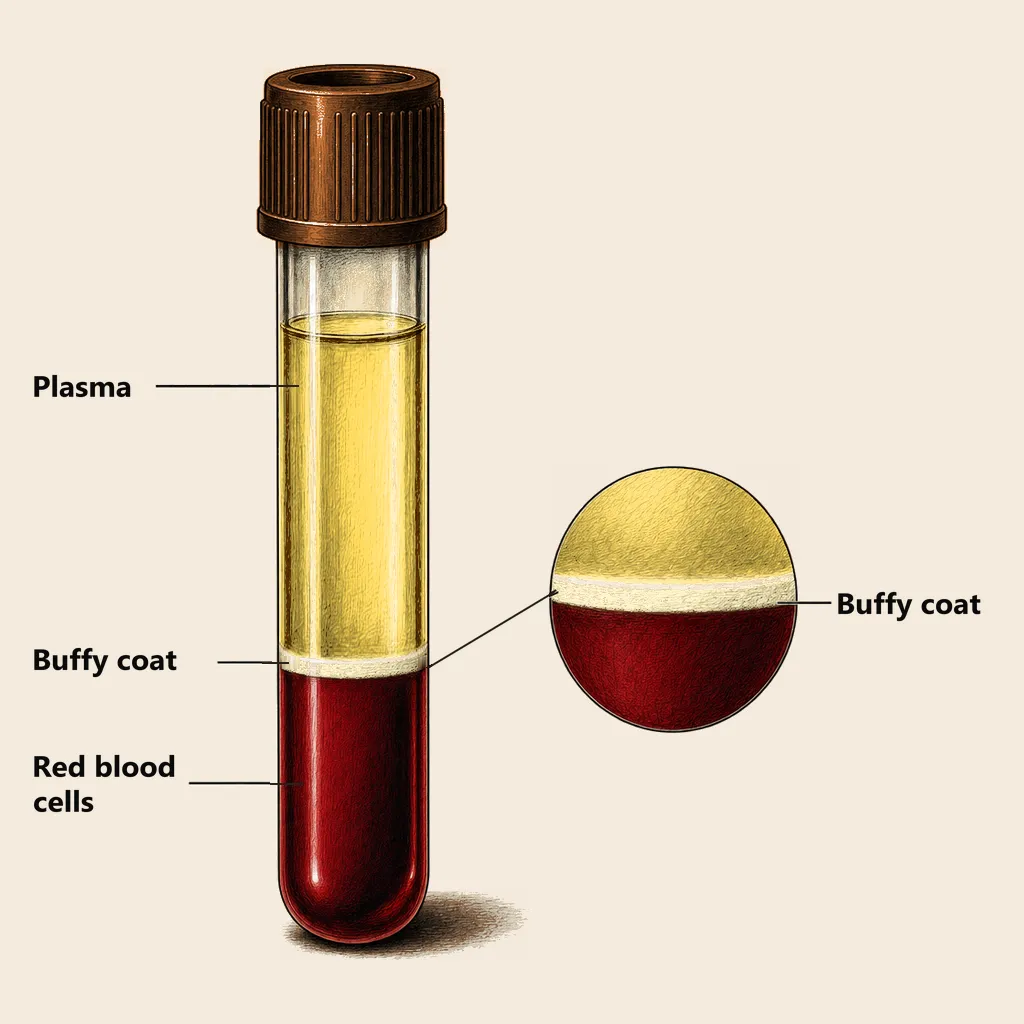
▲ The three layers that form when blood is spun — only the thin band in the middle (the buffy coat) is used in treatment (an illustration of the principle using an ordinary test tube)
2. What gathers in this band Platelets (cell fragments that help wounds heal), white blood cells (which handle immunity) including monocytes (the white blood cells that send regeneration and blood-vessel signals), and a small number of CD34+ cells gather here. CD34 is a protein on the cell surface that works like a name tag; in blood, it is carried mainly by the stem cells that make blood, so it is used as an estimated indicator of how many stem cells are present.
3. The core of the effect is the platelets' regenerative signal Platelets aren't stem cells, but they are packed with growth factors (proteins that signal cells to "grow and repair"). Fibroblasts (the cells that make collagen) that receive this signal are understood to produce collagen again, which is why results appear gradually over time.
Differences between the two injection routes
| Skin injection | IV injection | |
|---|---|---|
| Method | Divided injections into the facial dermis and scalp with a fine needle | A needle is placed in an arm vein and the components are infused slowly, like an IV drip |
| How it acts | Concentrated where it's placed, directly stimulating that spot | Spreads throughout the body in the bloodstream, with some understood to gather at damaged sites |
| Limitation | The effect is limited to the injected area | Far less reaches the skin |
Blood cells tend to be weak at finding their way to damaged sites (known as homing), so if your goal is the face, skin injection places more of the components where they're wanted.
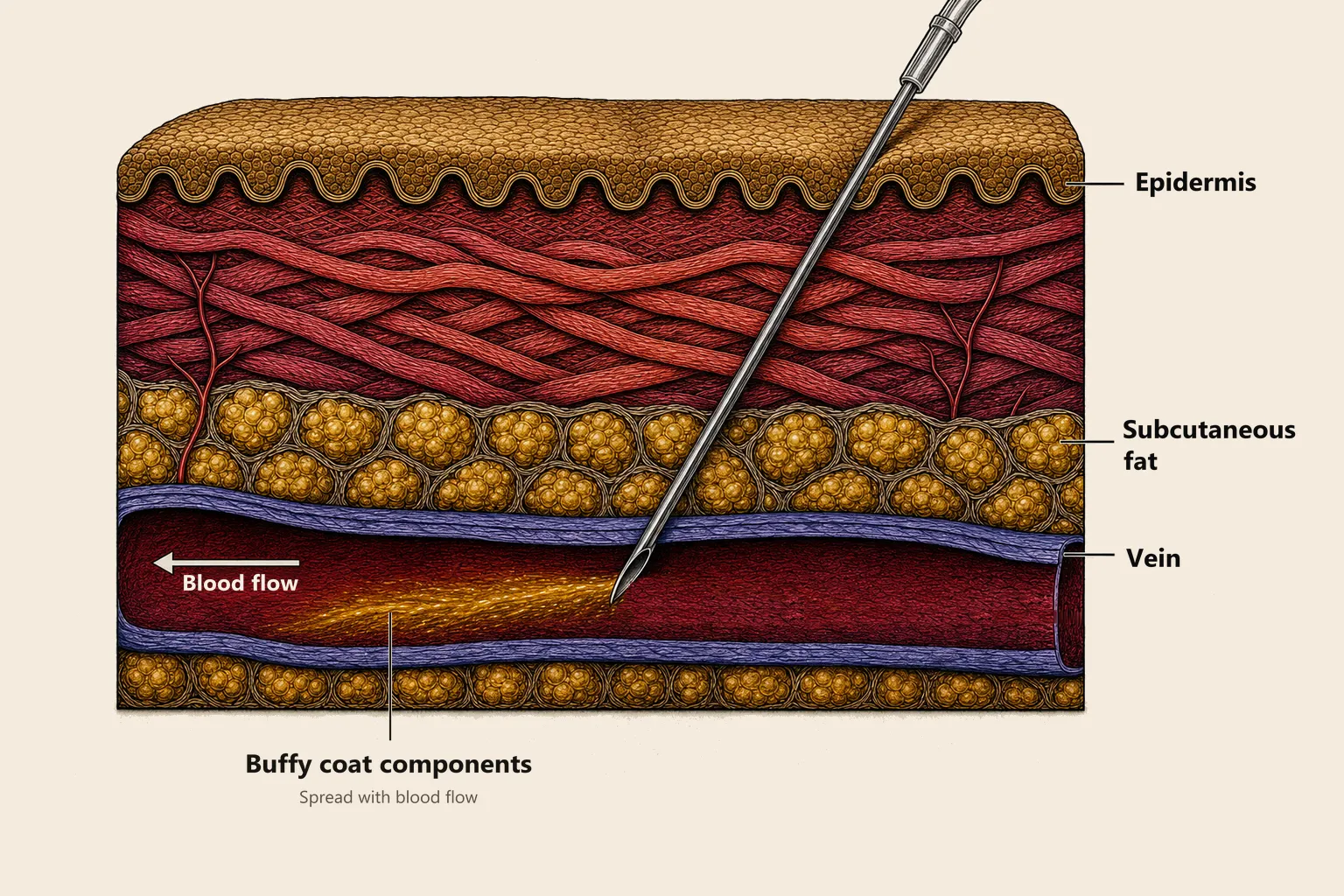
▲ IV injection — the components spread widely along the blood flow
Expected Results and Why
| Expected result (skin injection) | Why |
|---|---|
| Elasticity and fine lines | Fibroblasts are stimulated, so collagen and elastin (the fibers that give skin its elasticity) are newly made and reorganized |
| Radiance, tone, and texture | Signals for blood-vessel and epidermal renewal, along with an action that calms inflammation |
| Support for scar and pore recovery | Regenerative signals help damaged areas recover |
| Support for scalp hair follicles | Growth factors act around the hair follicles (the small pockets hair grows from) |
Because the source material is your own cells, results differ from person to person. At ages when the number and activity of stem cells decline (a tendency that begins gradually in your 30s and becomes clear after 40), the change you notice from one session may be small, so results are built up through repeated sessions.
When to Consider It
- Declining elasticity, fine lines, dull tone, or rough texture bother you
- You want support for scar or pore recovery, or for scalp care
- You'd rather be treated with your own cells than with ingredients obtained from other people or animals
- For IV injection: you want an approach that spreads throughout the body in the bloodstream (the amount that reaches the face is small)
When a different approach may be the right fit: If your goal is filling volume, lifting contours, or softening expression lines, fillers, lifting treatments, or treatments that reduce muscle movement are the right fit.
Differences from Other Treatments and Limitations
| Compared approach | What they share | How they differ |
|---|---|---|
| PRP (platelet-rich plasma) | Your own blood is spun to separate it · the platelets' regenerative signal is central | PRP is spun once, mainly for platelets; the buffy coat is spun twice to also collect white blood cells, monocytes, and CD34+ cells. It's the same principle, with a different precision of separation |
| Skin boosters that inject ingredients (injectable treatments aimed at the quality of the skin itself) | Both put ingredients that support regeneration into the dermis | Skin boosters inject set ingredients; the buffy coat injects your own cells and regenerative signals. In exchange, results vary more from person to person |
A common misconception: "It's called stem cell, so it must be a powerful treatment." What's produced is a buffy coat concentrate containing a small number of CD34+ cells, and the effect comes mainly from the platelets' regenerative signals.
Limitations: Results aren't immediate or permanent, so repeat sessions are needed, and it can't stop aging itself.
How It's Done
1. Consultation and checks We check your medical history and the medications you take, and decide the option together. For facial skin injection, 3D MetaVu imaging photographs your skin texture, pores, fine lines, and color.
2. Your physician's name and a final check We let you know the name of the physician treating you, and that physician examines the treatment area in person.
3. Blood draw and separation We draw 30cc per kit from an arm vein. That's less than a single blood donation in Korea (320–400cc). The blood is mixed with a medication that keeps it from clotting (an anticoagulant), and then only the buffy coat is separated using the TriCell kit.
4. Numbing For skin injection and plasma application, we apply numbing cream and wait 20 minutes. IV injection involves no numbing.
5. Injection The 2-kit options include either skin injection or IV injection, and the 4-kit options include both. The blood draw and IV injection feel like a sting as the needle goes into your arm; skin injection feels like a series of stings as a fine needle goes into several spots on the face.
6. For the plasma application options Plasma is applied with the Potenza Pumping Tip (see Q5), and the treatment finishes with Cryo Soothing Care (care that uses a cold device to cool skin that has warmed up) and a sheet mask.
Recovery, Expected Reactions, and Precautions
Aftercare (facial skin injection and plasma application)
- Water-only rinsing from 3–4 hours after treatment — the time the channels made by the needle take to close
- Cleanser and makeup: from the next morning
- Saunas and exercise that makes you sweat: put off for 3 days to 1 week — heat and sweat can increase redness and swelling
IV injection has almost no recovery period apart from bruising at the injection site.
Possible reactions: Because the cells are your own, immune rejection and allergic reactions hardly ever occur, but that doesn't mean there are no side effects. Pain, swelling, and bruising at the injection site are common; infection (rarer still with a closed kit), fever (mainly with IV injection), and dizziness from a brief drop in blood pressure due to nervousness are rare. An allergy to the medication mixed in to keep the blood from clotting is very rare, and with IV injection there is also a theoretical possibility that clumped cells could temporarily block small blood vessels, but meaningful reports of this are very rare. Other reactions are uncommon, but everyone responds differently — if a reaction lasts longer than expected or becomes more noticeable, contact us and we'll check it with you.
When we do not perform this treatment
- A history of cancer diagnosis or treatment (a family history alone does not apply) — stem cells and growth factors strongly support cell multiplication and the formation of new blood vessels, so there is a theoretical possibility of also stimulating cancer cells that remain in the body or lie dormant
- Pregnancy, possible pregnancy, or breastfeeding
When we postpone treatment
- When you have an infection or fever — we proceed after you've recovered
- When you're taking aspirin or anticoagulants (medications that keep blood from clotting easily) — bruising and bleeding at the blood-draw and injection sites can be greater. Don't stop these medications on your own; let us know at your consultation, and we'll decide the timing together
- For the plasma application options: when you're taking oral acne medication (isotretinoin) or stopped it less than 6 months ago — your skin is drier and more sensitive, so we adjust the timing
What to tell us in advance
- A blood disorder affecting platelets or the components that make blood clot, or chronic liver disease — because of the condition of your own blood, which is the source material, treatment may be difficult, so we check in advance
- Taking anti-inflammatory pain relievers (NSAIDs) — they can reduce platelet function and interfere with the effect
- (Plasma application options) An electronic device in the body, such as a pacemaker, or metal implants in the face — the radiofrequency microneedling device works by passing electric current through tissue, so we check in advance
- (Plasma application options) Conditions that worsen with cold, such as cold urticaria (hives triggered by cold) or Raynaud's disease — because the Cryo Soothing Care at the end cools the skin
- Other recent treatments — if you've had filler, a skin booster, laser, lifting, or similar treatments, let us know at your consultation
- Whether to have another treatment on the same day is decided together after your assessment
Before treatment: Drink plenty of water and avoid alcohol and smoking — they can lower the activity of the cells that serve as the source material.
How PECHE Clinic Does It
We follow standards built from more than 90,000 treatments performed across the clinic. From more than 90,000 treatments performed across PECHE Clinic, we have built standards for each area and skin condition, and the same standards apply whichever PECHE physician treats you. With the Stem Cell treatment, the areas and amounts for the divided skin injections follow those standards.
A physician checks in person before we begin. For facial skin injection, a physician personally reviews your 3D MetaVu results; for IV injection, a physician examines the treatment area in person — and checks once more just before treatment. Before we begin, we tell you the name of the physician who will treat you.
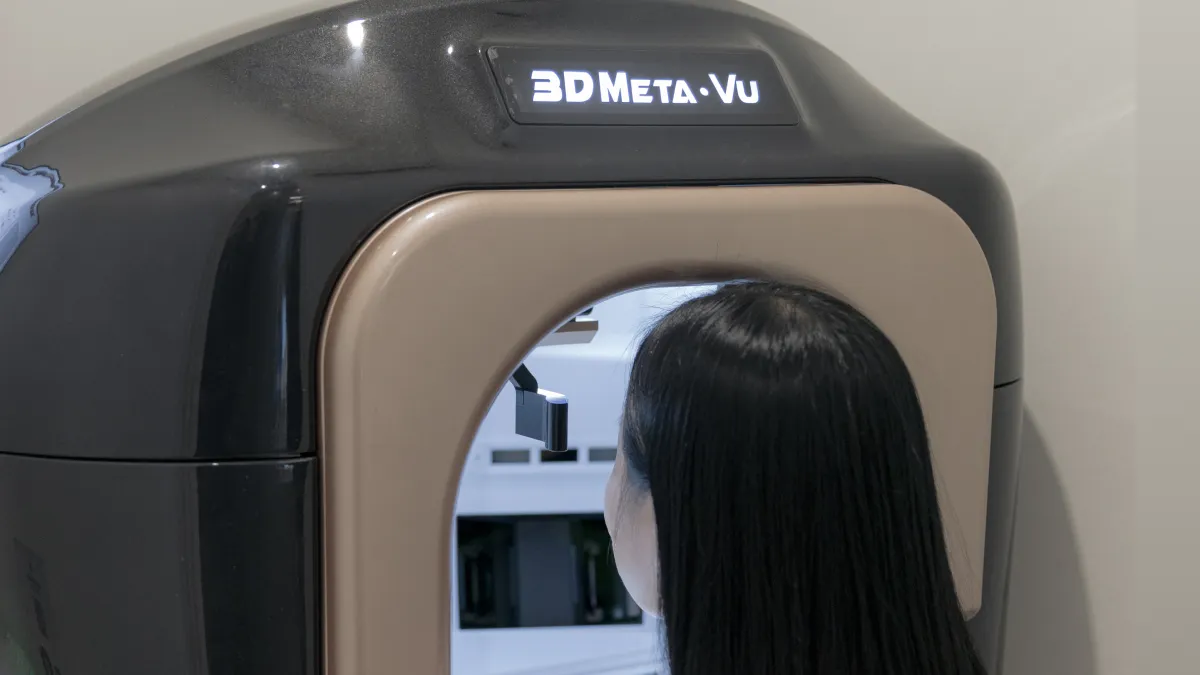
▲ We review your imaging results together
We use genuine single-use kits and keep the preparation area in view behind a full glass wall. The TriCell kit is a genuine consumable that is used once for one patient and then discarded. Treatment preparation takes place in an open-kitchen-style preparation area behind a full glass wall, so from the waiting area you can see the preparation process and hygiene practices for yourself.

▲ The treatment preparation area, seen through the glass wall from the waiting area
We recommend only the treatments your assessment results call for. We tell you up front what this treatment can do (recovery of overall skin elasticity, texture, and radiance) and what it can't (immediate change, lost volume, sagging). You're welcome to come in just for a consultation and leave.
Pricing
Prices for Stem Cell are published on our website for every product option. Whichever country you're visiting from and whichever channel you book through, the price is the same as the one published on our website — so there's no need to compare prices from one booking channel to another. Making sure you can come in trusting the price you checked in advance — that is the trust PECHE Clinic puts first.
It is offered in the four options below, and the option you need is decided together after your assessment.
- Stem Cell (IV or Skin Injection) 2 Kits
- Stem Cell (IV + Skin Injection) 4 Kits
- Stem Cell 2 Kits (IV or Skin Injection) + Potenza Pumping Tip (Plasma Application) + Cryo Soothing Care + Sheet Mask 1session
- Stem Cell 4 Kits (IV + Skin Injection) + Potenza Pumping Tip (Plasma Application) + Cryo Soothing Care + Sheet Mask 1session
Location and Clinic Hours
PECHE Clinic 3F, 364 Gangnam-daero, Gangnam-gu, Seoul Right outside Gangnam Station Exit 4 — the building entrance is right in front of you as you come out
Clinic Hours (Korea Standard Time, KST)
- Monday–Friday: 10:30 AM – 9:00 PM
- Saturday, Sunday, and public holidays: 10:00 AM – 6:00 PM
- No lunch break — we see patients straight through midday
FAQ
Q1. Who performs the Stem Cell treatment? A: Before treatment, we first let you know the name of the physician treating you, and that physician personally reviews your medical history and medications and examines the treatment area before starting. How the injections are divided follows standards built from more than 90,000 treatments performed across the clinic.
Q2. Blood is drawn as well — is that hard on my body? A: The amount drawn is less than a single blood donation. However, nervousness can make you briefly dizzy, so if that has happened to you before, let us know in advance.
Q3. Do 2 Kits and 4 Kits refer to the number of cells injected? A: No. The number of kits is the amount of blood drawn. Counting cells requires a separate test that counts them one by one, and results vary widely from lab to lab, so the treatment amount is expressed as blood volume.
Q4. If more blood is used, does the Stem Cell treatment become similar to a fat-derived stem cell treatment? A: It doesn't. Fat and bone marrow contain many stem cells that can turn into various tissues and are good at finding their way to damaged sites (mesenchymal stem cells), but blood contains almost none — so the difference lies not in the amount but in the type of cells.
Q5. What do the plasma application options add? A: They use the plasma left over after the buffy coat is separated, on your face. Plasma is blocked by the skin's outermost protective barrier (the stratum corneum), so simply applying it doesn't get it far in — but when it's applied over the tiny channels made by the ingredient-delivery tip of a radiofrequency microneedling device (the Pumping Tip), it can be delivered below the epidermis.