Jamber Thread — PECHE Clinic, Gangnam Station
A volumizing thread treatment that places a fine dissolvable thread, coiled into a spring shape, into a hollowed area — the thread's volume supports the area, and your own collagen takes over that space · Front and side cheeks, nasolabial folds, and marionette lines · Right outside Gangnam Station Exit 4
Jamber Thread
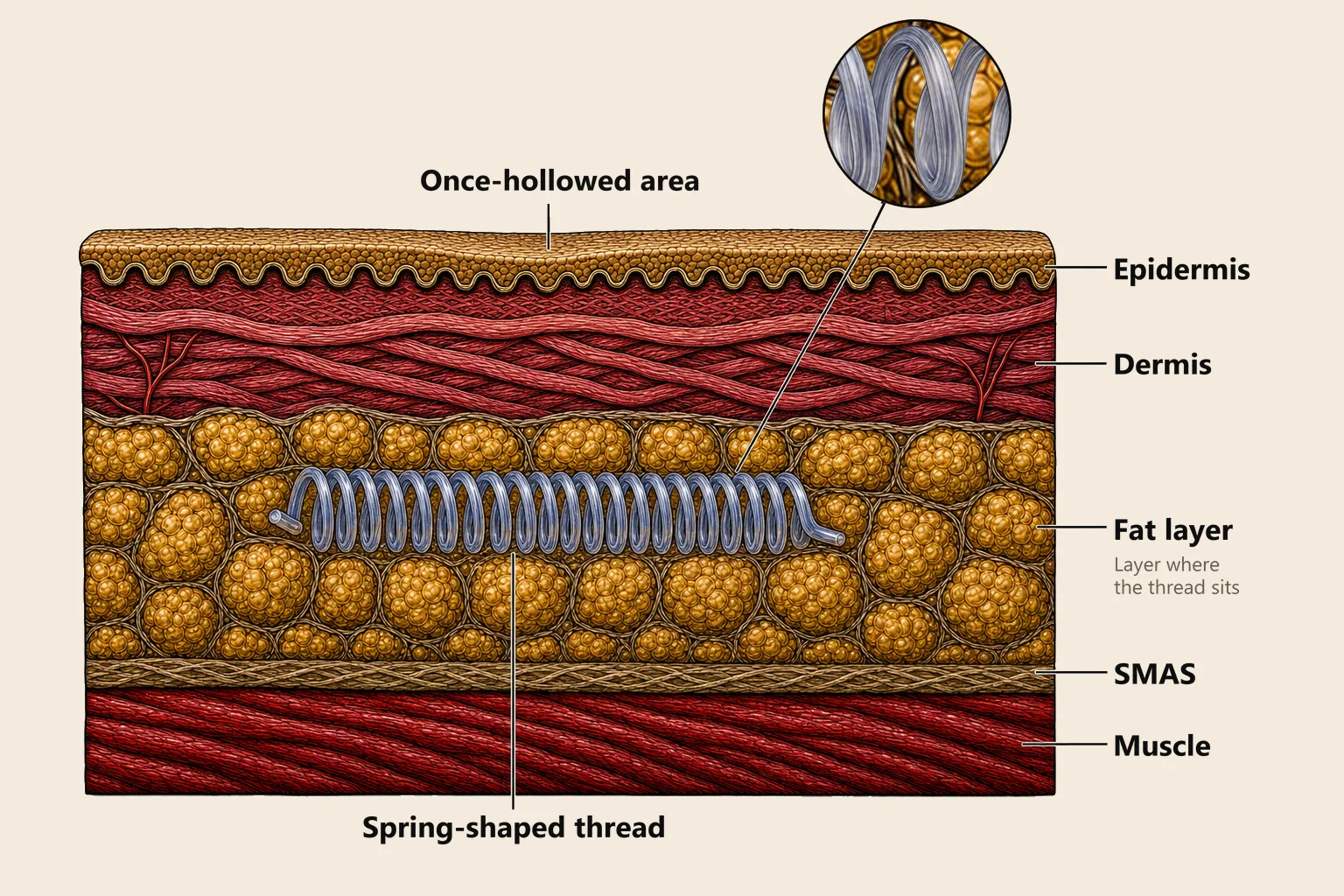
Jamber Thread is a treatment that places a volumizing thread (a thread that adds volume), made by coiling fine PDO thread into a spring (coil) shape, into the fat layer beneath the skin of a hollowed area. PDO (polydioxanone) is a material long used for surgical sutures that dissolve and disappear inside the body after surgery.
Put simply, it isn't a thread that lifts sagging areas — it's a thread that fills hollowed ones. The coiled thread's own volume supports the hollow, and the collagen your body forms inside and around the thread is understood to carry that volume forward.
▲ A spring-shaped thread placed in the fat layer beneath the once-hollowed area props the surface up with its volume (magnified circle = the spring structure, coiled from a single fine strand)
Jamber Thread at a Glance
| Item | Details |
|---|---|
| Category | Volumizing thread lift — a thread that fills hollowed areas (not a thread that pulls tissue up) |
| Thread structure | Fine PDO thread coiled into a spring (coil) shape |
| Mechanism | The spring structure's volume supports the hollowed area, and your own collagen that forms around the thread takes over that space |
| Target layer | The fat layer beneath the skin (subcutaneous fat layer) — in the hollowed area |
| Concerns and areas it suits | Sunken front and side cheeks · deep nasolabial folds · a hollowed groove in the mid-cheek · marionette lines · thin skin that has lost firmness |
| Available options | Jamber Thread: 1, 4, or 8 threads |
| Numbing | A numbing spray that acts only on the treatment area · no separate numbing wait |
| When results show | Support from the thread's volume: right after treatment · collagen around the thread: forms over several weeks to several months |
| How long the thread takes to dissolve | PDO takes more than 6 months to break down (about 6–8 months, based on surgical sutures made of the same material) · varies with the thread's thickness and form |
| How long it lasts | Even after the thread breaks down, the collagen in that area provides support for a period · how long varies from person to person, and it is not permanent |
| Recovery | Swelling and bruising settle over several days to 2 weeks · you may feel soreness and throbbing for a few days |
The number in each option is how many threads are placed. Marionette lines are the creases that run down from the corners of the mouth toward the chin.
How It Works
1. The spring structure's volume provides support right away Because it is a long thread wound tightly, like a rubber band, into a spring shape, it takes up a set amount of space where it is placed. Like a solid filler, it creates physical volume and supports the hollowed area from below.
2. Your own collagen forms along its broad surface Your body recognizes the thread as a foreign material and responds by surrounding it. In this process, the cells that make collagen (fibroblasts) produce collagen along the broad surface of the spring structure, so collagen builds up richly inside and around the thread. A coiled structure offers more surface for collagen to form on than a single strand placed straight.
3. As the thread breaks down, your own collagen takes over its place PDO thread reacts with water and slowly breaks down into water and carbon dioxide. Meanwhile, the space where the thread was fills with your own collagen tissue, so volume continues for a period even after the thread is gone.
The thread is placed in the fat layer beneath the skin. If it sits too shallow and reaches the dermis (the main body of the skin, beneath the epidermis), the surface contour can change or the thread can show through. And just below the deeper SMAS (a thin, tough layer that supports the skin and fat so they don't sag) run blood vessels and the nerves that control facial expression, which could be injured.
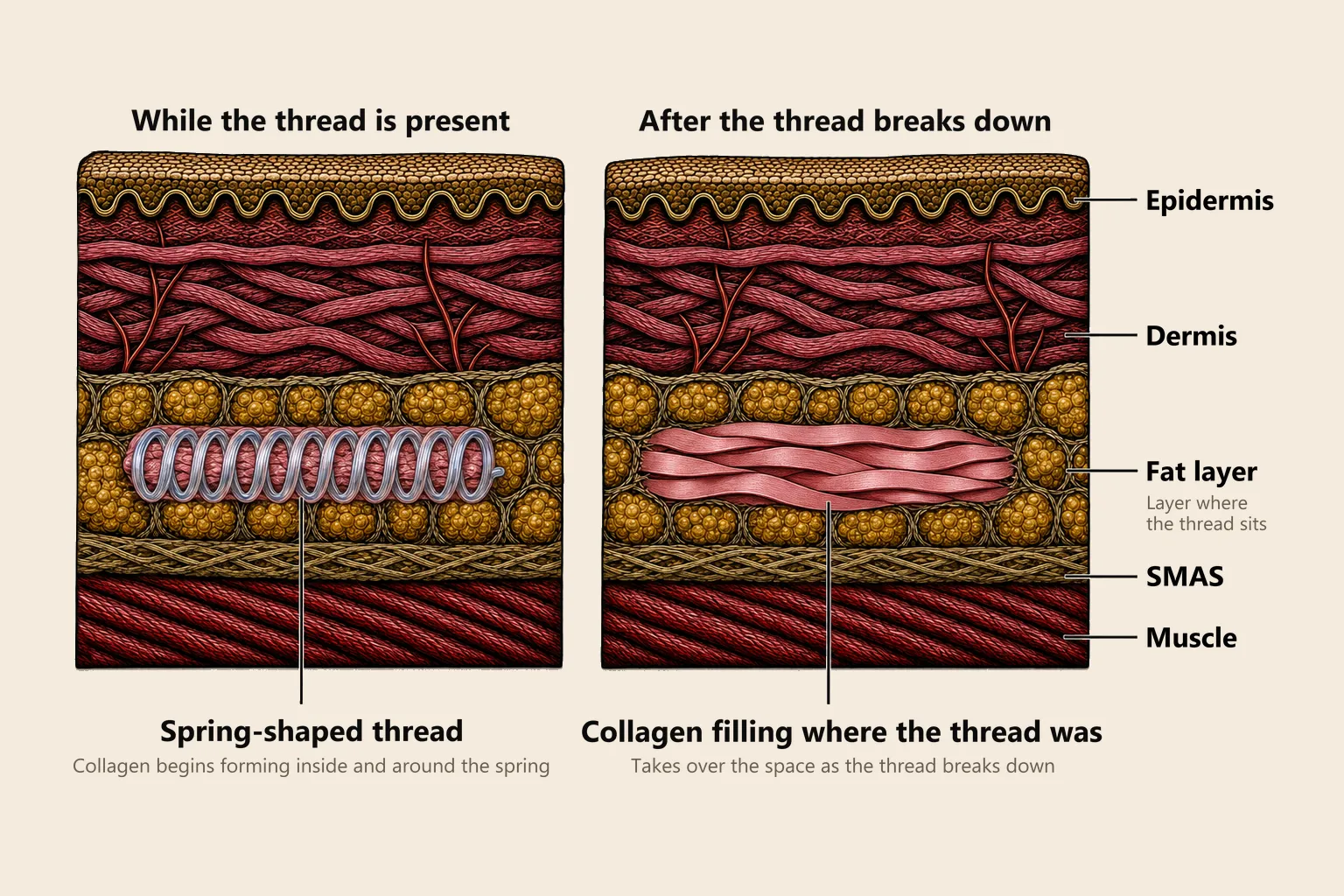
▲ While the thread is present (left), the thread's volume and collagen work together; after it breaks down (right), the collagen in that spot provides the support (degree and duration vary from person to person)
Expected Results and Why
| Expected result | Why |
|---|---|
| Improvement in nasolabial folds and a hollowed mid-cheek groove (the groove that runs diagonally from below the eye down toward the cheek) | Volume from the spring structure + your own collagen formation (case reports) |
| Volume in sunken front and side cheeks and marionette lines | The same principle |
| Density in thin skin that has lost firmness | The collagen-forming response around the thread |
The effect comes in two overlapping layers. Support from the thread's volume begins right after treatment, and collagen is then made over the following several weeks to several months. How long this takes varies with your skin condition.
Right after treatment, swelling is also present, so how you look once the swelling has gone down is closer to the actual volume.
A common misconception — "If the thread dissolves, doesn't the volume disappear the moment it does?" As the thread breaks down, your own collagen fills its place, so the volume is supported for a period even after the thread is gone. That said, this is not a permanent treatment.
When to Consider It
- Your front or side cheeks have become sunken from aging or fat loss, making your face look gaunt
- Your nasolabial folds, mid-cheek groove, or marionette lines have deepened
- Your skin is thin and lacks firmness, and you'd like more density beneath the surface
- You have hollows that pulling alone can't resolve
- You want a subtle change
When a different approach may be the right fit
- Sagging, rather than hollowing, is your main concern — a volumizing thread has almost no ability to lift sagging tissue
Differences from Other Treatments and Limitations
| Compared approach | What they share | How they differ |
|---|---|---|
| Barbed pulling threads | Both place dissolvable threads in the subcutaneous fat layer, and your own collagen forms around the thread | Pulling threads are for traction — their barbs catch sagging tissue and pull it up; Jamber Thread is for volume — it fills hollowed areas |
| Filling with an injected material (filler) | Both add volume to a hollowed area | With filler, the injected material itself becomes the volume; with Jamber Thread, the thread's volume and the collagen your body forms in that spot become the volume |
| A single smooth thread (mono thread) | Collagen forms around a dissolvable thread | A mono thread works in a shallow layer to help with skin texture and elasticity; a spring-shaped thread is a structure with volume, which widens the surface where collagen can form and so builds volume |
This is not a matter of better or worse but of differences in materials and how they work.
Limitations: Because it has almost no pulling force, this thread doesn't address heavy sagging.
How It's Done
1. 3D skin analysis and consultation 3D MetaVu imaging captures your facial contours and left–right balance. Through an examination, we determine whether your concern comes from hollowing or sagging, and decide together where to place the threads and how many to use.
2. Your physician's name and a final check Before treatment, we let you know the name of the physician treating you, and that physician personally reviews your assessment results and the condition of your face and skin.
3. Mapping and marking We mark on your face where the threads will go and the direction they will run.
4. Numbing Numbing is done with a spray that acts only on the treatment area.
5. Thread placement We make a small entry point and insert a thin, blunt-tipped tube (cannula) holding the thread into the subcutaneous fat layer of the hollowed area. When the tube is withdrawn, only the spring-shaped thread stays in place.
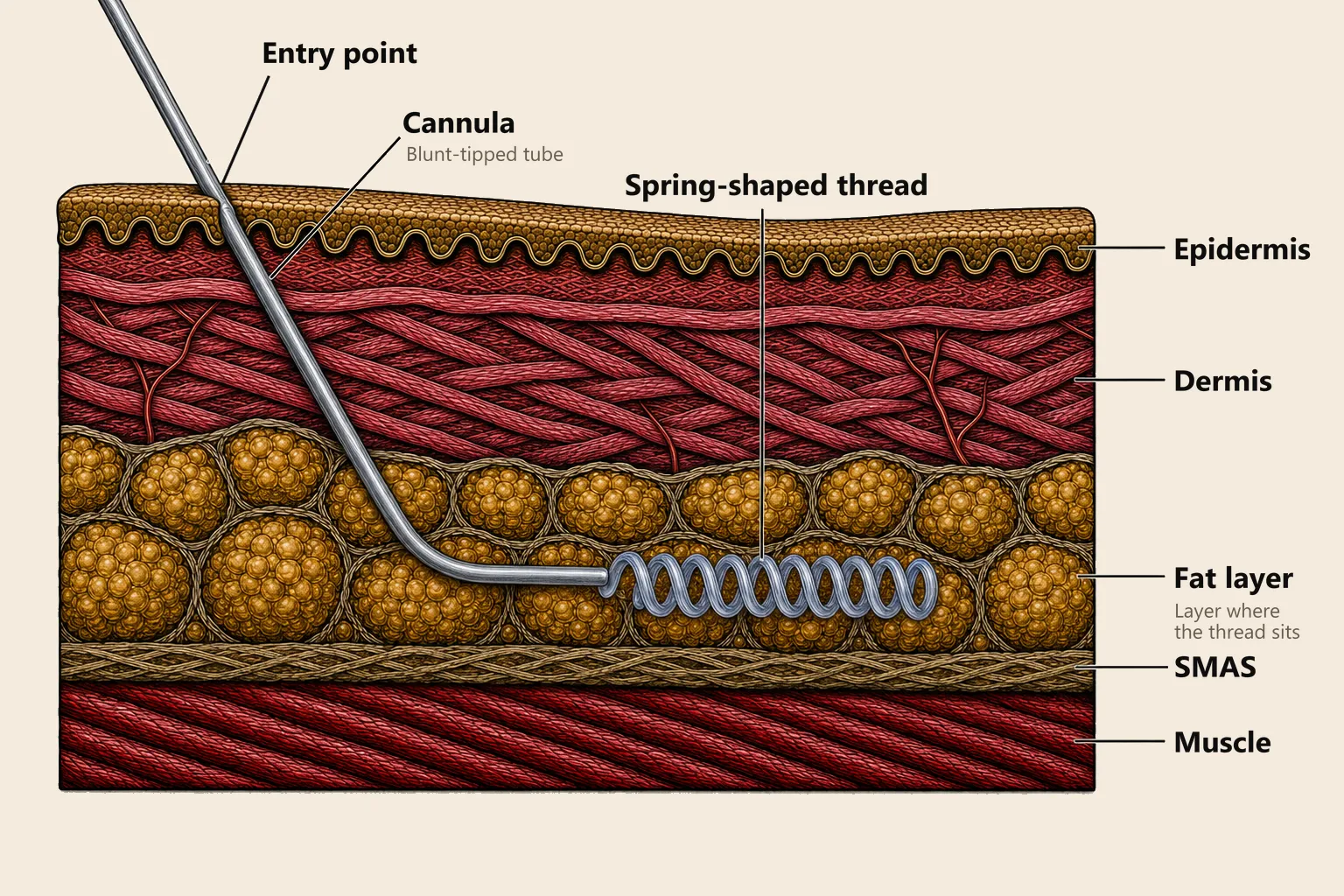
▲ The tube enters through a single entry point, and the thread is laid in the fat layer along the path the tube has taken
6. Finishing The remaining thread ends are tucked beneath the skin. The entry point is a small hole, so once it heals it usually isn't noticeable.
Rather than a sharp, cutting pain, the main sensation is a heavy, dull pressure as the coiled, spring-shaped thread passes deep beneath the skin.
Recovery, Expected Reactions, and Precautions
Recovery: Swelling and bruising settle over several days to 2 weeks, and you may feel soreness and throbbing for a few days after treatment.
Aftercare instructions
- While swelling and bruising settle, avoid making big facial expressions or massaging the treated area — this keeps the thread from being pushed out of place before it settles
- Heat-based lifting such as radiofrequency (RF) or ultrasound: from about 2 months after treatment (or later, once any foreign-body feeling or swelling has gone) — heat can weaken the threads or affect the tissue around them
Reported side effects With thread lifts, the following have been reported: the thread showing through or being felt under the skin, the thread poking out or working its way out, the thread moving out of position, the skin dimpling inward or showing pull marks (dimpling), infection, and granulomas (small lumps formed when inflammatory cells cluster around a foreign material). With volumizing threads, the thread may poke out toward the inside of the mouth or around the nose, and if it is placed too shallow, it can reach the dermis and change the surface contour or leave scar tissue. The standard treatment for a thread that causes a problem is to remove it. Other reactions are uncommon, but everyone responds differently — if a reaction lasts longer than expected or becomes more noticeable, contact us and we'll check it with you.
When to contact us right away Contact us right away if you can feel the end of a thread or feel it poking out, or if swelling, warmth, or pain keeps increasing. If a thread pokes out or shifts, or an infection develops, the sooner it is addressed, the better the chance of keeping it from becoming a bigger problem.
When we do not perform this treatment
- Pregnancy, possible pregnancy, or breastfeeding
When we postpone treatment
- Inflammation, a wound, or a skin condition at the treatment area — germs could enter along the path the thread takes, so we proceed once the skin has settled
What to tell us in advance
- Filler or implants already placed in the treatment area — they affect where the thread can go
- Blood-thinning medications such as aspirin or anticoagulants, or a tendency for bleeding to be slow to stop — you may bruise more
- Keloid-prone skin (scars that heal raised and thickened) — the entry points may heal raised
- Allergy to anesthetics — because the treatment uses a numbing spray
- Other recent treatments — if you've had filler, a skin booster, heat-based lifting, another thread lift, or similar treatments, let us know at your consultation
- Whether to have another treatment on the same day is decided together after your assessment
How PECHE Clinic Does It
We follow standards built from more than 90,000 treatments performed across the clinic. From more than 90,000 treatments performed across PECHE Clinic, we have built standards for each area and skin condition, and the same standards apply whichever PECHE physician treats you. With Jamber Thread, those standards determine how many threads are placed in the hollowed area and in which direction.
A physician personally reviews your assessment results before we begin. A physician reviews your facial contours and left–right balance captured with 3D MetaVu imaging, and checks your face and skin once more right before treatment. Pulling alone on a hollowed area can actually make the unevenness stand out, so we identify the cause first. Before we start, we tell you the name of the physician treating you.
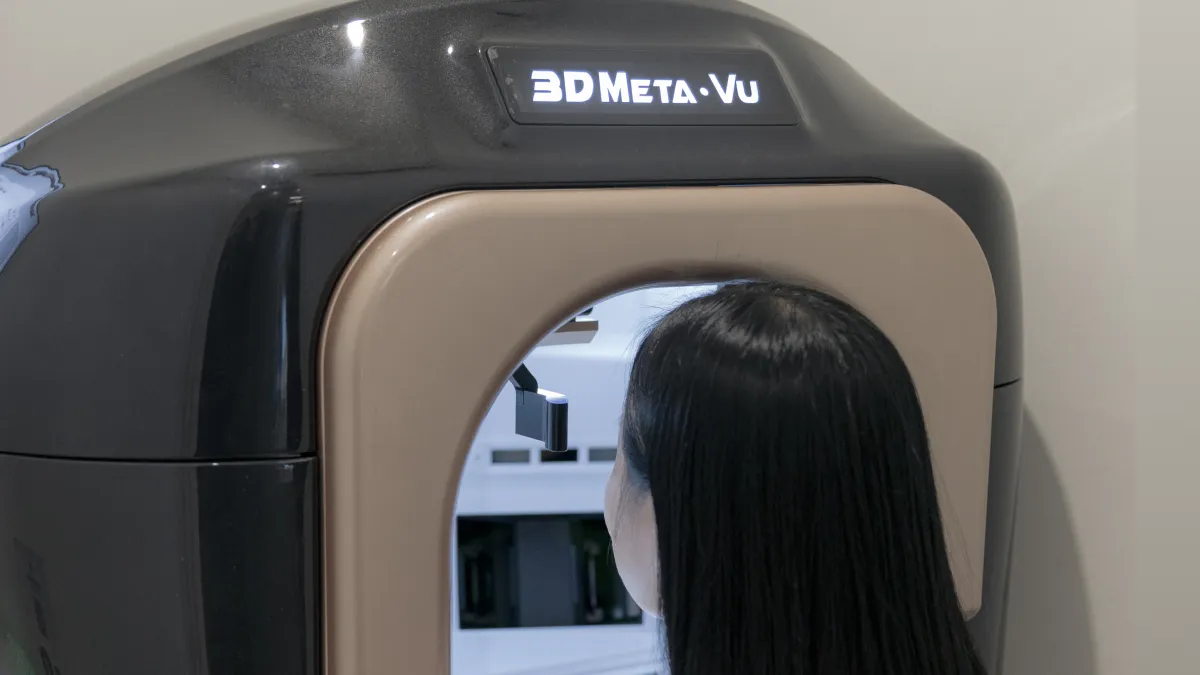
▲ We start by looking at your facial contours and left–right balance
We keep the preparation area in view behind a full glass wall. Treatment preparation takes place in an open-kitchen-style preparation area behind a full glass wall, so from the waiting area you can see the preparation process and hygiene practices for yourself.

▲ The treatment preparation area, seen through the glass wall from the waiting area
We recommend only the treatments your assessment results call for. We tell you first what this treatment can do (volume in hollowed areas and density beneath the surface) and what it can't (lifting sagging tissue or permanent volume). You're welcome to come in just for a consultation and leave.
Pricing
Prices for Jamber Thread are published on our website for every product option. Whichever country you're visiting from and whichever channel you book through, the price is the same as the one published on our website — so there's no need to compare prices from one booking channel to another. Making sure you can come in trusting the price you checked in advance — that is the trust PECHE Clinic puts first.
Jamber Thread comes in 1-thread, 4-thread, and 8-thread options. We look at the extent of the hollowing and decide on the option you need together after your assessment.
Location and Clinic Hours
PECHE Clinic 3F, 364 Gangnam-daero, Gangnam-gu, Seoul Right outside Gangnam Station Exit 4 — the building entrance is right in front of you as you come out
Clinic Hours (Korea Standard Time, KST)
- Monday–Friday: 10:30 AM – 9:00 PM
- Saturday, Sunday, and public holidays: 10:00 AM – 6:00 PM
- No lunch break — we see patients straight through midday
FAQ
Q1. Who performs the Jamber Thread treatment? A: Before treatment, we first let you know the name of the physician treating you, and that physician personally reviews your assessment results and the condition of your face and skin before starting. Where the threads go and how many are placed follow standards built from more than 90,000 treatments performed across the clinic, so the same standards apply even if a different physician treats you.
Q2. Do volume-filling threads also lift a sagging face? A: They have almost no lifting force. A spring-shaped thread has no barbs to catch tissue, so for heavy sagging, barbed pulling threads are the suitable option. If you have both sagging and hollowing, using the two types of thread together, each for its own role, has been proposed, and which approach fits you is decided together after your assessment.
Q3. Can I have it together with filler? A: Using the two together has been reported. According to those reports, when they are placed together, the thread's spring structure acts as a support that partly keeps the filler from being pushed sideways. Whether to have them together, and in what order, is decided together after your assessment.
Q4. Because the thread is spring-shaped, won't it look bumpy from the outside? A: In most cases, it isn't visible from the outside. However, if a volumizing thread is placed shallow, it can reach the dermis and change the surface contour or leave scar tissue, so it's important that it isn't placed shallow. You may feel a foreign-body sensation while it settles.
Q5. What should I look for when choosing a clinic for Jamber Thread? A: Look at three things. First, whether they distinguish hollowing from sagging before anything else — that judgment determines the right thread. Second, whether they tell you upfront what it can't do, such as the fact that it has no lifting force. Third, whether prices are published in advance.