Hyperhidrosis Botox — PECHE Clinic, Gangnam Station
An injection placed at the sweat glands in the skin of one area — the underarms, hands, or feet — to briefly block the nerve signal that tells them to release sweat · 50 units or 100 units · Right outside Gangnam Station Exit 4
Hyperhidrosis Botox
Hyperhidrosis Botox is an injection that places botulinum toxin (a medication made by purifying a protein produced by botulinum bacteria) into the skin (the dermis) of one area where you sweat excessively — the underarms, palms, or soles — temporarily blocking the nerve signal that switches on the sweat glands so that sweating decreases. PECHE Clinic uses four products for this treatment: Newlux, Coretox, Xeomin, and Allergan.
Put simply, it's an injection placed not in muscle but at the sweat glands in the skin, so that you sweat less.
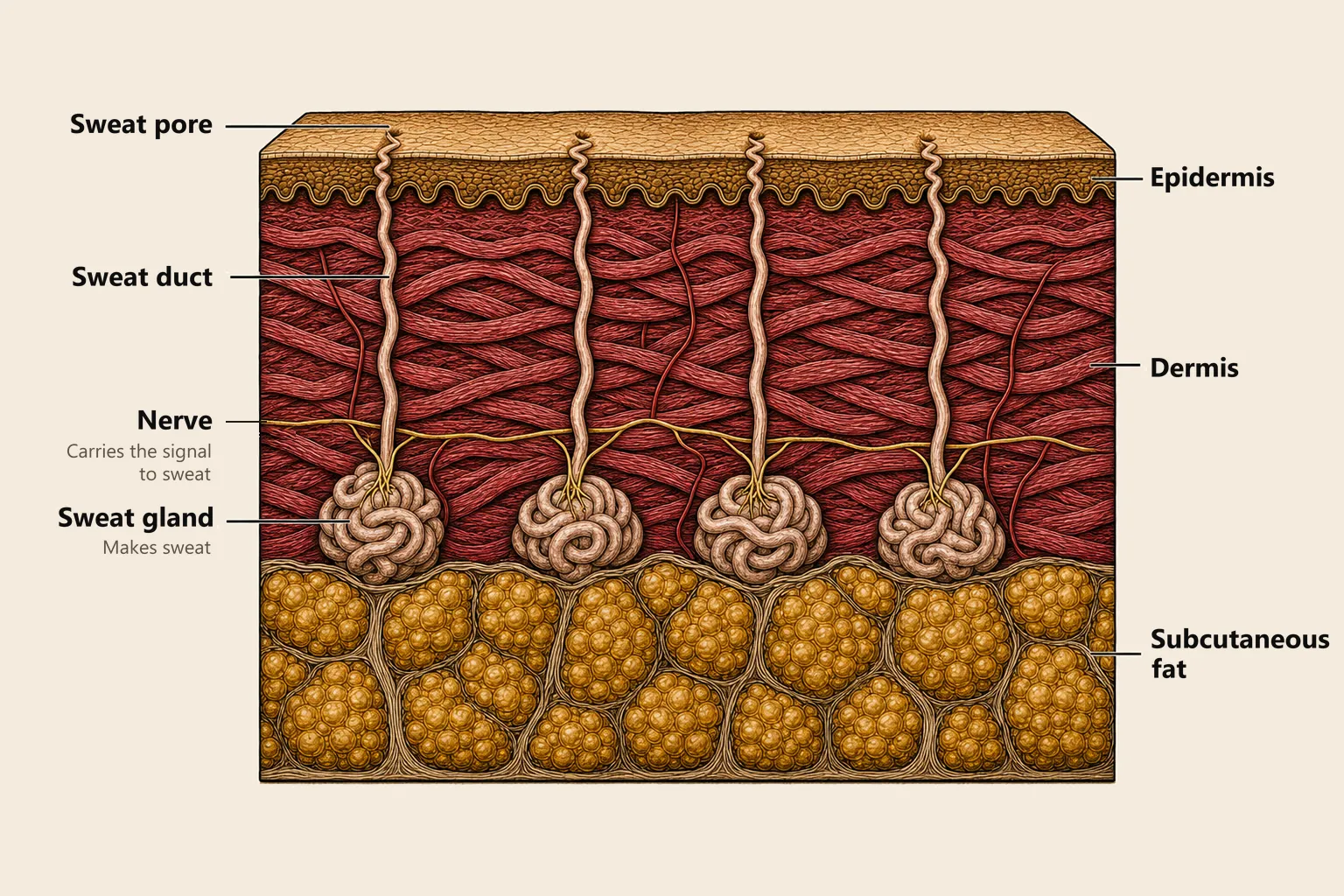
▲ Sweat glands are tubes coiled like balls of thread in the lower dermis — they make sweat on a signal from the nerve, and the sweat travels up the duct and out through the sweat pore
Hyperhidrosis Botox at a Glance
| Item | Details |
|---|---|
| Target layer | The sweat glands in the skin (the dermis) — the target is the glands, not muscle |
| Treatment areas | One area: underarms (axillae) · palms · soles |
| Available options | 50 units · 100 units |
| Approved scope | In Korea, the only product approved by Korea's Ministry of Food and Drug Safety (MFDS) for hyperhidrosis is Allergan, and the approved scope is severe underarm hyperhidrosis in adults 18 and older that is not controlled by topical antiperspirants or similar treatments. Hyperhidrosis injections with the other products, or hyperhidrosis injections in the hands or feet, are off-label use (use outside the approved indication, based on a physician's judgment), and the hands and feet are outside the approved scope in both Korea and the U.S. |
| Numbing | Ice pack for about 5 minutes |
| When results show | Gradually from days 3–7 → clearest at around week 2 (the timing commonly described for botulinum toxin in general) |
| How long it lasts | Underarms usually 4–12 months (up to 14 months) · hands need another treatment after about 6 months · on the feet, the treatment is reported to be less effective than in other areas (as summarized by the International Hyperhidrosis Society) |
| Repeat interval | Decided together after an assessment, timed to when sweating starts to increase again (at least 3 months apart) |
A unit is a measure of the product's potency. Each product measures it differently, so unit numbers can be compared only within the same product.
How It Works
1. Sweat glands release sweat on a signal from nerves Sweat glands are tubes coiled like balls of thread in the lower dermis, and the sweat they make travels up a fine duct to the sweat pores on the skin's surface. They work in response to acetylcholine (a chemical that carries the "release" message to the gland), which comes from the endings of autonomic nerves (nerves that regulate the body without your conscious control).
2. Botulinum toxin briefly blocks that signal Botulinum toxin placed in the skin blocks the release of this chemical from the nerve endings. Without the signal, the sweat glands make less sweat, so sweating decreases in the area where it was placed. It does not remove the sweat glands or cut the nerves.
3. When the nerves recover, sweating returns Over several months, as the nerve endings recover, sweat gradually starts to come back.
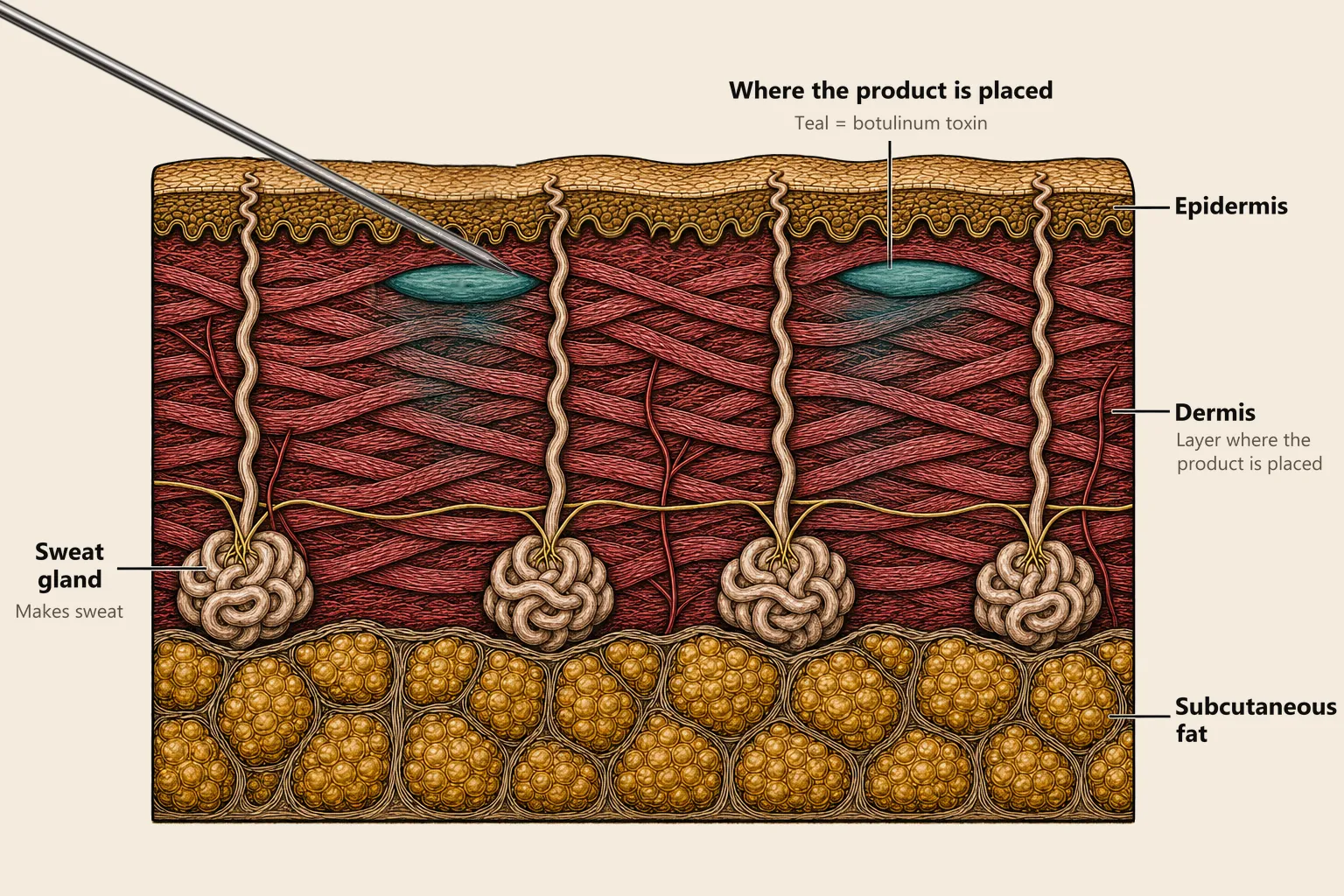
▲ The product (teal) is placed in divided amounts at even spacing in the skin (the dermis) — it acts on the sweat glands around each spot where it is placed
Expected Results and Why
| Expected result | Why |
|---|---|
| Fewer underarm sweat marks, and less of the discomfort of damp palms and soles | The signal that switches on the sweat glands is blocked in the injected area, so less sweat is produced |
What decreases is the sweat in the area where the product was placed, and how much it changes differs by person and by area.
When to Consider It
| Concern | Area |
|---|---|
| Sweat soaks through and leaves marks on your clothes, regardless of heat or nervousness | Underarms |
| Sweaty hands dampen paper, or handshakes make you self-conscious | Palms |
| Your feet sweat so much that the inside of your shoes feels constantly damp | Soles |
It's meant for sweating that is heavy enough to interfere with daily life and that occurs on its own, without another underlying condition (primary hyperhidrosis).
When a different approach may be the right fit
- Sweating that has increased suddenly, or that comes with other symptoms — it may be hyperhidrosis caused by another condition (secondary hyperhidrosis), so the cause needs to be checked first
- Odor, more than the amount of sweat, is your main concern — an approach with a different goal may be the right fit
Differences from Other Treatments and Limitations
| Compared approach | How they differ |
|---|---|
| Surgery that cuts the nerve trunk carrying the sweat signal (sympathectomy) | Surgery works by cutting the nerve trunk; this injection works by temporarily blocking the signal, so sweating returns after several months |
| Botulinum toxin placed diluted and close together in the shallow layer of facial skin | Both are placed in the dermis, but that approach aims at facial skin texture and oil, while Hyperhidrosis Botox aims to reduce sweating |
Limitations: It's often assumed that one injection stops sweating for good, but the effect isn't permanent, so it needs to be repeated periodically. It also doesn't treat the cause of hyperhidrosis brought on by another condition.
How It's Done
1. Consultation and treatment-area check We hear where you sweat and how much, and together decide on the area to be treated (one of the underarms, palms, or soles), the option, and the product.
2. Your physician's name and a final check Before treatment, we let you know the name of the physician treating you, and that physician personally examines the treatment area.
3. Disinfection and numbing The treatment area is disinfected, and an ice pack cools it for about 5 minutes to dull the sensation.
4. Injection A very fine needle is inserted shallowly to place divided amounts at even spacing across many points in the skin (the dermis). When the product is placed in the dermis, that spot puffs up slightly into a small bump (a wheal). Injections in the palms do hurt, and in the soles the pain is relatively greater.
Recovery, Expected Reactions, and Precautions
Recovery: Injection marks settle within 1–2 hours, and bruising, if it occurs, fades within 3–7 days.
On the day of treatment: Don't lie down for 4–6 hours, and avoid saunas, strenuous exercise, and massaging the treated area. This is to reduce the chance of the product spreading beyond where it was placed.
Possible effects with Hyperhidrosis Botox
- Underarms — the product labeling lists these as common reactions (each in roughly 3–10 out of 100 people): pain or bleeding at the injection site, increased sweating in areas other than the underarms, infection, a swollen, sore throat, flu-like symptoms, headache, fever, neck or back pain, itching, and anxiety
- Hands — along with injection pain, the hand muscles may temporarily lose some strength (a warning in the product labeling)
Although rare, a risk shared by all botulinum toxin products is that the effect can spread beyond where it was injected, causing weakness throughout the body, double vision, drooping eyelids, or difficulty swallowing, speaking, or breathing. These symptoms can appear anywhere from a few hours to a few weeks after treatment — if you notice any of them, contact the clinic or seek medical care right away.
Other reactions are uncommon, but everyone responds differently — if a reaction lasts longer than expected or becomes more noticeable, contact us and we'll check it with you.
When we do not perform this treatment
- A past allergic reaction to botulinum toxin or to an ingredient of the product to be used (such as human albumin)
- Pregnancy, possible pregnancy, or breastfeeding
When we postpone treatment
- Infection or inflammation at the injection site — we proceed once it has settled
What to tell us in advance
- Conditions in which the nerves' ability to move the muscles is already weakened, such as myasthenia gravis or ALS (Lou Gehrig's disease) — the risk of symptoms such as difficulty swallowing or breathing increases
- Taking muscle relaxants or certain antibiotics — the product's effect may become too strong
- Under 18 — the safety and effectiveness of treatment for underarm hyperhidrosis in people under 18 have not been established
- Botulinum toxin received elsewhere recently — tell us when, which product, and how much (we need this to set the interval and the dose)
- Other recent treatments — if you've had another sweat treatment, an underarm procedure, or similar treatments, let us know at your consultation
- Whether to have another treatment on the same day is decided together after your assessment
How PECHE Clinic Does It
We follow standards built from more than 90,000 treatments performed across the clinic. From more than 90,000 treatments performed across PECHE Clinic, we have built standards for each area and skin condition, and the same standards apply whichever PECHE physician treats you. For Hyperhidrosis Botox, how many points the product is divided across and at what spacing, matched to the size of the area being treated, are set according to those standards.
A physician examines the treatment area in person before we begin. A physician examines the treatment area in person before starting, and takes one more look right before treatment. We let you know by name who will treat you before we begin.
We offer four botulinum toxin products. Botulinum bacteria make the active ingredient — the part that creates the effect — wrapped in other proteins that protect it. That active ingredient is the same in all four products. What differs is whether the wrapping proteins were left in, whether human albumin (a protein naturally present in human blood) was added to help with storage, and the manufacturer and what each product is approved for. These are differences in composition, not in quality.
| Product | Made by | Wrapping proteins | Human albumin |
|---|---|---|---|
| Newlux | Korea · approval held by Numeco (a Medytox affiliate), manufactured by Medytox | Kept | Added |
| Coretox | Korea · Medytox | Removed | Not added (uses a synthetic stabilizer) |
| Xeomin | Germany · Merz | Removed | Added |
| Allergan | USA · AbbVie (which acquired Allergan) | Kept | Added |
When the wrapping proteins enter the body along with the active ingredient, the body can more easily recognize the product as foreign and may form antibodies — and then a later dose of the same amount may not work as well as it once did (known as resistance). This is uncommon, and it is generally understood that products with the wrapping removed may carry a lower chance of it. The factors that raise the risk are repeat injections at short intervals or extra injections to boost the effect, a large amount at one time, and the total amount of protein entering the body — so the principles for prevention are a dose suited to the area and an interval of at least 3 months. Products with the wrapping removed include both a Korean-made product (Coretox) and an imported one (Xeomin), so whether the wrapping is removed does not depend on whether a product is Korean-made or imported. If you have had a hypersensitivity reaction to an added ingredient (such as human albumin), products containing that ingredient are not used, so the albumin column is also considered when choosing a product.
We open genuine products in front of you and keep the preparation area in view behind a full glass wall. All four products are stored as a powder and dissolved in saline before use. This is because the product instructions specify that, once dissolved, the product is to be used without being stored for long. The genuine product is opened in front of you, and treatment preparation takes place in an open-kitchen-style preparation area behind a full glass wall, so from the waiting area you can see the genuine product, the dissolving process, and hygiene practices for yourself.

▲ The treatment preparation area, seen through the glass wall from the waiting area
We recommend only the treatments your assessment results call for. We tell you first what this treatment can do (less sweating in the injected area) and what it can't (stopping sweat permanently, or treating the cause of hyperhidrosis brought on by another condition). You're welcome to come in just for a consultation and leave.
Pricing
Prices for Hyperhidrosis Botox are published on our website for every product option. Whichever country you're visiting from and whichever channel you book through, the price is the same as the one published on our website — so there's no need to compare prices from one booking channel to another. Making sure you can come in trusting the price you checked in advance — that is the trust PECHE Clinic puts first.
Hyperhidrosis Botox (Korean/Newlux), Hyperhidrosis Botox (Korean Premium/Coretox), Hyperhidrosis Botox (Imported/Xeomin), and Hyperhidrosis Botox (Imported/Allergan) each come in 50U and 100U options; you choose one of the three areas — underarms, hands, or feet — and we decide together on the option you need after your assessment.
Location and Clinic Hours
PECHE Clinic 3F, 364 Gangnam-daero, Gangnam-gu, Seoul Right outside Gangnam Station Exit 4 — the building entrance is right in front of you as you come out
Clinic Hours (Korea Standard Time, KST)
- Monday–Friday: 10:30 AM – 9:00 PM
- Saturday, Sunday, and public holidays: 10:00 AM – 6:00 PM
- No lunch break — we see patients straight through midday
FAQ
Q1. Who performs Hyperhidrosis Botox? A: Before treatment, we first let you know the name of the physician treating you, and that physician personally examines the treatment area before starting. The spacing of the injection points and the amount used follow standards built from more than 90,000 treatments performed across the clinic, so the same standards apply even if a different physician treats you.
Q2. If sweating is blocked, won't I sweat more somewhere else? A: After surgery that cuts the nerve trunk carrying the sweat signal, increased sweating in other areas (compensatory hyperhidrosis) is common, but it has not been reported as a problem with this injection. That said, "increased sweating in areas other than the underarms" is among the common reactions listed in the product labeling, so we can't say it doesn't happen at all — if you notice a change like that, let us know.
Q3. Will getting it in my hands make them weaker? A: In the palm, small muscles that move the fingers lie close beneath the skin, so if the product's effect reaches those muscles, your hand may temporarily have less strength. It returns with time, but if your work involves fine use of your hands, such as playing a musical instrument, let us know in advance at your consultation.
Q4. How are 50 units and 100 units decided? A: We decide together after an assessment, based on the size of the area being treated and how heavily it sweats. A large amount at one time is a risk factor for resistance, so the principle is to use only the amount suited to the area.
Q5. Hyperhidrosis Botox — what should I look for when choosing a clinic? A: Look for whether they explain, before starting, if the area you want treated is within the product's approved scope or outside it, and what differs by area, such as changes in hand strength or pain in the feet. It also helps to see whether they tell you the product and price in advance, and whether you can see how the medication is prepared.