ONDA Lifting — PECHE Clinic, Gangnam Station
Microwave contouring that gathers heat in the subcutaneous fat layer to reduce the fat volume of a double chin and deep cheek fat · Face and body · Right outside Gangnam Station Exit 4
ONDA
ONDA uses microwaves (the same kind of electromagnetic waves a microwave oven uses) to warm the subcutaneous fat layer beneath the skin, reducing fat cells and tightening the skin to refine the contours under the chin and on the body. The device is made by DEKA of Italy.
Put simply, it is not a treatment that lifts sagging fascia (the deeper layer that supports the skin) — it refines your contours by taking away the weight of fat. It suits volume created by fat, such as a double chin or deep cheek fat (fat deep in the cheeks beside the corners of the mouth), and it is done without incisions, injections, or numbing.
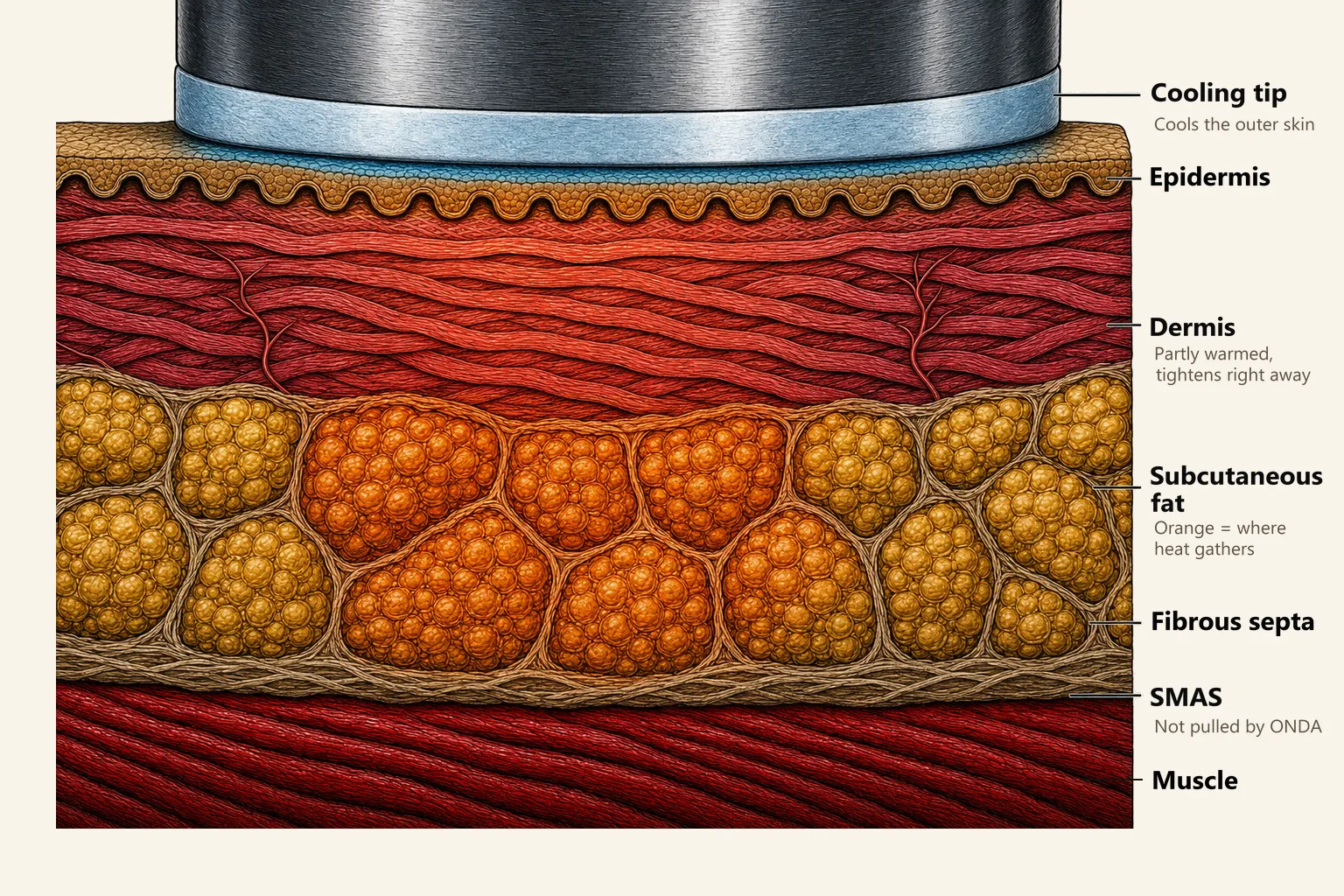
▲ Deep orange = the subcutaneous fat layer where heat gathers; light orange = the dermis, which warms along with it
ONDA at a Glance
| Item | Details |
|---|---|
| Category | Microwave contouring (non-invasive — does not break the skin) |
| Mechanism | Microwave heat reduces fat cells and tightens dermal collagen and the fibrous membranes between clusters of fat (fibrous septa) |
| Target layer | Centered on the subcutaneous fat layer (+ dermal collagen and fibrous septa) |
| Surface protection | Continuous contact cooling — the tip surface is kept cold and glides over the skin throughout |
| Manufacturer | DEKA (Italy) |
| Concerns it suits | Double chin and fat under the chin · deep cheek fat · localized fat on the body |
| Available options | ONDA Lifting (face): 20, 40, 60, or 80KJ · ONDA Body Lifting: 10, 50, or 100KJ |
| Numbing | Performed without numbing (no numbing wait) |
| When results show | A light tightening right after treatment → fat volume reduces over 2–3 months |
| Recommended sessions | Face: 3 sessions at 3–4 week intervals is the standard (based on 60–80KJ for the full face) · Body: repeated at intervals of several weeks, with the number of sessions decided together after your assessment |
| How long it lasts | About 6 months to 1 year after completing the series of sessions (for the face, based on 3 sessions at 60–80KJ · varies with weight change and from person to person) |
| Recovery | Usually little to no bruising, swelling, or scabbing · a light redness right after treatment lasts a short time |
kJ (kilojoule) is a unit that counts the total amount of energy delivered during treatment; the larger the number, the more energy is delivered.
How It Works
1. The depth where heat gathers is set by design ONDA's microwaves vibrate about 2.45 billion times per second (2.45GHz), shaking the tissue to produce heat. The head of the device that is held in the hand and placed on the skin (the handpiece) is built so heat gathers about 0.7cm or about 1.2cm below the skin (as labeled by the manufacturer), and the manufacturer explains that it is designed to reduce the effect on the epidermis and dermis and gather heat in the subcutaneous fat layer.
2. The cold tip cools the water-rich outer skin Microwaves are strongly absorbed by water. That's why the outer skin, which holds a lot of water, is cooled throughout the treatment by keeping the tip surface that touches the skin cold.
3. Fat cells shrink and leave the body over several weeks Fat cells that take on the heat are understood to shrink as the membrane surrounding them is damaged. The remaining debris is handled by macrophages (immune cells that clear away debris in the body) and leaves over several weeks, carried by the flow of lymph (the fluid that carries waste through the body). That's why changes in your contours show gradually afterward, not on the day of treatment.
4. The tightening right afterward comes from the dermis Even so, some heat does form in the dermis, and dermal collagen contracting right away in response to this heat is the main reason the skin feels tighter right after treatment. The tough fibrous membranes that divide clusters of fat like partitions (fibrous septa) also tighten in the part closest to the skin.
Expected Results and Why
| Expected result | Why |
|---|---|
| Reduced fat volume (double chin, localized body fat) | The heat gathered in the fat layer reduces the number of fat cells |
| Tightening right after treatment | Dermal collagen contracts right away, and the fibrous septa tighten along with it |
| Contours look more defined and lifted | With heavy fat reduced, there is less weight pulling down, and the tightened septa firmly connect the skin to the tissue beneath (this is different from lifting that pulls up the fascia) |
The results appear in two stages. The tightening right after treatment comes first, and the change in contour as fat cells are cleared appears over 2–3 months. Because there is a time gap — fat reduction starts to show around the time the immediate tightening settles — you may feel partway through as if the effect has disappeared.
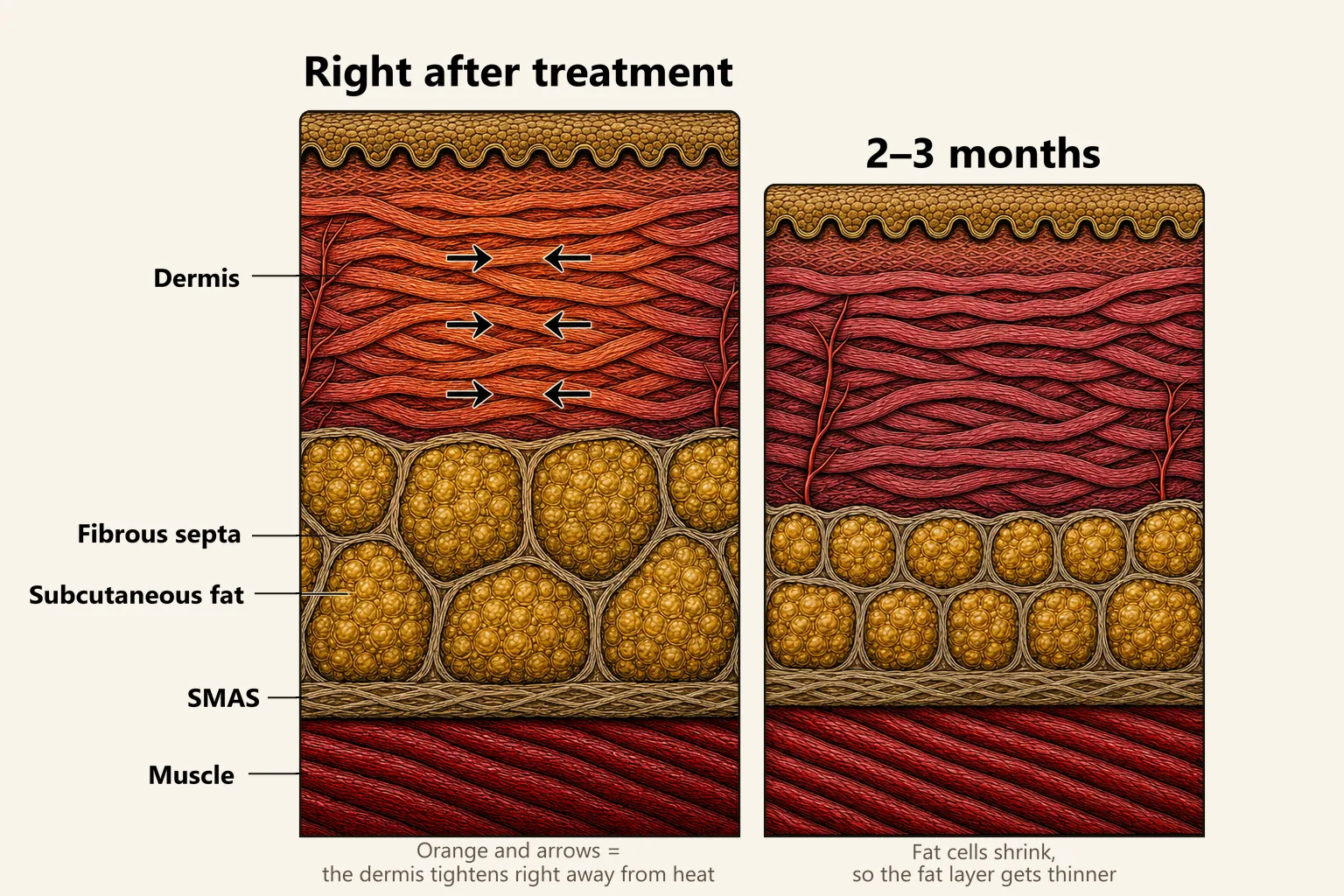
▲ Left: the tightening in the dermis. Right: a change in which only the fat layer has become thinner
Because fat cells need time to shrink and be cleared, the treatment isn't done just once — it's repeated at intervals. For the face, the 3 sessions at 3–4 week intervals and the duration (about 6 months to 1 year) are based on 60–80KJ, which covers the full face. 20–40KJ is used to treat a small area lightly or for maintenance, so the same change is hard to expect from it.
When to Consider It
- A double chin or fat under the chin makes the line of your profile look heavy
- Deep cheek fat looks heavy and weighed down
- Your fat is firm or the fat layer is thick, so methods that draw the skin in with suction don't grip it well
- You need a treatment with little recovery time
- Localized fat on the body bothers you — this is done with the dedicated body option (ONDA Body Lifting)
On the face, the area supported by evidence in the treatment recommendations (2024) of an advisory committee of physicians from several countries is fat under the chin (double chin); for deep cheek fat, the treatment is applied based on clinical experience.
When a different approach may be the right fit
- Sagging of the SMAS (a thin, tough layer that supports the skin and fat so they don't sag), rather than fat, is the main cause — ONDA does not pull the SMAS
- Skin that has become thinner and lost strength is your main concern — a method that heats the dermis to increase skin density is closer to that goal
- There is little fat on your face and the front or side cheeks are already hollow — because this treatment reduces fat, the cheeks could become more hollow, so it isn't applied to those areas
Differences from Other Treatments and Limitations
| Compared approach | What they share | How they differ |
|---|---|---|
| Suction-based radiofrequency (draws the skin in with suction, then reduces fat with radiofrequency and electrical pulses) | Both reduce fat while also tightening the skin to some degree | The suction-based method gets a good grip on soft fat that is easy to pinch, and suction marks or bruising can last several days. ONDA works with heat, without suction or electrical stimulation, so it is also used on firm, thick, compact fat, and there is little to no bruising or swelling. This is not a matter of better or worse — which one suits you depends on the nature of the fat |
| Focused ultrasound (HIFU) | Both use heat | Ultrasound concentrates energy at a single point to tighten and lift the SMAS, while ONDA reduces fat volume. They work on different layers, so they are sometimes used together |
| Radiofrequency that heats the dermis | Both use heat to tighten the skin | A method that increases skin density and elasticity and ONDA, which reduces fat volume, have different goals altogether |
Limitations: ONDA does not address structural sagging caused by loosened fascia itself.
How It's Done
1. Assessment and consultation For the face, 3D MetaVu imaging captures your contours and left–right balance, and a physician's examination is added so we can determine together what is causing the volume. For the body, a physician looks at and checks the treatment area in person.
2. Your physician's name and a final check Before treatment, we let you know the name of the physician treating you, and that physician personally reviews your assessment results and the condition of the treatment area.
3. Cleansing the treatment area and preparing bare skin Microwaves are strongly absorbed by water. If a water-rich cream or ointment is left on the skin's surface, the energy is absorbed at the surface first and can't travel deep, and the risk of a surface burn rises. That's why no numbing cream is applied either, and we start on bare skin.
4. Mapping and marking We mark the areas to be treated on your skin.
5. Treatment This is performed without numbing. The cold tip is held firmly against the skin and moved in a rubbing motion as the planned energy is built up.
It feels like a cool tip gliding over the skin, and then at certain points a sudden, intense heat rises from deep in the skin. It can feel hotter on the jawline and cheekbones, where bone is close and fat is thin. If a spot feels unusually hot, tell us and we adjust the speed and intensity.
If the heat sensation is a concern, you can add Non-Sedation Gas Anesthesia (Air Nox) as an option — you breathe in a mix of oxygen and nitrous oxide that reduces pain and tension while you stay conscious and responsive.
Recovery, Expected Reactions, and Precautions
Recovery: There is usually little to no bruising, swelling, or scabbing, and the light redness right after treatment usually settles within 1–2 hours. You can usually wash your face and wear makeup the same day. Other reactions are uncommon, but everyone responds differently — if a reaction lasts longer than expected or becomes more noticeable, contact us and we'll check it with you.
When we do not perform this treatment
- Metal or electronic devices implanted in the body, such as a pacemaker — because this method uses electromagnetic waves, it could affect how the device works or the area around the metal
- Pregnancy, possible pregnancy, or breastfeeding
What to tell us in advance
- Other recent treatments — if you've had filler, a hyaluronic acid "glow" injection, another lifting treatment, or similar treatments, let us know at your consultation. In areas where an ingredient that holds water has been injected, such as filler or a "glow" injection, the area could overheat or the injected ingredient could be lost because microwaves are strongly absorbed by water, so we check in advance
- Whether to have another treatment on the same day is decided together after your assessment
How PECHE Clinic Does It
We follow standards built from more than 90,000 treatments performed across the clinic. From more than 90,000 treatments performed across PECHE Clinic, we have built standards for each area and skin condition, and the same standards apply whichever PECHE physician treats you. With ONDA, those standards determine how the energy is divided across each area.
We start by telling fat apart from sagging. Even with the same double chin, ONDA is the right fit if the cause is fat, while a method that works on the SMAS is the right fit if the cause is sagging of the SMAS. For the face, a physician reviews the results photographed with 3D MetaVu and adds an examination to determine the cause. Right before treatment, a physician looks at the treatment area once more, and before we start, we tell you the name of the physician treating you.
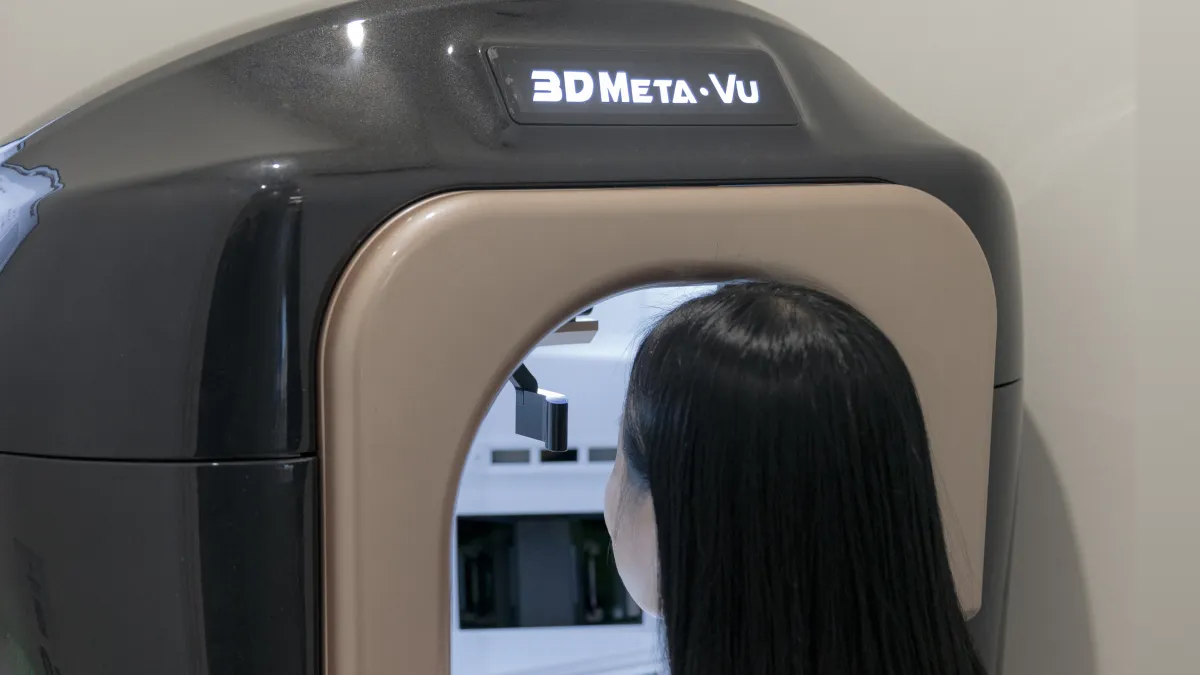
▲ We review your imaging results together
We keep the preparation area in view behind a full glass wall. Treatment preparation takes place in an open-kitchen-style preparation area behind a full glass wall, so from the waiting area you can see the preparation process and hygiene practices for yourself.
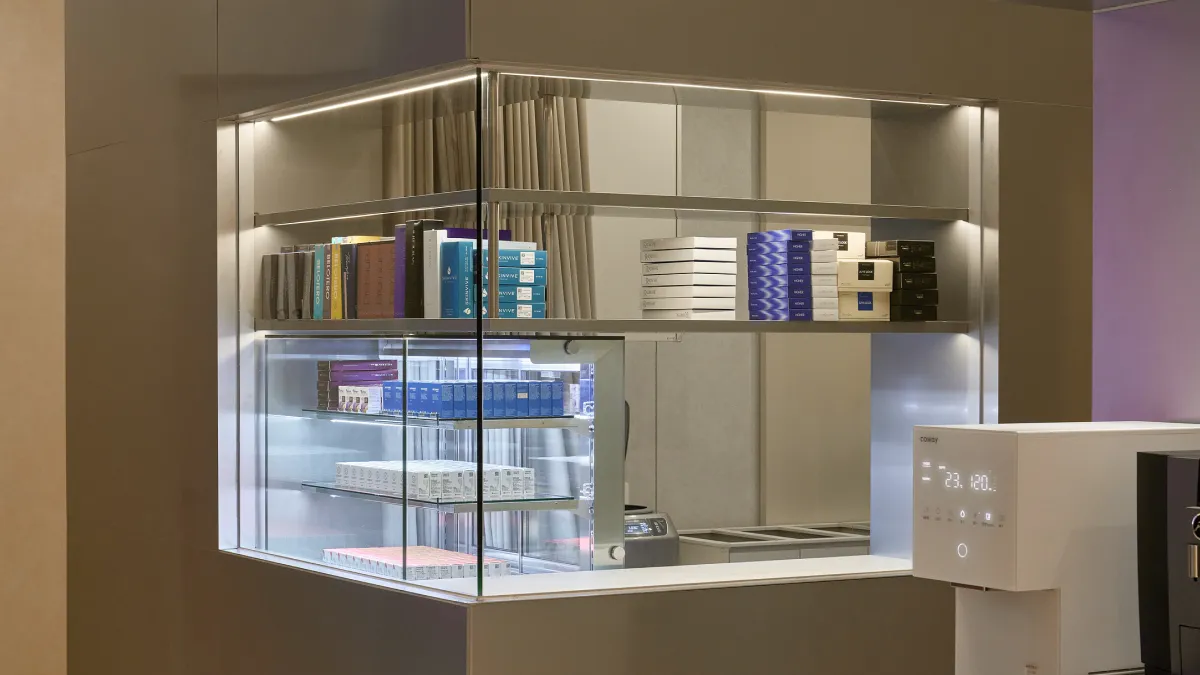
▲ The treatment preparation area, seen through the glass wall from the waiting area
We recommend only the treatments your assessment results call for. We tell you first what this treatment can do (reduce fat volume and tighten the skin right afterward) and what it can't (sagging of the SMAS or loose skin itself). You're welcome to come in just for a consultation and leave.
Pricing
Prices for ONDA are published on our website for every product option. Whichever country you're visiting from and whichever channel you book through, the price is the same as the one published on our website — so there's no need to compare prices from one booking channel to another. Making sure you can come in trusting the price you checked in advance — that is the trust PECHE Clinic puts first.
For the face, ONDA Lifting comes in 20, 40, 60, and 80KJ; for the body, ONDA Body Lifting comes in 10, 50, and 100KJ. We decide on the option you need together after your assessment.
Location and Clinic Hours
PECHE Clinic 3F, 364 Gangnam-daero, Gangnam-gu, Seoul Right outside Gangnam Station Exit 4 — the building entrance is right in front of you as you come out
Clinic Hours (Korea Standard Time, KST)
- Monday–Friday: 10:30 AM – 9:00 PM
- Saturday, Sunday, and public holidays: 10:00 AM – 6:00 PM
- No lunch break — we see patients straight through midday
FAQ
Q1. Who performs the ONDA treatment? A: Before treatment, we first let you know the name of the physician treating you, and that physician personally reviews your assessment results and the condition of the treatment area before starting. How the energy is divided across each area follows standards built from more than 90,000 treatments performed across the clinic, so the same standards apply even if a different physician treats you.
Q2. Does ONDA feel very hot without numbing? A: The cold tip keeps cooling the outer skin throughout the treatment, so the heat comes as a sudden, intense surge at certain points that then fades, and it can be felt more on the jawline and cheekbones, where bone is close and fat is thin. If a spot feels hot, tell us and we adjust the speed and intensity for that spot.
Q3. I'm worried my cheeks will become hollow. A: At your consultation, just tell us whether your cheeks are on the thin side and which areas concern you. Because this treatment reduces fat, areas with little fat where the front or side cheeks are already hollow are left out of the treatment range, and only the areas to reduce (such as under the chin and deep cheek fat) are decided.
Q4. Once fat cells are reduced, will my results stay the same even if I gain weight? A: No. The number of fat cells that were reduced doesn't increase again, but if you gain weight, each remaining fat cell gets bigger, and your contours can return. To keep your results longer, it's important to avoid gaining a significant amount of weight.
Q5. Can I compare the KJ number with what I had elsewhere? A: KJ is the total amount of energy delivered, so within ONDA it serves as a basis for comparing how much treatment was given. However, numbers from other devices (KJ or shot counts) can't be compared directly, because those devices produce energy in different ways. The right number of KJ is decided together after an examination of the area and the amount of fat.