Belotero — PECHE Clinic, Gangnam Station
A hyaluronic acid filler whose single gel mixes denser and looser areas, so it spreads as if seeping in between the tissues · Fine lines, under-eyes, smile lines, and cheeks · Right outside Gangnam Station Exit 4
Belotero
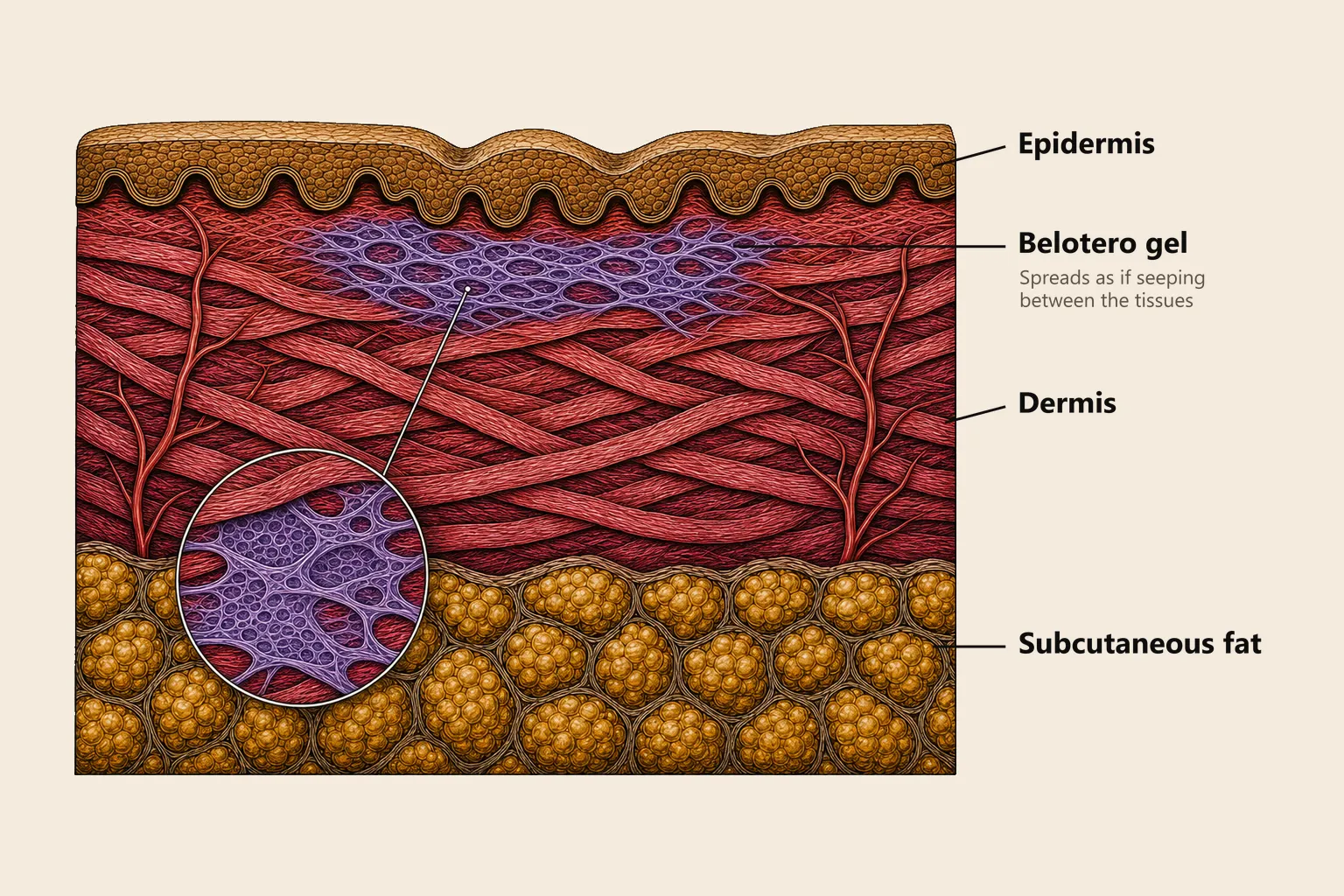
Belotero is a hyaluronic acid (HA) filler brand made by Merz of Germany. It's made with the manufacturer's process (CPM), which puts tightly linked areas and loosely linked areas together in one gel, and its defining feature is that, once injected, it spreads as if seeping in between the tissues.
Put simply, it's a filler that settles into the skin as if seeping in, so it tends to show through or clump less, even in thin-skinned areas. PECHE Clinic uses two lines: Soft, for fine lines and the under-eyes, and Intense, for smile lines and deep wrinkles.
▲ The purple is the Belotero gel. The circle is a magnified view of the gel, where denser areas (small mesh) and looser areas (large mesh) are mixed together
Belotero at a Glance
| Item | Details |
|---|---|
| Category | Hyaluronic acid (HA) filler — the injected gel fills sunken areas and the grooves of wrinkles |
| Manufacturer and technology | Merz (Germany) · a process that puts areas of different density together in one gel (CPM) |
| Lines used at PECHE Clinic | Soft · Intense — see the line table below |
| Treatment areas | Wrinkles / forehead, aegyo-sal (the small band of fullness just below the lower lash line), nose bridge, under-eyes / outer cheeks, front cheeks, smile lines (nasolabial folds), chin |
| Pain | Placed deep (such as Intense): a sting as the needle first goes in, followed by a heavy feeling of the gel pushing in from the inside · Placed shallow: a prickly stinging on the skin surface (similar to a skin booster injection — an injectable treatment aimed at the quality of the skin itself) |
| Pain control | Wrinkles and the chin: numbing cream · other areas: numbing cream or local anesthesia (numbs only the treatment area), depending on the situation · then about a 5-minute wait · more numbing is added if needed · both lines contain an anesthetic ingredient (lidocaine) in the gel |
| When results show | The area is filled right after injection — the actual shape is judged 2–4 weeks later, once the swelling has gone down and the gel has settled, and at that point we decide together whether to top up any shortfall |
| How long it lasts | Depends on the area treated, not the line — about 12–18 months for areas where volume is filled in a deep layer, such as the front and outer cheeks · about 6–12 months for the under-eyes and fine lines (averages · varies by person) |
| Recovery | Swelling about 3–7 days · bruising, if it occurs, fades over 1–2 weeks |
| Adjustability | Can be dissolved and adjusted with an injection of an enzyme that breaks down hyaluronic acid (hyaluronidase) |
How It Works
1. Hyaluronic acid is linked into a gel Hyaluronic acid is a substance naturally present in the dermis (the layer beneath the epidermis that gives skin its elasticity and thickness), where it holds water to create volume. Left as it is, it flows like water and breaks down quickly, so its strands are linked together at points here and there (cross-linking) to make a gel that holds its shape.
2. One gel holds both denser and looser areas Instead of linking the strands evenly, Belotero puts tightly linked areas and loosely linked areas together in one gel. The denser areas hold the shape and the looser areas spread between the tissues, so rather than standing out as a single mass, the gel settles evenly in among the tissue.
3. It tends to show through or clump less, even in a shallow layer When gel sits in a shallow layer where the skin is thin, it can show through with a bluish tint (the Tyndall effect). Belotero has a property of adhering closely to the tissue, which is understood to be why it tends to show this less, even when placed in a shallow layer.
4. Within the same brand, each line is placed at a different depth
| Line | Hyaluronic acid concentration | Injection depth stated by the manufacturer | Uses stated by the manufacturer |
|---|---|---|---|
| Soft | 20mg/mL | Shallow to middle layers of the dermis | Fine lines around the mouth, forehead, and eyes, and fine creases such as those at the corners of the mouth |
| Intense | 25mg/mL | Deep layer of the dermis | Filling deep wrinkles and folds, and distinct volume enhancement such as contours |
mg/mL is the amount of hyaluronic acid in 1 mL of gel, and across the manufacturer's lines, the higher the concentration, the deeper the layer the line is meant for. There are four lines in all, including Balance and Volume, and PECHE Clinic uses Soft and Intense.
For the under-eyes, Soft is used whether the concern is hollowness or fine surface lines — only the depth differs. For hollowness (tear troughs), it's placed in the deep layer closest to the bone to prop up the muscle and thin skin above; for fine lines on the surface, it's spread thin in the dermis close to the surface. The softest line is used even for deep hollows because under the eyes, where the skin is thinnest, keeping the gel from showing through comes first. Using it for deep hollows is a clinical approach that differs from the depth stated by the manufacturer.
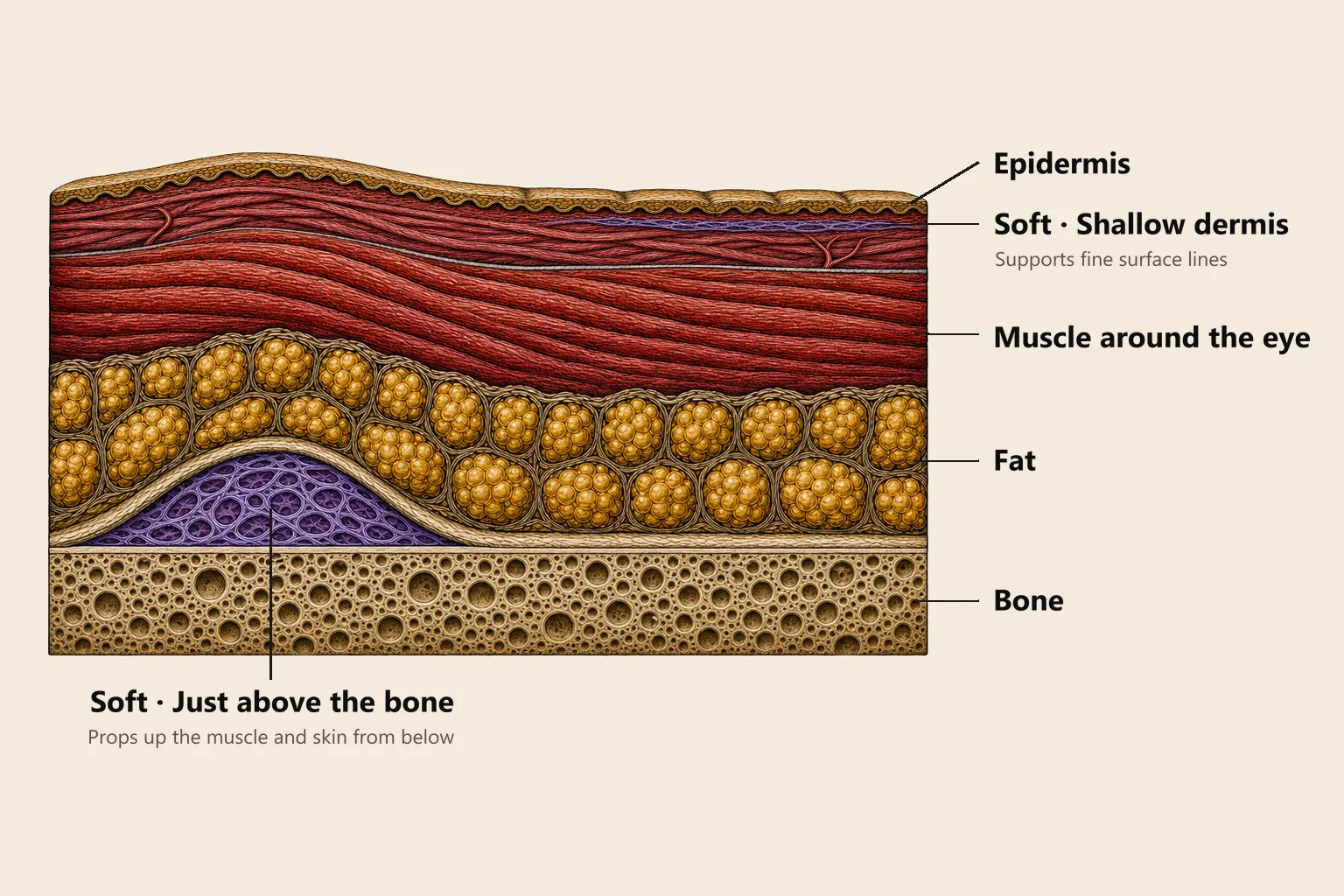
▲ The same Soft is placed just above the bone for under-eye hollows (left) and in the shallow layer of the dermis for fine surface lines (right)
Expected Results and Why
| Expected result | Why |
|---|---|
| Fine lines smooth out with little sense of something foreign (Soft) | Even when spread thin in the shallow dermis, it blends with the tissue as it settles |
| A tired look from under-eye hollows is softened (Soft) | Above the bone, it supports the muscle and skin above from below |
| Smile lines and deep wrinkles are softened, and volume is enhanced (Intense) | A more concentrated gel provides support in the deep dermis |
Deep grooves become gentler rather than flat all at once. In a study conducted jointly at multiple clinics (Kühne et al., 2016 · 108 participants), about 90% improved by 1 point or more on a wrinkle score both right after treatment and 17 days (±3 days) later with a Belotero-family filler containing an anesthetic ingredient, and apart from 1 case of bruising, all adverse reactions were mild to moderate. The degree of change varies from person to person.
When to Consider It
- Fine, crinkly lines remain around your eyes and mouth even when your face is relaxed
- Your skin is thin and you're worried filler might show through or look lumpy
- Your under-eyes are hollow, shadowed, and look tired, or you have fine lines on the surface of the under-eye skin
- Your smile lines look deep
- Sunken areas such as the forehead, aegyo-sal, front cheeks, or outer cheeks need volume
When a different approach may be the right fit
- Expression lines that appear only when you smile or frown — lines created by muscle movement are the domain of injections that relax the muscles (botulinum toxin)
- Correction that raises the nose bridge high or brings the chin tip forward — this needs firm, bone-like support, so a firm filler is a better fit than a gel that spreads softly. In that case, we also consider the other fillers we offer
- Skin texture and hydration are your main concern — the skin-booster family may be the right fit
- Sagging, rather than hollowness, is the cause — this is a filling treatment, so it doesn't lift the sagging tissue itself
Differences from Other Treatments and Limitations
| Compared approach | What they share | How they differ |
|---|---|---|
| Particle-type hyaluronic acid fillers (cross-linked gel broken into fine particles and mixed into a thinner gel) | Both are hyaluronic acid fillers | The particles act as a scaffold, so their lifting power tends to be greater. Belotero is a single continuous gel with no particles, designed to adhere closely to the tissue |
| Collagen-stimulating injections (injections that prompt your body to produce its own collagen) | Both fill sunken areas | With Belotero, the injected gel itself becomes the volume, and it can be dissolved to adjust it. Collagen-stimulating injections work as your own collagen builds up, and they may be difficult or impossible to reverse by dissolving |
This is not a matter of better or worse but of design goals.
Limitations: It isn't permanent — over time, the body gradually breaks it down and absorbs it.
How It's Done
1. 3D skin analysis and consultation 3D MetaVu imaging captures your wrinkles, skin texture, and facial left–right balance, and we review the results on screen together to decide on the areas, the line, and the amount.
2. Your physician's name and a final check Before treatment, we let you know the name of the physician treating you, and that physician personally reviews your assessment results and the condition of your face.
3. Numbing We numb the area with the method suited to it and wait about 5 minutes (see the at-a-glance table above for the method).
4. Treatment The genuine product is opened in front of you, then placed in portions at the depths we decided on.
Recovery, Expected Reactions, and Precautions
Recovery: Swelling, bruising, redness, and tenderness when pressed mostly settle down over time. In areas where the gel is placed shallow with many small injections, as with Soft, small dot-like bleeding spots or bruises can appear at each needle point. Other reactions are uncommon, but everyone responds differently — if a reaction lasts longer than expected or becomes more noticeable, contact us and we'll check it with you.
Aftercare instructions
- Washing your face and makeup: gently, from 3–4 hours after treatment, once the needle marks have closed (to be on the safe side, from the next day)
- For 1–2 weeks, avoid saunas, strenuous exercise, and anything that presses hard on the treated area, such as sleeping face down or vigorous massage — this keeps the shape from changing before the gel settles
Rare but possible effects: Although rare, a risk shared by all injection treatments is that the product can enter a blood vessel and block it. If pain keeps getting worse after treatment, or the skin turns white or a dark, dusky red, contact us right away.
When we do not perform this treatment
- Pregnancy, possible pregnancy, or breastfeeding
- An allergy to the filler ingredients or the anesthetic ingredient (lidocaine), or a past anaphylaxis (a sudden, severe whole-body allergic reaction)
- Allergy to gram-positive bacterial proteins — the raw material is made by bacterial fermentation, so very small amounts of those proteins may remain
When we postpone treatment
- Inflammation or infection where the treatment will be done (acne, a rash, and the like) — we proceed once it has settled
What to tell us in advance
- Blood-thinning medications such as aspirin, anti-inflammatory pain relievers (NSAIDs), or warfarin — you may have more bruising and bleeding
- Keloid-prone skin (scars that heal raised and thickened), or currently receiving treatment that lowers the immune system — in these cases safety hasn't been studied or caution is needed, so we check in advance
- Other recent treatments — if you've had other filler, heat-based lifting, laser, or similar treatments, let us know at your consultation. We also check whether filler from a previous treatment still remains
- Whether to have another treatment on the same day is decided together after your assessment
How PECHE Clinic Does It
We follow standards built from more than 90,000 treatments performed across the clinic. From more than 90,000 treatments performed across PECHE Clinic, we have built standards for each area and skin condition, and the same standards apply whichever PECHE physician treats you.
A physician personally reviews your assessment results before we begin. A physician reviews your 3D MetaVu imaging results and checks the condition of your face once more just before treatment. That's why, even with the same Belotero, where it goes and how deep it's placed differ from person to person.
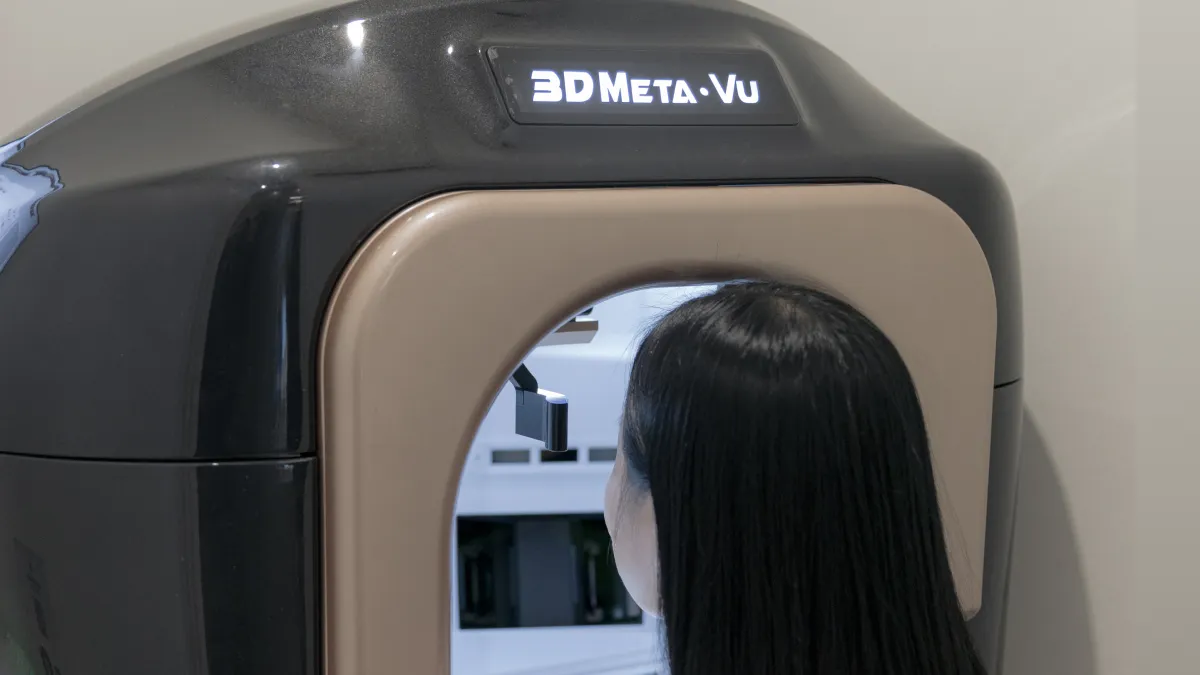
▲ We review your imaging results together
We open genuine products in front of you and keep the preparation area in view behind a full glass wall. The genuine product is opened in front of you. Treatment preparation takes place in an open-kitchen-style preparation area behind a full glass wall, so from the waiting area you can see the genuine product, the preparation process, and hygiene practices for yourself.

▲ The treatment preparation area, seen through the glass wall from the waiting area
We recommend only the treatments your assessment results call for. We tell you up front what this treatment can do (filling sunken areas and the grooves of wrinkles) and what it can't (sagging itself, and lines made by the muscles of expression), along with the changes to expect. You're welcome to come in just for a consultation and leave.
Pricing
Prices for Belotero are published on our website for every product option. Whichever country you're visiting from and whichever channel you book through, the price is the same as the one published on our website — so there's no need to compare prices from one booking channel to another. Making sure you can come in trusting the price you checked in advance — that is the trust PECHE Clinic puts first.
It is offered as Belotero 1cc, divided by area into wrinkles / forehead, aegyo-sal, nose bridge, under-eyes / outer cheeks, front cheeks, smile lines, chin. The configuration you need is decided together after your assessment.
Location and Clinic Hours
PECHE Clinic 3F, 364 Gangnam-daero, Gangnam-gu, Seoul Right outside Gangnam Station Exit 4 — the building entrance is right in front of you as you come out
Clinic Hours (Korea Standard Time, KST)
- Monday–Friday: 10:30 AM – 9:00 PM
- Saturday, Sunday, and public holidays: 10:00 AM – 6:00 PM
- No lunch break — we see patients straight through midday
FAQ
Q1. Who performs the Belotero treatment? A: Before treatment, we let you know the name of the physician treating you, and that physician personally reviews your assessment results and the condition of your face before starting. The line, the depth, and the amount for each area follow standards built from more than 90,000 treatments performed across the clinic, so the same standards apply even if a different physician treats you.
Q2. When Soft is placed deep under the eyes, does it still feel like a prickly sting? A: The sensation follows the injection depth more than the line. Even with the same Soft, areas where it's placed deep near the bone, such as under-eye hollows, feel closer to a sting followed by a heavy feeling of the gel pushing in, while areas where it's spread shallow, such as fine surface lines, feel more like a prickly sting on the surface. Knowing this in advance, you're less likely to be caught off guard during treatment.
Q3. Are Soft and Intense ever used together in the same area? A: In areas with a lot of movement and a complex structure, such as smile lines, one approach is to place a gel that provides support in a deep layer and a soft gel in a shallow layer, separately. The deep groove is supported from below, and the shallow line that remains above it is smoothed close to the surface. Whether to use both is decided at your assessment.
Q4. How is the Belotero line chosen? A: We don't decide by depth alone, as in "a soft line for the surface, a firm line for deep areas." We look at how much the tissue above needs to be supported, how thin the overlying skin is, whether the goal is to fill volume or smooth fine lines, and how much the gel blends into the tissue — all together. We decide together based on your assessment results.
Q5. If Belotero looks like it isn't enough, when is more added? A: Right after injection, swelling is mixed in, so it's hard to judge the actual shape. Once the swelling has gone down and the gel has settled, we review how it looks and decide whether to top up only the amount that's lacking. Trying to fill everything at once can mean more goes in than needed, which can look unnatural.