Thermage FLX in Seoul: Pain Control Decides How Skin Tightening Feels
Why the same treatment feels different from person to person, and what the device and the clinic can each do about it
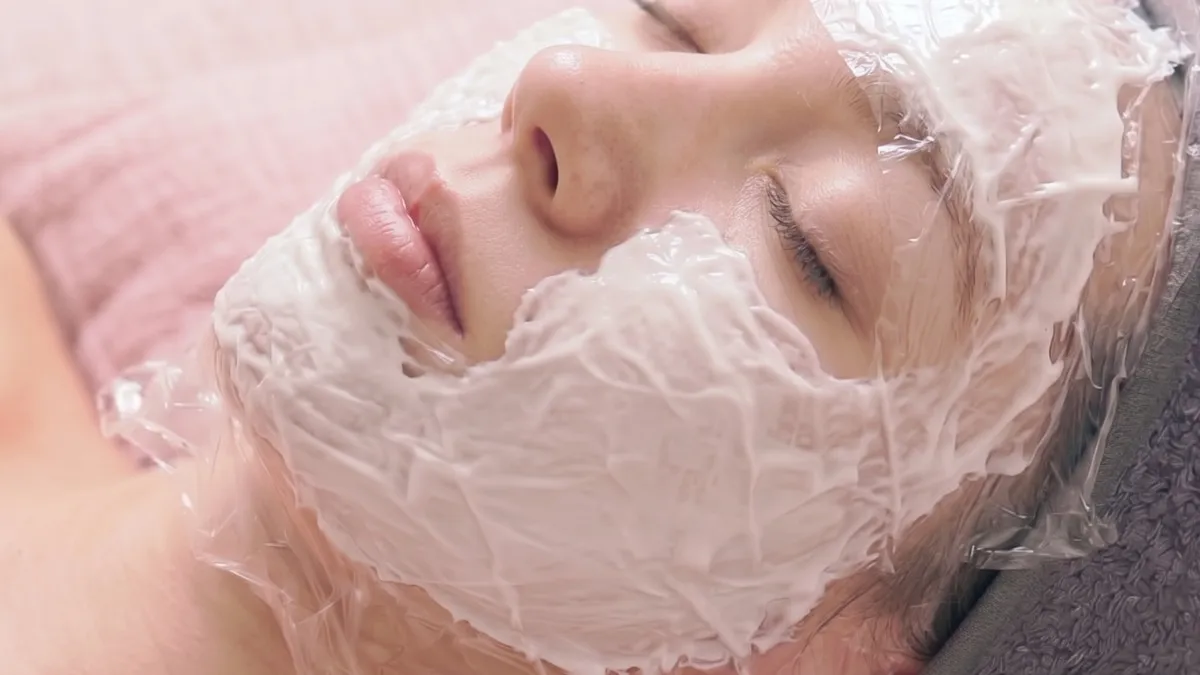
"I've got four days in Seoul and I want to book Thermage. But everything I read says it hurts. How bad is it really?"
It is the first question people ask about this treatment, ahead of price and ahead of results, and it is a fair one to ask before committing part of a trip to it. The frustrating part is that the reviews online contradict each other — one person describes a hot snap they would not repeat, the next says it was far more bearable than they expected — and both are telling the truth about themselves.
Why Does Thermage FLX Hurt More for Some People Than Others?
Because heat perception varies far more between people than most of us assume. In one laboratory study, 312 healthy adults with no ongoing pain problems were each given the same train of brief heat pulses at the same temperature, delivered the same way. In that study, even with the people and the stimulus matched that closely, responses split three ways: pain ratings climbed for 29%, stayed flat for 59%, and actually fell for 12% (1). It was not a study of Thermage, but it shows that the response to heat pain itself differs from person to person under the same stimulus and the same protocol.
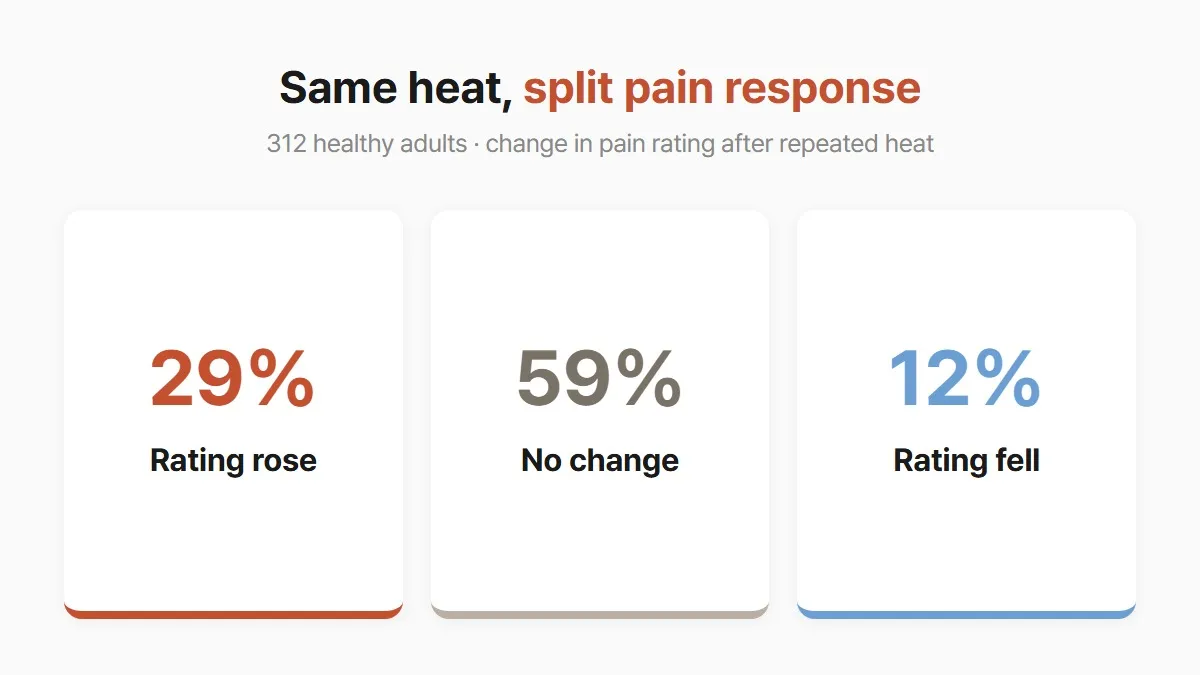
That is worth holding onto when you read reviews. A stranger's pain score describes their nervous system, not the treatment, and it cannot be transferred to you.
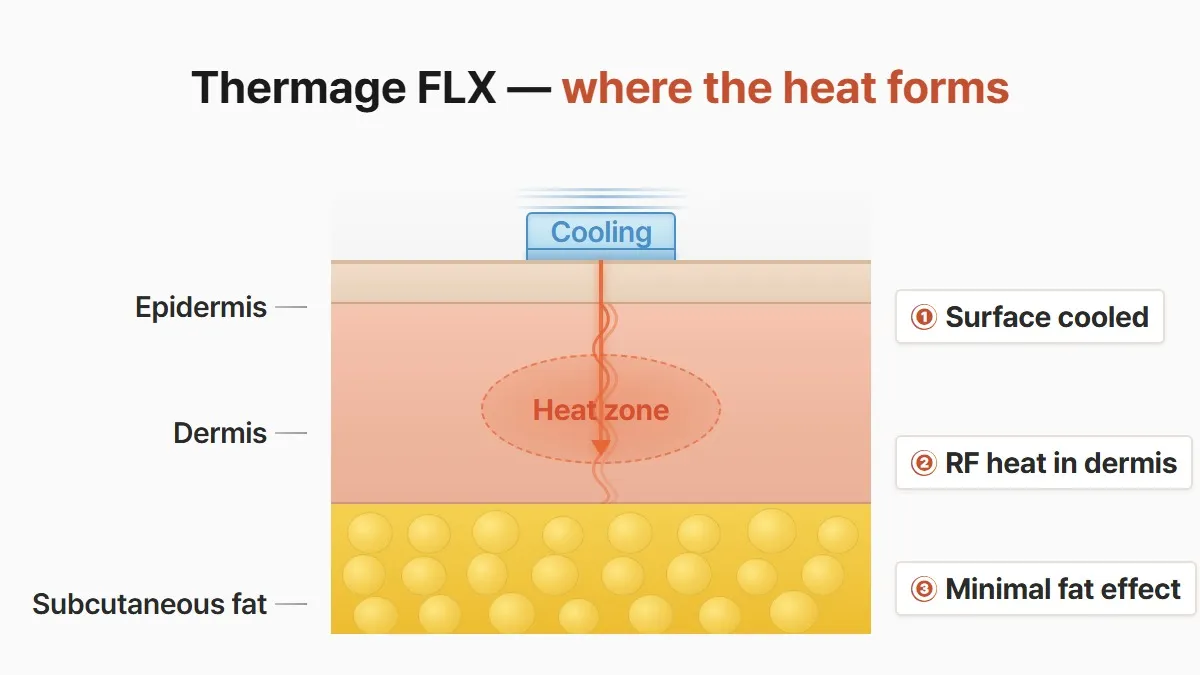
The heat itself is not incidental. Monopolar radiofrequency passes current through the dermis, and the tissue's own resistance turns that current into heat below the surface — much the way a phone grows warm in your hand while it is working, with the warmth generated inside the object rather than applied to it. Collagen is the mesh that holds skin up from the inside; it thins and loosens with age, which is what lets skin slacken. When researchers took skin samples three months after monopolar radiofrequency treatment, the type I and type III collagen that makes up that mesh had increased significantly, and so had newly synthesised collagen (2). The heat had not damaged the skin; it had prompted the skin to rebuild the support it had lost. The warmth is the treatment working. The task is to keep it tolerable rather than to remove it.
How Much of Thermage FLX Pain Does the Device Handle on Its Own?
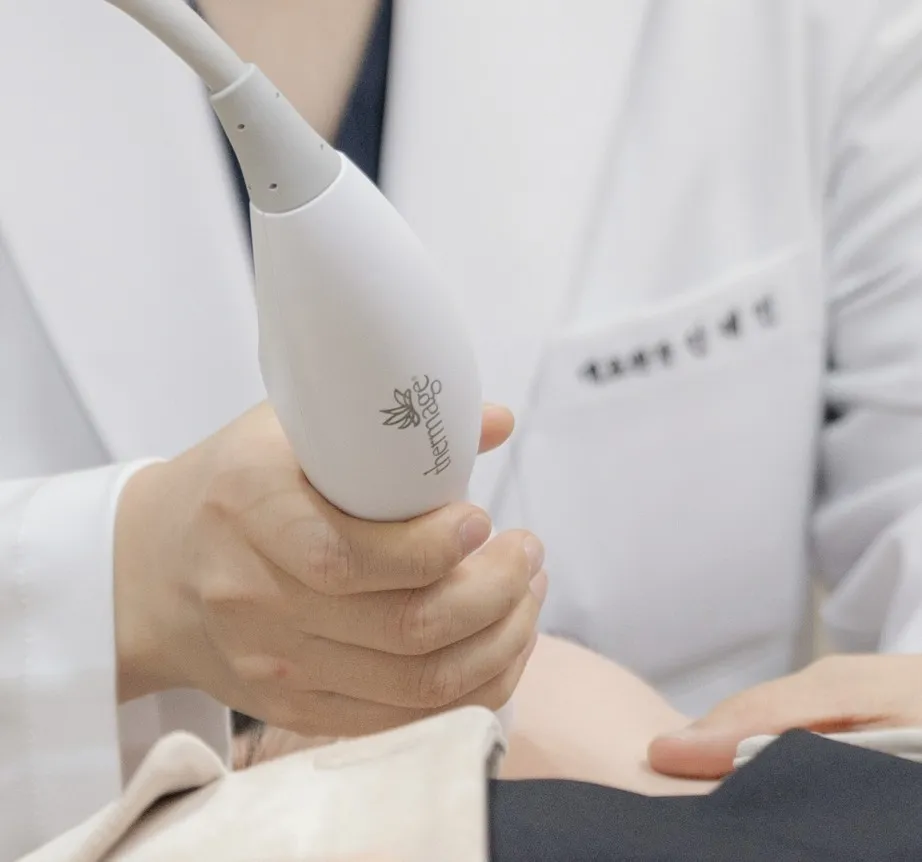
The device handles pain through the integrated cooling and vibration built into every pulse. The Thermage FLX handpiece delivers radiofrequency energy together with integrated cooling and vibration, both of which Solta Medical describes as comfort features rather than optional extras. Cooling protects the surface while the heat goes deeper, and vibration eases the burning sensation on the same instinct that makes you rub a spot you just bumped.
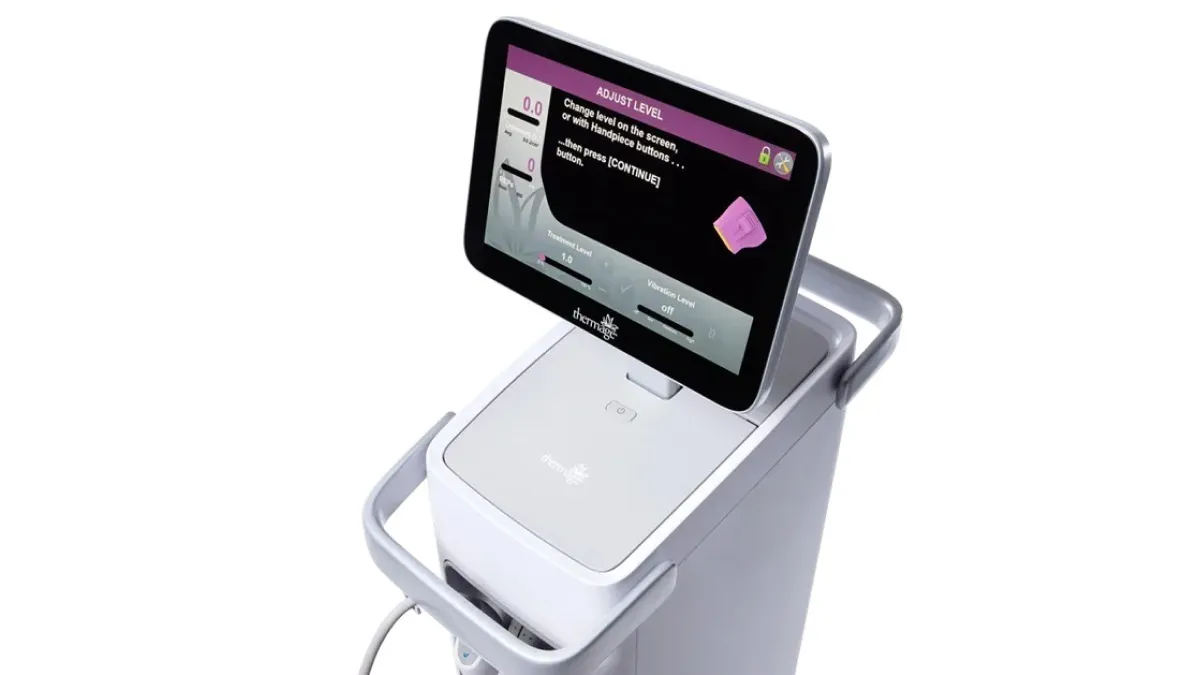
That much, though, is identical wherever you have it done, at any clinic running a Thermage FLX. Choosing the machine does not settle how much it hurts. What actually varies between clinics is the bottom three rows of the table below.
| Where pain control comes from | What it does | Does it vary by clinic? |
|---|---|---|
| Cooling in each pulse | Protects the skin surface as deeper layers heat | Built into the device — the same everywhere |
| Vibration in each pulse | Competes with the burning sensation for nerve traffic | Built into the device — the same everywhere |
| Numbing cream | Raises the threshold before treatment begins | Depends on the clinic |
| Non-sedation gas | Blunts the response for people who want more than cream | Depends on the clinic |
| Mid-session adjustment | Changes intensity while the treatment is running | Depends on the clinic |
How Is Thermage Pain Managed at a Clinic in Seoul?
By raising the pain threshold with anaesthetic before the first pulse, and adjusting to your response during the rest of them — the two parts the machine cannot supply.
Numbing cream is the standard starting point, and for a fair number of people it is genuinely enough on its own — particularly on the cheeks and jawline, where there is more tissue between the surface and the nerve endings. Around the forehead and the eye area, where skin is thin, the same cream leaves the sensation noticeably stronger. That is anatomy, not a failure of the cream, and it is why a single answer to "does it hurt" was never going to work.
For those who would rather not rely on cream alone, PECHE also offers Non-Sedation Gas Anesthesia (Air Nox) as an option. You stay awake and responsive throughout; it takes the edge off the response rather than switching it off, and it clears quickly enough that the rest of your day is not written off.
The part that matters most is the least visible. At PECHE, treatment runs as a conversation: we say which area is next and roughly what it will feel like, you say when a pulse crosses from hot into sharp, and intensity or pacing changes from that point rather than at the end. Anaesthetic timing is set per person too, rather than one fixed timer applied to every face and every area. If English is easier for you, our own in-house staff are there so that entire exchange can happen in English.
There is a wider set of things worth checking before booking any aesthetic treatment in Korea, and we have laid those out separately.
→ How to Choose a Dermatology Clinic in Korea: 6 Things to Check Before You Book
Does Thermage FLX Fit Into a Short Trip to Seoul?
It fits unusually well, for two reasons. Recovery is minimal — there is little to no downtime and no special aftercare, so most people go straight back to their plans, with any flushing settling over the following hours. And because it is a single session rather than a course spaced over weeks, you are not trying to fit a schedule you cannot keep into a week-long trip.
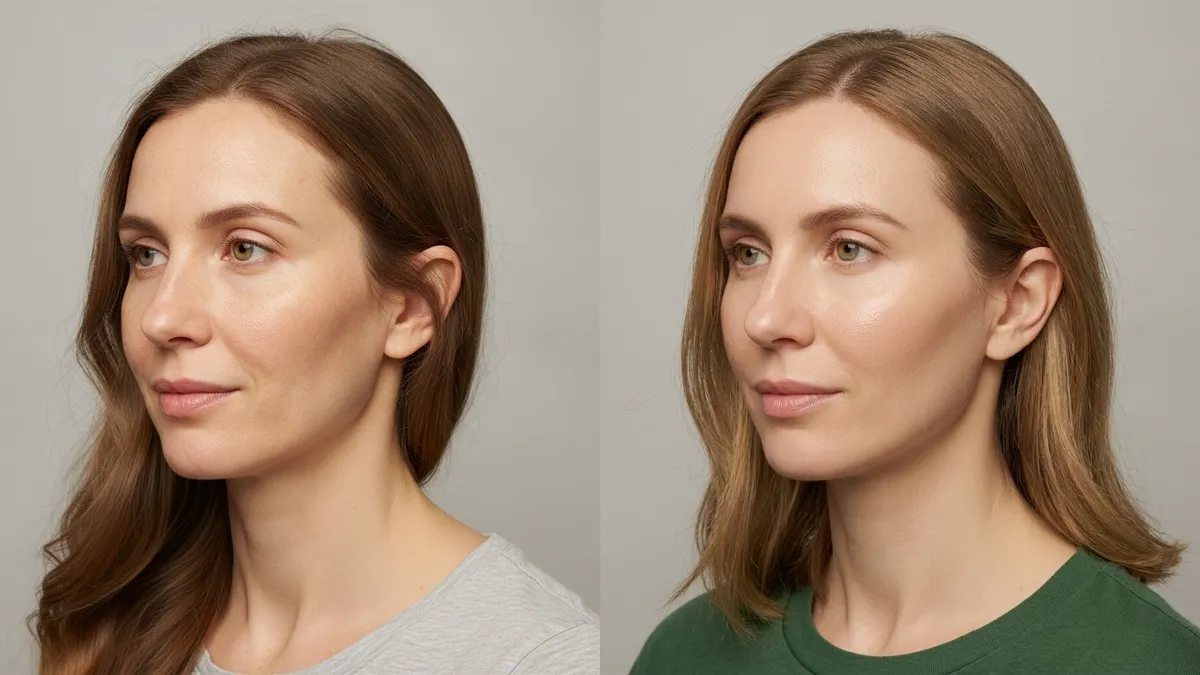
The trade-off is worth knowing before you book. Any immediate tightening you notice on the day is the smaller part of the effect; the larger part arrives over the following two to six months as collagen rebuilds, which means it will happen at home, not in your holiday photos. If you are choosing between treatments for a trip, that is the honest distinction: this one costs you almost no time in Seoul and pays out slowly afterwards.
One practical note. Flushing right after treatment is normal and fades, but heat exposure is worth easing off for a day or two, so a long sauna or hot spring visit is better placed at the start of a trip than the evening of your appointment.
5 Things to Confirm Before Booking Thermage in Seoul
Sending these over messenger before you fly settles most of it. PECHE takes consultations on WhatsApp.
- "What pain relief do you offer besides numbing cream?" — Ask whether a gas option exists and whether it costs extra, so you are not deciding on the day.
- "Is the numbing cream always left on for a fixed time?" — Some clinics apply the same timer to everyone. If the answer is that timing changes with the area and with how sensitive you are to pain, they are already adjusting for the thin-skinned areas, like the forehead and around the eyes, where cream does less.
- "Can I stop or slow the treatment partway through?" — What you want to hear is that intensity changes on your feedback, not that you should push through.
- "Who will I be speaking to in English?" — In-house staff and a booked interpreter are different things, and the difference shows up mid-treatment.
- "Is the price on your site the price I pay?" — Confirm the amount and what it covers before travelling.
PECHE runs Thermage FLX with anaesthetic timing set per person, Air Nox available for those who want it, and pain reported and acted on while the session is still running. What our website lists is what reception charges, and nationality does not change the figure. Our English-, Japanese- and Chinese-speaking staff are on site, so the same language carries from booking through aftercare, and the clinic sits at Exit 4 of Gangnam Station — the building you see as you come out — open until 9 PM on weekdays and 6 PM on weekends, every day of the year.
Pain is the reason many people put this treatment off, and it is also the part most within a clinic's control. The device brings cooling and vibration; the clinic brings preparation, options, and the willingness to change course mid-session. Ask about the second half, since that is the half that varies. For an accurate judgment on what suits your skin, please consult a doctor.
FAQ
Q: Does Thermage FLX hurt? A: It produces a deep heat that peaks briefly with each pulse, and how strong that feels differs genuinely from person to person — in one study of identical heat stimulation, responses split into three distinct patterns. Numbing cream is enough for many people, and PECHE also offers a non-sedation gas option for those who want more.
Q: Is Thermage in Seoul different from Thermage at home? A: The device and its comfort features are the same wherever it is used, so what differs is the preparation and the way the session is run. Those are the parts worth asking about when you book.
Q: How long does Thermage FLX take, and how many sessions will I need? A: The manufacturer describes it as a single treatment rather than a course, which is part of why it suits a short trip. Most of the visible change develops over the following months rather than on the day.
Q: Can I sightsee after Thermage FLX on the same day? A: Yes for most people — recovery is described as little to no downtime, with any flushing settling over a few hours. Easing off saunas and long heat exposure for a day or two is sensible.
Q: Can I ask them to turn the energy down during Thermage? A: You can, and it is worth confirming beforehand that the clinic works that way. At PECHE the session runs as a conversation, and intensity or pacing changes as soon as you say a pulse has crossed the line.
Q: Will a Seoul clinic charge foreign patients more for Thermage FLX? A: Some clinics do keep separate pricing, so check what you are quoted against the published price list. PECHE applies one price regardless of nationality or booking route.