How to Choose a Dermatology Clinic in Korea: 6 Things to Check Before You Book
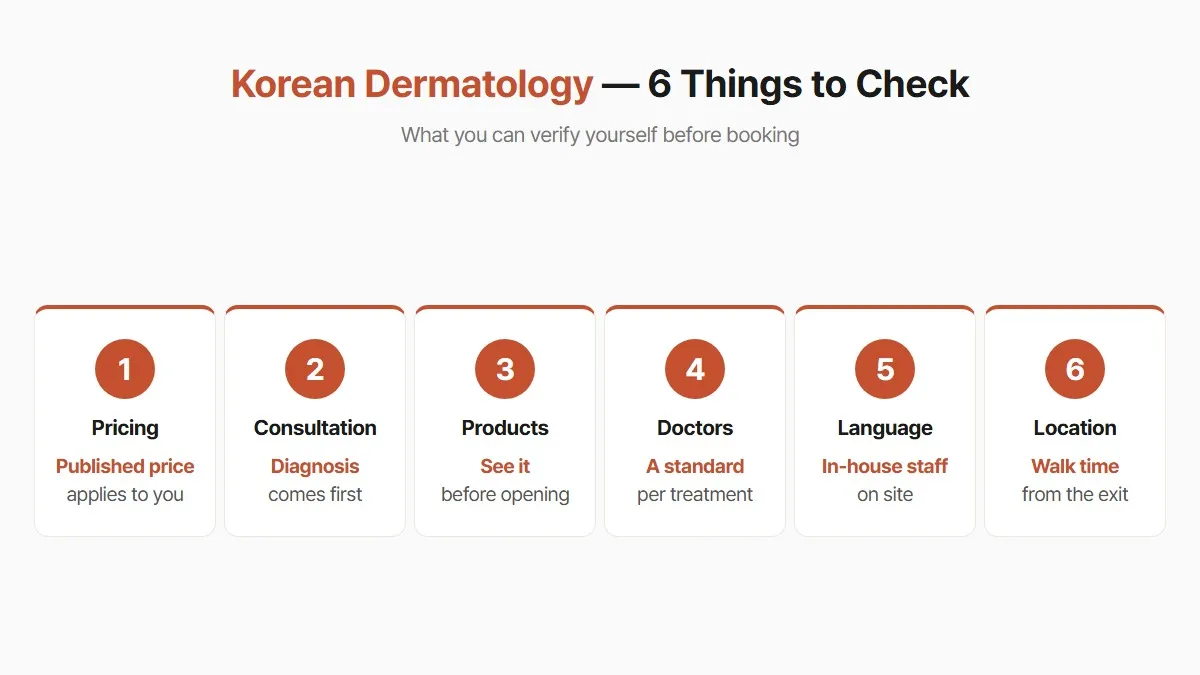
Six things you can verify yourself before your trip — pricing, consultation, products, doctors, communication, and hours
"I've read through the reviews, but the clinics all look the same. What else should I check?"
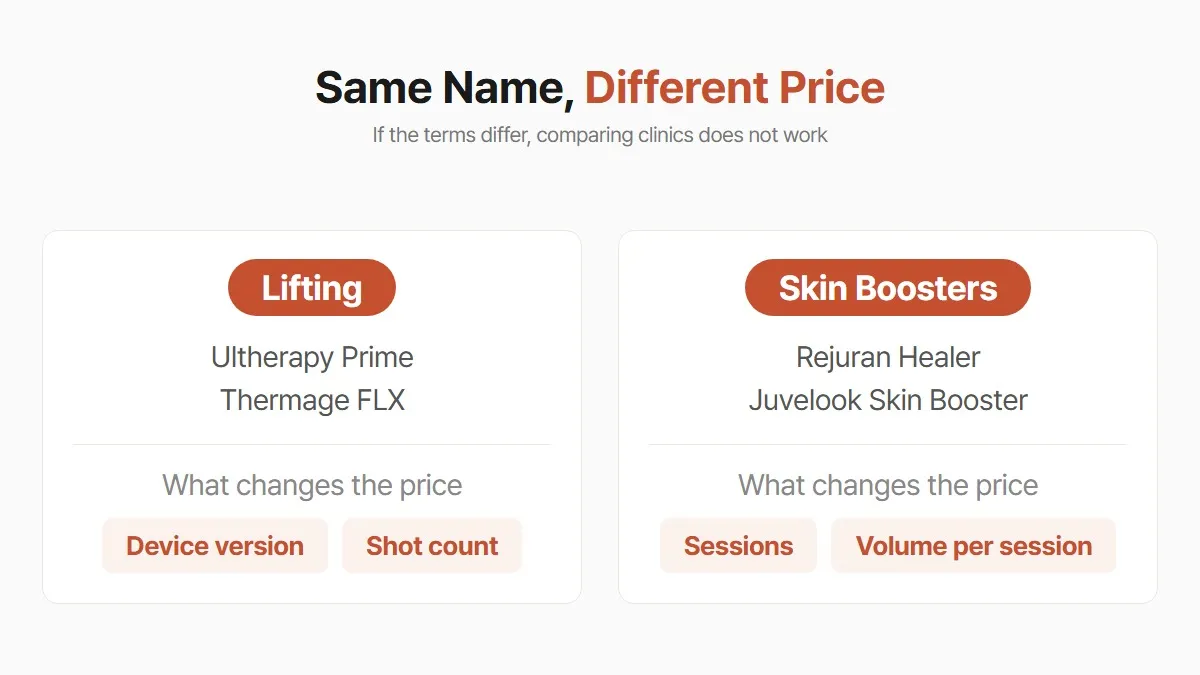
We hear this constantly from people planning a trip to Korea. Search and you will find plenty of clinic names, you might read dozens of reviews and still not know what to base your final call on. It is especially tricky for lifting treatments (Ultherapy Prime, Thermage FLX) and skin boosters (Rejuran, Juvelook), the treatments we get the most questions about from English-speaking and Japanese patients: the name may be identical, but the terms behind it differ from clinic to clinic, so the name alone tells you nothing.
In 2025, 2.01 million international patients visited Korea, and dermatology was the most common specialty at 62.9% (1). That is a lot of people receiving aesthetic treatments in Korea — yet almost no one lays out what to actually look for when picking a clinic. No wonder the decision drags on.
Beyond Reviews, What Should You Look At?
Look at the things you can verify before you book. Reviews help you gauge the atmosphere and general satisfaction, but most Korean treatment reviews are written in Korean, and even with a translator you rarely get down to details like shot counts or volumes. The six items below take one question, or a quick look at what the clinic has already published.
| What to check | How to check it | Why it matters |
|---|---|---|
| Pricing policy | Compare the published price with the amount you are quoted | Reveals whether the clinic runs a separate price list for foreigners |
| How the consultation starts | Ask, "Do you start with a diagnosis?" | Distinguishes clinics that push treatments before diagnosing |
| Authentic products, full doses | Ask whether you can see the product before it is opened | Confirms the product is approved and the full dose is used |
| Treatment standards | Ask, "Is there a qualification standard for each treatment?" | Keeps results and communication consistent whichever doctor you see |
| Language support | Ask, "Do you have staff who speak my language on site?" | Your booking is not tied to an interpreter's schedule |
| Location and hours | Check the exit and walking time on a map app | Travel time decides how much of your day is left |
If you have already settled on a treatment, there are a few more specifics worth checking. For lifting, it is the device and the shot count; for skin boosters, the number of sessions and how the product is prepared. That is where clinics differ.
Do Korean Clinics Charge Foreigners More?
It depends on the clinic. In Korea, aesthetic treatments are elective, out-of-pocket procedures, which means each clinic sets its own pricing, and some do maintain a separate price list for international patients.
You do not need to ask the clinic for anything special to check this. Most aesthetic clinics in Korea already publish their treatment prices on their websites.
So the question is not whether a price list exists — it is whether the published price is what actually gets applied. Find the treatment you want on the website's price list, note the volume and session terms attached to it, then compare that with the amount you are quoted in your consultation. If the clinic runs separate pages by language, check that the same amount appears no matter which language you read it in.
Lifting and skin boosters are where this comparison matters most. With lifting treatments like Ultherapy Prime and Thermage FLX, the price swings with the device and the shot count; with skin boosters like Rejuran and Juvelook, it swings with the number of sessions and the volume per session. Compare prices across clinics by treatment name alone and you are really comparing two different things. Even treatments with the same name can run on different device versions, so it is worth confirming which device is used and how many shots you are getting.
At PECHE, the price is the same through every channel, and the price published on our website is the price applied in the treatment room. Our language pages list the same KRW amounts, so the figure does not change whether you read it in English, Japanese, or Chinese. International patients pay exactly what Korean patients pay.
What Matters Most in a Consultation?
What the consultation starts with. Some clinics open with a treatment recommendation; others open by showing you diagnostic data — and in a foreign-language consultation, that gap widens. Explanations get shorter, and a shortened explanation tends to compress into a single sentence: "This treatment would be good for you." When you cannot see the evidence, you end up agreeing before you have had a chance to weigh anything.
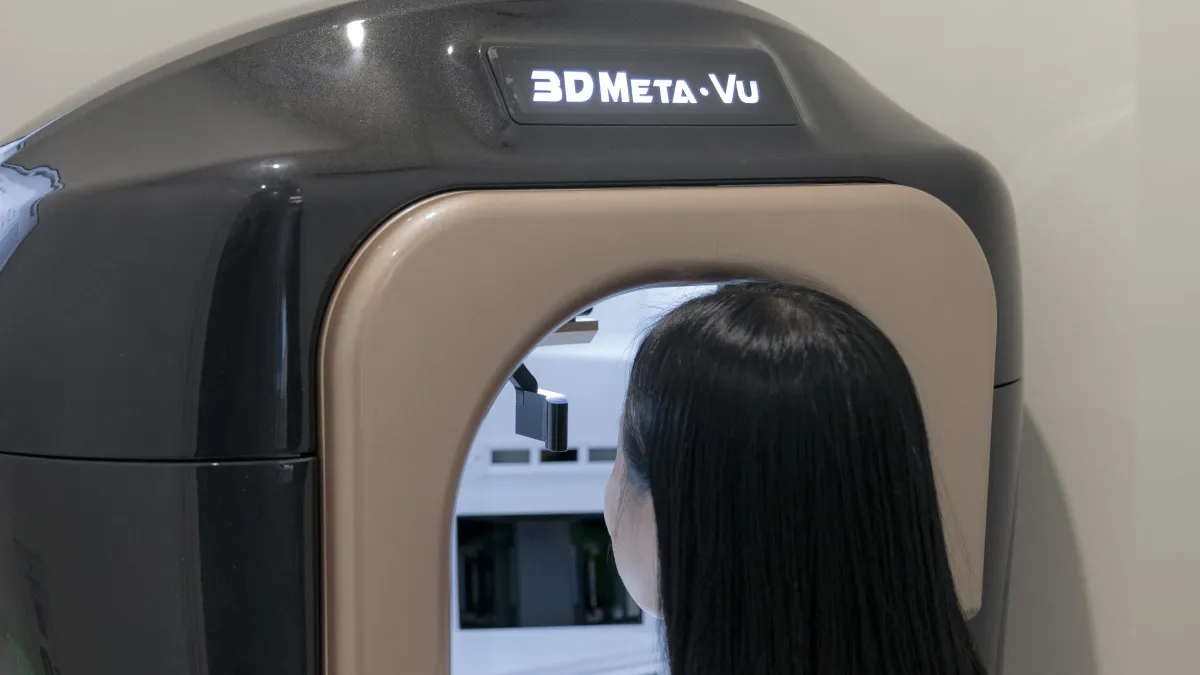
At PECHE, every consultation starts with MetaView 3D diagnostics. The things you cannot judge by eye — pigmentation, pores, wrinkles — go up on the screen, and we use that data to determine together exactly which areas require treatment. You can point at the area on the screen and see the issue for yourself.
Can You Confirm the Products Are Authentic and Fully Dosed?
You can. The product name and volume are printed on the box and the syringe, so at a clinic that shows you the preparation, you can confirm both with your own eyes — no Korean required. Before booking, just ask: "Can I see the product before it is opened?"
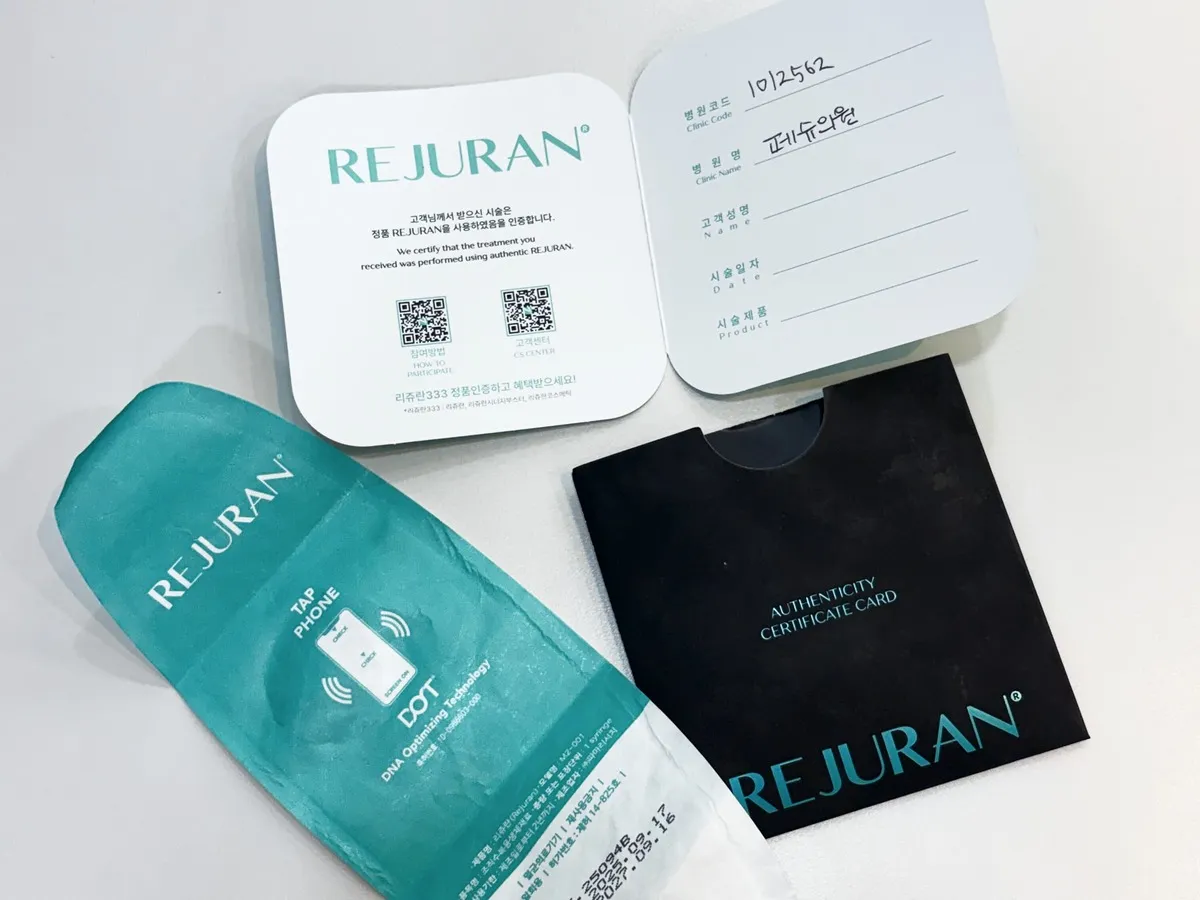
Start with authenticity. Products approved by Korea's Ministry of Food and Drug Safety, such as Rejuran Healer, come with a verification process built for the patient. There are three steps: the DOT wording you see as the box opens, the QR code on the back of the box, and the NFC tag on the back of the blister pack. The manufacturer introduced this system as counterfeits and illegal distribution grew alongside the brand, and it advises patients to confirm before treatment that an approved product is being used, since there are treatments out there with names or ingredients designed to sound similar (2).
Then there is the dose. Skin boosters have a set volume per session, but it is entirely possible to use less than that and top the syringe up with saline to match the volume. The injected volume looks the same while the active ingredient going in is reduced. That is why the number that matters is not how many cc you received — it is which product was used and how many units were opened. Ask to see the unopened box and the syringe together, and you confirm authenticity and dose in one go.
At PECHE, the preparation room is a glass display case that stays open to view, so you can see exactly which product is being prepared and in what volume. Skin boosters like Rejuran and Juvelook are injectables, so the box and the volume are the evidence themselves. Product names and numbers are information you can verify by eye without reading Korean. Products that cannot be prepared in advance and have to be used immediately after opening — Rejuran Healer among them — are opened right in front of you at the treatment chair. After a Rejuran Healer treatment, you receive an authenticity certificate card with the clinic's name on it.
With some skin boosters, the preparation itself affects the result. Confirming in your consultation which product is used and how it is prepared leaves you with less to decide on the day.
How Can You Judge a Doctor's Skill?
It comes down to how the clinic manages its treatment standards. Unlike the items above, which you can verify with your own eyes before booking, skill is the hardest thing to confirm — and there is a limit to what reviews can tell you.
What you can check with a question is whether the treatment standard belongs to the clinic rather than to an individual doctor. Ask whether the treatment stays the same when a different doctor performs it. At clinics where the standard is documented and shared, you get a result you are happy with whichever doctor you see.
At PECHE, the 60,000-plus treatments performed by our chief director and general director were never left as personal know-how. Energy settings by area, depth by skin type, adjustment ranges based on pain sensitivity — all of it is documented as a protocol shared by every doctor, and a doctor is authorized to perform a given procedure only after meeting the strict quality standards set by our chief director. The entire medical, nursing, and consulting team meets weekly to train on these standards. That is how we keep the things that come down to the practitioner's hands — treatment depth in lifting, injection angle in skin boosters — aligned across the team.
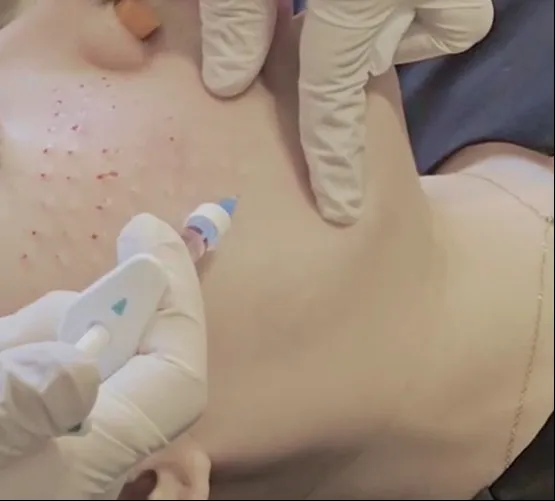
How comfortable you are during the treatment carries the same weight. Rather than "Are you okay?", we ask "On a scale of 10, how strong is the pain right now?" and adjust shot intensity or injection speed on the spot based on your answer. The areas and settings from your last treatment, along with the pain responses and requests you mentioned that day, stay in your chart, and the doctor handling your next visit reviews that record before starting. Whichever doctor treats you, you get the same standard of treatment and the same style of communication.
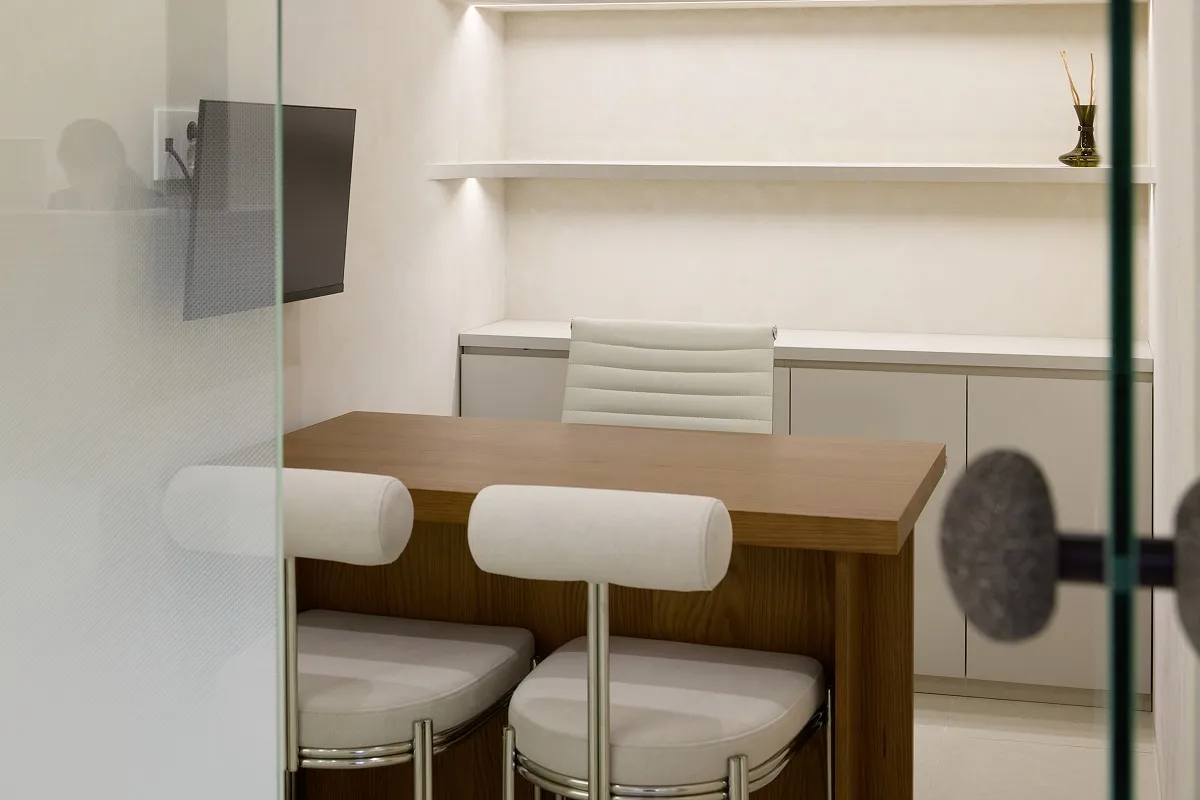
Can You Have a Consultation Without Bringing an Interpreter?
Some clinics advertise foreign-language consultations but bring in an outside interpreter for your appointment slot. If the interpreter is not available, you cannot get the date you want.
So the question to ask is not "Do you speak English?" but "Do you have interpreting staff on site full time?" With in-house staff, your booking is not tied to an interpreter's schedule, and the same person carries the same language through the consultation, the treatment, and the aftercare. If something comes up mid-treatment — "a little gentler, please" — it gets relayed right then.
PECHE has staff on site who speak English, Japanese, and Chinese. There is no outside interpreter to arrange: booking, consultation, treatment, and aftercare all run in the same language.
Does the Location Fit Your Travel Schedule?
Travel time is the biggest variable. The treatment itself may take about an hour, but if getting there and back takes another hour, half your day is gone.
Check on a map app how many subway stops the clinic is from your hotel and your main plans, and how long the walk from the station takes. "Right by the station" can still mean a 10-minute walk from the exit, so pin down the exit number too.
It is worth choosing your time slot deliberately as well. Sightseeing and shopping tend to cluster in the evenings and on weekends — and so do clinic bookings. Schedule your treatment on a weekday afternoon and you will get the time you want with a shorter wait.
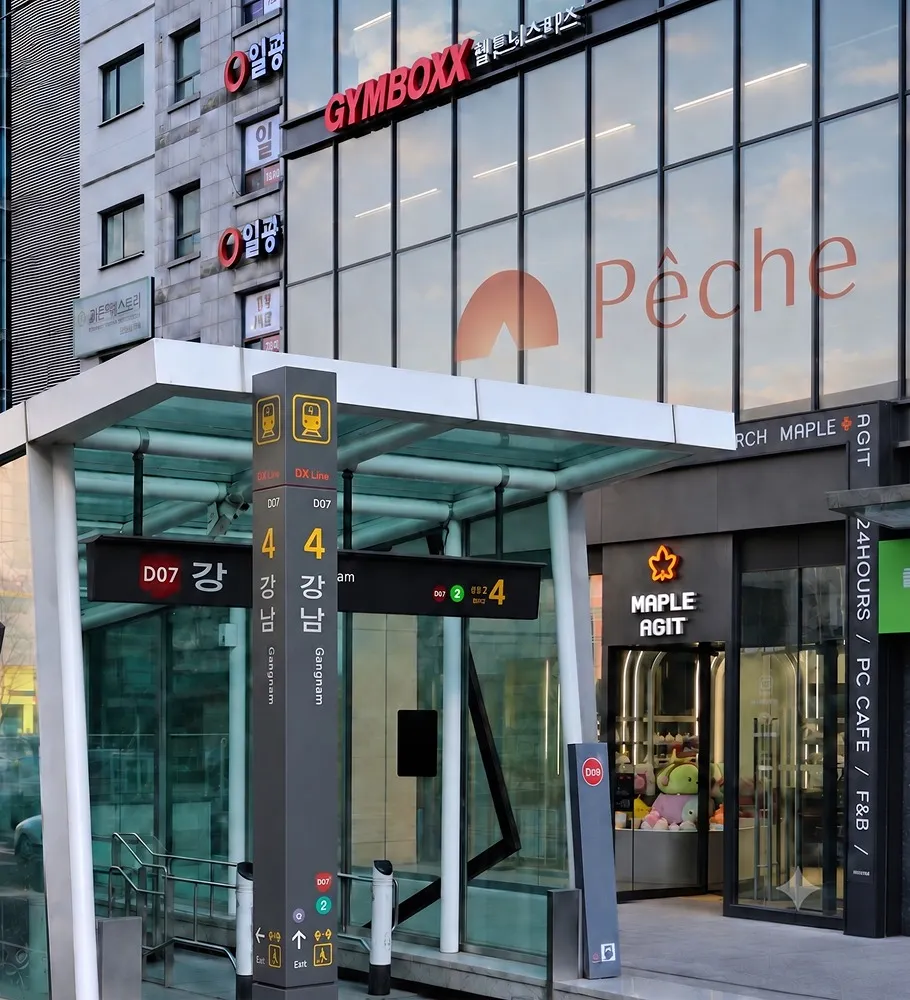
PECHE is right in front of Exit 4 of Gangnam Station, less than a minute on foot. It is where Line 2 meets the Shinbundang Line, so it is easy to reach from anywhere in central Seoul, and the building is the one you see as you step out of the exit — almost no travel time at all. We are open until 9 PM on weekdays and 6 PM on weekends, every day of the year, so there is room to shift your appointment if your schedule slips. For treatments with intervals between sessions, like skin boosters, tell us how long you are staying when you book and we will set your next visit at the same time.
6 Questions to Ask Before You Choose
Sending these over messenger before your visit settles most of the decision. PECHE takes consultations on WhatsApp.
- "Does the price on your website apply to me as well?" — For lifting, confirm the shot count; for skin boosters, the number of sessions and the volume, so you know the terms match.
- "What does the consultation start with?" — Diagnosis first, or a treatment recommendation first. That is the split.
- "Can I see the products and devices you will use?" — For skin boosters like Rejuran and Juvelook, it is the box and the volume; for lifting treatments like Ultherapy Prime and Thermage FLX, it is the device and the shot count.
- "Is there a qualification standard for each treatment?" — Ask whether the treatment stays the same when a different doctor performs it, and whether pain or requests during the session are acted on right away.
- "Do you have interpreting staff on site full time?" — Clinics that call in an interpreter and clinics with in-house staff differ from the booking stage onward.
- "How many minutes is it on foot from the station?" — Ask for the exit number too and you can plan your travel time precisely.
If the answers come back clearly, chances are the clinic explains things the same way during treatment. At PECHE, the price published on our website applies regardless of nationality or booking channel, and we review MetaView 3D diagnostic data before deciding on a treatment plan. Our treatment standards are documented as a protocol shared by every doctor, so the treatment stays the same when a different doctor performs it, and staff who speak English, Japanese, and Chinese are on site, carrying the same language from booking through aftercare. We are right in front of Exit 4 of Gangnam Station, less than a minute on foot, so there is almost no travel time, and we are open until 9 PM on weekdays and 6 PM on weekends, every day of the year, leaving room to adjust your schedule.
Choosing a dermatology clinic in Korea is often a language problem rather than an information problem. Once reviews have narrowed your shortlist, go through the items that hold up regardless of language — the numbers on the price list, how the consultation starts, seeing the products. Whether it is lifting or a skin booster, sorting out these six before you settle on a treatment name gets you there faster in the end. For an accurate judgment on what suits your skin, please consult a doctor.
FAQ
Q: Will a Korean dermatology clinic charge me more as a foreigner? A: It varies by clinic, and some do maintain a separate price list for foreigners. Price lists are usually published on the clinic's website, so compare the amount you are quoted against that published price. At PECHE, international and Korean patients pay the same.
Q: Is the price on a Korean clinic's website what I'll actually pay? A: It depends on the clinic, so it is worth confirming once during your consultation. Check the volume and session terms for your treatment on the website's price list in advance, then compare them with the amount you are quoted. At PECHE, the published price and the price applied are the same.
Q: I'm considering lifting or a skin booster in Korea. Anything extra to check? A: For both treatment groups, the terms drive the result and the price together. For lifting, confirm the device and the shot count during your consultation; for skin boosters, the number of sessions, the volume per session, and how the product is prepared. Recovery time and follow-up timing also differ by treatment, so plan them around how long you are staying.
Q: Can I see the products before treatment at a Korean clinic? A: It varies by clinic, so ask when you book. At PECHE, the preparation room is a glass display case that stays open to view, so you can see the products and volumes for yourself.
Q: Will my results depend on which doctor I see at a Korean clinic? A: It depends on how the clinic manages its treatment standards. Check whether there is a qualification standard for each treatment and whether that standard is shared across the whole team. At PECHE, more than 60,000 treatments' worth of clinical experience is documented as a protocol shared by every doctor, and the entire medical, nursing, and consulting team trains together every week.
Q: Do I need my own interpreter at a Korean dermatology clinic? A: Some clinics only bring in an outside interpreter for your appointment slot, so ask first whether interpreting staff are on site full time. PECHE has staff on site who speak English, Japanese, and Chinese.
Q: Can I fit treatment and a follow-up at a Korean clinic into one trip? A: It depends on the treatment and the recovery time. Lifting needs recovery progress taken into account and skin boosters need the timing of the next session, so tell the clinic how long you are staying when you book and set your visits together.