Temporalis Botox — PECHE Clinic, Gangnam Station
Reducing the bulk of the chewing muscle you can feel at your temples, to slim the sides of the head · 50-unit configuration · Right by Gangnam Station Exit 4
Temporalis Botox
Temporalis Botox places botulinum toxin into the fan-shaped chewing muscle at your temples, making that muscle work less. As the muscle rests, its bulk decreases, and the line running from the side of the head down to the temple turns gentler.
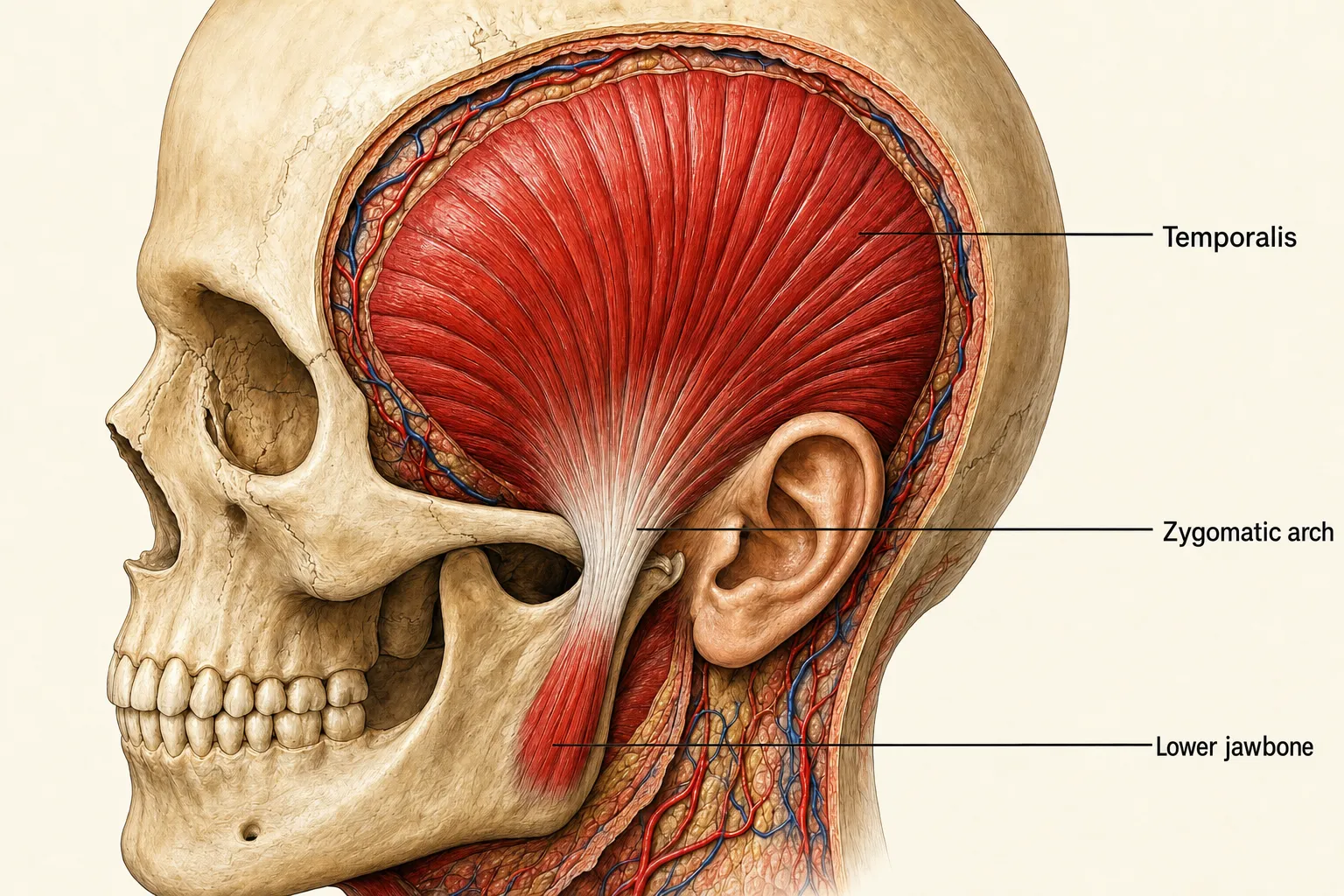
▲ An anatomical drawing of the head's side with the skin removed — the red muscle fanned across the temple is the temporalis, gathering downward into a white tendon that passes beneath the cheekbone arch and attaches to the jawbone. When you bite down, this muscle lifts the lower jaw
The temporalis fans across the temple, then passes beneath the bony arch running from cheekbone to ear and attaches to the lower jaw. It lifts the jaw when you bite — and long-standing clenching or grinding builds it up. The thicker it grows, the more the temple area is pushed outward, making the sides of the head look wider.
When to Consider It
- Seen from the front, the upper part of your face looks wide
- The muscle feels firm when you press your temples
- Your temples visibly bulge when you bite down
- You have a clenching habit or grind your teeth
- With your hair tied back, the side line of your head looks angular
If your temples are hollow and the area above them stands out by contrast, muscle isn't the cause. And this treatment's goal is the contour — if pain or jaw-joint symptoms are the concern, the direction of care is different.
What Makes the Width at the Side of the Head
The thickness of this muscle, lying on the outside of the skull, is what sets the width of the line from temple to side of head. The skull's own size doesn't change with an injection; what changes is the bulk of the muscle covering it.
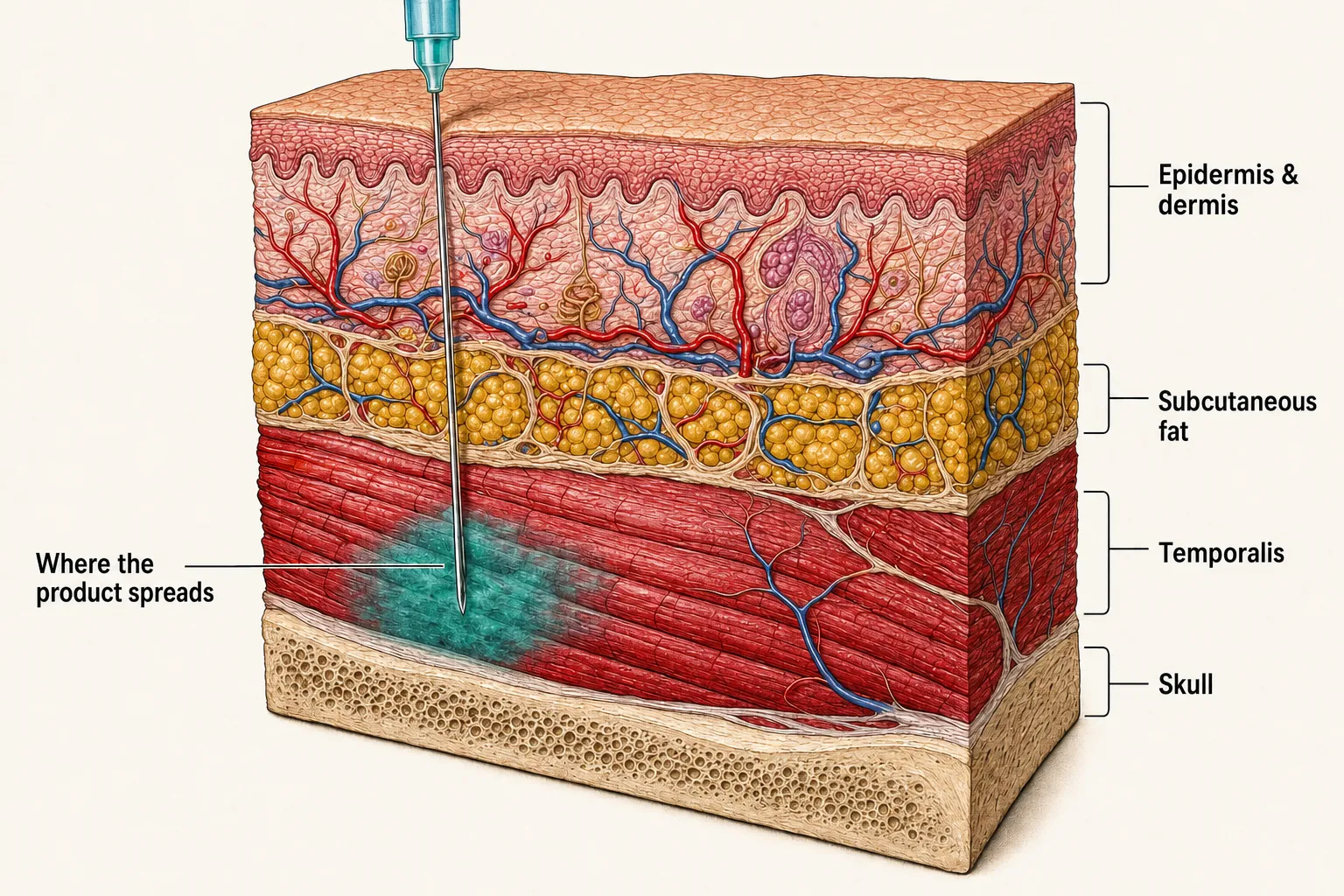
▲ A vertical cross-section of the temple — the ivory at the bottom is the skull, the red layer attached to its outside is the temporalis, and above it the yellow subcutaneous fat, dermis, and epidermis. This muscle's thickness makes the width at the side of the head. The needle tip and teal product stay within the muscle
With less signal telling it to engage, the muscle is used less — and a muscle that goes unused loses bulk.
| Treatment area | The chewing muscle at the temples (temporalis) — both sides |
|---|---|
| Configuration | 50 units |
How It's Done
1. Assessment A 3D MetaVu scan captures your facial contours and left–right balance.
2. Muscle range check With a hand on your temple, you bite down and release while we trace how far the bulging muscle extends.
3. Mapping the points A broad, fanned muscle isn't dosed at one spot. We place points along the thicker zones and set how much goes to each side.
4. Numbing A cold roller dulls the sensation before we start.
5. Injection The mapped points are dosed in order.
6. Aftercare guidance We go over what to follow for the day.
Results and Recovery
| Item | Details |
|---|---|
| Where it acts | The chewing muscle at the temples (temporalis) — outside the skull, beneath the skin and fat layer |
| Amount per session | Around 50 units — a unit is the measure of the drug's amount · varies with muscle development and the difference between sides |
| When results show | Chewing force starts easing from days 3–7 and is clearest at week 2; the contour change emerges gradually after that — the signal doesn't cut off at once; it tapers over several days |
| How long it lasts | 3–6 months |
| Repeat cycle | 5–6 months or longer — we also look at when the reduced muscle begins to regain its bulk |
| Pain | A light sting as the needle enters; then, as the product spreads through the muscle, a deep, heavy, tingling pressure |
| Pain control | A cold roller dulls the sensation before we start |
| Downtime | The marks at the injection points settle within 1–2 hours; you can wash your face and wear makeup after 2–3 hours · bruises, if any, fade within 3–7 days |
| For the day | Don't lie down for 4–6 hours · skip saunas, hard exercise, and massaging the treated area — all to keep the product from spreading beyond where it was placed |
| What you may notice early on | The first 2–3 weeks bring the least chewing force; around a month in, the surrounding muscles adapt and it fades |
As the effect fades, you use the muscle again and its bulk returns. Areas treated over several rounds don't regain their former size, or regain it more slowly.
Expected Reactions and Possible Side Effects
Common, temporary reactions — part of the normal response:
- Marks at the injection points, settling within 1–2 hours
- Bruises, if any, fading within 3–7 days
- The first 2–3 weeks bring less chewing force — fading as the surrounding muscles adapt, around a month in
Anything beyond this is uncommon. If a reaction lasts longer than expected or worsens, contact us and we'll check it with you.
What We Check Beforehand
If any of these apply to you, let us know during your consultation. We postpone or adjust the timing.
- Pregnancy or breastfeeding
- Conditions affecting the point where nerves meet muscles, such as myasthenia gravis — the very site where botulinum toxin acts, so symptoms could worsen
- Medications that affect nerve–muscle signaling (including some antibiotics)
- Temples already on the hollow side — reduced muscle can deepen the hollow look, so the dose is adjusted
- Jaw-joint pain, or difficulty opening your mouth — we check the condition first
- Inflammation or wounds at the injection site
- Aspirin or blood thinners (anticoagulants) — bruising can be heavier, so tell us in advance and we'll plan for it
- Botulinum toxin received elsewhere recently — tell us when, with which product, and how much, and we'll recalculate the total amount given in one session and the interval to your next treatment
How PECHE Clinic Does It
We find where the muscle is thickest and spread the doses across those zones. The temporalis spreads wide, and where it runs thickest differs from person to person. From the range traced by touch, the balance confirmed in your scan, and standards built from over 90,000 treatments, we set the injection points.
We offer four botulinum toxin products. Botulinum toxin is a substance produced by bacteria. The bacteria send it out wrapped in other proteins to keep it intact — but only the core inside produces the effect; the wrapping plays no part in it. The core is identical across all four products; what differs is that some products keep the wrapping, and some strip it away to leave only the core.
| Product | Made by | Protein wrapping | Albumin (storage aid) |
|---|---|---|---|
| Newlux | Medytox, Korea | Kept | Used |
| Coretox | Medytox, Korea | Stripped away | Not used |
| Xeomin | Merz, Germany | Stripped away | Used |
| Allergan Botox | AbbVie, USA | Kept | Used |
What keeping or stripping the wrapping means. The wrapping protects the core — but it also means foreign proteins unrelated to the effect enter your body along with it. Repeated over the years, your body can come to recognize and respond to those proteins — and then the same dose may not work as well as it once did. Stripped products leave less room for that. For a one-off treatment the difference is negligible; it matters when you plan to continue over several years.
Albumin is a common protein naturally present in human blood. It keeps the core from degrading while the drug is stored as a dried powder — and Coretox does without it too. The temporalis takes a larger dose per session than treatment for expression lines and is repeated in half-year rounds, so we choose the product with your longer-term plan in mind.
We open the genuine product in front of you — and you can watch it being dissolved through the glass wall, too. Botulinum toxin doesn't keep long once dissolved, so it's stored as a powder and dissolved in saline just before treatment. The more diluted it is, the larger its volume — and the wider it spreads. With points divided across a broad muscle, the dilution sets how much range each point covers. You see which product is opened right in front of you, and the dissolving itself is visible through the glass wall from the waiting area.

▲ The prep room, seen through the glass wall from the waiting area — everything from opening to dissolving happens in plain sight
We tell you upfront that it can look hollower. The temple carries little flesh to begin with, so as the muscle's bulk comes down, the contour can look more sunken. If your temples are already on the hollow side, we reduce the dose or point you in another direction first. You're welcome to come in just for a consultation.
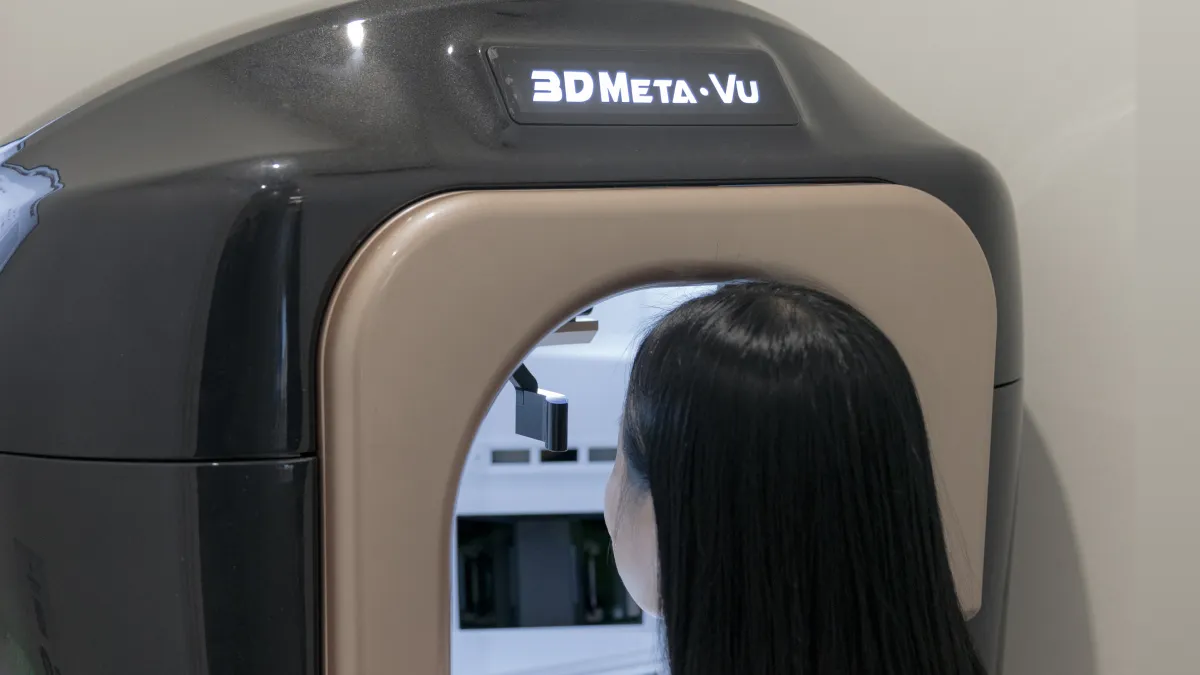
▲ The 3D MetaVu screen — contours and balance are captured before treatment, confirming the difference in width between your two sides
Pricing
Temporalis Botox runs as a 50-unit configuration. The cost varies with the product used, and we quote after confirming the muscle's range by touch.
Location
PECHE Clinic 3F, 364 Gangnam-daero, Gangnam-gu, Seoul Right in front of Gangnam Station, Exit 4
Because the dose is fine-tuned over visits by feeling the thickness on each side, being easy to reach genuinely matters.
FAQ
Q1. Who performs the treatment? A: PECHE physicians who all work to the same injection standards, built from over 90,000 documented treatments. On a muscle this broad, finding the thick zones and spreading the doses across them decides the result — a judgment made by these standards, not by feel.
Q2. How much will my face's width change? A: What decreases is the muscle's thickness; the skull's width stays as it is. So the size of the change depends on how developed the muscle is — and if muscle isn't the cause, little changes at all. We confirm the expected range together before starting.
Q3. It's injected at the side of the head — is that all right? A: The drug stays within the muscle attached to the outside of the skull. It doesn't go inside the bone, and the depth is set within that muscle's thickness. The weaker chewing force of the first 2–3 weeks happens because the targeted muscle is one you chew with.
Q4. Won't my temples look hollow? A: The temple carries little flesh, so as the muscle shrinks, the contour can come inward. That's why this area is dosed only as much as needed, rather than generously — and if your temples are already hollow, we may advise against the treatment.
Q5. What should I look for when choosing a clinic? A: Whether they first separate the causes — a wide look from muscle, or from hollowness making it look that way. If the real cause is the opposite and you're treated anyway, the area can end up looking more sunken, so that check has to come first.