Radiesse — PECHE Clinic, Gangnam Station
A volume and contour treatment where microspheres of the same calcium compound as bone and teeth become a scaffold for your own collagen and elastin to weave onto · Right by Gangnam Station Exit 4
Radiesse
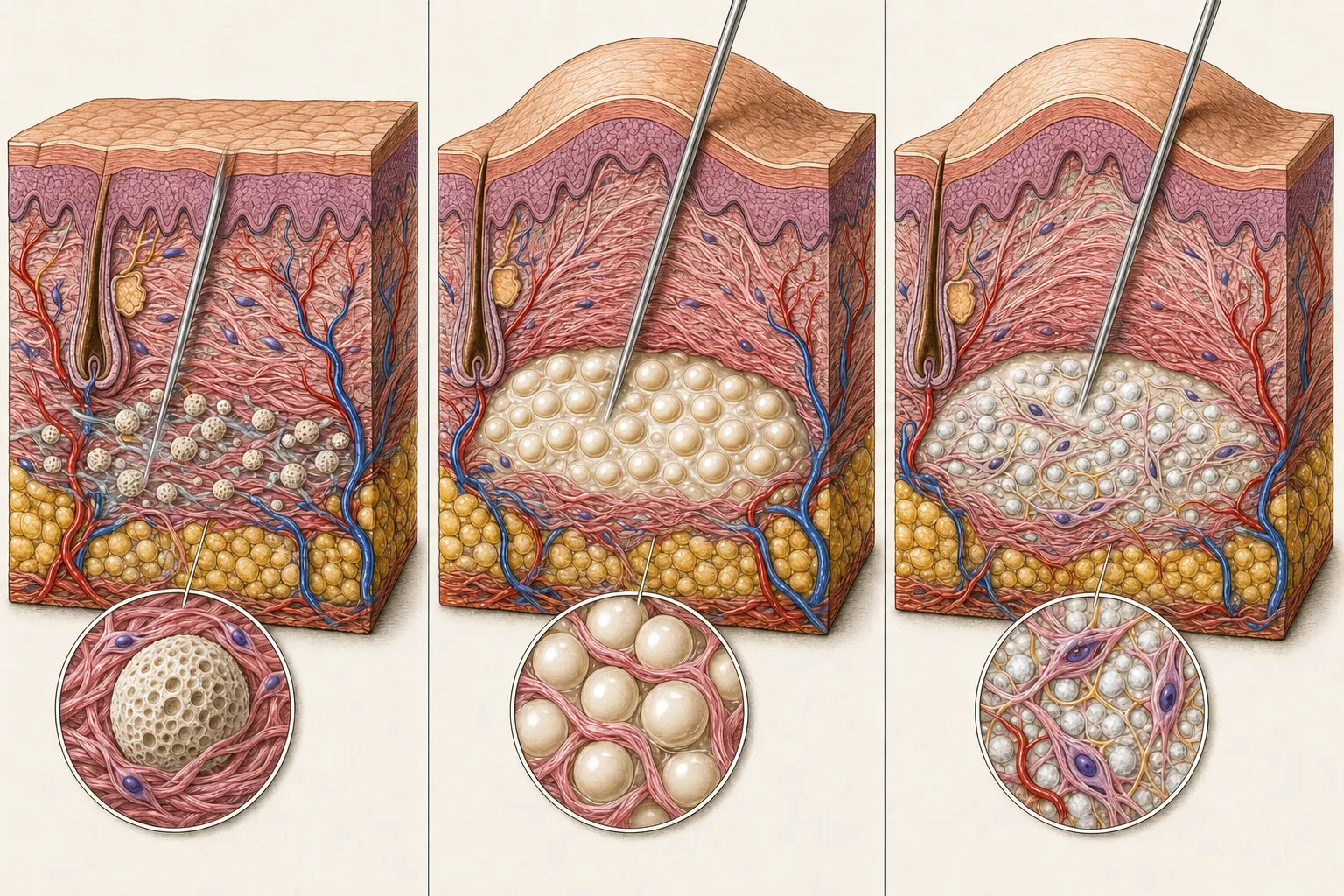
Radiesse is a volume and contour treatment that blends 30% smooth microspheres of CaHA (the same calcium compound found in bone and teeth) into 70% CMC gel (a water-soluble gel derived from plant fiber) and injects it between the deep dermis and the subcutaneous layer. Right after treatment the gel creates the volume, so the shape shows on day one; the gel then absorbs within a few weeks.
The spheres that remain act as a scaffold. Collagen-producing cells (fibroblasts) attach to the spheres and weave collagen onto them, along with elastin — the stretchy fiber that lets skin snap back into place — and new microvessels also form (per the manufacturer's data). Your own tissue, built this way, takes over the volume.
▲ Three particles of the collagen-stimulating family — left, powder-type (PDLLA · mixed in water, collagen builds slowly) · center, PCL spheres (gel gives immediate volume; collagen wraps around each sphere) · right, Radiesse's CaHA spheres (gel gives immediate volume; the spheres become a scaffold that collagen and elastin weave onto) · The center and right look alike from the outside, so check the magnified circles — on PCL, collagen wraps the sphere; on CaHA, cells attach to the sphere and weave like a net (sizes and ratios are not to scale; both spheres are about half the width of a hair — PCL 25–50 µm · CaHA 25–45 µm). A difference of mechanism, not a ranking
When to Consider It
You want structure-defining areas filled — the jawline, outer cheeks, front cheekbones, smile lines, marionette lines, a receding chin The gel and spheres create volume on day one, propping up areas that have lost their line. You can confirm the shape as it's filled, and new tissue takes the volume over afterward.
You'd like skin firmness and density to rise along with the volume Per the manufacturer's data, the weak collagen formed first (type III) matures into the firmly supporting form (type I), with elastin and microvessels increasing as well — so it's considered where volume and skin quality are both in play.
You want the filled volume to hold for a long time An HA filler gel softens and absorbs over time, so its shape can change — and in exchange, it can be dissolved and corrected. With Radiesse, the spheres weave into new tissue and connect with their surroundings — and in exchange, it cannot be dissolved away. This is a treatment you choose knowing that difference.
How It's Done
1. 3D skin analysis A 3D MetaVu scan maps your facial contours and left–right balance in 3D, and your texture, pores, fine lines, and tone under different light sources. We look at the hollowed areas and any asymmetry together on screen.
2. Design consultation Because this treatment cannot be dissolved away, the areas, amount, and shape are decided together before treatment, and we explain the expected changes and limits.
3. Numbing cream Applied and left to absorb for 30–40 minutes.
4. Genuine product and dose check, then treatment The genuine product is opened in front of you, so you can confirm the product and the amount — then it's injected between the deep dermis and the subcutaneous layer. This product is not placed in the shallow layers.
5. Soothing care The injection sites are soothed to finish. The look after the swelling settles — a few days later — is the real baseline.
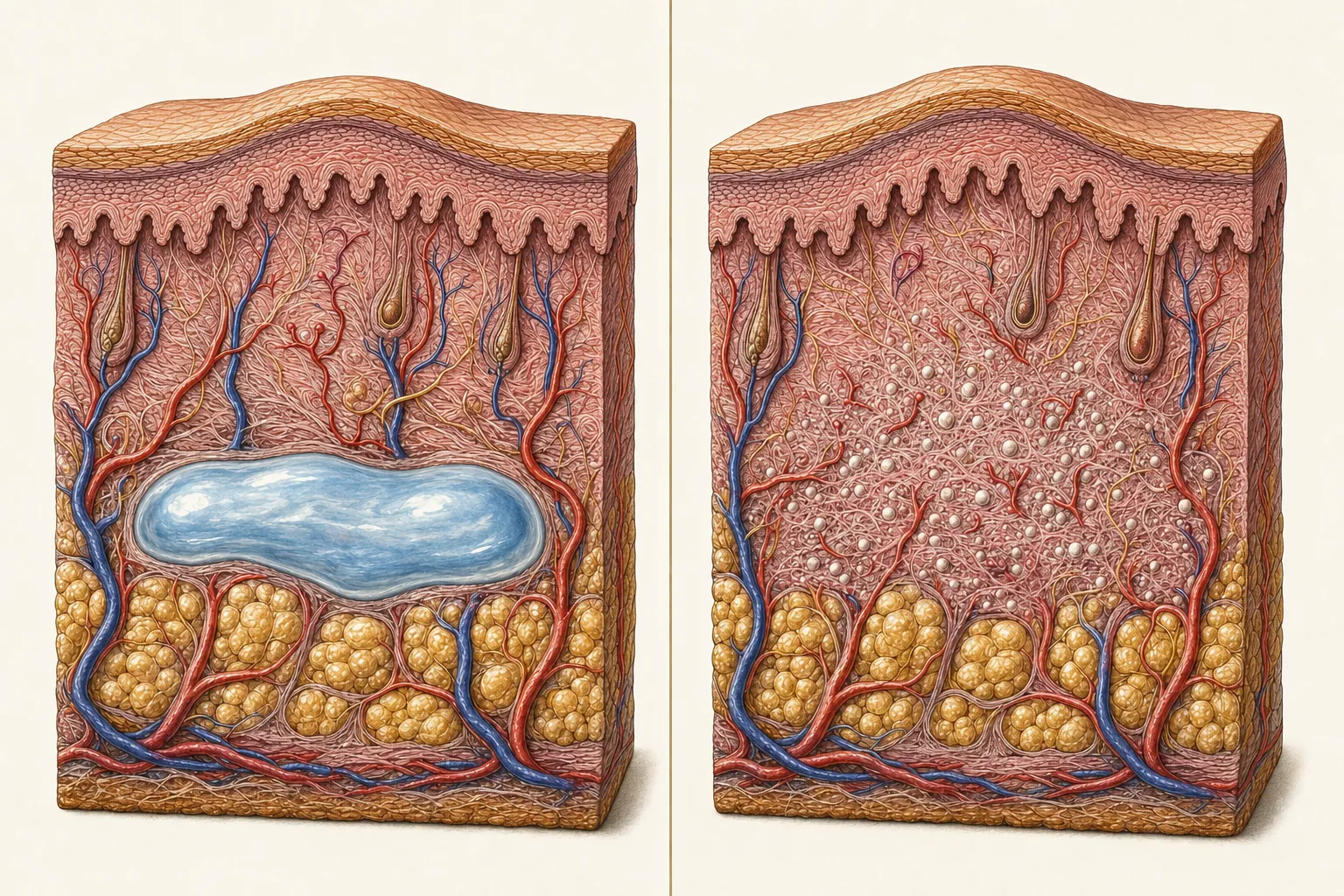
▲ Months later — the HA filler (left) remains as a gel mass (dissolvable for correction), while Radiesse (right) has its spheres woven into new tissue where the gel used to be, connected with the surroundings (cannot be dissolved). This shows a difference of material, and results vary by person
Results and Recovery
| Item | Details |
|---|---|
| Ingredient and form | Smooth CaHA microspheres (25–45 µm) 30% + CMC gel 70% — the gel absorbs within weeks; the spheres remain as a scaffold |
| Injection layer | Deep dermis to the subcutaneous layer (not placed shallow) |
| Main areas | Jawline · outer cheeks · front cheekbones · smile lines · marionette lines · receding chin |
| Areas we don't treat | Lips (not recommended by the manufacturer) · the nose — a problem there demands immediate dissolving, so we point you to the dissolvable HA filler family instead |
| When results show | The gel makes the volume on day one → a slight settling feeling over weeks 2–4 as the gel absorbs → from a month on, collagen forms and the area fills back → over the following months, new tissue takes over |
| How long it lasts | 12–18 months (manufacturer's clinical data · individual results vary) — a single maintenance session after that, if you wish |
| Sessions | One session as the base · if an area needs more, we watch the progress and decide together on a touch-up · one maintenance session at 12–18 months if desired |
| Can it be corrected? | It cannot be dissolved by hyaluronidase (the agent that dissolves HA fillers) — which is why the amount and shape are decided together before treatment |
| Pain | Less a sharp pain than a heavy, pressing fullness and a dull ache as the firm gel pushes into the deep tissue |
| Pain control | Numbing cream (30–40 minutes) as standard · Air Nox (inhaled calming while you remain conscious) available |
| Downtime | Needle marks and redness for 1–2 days · bruises, if any, for 3–7 days · a few days of swelling depending on the area |
| Aftercare | A light water-only rinse from 3–4 hours after · makeup from the next day · don't press or rub the treated area firmly |
The size of the change and how long it lasts vary from person to person.
Expected Reactions and Possible Side Effects
Common, temporary reactions — part of the normal response to injection:
- Needle marks and redness for 1–2 days
- A few days of swelling, depending on the area
- Bruises, if any, fading within 3–7 days
Anything beyond this is uncommon. If a reaction lasts longer than expected or worsens, contact us and we'll check it with you.
What We Check Beforehand
If any of these apply to you, let us know during your consultation. We postpone or adjust the timing.
- Pregnancy or breastfeeding
- Inflammation or active acne in the treatment area — we proceed after it clears
- Keloid-prone skin (scars that heal raised and thickened)
- Aspirin or blood thinners — bruising can be heavier, so tell us in advance and we'll plan for it
- Planning a lifting treatment as well — on the same day, the lifting goes first and Radiesse after
How PECHE Clinic Does It
Because it can't be dissolved, we settle the design together first. Unlike HA fillers, this can't be dissolved. So we look at the scan together and settle the areas, amount, and shape before treatment — and tell you the expected changes and limits first.
We start from measurements, not from the product's name. The same hollow can call for different treatment families depending on whether it's wide, a shallow texture issue, or driven by sagging. We confirm this in your assessment, with the help of the 3D scan, and recommend Radiesse only when your condition fits it.
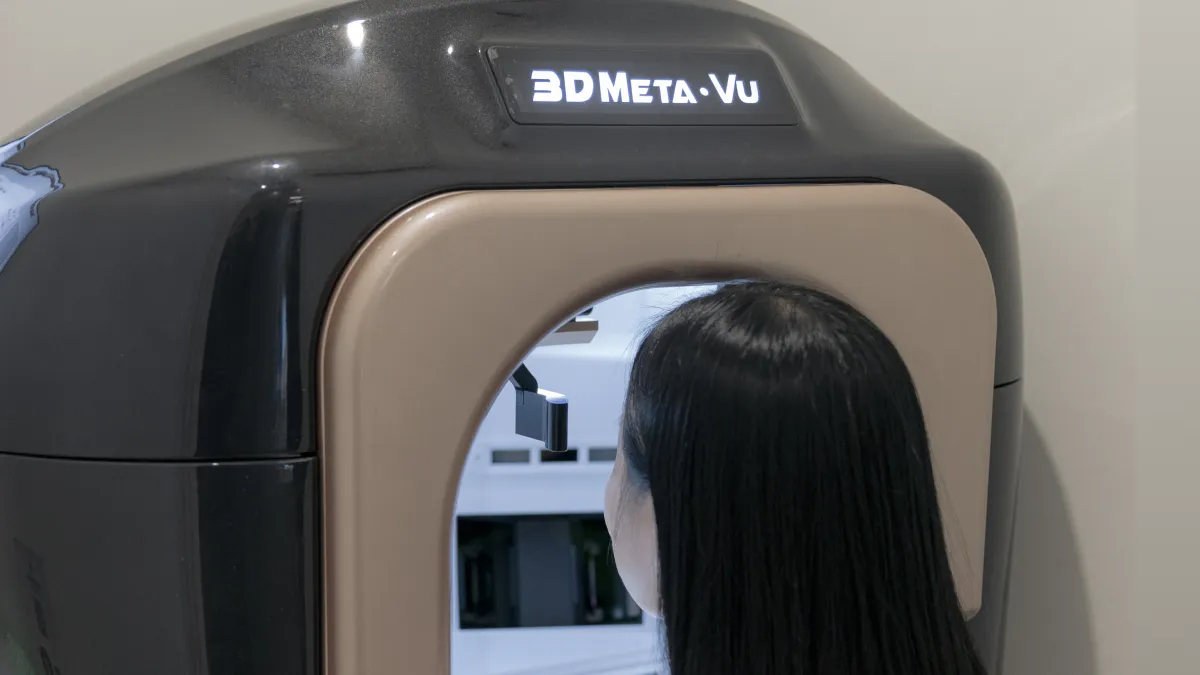
▲ We look at the measurements together
We treat by standards built on 90,000+ documented treatments. This is a treatment where a too-shallow injection causes problems, so depth and amount standards matter. Area-by-area standards mean every PECHE physician works to the same criteria — whoever treats you.
We open the genuine product in front of you — and the prep room is behind glass. The genuine product is opened in front of you so you can confirm the product and amount, and you can watch preparation and hygiene management through the glass wall from the waiting area.
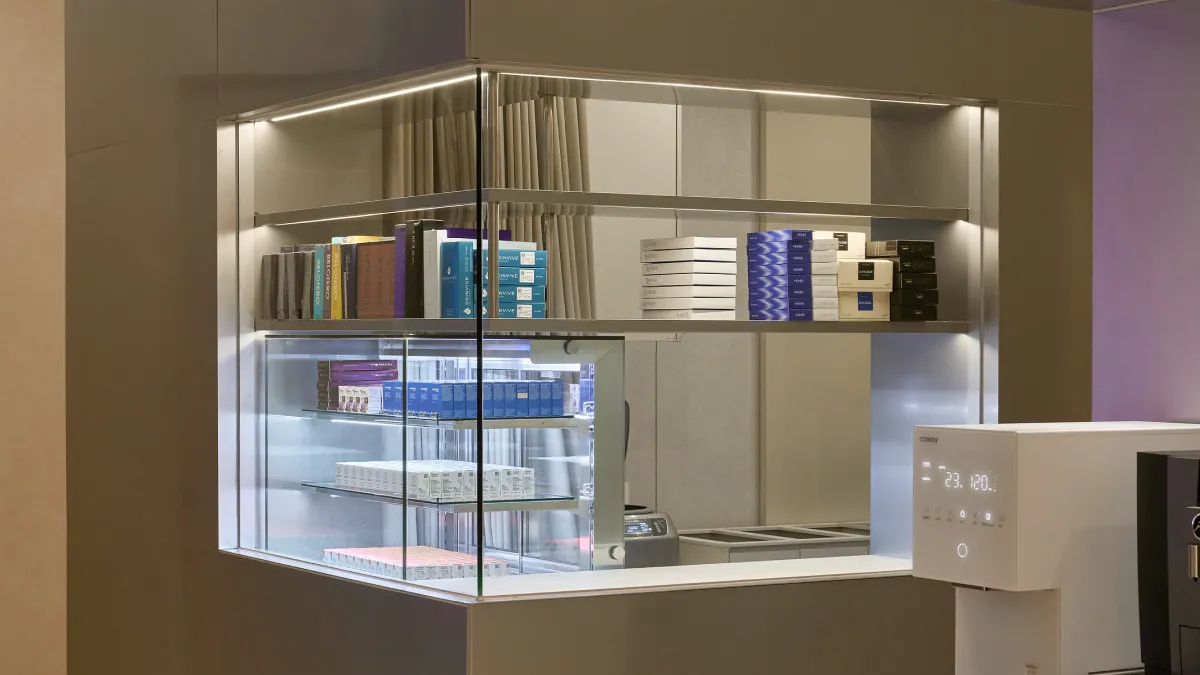
▲ The prep room, seen through the glass from the waiting area
We only recommend what you need. We tell you first what this treatment does (volume, contour) and what it doesn't (sagging itself — or dissolving later to correct). No same-day payment pressure, no package push.
Pricing
The cost of Radiesse depends on the amount (number of syringes) and the areas. We set the plan after your assessment and quote from there.
Location
PECHE Clinic 3F, 364 Gangnam-daero, Gangnam-gu, Seoul Right in front of Gangnam Station, Exit 4
FAQ
Q1. Who performs the treatment? A: PECHE physicians who all work to the same area-by-area injection standards, built from over 90,000 documented treatments. Depth, amount, and shape are set by these standards and your assessment results — not by feel — and the standards stay the same whoever treats you.
Q2. How is it different from the PCL sphere injection in the same family? A: The sphere's material, and the way your tissue bonds to it, differ. PCL is the material used in dissolvable medical sutures, and collagen forms around its spheres; Radiesse's CaHA is the calcium compound of bone and teeth, and its spheres become a scaffold that new tissue weaves onto. It's a difference of mechanism, not a ranking — we decide together at your assessment, by area and goal.
Q3. It can't be dissolved — what if I don't like the result? A: That's true. Hyaluronidase, which dissolves HA fillers, doesn't work on CaHA. That's exactly why the areas, amount, and shape are decided together before treatment. The spheres and new tissue diminish gradually over time, but there is no way to reverse it immediately. If that's a concern, the HA filler family may be the better fit.
Q4. Can it be felt under the skin, or form lumps? A: Placed too shallow, it can be felt under the skin — so we follow the manufacturer's standard of the deep dermis to the subcutaneous layer, and skip the non-recommended area (lips). Not pressing or rubbing the area firmly after treatment also matters. In the rare case a palpable spot remains, come in and we'll check it together.
Q5. Can I just come in for a consultation first? A: Yes — with a treatment that can't be dissolved, we'd encourage exactly that. Hear whether Radiesse fits, or whether an HA filler or another family fits better, and decide then.