Laetigen — PECHE Clinic, Gangnam Station
A skin booster that places finished type I collagen directly into the dermis — unlike approaches that stimulate your skin to make new collagen · Right by Gangnam Station Exit 4
Laetigen
Laetigen is a skin booster that injects finished type I collagen directly into the dermis. Collagen makes up 80–90% of the dermis, and most of it is type I — so this approach refills the very material that drains away with age, in the same form. What it refills is density, not volume, which makes its purpose different from volume treatments that plump hollowed areas.
What goes in — type I collagen at 99.9% purity. It comes as atelocollagen: the part of collagen that can trigger an immune response (the telopeptide) has been cut away by enzymes. The collagen is then refined through multiple filters and sterilized with pressurized steam. The product is pH-neutral rather than acidic, which the manufacturer credits for lower swelling and burning after treatment, and it is a medical device approved by Korea's MFDS (Ministry of Food and Drug Safety).
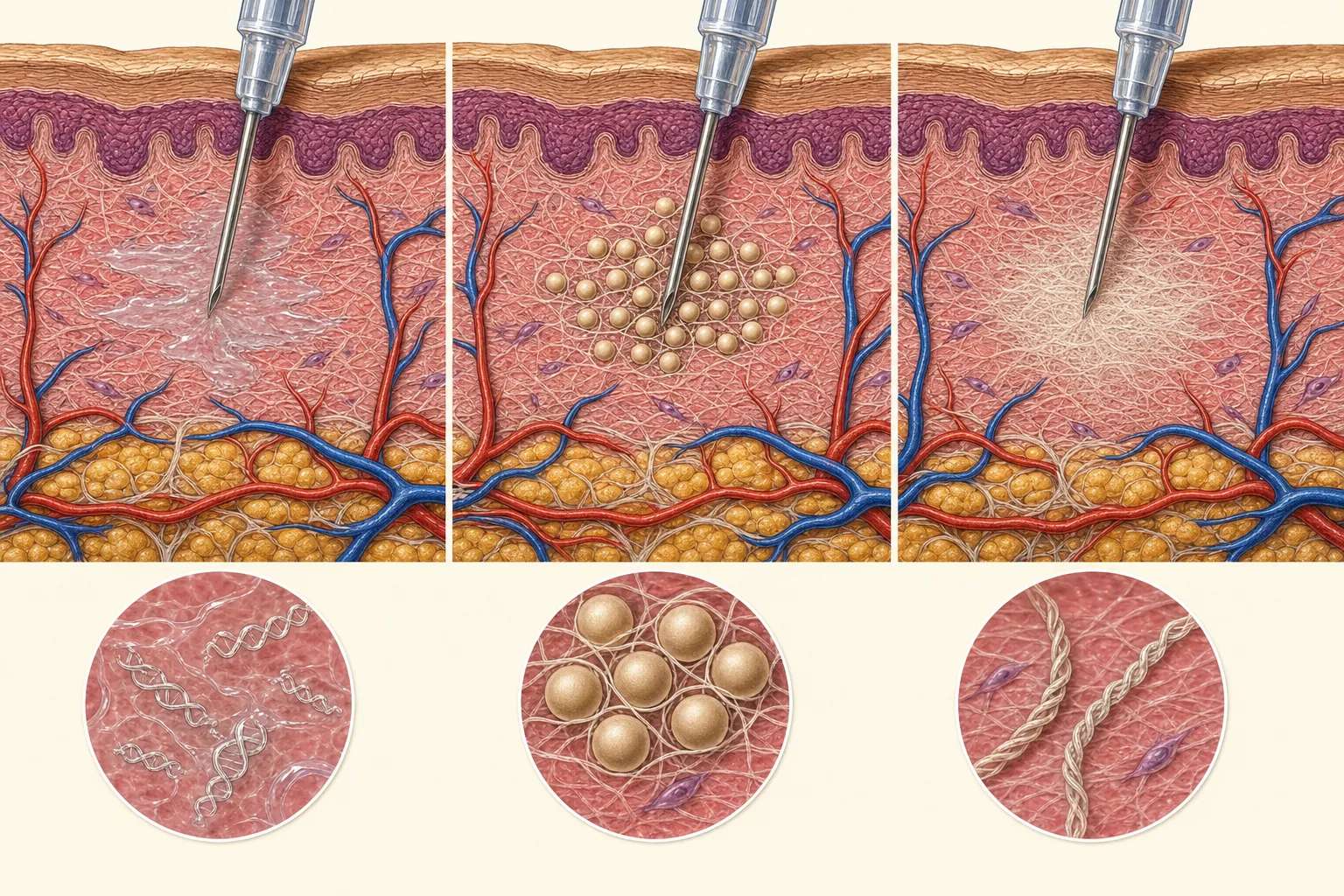
▲ A comparison of what each treatment injects. Left: a repair-signal fluid; center: particles that prompt collagen to be made; right: Laetigen — finished collagen. The circles below are magnified views; in reality collagen is too fine to see. A drawing to aid understanding — not a statement that one is better
When to Consider It
Your skin has thinned and feels like it's lost its supporting strength Fine lines crinkle and makeup sits unevenly — but your cheeks aren't hollowed. What's missing is density, not volume.
You'd rather refill the material directly than wait for it to be made Stimulating treatments take weeks: the particles settle, then your body builds new collagen. Laetigen places finished collagen right where it's lacking. Note that it differs in purpose from approaches that prompt your body to build up a lot of its own collagen and gain volume along with it.
What's lacking is the material itself — not a repair signal A damaged skin barrier in need of recovery and a dermis whose collagen itself has declined are different states. The first suits the repair-signal family; the second suits refilling the material.
If a large hollow is the concern, the volume family fits better; if sagging is the main issue, lifting comes first. We decide together, based on your assessment results.
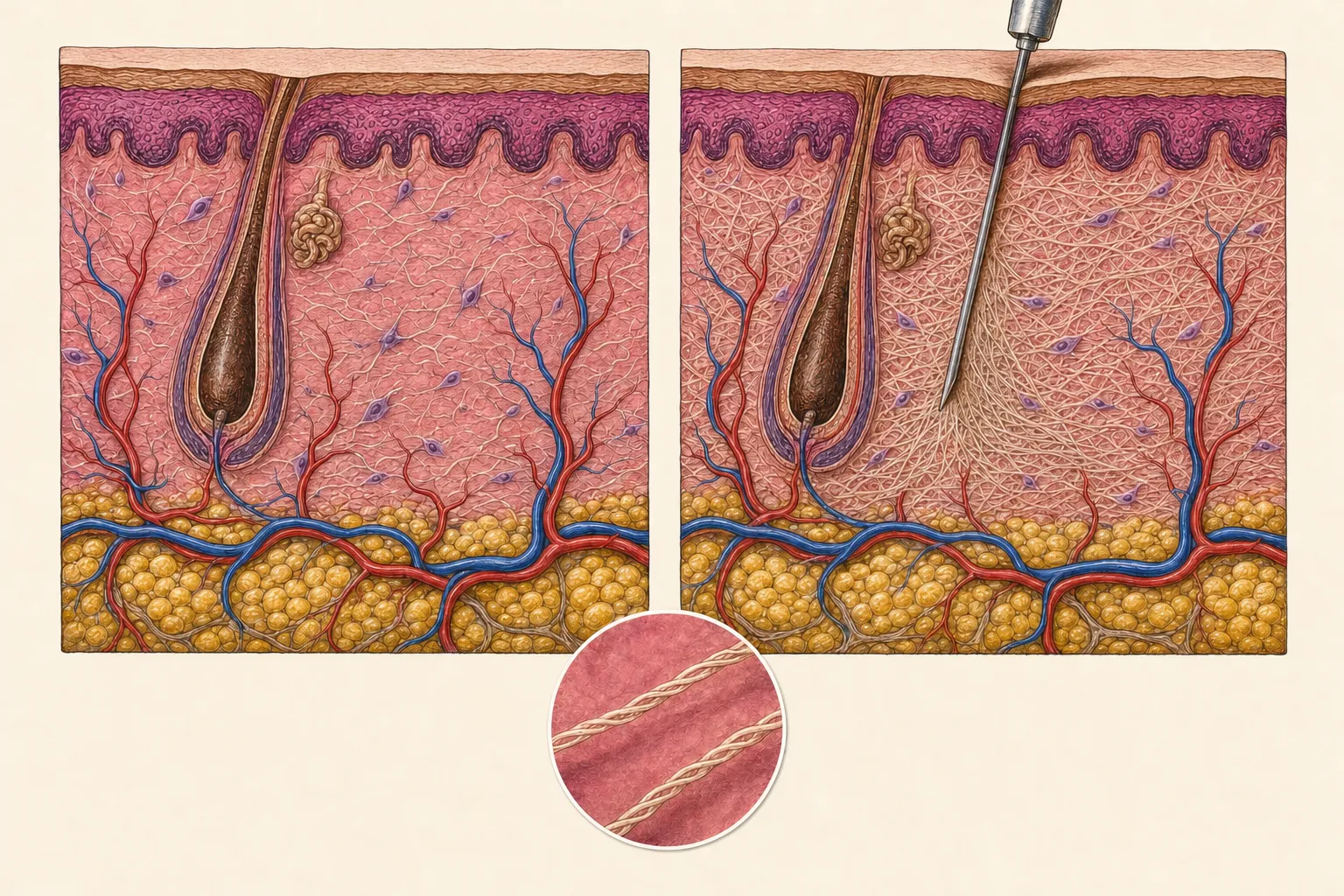
▲ Left: skin interior gone sparse as collagen declined; right: refilled and dense again. The collagen in the circle below is magnified — in reality it's too fine to see. A drawing to aid understanding; the degree of change varies by person
How It's Done
1. 3D skin analysis A 3D MetaVu scan examines your texture, pores, fine lines, and tone under different light sources. Whether your concern is density and texture, or volume and sagging, is judged from this and the consultation.
2. Treatment plan Looking at the scan together, we go over the areas, configuration, sessions, and the changes to expect — including the limits.
3. Numbing cream Applied and left to absorb for 30–40 minutes.
4. Product and amount check, then injection The genuine product is opened in front of you, so you can confirm the product and the amount — then it's injected across the dermis.
5. Soothing care The injection sites are soothed to finish. The raised bumps at the injection points settle within days.
Results and Recovery
| Item | Details |
|---|---|
| Ingredient | Type I collagen at 99.9% purity — atelocollagen with the telopeptide removed · pH-neutral |
| Configurations | 1.0 g for a focused area · 2.0 g for the full face — decided by area and condition |
| Product form | Comes as a finished liquid (gel) in the syringe — nothing to dissolve or mix |
| Injection layer and areas | The dermis — full face · under-eyes · outer cheeks · neck |
| Purpose | Skin density, firmness, texture (not a volume treatment that fills space) |
| When results show | Because finished collagen is being placed, it doesn't rely on waiting for new collagen to form. For the first few days, swelling and needle marks are still mixed in, so it's best to judge once those settle — and when you feel the change varies by person and skin condition |
| How long it lasts | About 6–12 months — varies with your skin's condition |
| Sessions | 3 sessions at 3–4 week intervals as the base → maintenance every 3–6 months after (the shared skin-booster principle, adjusted as we watch your progress) |
| Pain | The prick of the needle going in, plus a dull pressure as the product spreads — more a pressure feeling than a burning, raw one |
| Pain control | Numbing cream (30–40 minutes) as standard · Air Nox (inhaled calming while you remain conscious) available |
| Downtime | Raised bumps for 1–3 days · needle marks and redness for 1–2 days · bruises, if any, for 3–7 days |
| Aftercare | A light water-only rinse from 3–4 hours after · cleanser and makeup gently from the next morning |
The raised bumps mean the product has properly entered the dermis — just avoid pressing or rubbing until they settle.
Expected Reactions and Possible Side Effects
Common, temporary reactions — part of the normal response to injection:
- Raised bumps at the injection points for 1–3 days
- Needle marks and redness for 1–2 days
- Bruises, if any, fading within 3–7 days
Anything beyond this is uncommon. If a reaction lasts longer than expected or worsens, contact us and we'll check it with you.
What We Check Beforehand
If any of these apply to you, let us know during your consultation. We postpone or adjust the timing.
- Pregnancy or breastfeeding
- Inflammation or active acne in the treatment area — we proceed after it clears
- Keloid-prone skin (scars that heal raised and thickened)
- Aspirin or blood thinners — bruising can be heavier, so tell us in advance and we'll plan for it
- A history of allergic reaction to injections or protein-based ingredients
- Planning a lifting treatment as well — on the same day, the lifting goes first and Laetigen after. Depending on the device and your skin, a gap may be needed — decided at your assessment
How PECHE Clinic Does It
We start from measurements, not from the product's name. The same fine lines and dull, rough-feeling skin can come from moisture, from the material itself, or from volume and sagging — and each calls for a different family. We confirm your skin's condition in the 3D scan, and recommend Laetigen when your condition fits it.
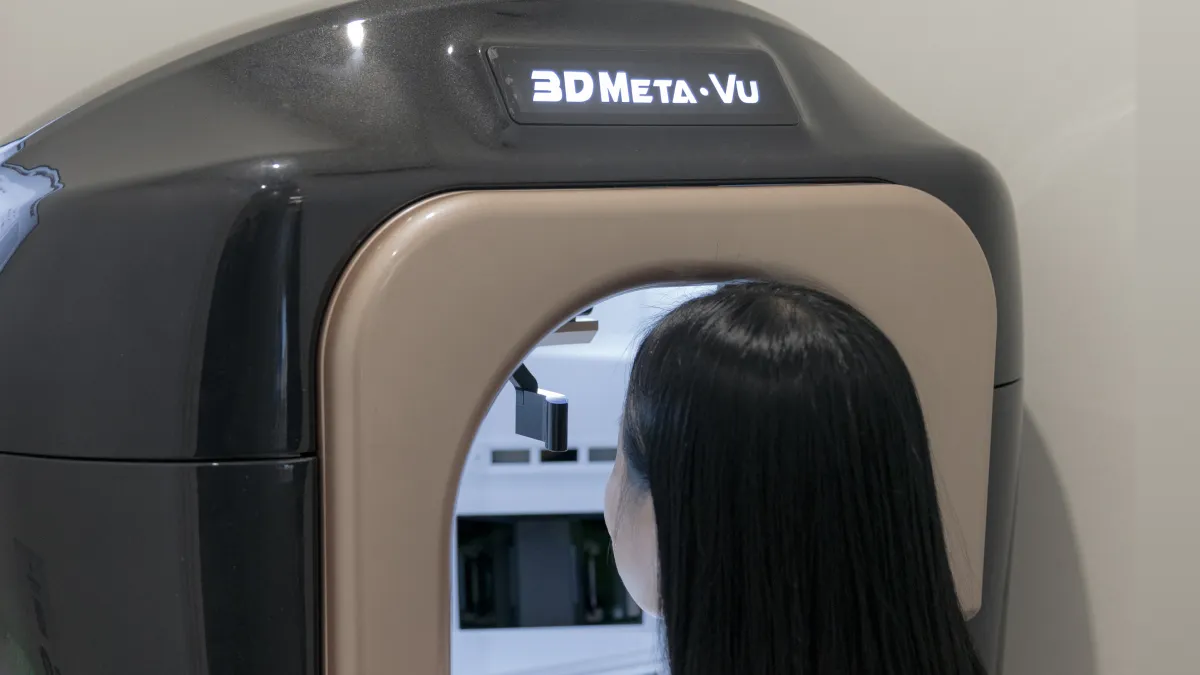
▲ We look at the measurements together
We treat by standards built on 90,000+ documented treatments. A treatment placed across the dermis comes out even only when depth and spacing stay consistent. Area-by-area standards mean every PECHE physician works to the same criteria — whoever treats you.
For pain, we start with methods that don't touch the ingredient. Numbing cream first; when needed, Air Nox — an inhaled calming option you stay conscious through — is added.
We open the genuine product in front of you — and the prep room is behind glass. With injectables, what goes in and how much is the baseline of trust. The genuine product is opened in front of you so you can confirm the product and amount, and the prep room's glass wall lets you watch the preparation and hygiene management from the waiting area.

▲ The prep room, seen through the glass from the waiting area
We only recommend what you need. We tell you first what this treatment does (skin density, firmness, texture) and what it doesn't (volume for hollowed areas, sagging itself). No same-day payment pressure, no package push.
Pricing
The cost of Laetigen depends on the configuration (1.0 g, 2.0 g), the areas, and the sessions. We quote after your assessment.
Location
PECHE Clinic 3F, 364 Gangnam-daero, Gangnam-gu, Seoul Right in front of Gangnam Station, Exit 4
FAQ
Q1. Who performs the treatment? A: PECHE physicians who all work to the same area-by-area injection standards, built from over 90,000 documented treatments. A treatment placed across the dermis depends on consistent depth and spacing — set by those standards, not by feel, and the same whoever treats you.
Q2. Does the injected collagen stay as it is? A: No. The injected collagen breaks down gradually in the body. While it lasts, it supports the skin from within — and that process becomes an environment where your collagen-making cells can work. That's why it's done as a series rather than a single session, with the maintenance timing decided together as we watch your progress.
Q3. I'm worried about allergies or a foreign-body reaction. A: It's atelocollagen — the part of collagen that can trigger an immune response has been enzymatically removed, a form designed to lower that risk. Still, no injectable is entirely without reactions, so instead of a prior skin test we screen your allergy history and past reactions to injections in the consultation before proceeding.
Q4. Is this different from collagen you eat or apply? A: Where it ends up differs. Collagen you eat is broken into small pieces during digestion, so it doesn't travel to the dermis as-is; collagen in creams has molecules too large to pass the surface. Laetigen places collagen directly into the dermis where it has declined.
Q5. Can I just come in for a consultation first? A: Yes. You can hear whether your concern sits on the density-and-texture side or the volume-and-sagging side, and how far this treatment reaches, then decide. We won't ask for same-day payment.