Jamber Thread — PECHE Clinic, Gangnam Station
Fine dissolvable threads woven into a mesh, placed into hollowed areas so your own collagen fills in along the frame · Nasolabial folds and sunken side cheeks · Right by Gangnam Station Exit 4
Jamber Thread
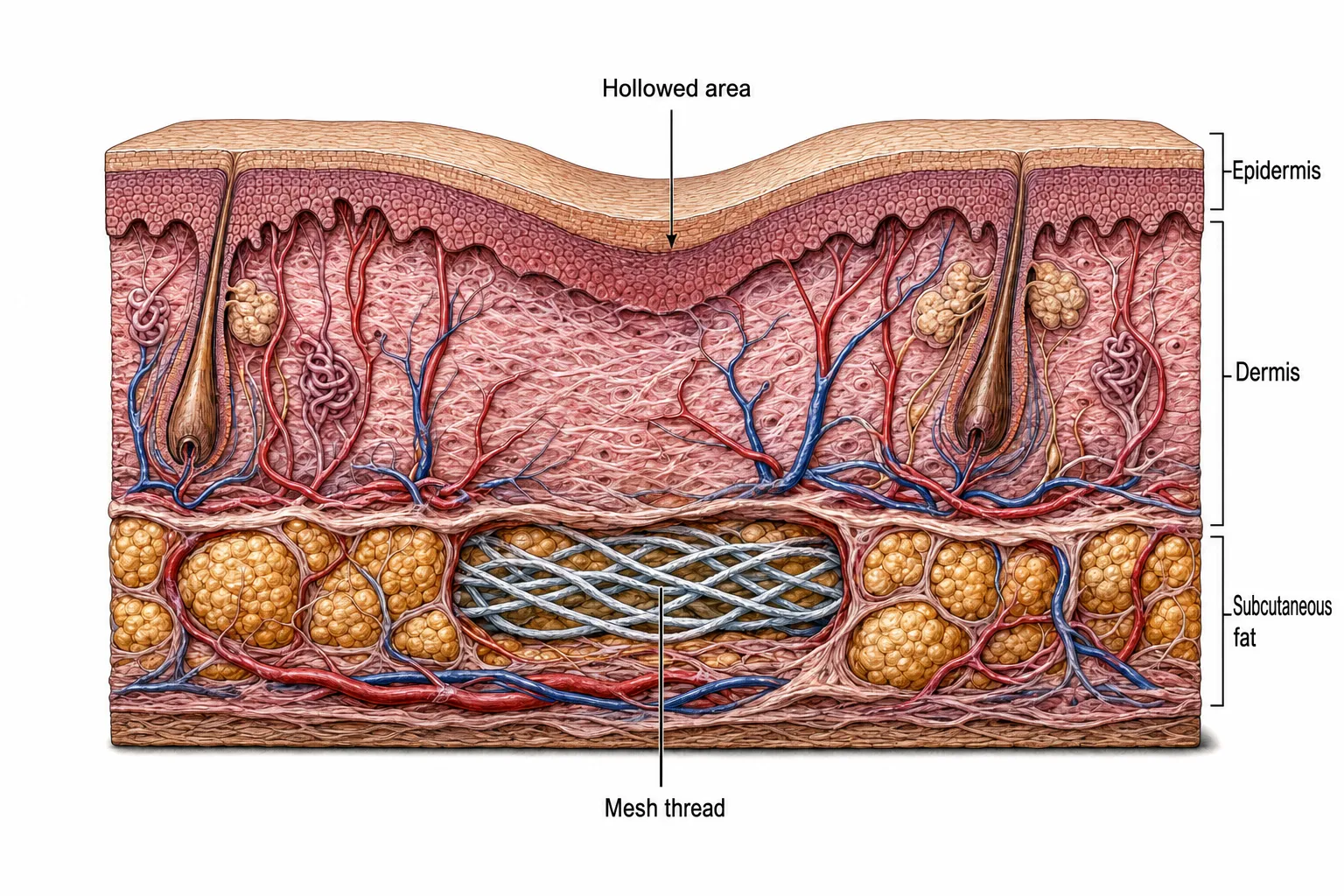
Jamber Thread takes many strands of fine dissolvable thread — twisted like a spring or woven like a mesh — and places them beneath the skin of a hollowed area. Unlike thread lifts that pull upward, this one fills what has sunken.
The filling material isn't the thread — it's your own collagen. As the body breaks the thread down, it builds collagen densely along the thread's broad surface; over several months, as the thread is absorbed, the newly made collagen takes over its place.
▲ The mesh threads build a frame in the hollowed area, and collagen forms along that frame
When to Consider It
- Sunken side cheeks or front cheeks make your face look gaunt
- The grooves of your nasolabial folds or mouth lines have deepened
- Your skin is thin and weak, and you want density built from within
- You'd rather have volume arrive gradually than all at once
If your main concern is sagging rather than hollowing, a pulling approach may fit better than a filling one. Pulling on a hollowed spot can even make the dip stand out — so we first determine which it is.
How a Mesh Becomes Volume
| Stage | What happens |
|---|---|
| 1. The frame | The mesh thread enters the hollowed area and becomes a three-dimensional frame |
| 2. Collagen forms | As the body breaks the thread down, collagen-making cells gather along its broad surface, filling the mesh inside and out |
| 3. The handover | The thread (PDO, a dissolvable material) breaks down over 6 months–1 year, and the collagen that formed takes over, supporting the volume |
This is why fine strands are woven in numbers: collagen forms along the thread's surface, so the broader the surface, the more fills in.
How It's Done
1. Contour check and assessment A 3D MetaVu scan records your facial contours and left–right balance, and we first sort out whether the cause is hollowing or sagging.
2. Numbing No numbing injection — a numbing spray is applied, then we proceed. There is no needle-stick numbing step at all.
3. Thread placement Through a needle-mark-sized entry point, a blunt-tipped thin tube (cannula) places the mesh thread beneath the skin of the hollowed area.
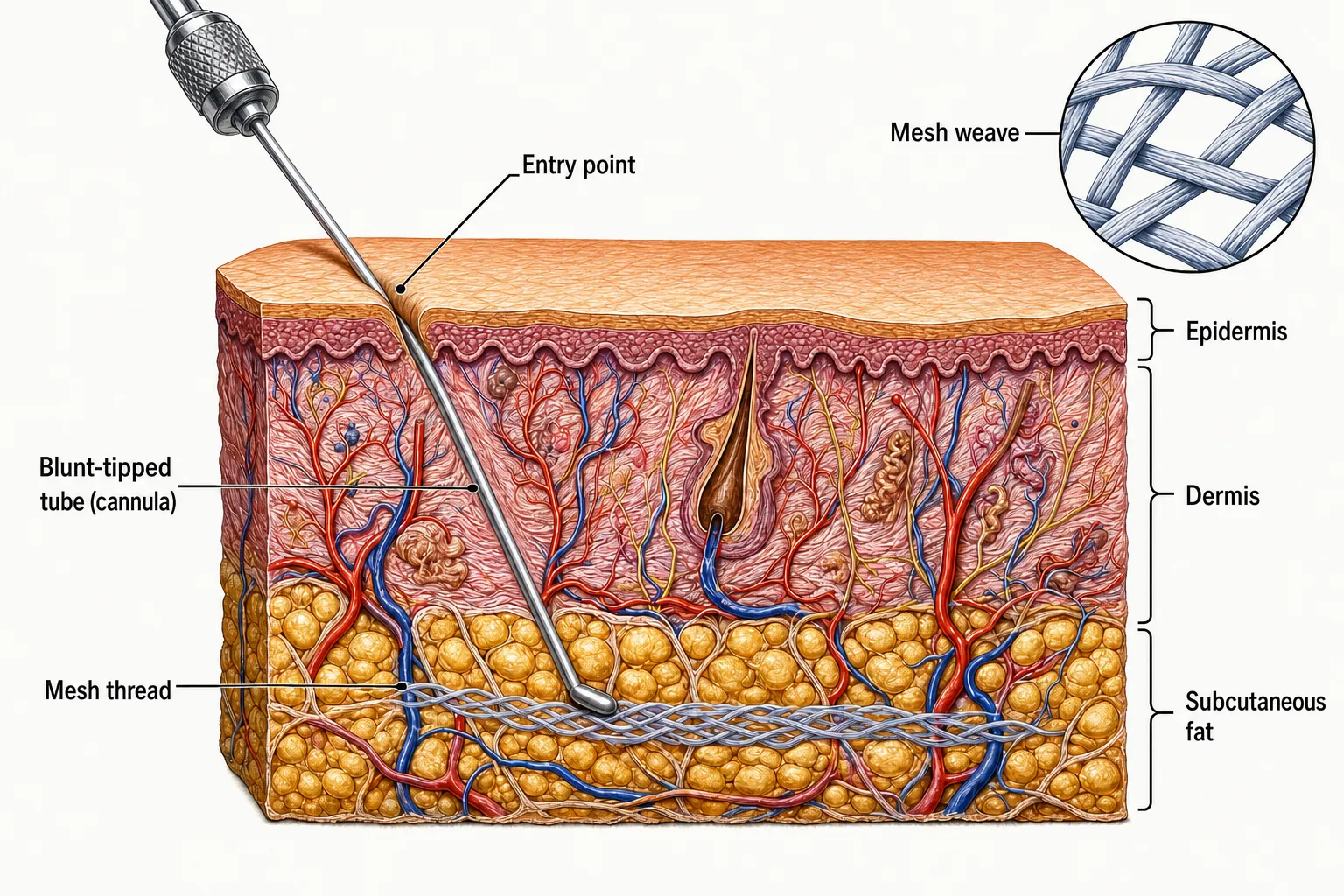
▲ The tube enters through a small opening and lays the mesh thread beneath the skin — the magnified circle shows the mesh weave
4. Finish The remaining thread is trimmed. The entry point is needle-mark-sized, so once healed it tends not to show.
Results and Recovery
| Item | Details |
|---|---|
| Target | Sunken side and front cheeks · deep nasolabial and mouth lines — face and jawline |
| How it works | The mesh thread becomes the frame, and your own collagen forms along it, filling the volume |
| When results show | Not a method that fills on placement — it fills in gradually over the several months collagen takes to form |
| How long the thread takes to dissolve | PDO-based, dissolving over 6 months–1 year |
| After it dissolves | The collagen that formed takes over and holds the area up — duration varies by person and is estimated at the consultation |
| Pain | After numbing, less a sharp cutting pain than a heavy, dull pressure as the thickened bundle of woven strands passes deep beneath the skin |
| Pain control | Numbing spray before starting (no numbing injection is used) · tell us how it feels mid-treatment and we adjust |
| Downtime | Swelling and bruising for several days to 2 weeks |
| Aftercare | While swelling and bruising settle, avoid exaggerated expressions — so the thread isn't shifted out of place before it settles |
| Spacing other treatments | RF or ultrasound lifting can start 2 months after — later if any foreign-body feeling or swelling remains |
It works differently from treatments that fill instantly. Unlike injected methods where volume arrives the moment the material goes in, Jamber Thread fills at the pace your collagen forms. The choice comes down to whether you want a fast change or a gradual fill.
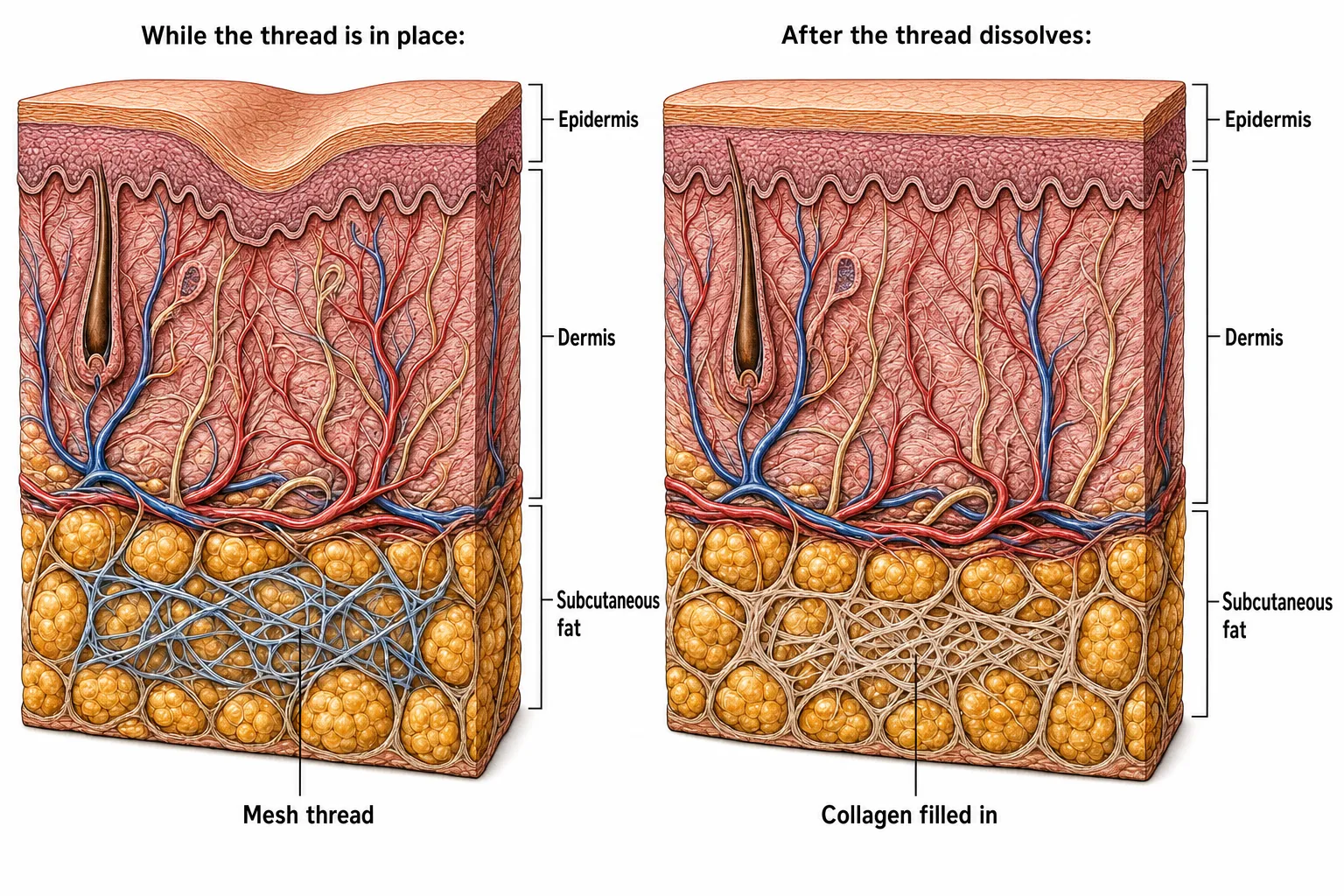
▲ With the thread in place (left) and after it dissolves (right) — your own collagen takes over where the thread was (individual results vary)
Expected Reactions and Possible Side Effects
Common, temporary reactions — part of the normal course:
- Swelling and bruising for several days to 2 weeks
- A temporary foreign-body feeling may occur while the thread settles
Anything beyond this is uncommon. If a reaction lasts longer than expected or worsens, contact us and we'll check it with you.
What We Check Beforehand
If any of these apply to you, let us know during your consultation. We adjust the timing or the approach.
- A condition where bleeding is slow to stop, or blood thinners (anticoagulants) — bruising can be heavy
- A keloid tendency (scars that heal raised)
- Inflammation, wounds, or a skin condition at the treatment area
- Filler or implants already placed in the area — they affect where the thread can go
- Pregnancy or breastfeeding
- RF or ultrasound lifting planned within 2 months — we sequence them together
- If a fast volume change comes first for you — this treatment fills over several months
How PECHE Clinic Does It
Hollowing or sagging — we sort that out first. The same nasolabial groove can come from hollowing in one face and sagging in another. A different cause means a different method — and pulling alone on a hollowed spot can make the dip stand out. The 3D MetaVu scan records your contours and balance, the examination identifies the cause, and we decide the approach together.
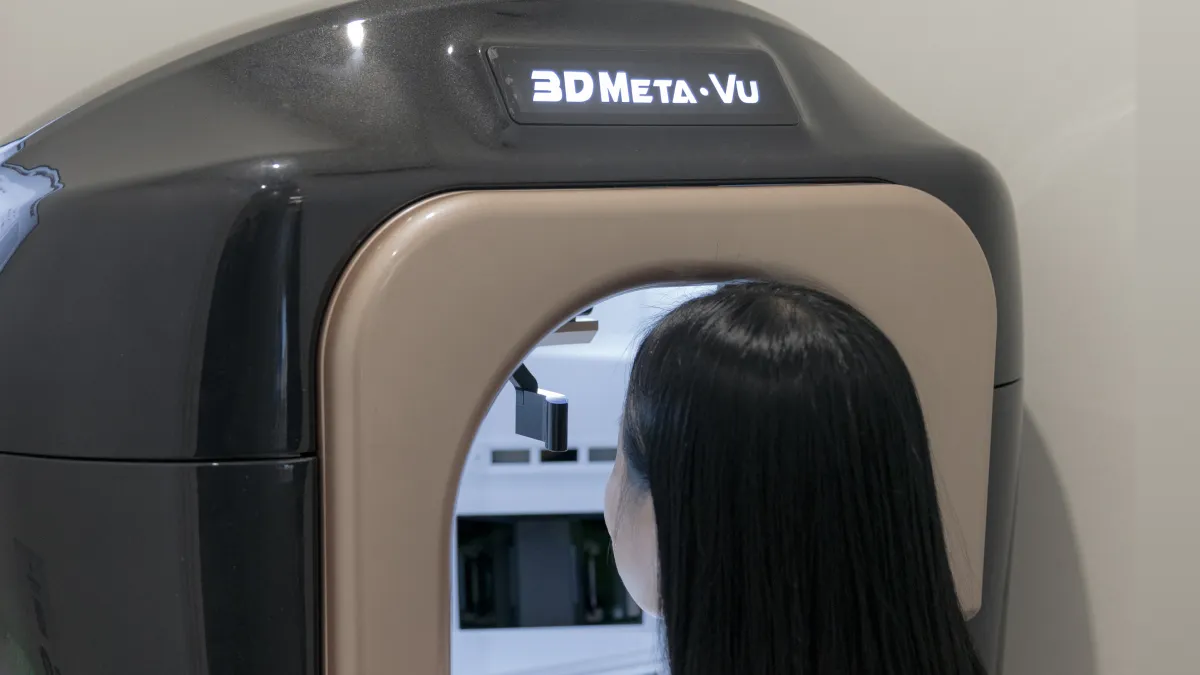
▲ Hollowing or sagging — sorted out first
The prep room is behind a glass wall, in full view. The preparation and hygiene routine is visible through the glass from the waiting area.

▲ The prep room, seen through the glass from the waiting area
We're honest about what to expect. This is a treatment that fills slowly — and we tell you first what it can do (density and volume within the hollowed area) and what it can't (repositioning sagged tissue, immediate volume). We don't push same-day payment or packages — you're welcome to come in just for a consultation.
Pricing
Jamber Thread cost depends on the area and the thread configuration. We set the configuration after your assessment, then give you a quote.
Location
PECHE Clinic 3F, 364 Gangnam-daero, Gangnam-gu, Seoul Right in front of Gangnam Station, Exit 4
You may come back to check how the fill is progressing — a short trip makes that easier.
FAQ
Q1. Who performs the treatment? A: PECHE physicians who all work to the same standards, built from over 90,000 documented treatments. Where the threads go and how deep are set from your contour record and these standards, not by feel — and the same standards apply even if your physician changes.
Q2. When will I see it fill in? A: It isn't a method that fills on placement — it fills gradually over the several months collagen takes to form. Change right after may be swelling, so progress is read in months. If a fast change comes first for you, a different method may fit better, and we'll say so honestly at the consultation.
Q3. Can it be combined with a pulling thread lift? A: If a face carries both sagging and hollowing, pulling threads and filling threads are sometimes used together. Which combination fits is decided together, from your contour record and the examination.
Q4. Will the threads be felt, or show? A: The threads sit beneath the skin and don't show from outside. A temporary foreign-body feeling can occur while they settle. Avoiding exaggerated expressions during that time helps them settle.
Q5. What should I look for when choosing a clinic? A: Three things. First, whether they distinguish hollowing from sagging — that judgment decides the method. Second, whether they tell you upfront that this treatment fills slowly. Third, whether it's an easy trip back to check the progress.