Ultherapy Prime — PECHE Clinic, Gangnam Station
HIFU lifting that focuses ultrasound at a single point to create small heat points in the SMAS and the dermis · Face and body · Right outside Gangnam Station Exit 4
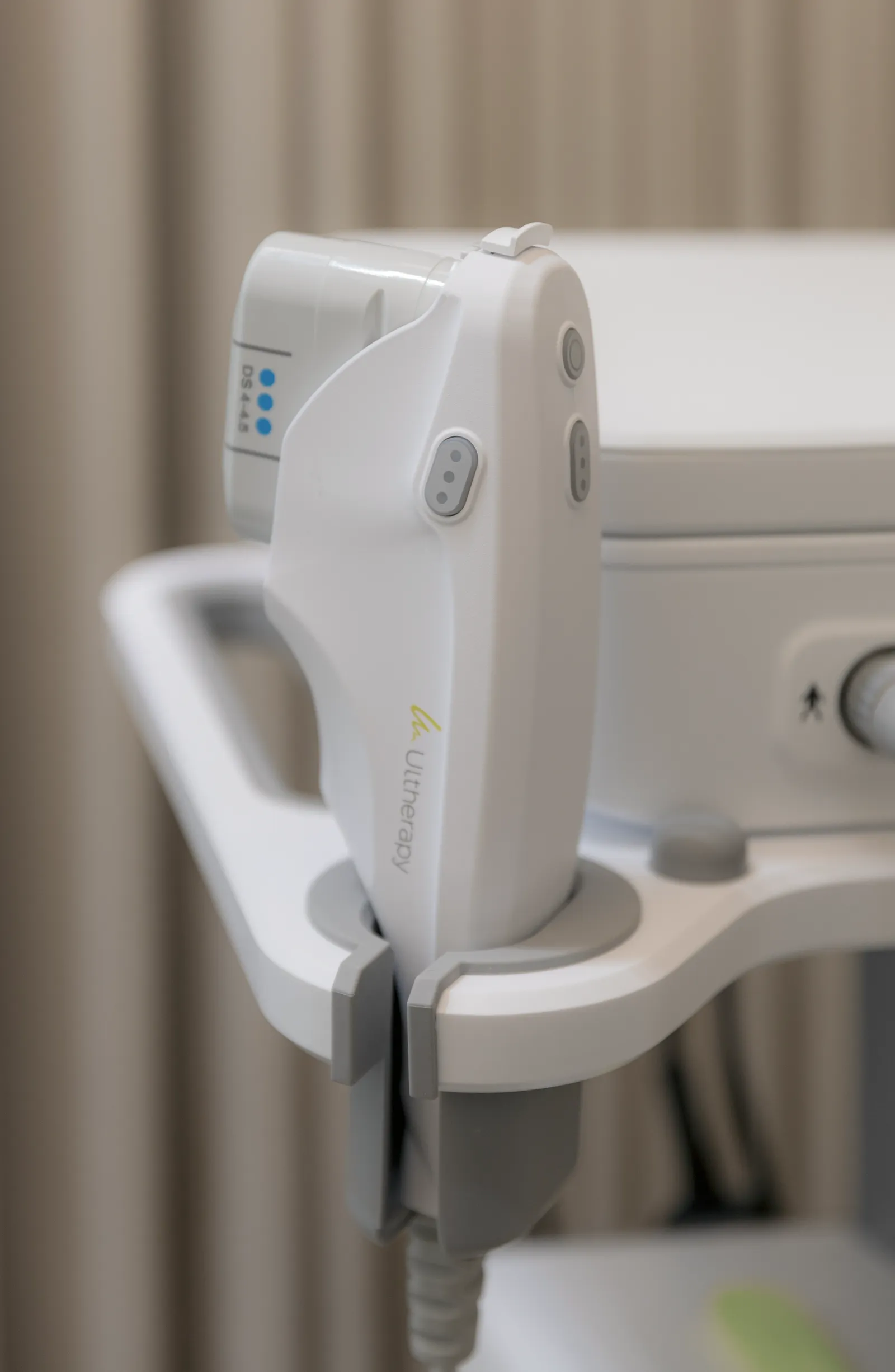
Ultherapy Prime
Ultherapy Prime is a lifting device that uses focused ultrasound (HIFU — a method that concentrates ultrasound at a single point inside the skin) to create small heat points in the SMAS (a thin, tough layer that supports the skin and fat so they don't sag) and in the dermis above it, lifting the sagging structure. Made by Merz Aesthetics, it is the latest-generation device in its line, and it has been cleared by the U.S. FDA for uses including brow, neck, and under-chin lifting.
Put simply, it focuses ultrasound onto a single point inside the skin, the way a magnifying glass focuses light, to tighten, from the inside, the dermis and the layer that supports the face. It leaves no wound on the skin's surface and involves no incisions or injections.
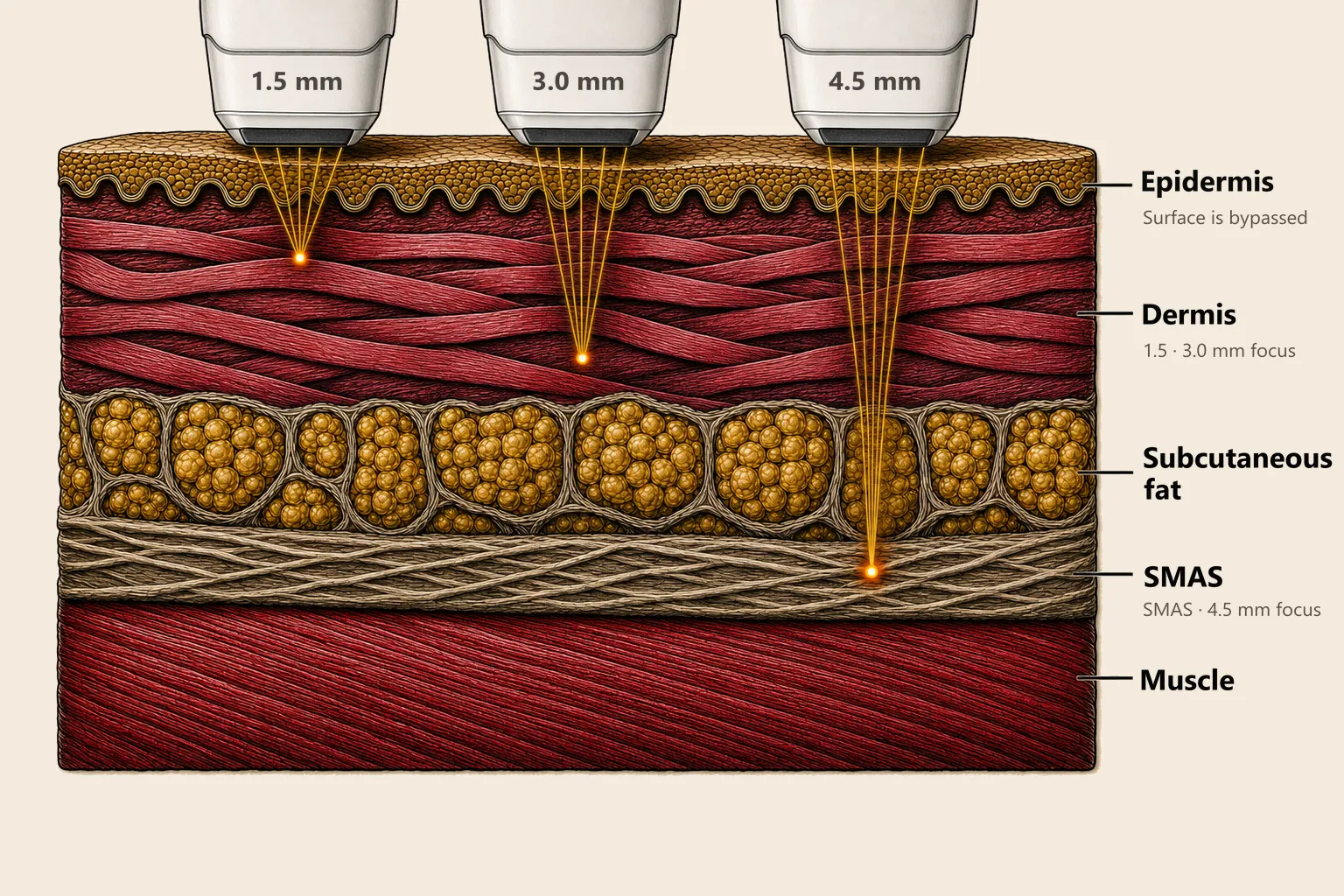
▲ Each tip forms heat points at a different depth — 1.5 mm shallow dermis · 3.0 mm deep dermis · 4.5 mm SMAS
Ultherapy Prime at a Glance
| Item | Details |
|---|---|
| Category | Focused ultrasound (HIFU) lifting (non-invasive — does not break the skin) |
| Mechanism | Focuses ultrasound at a single point inside the skin to create a small heat point |
| Target layer (tip depth) | 4.5 mm SMAS · 3.0 mm deep dermis · 1.5 mm shallow dermis |
| Surface protection | Heat concentrates at the focal point, so the surface is bypassed (no separate surface cooling) |
| Imaging function | Built-in function that shows the layers inside the skin as an ultrasound image (DeepSEE®) |
| Manufacturer and approvals | Merz Aesthetics · cleared by the U.S. FDA — brow, neck, and under-chin lifting, and fine lines on the upper chest (décolletage) · arms and abdomen added in 2025 |
| Concerns it suits | Sagging along the jawline and under the chin · drooping brows and eye area · loose skin on the neck · loose skin on the body |
| Available options | Ultherapy Prime (face): 100, 300, 600, or 900 shots · Ultherapy Prime Body: 100, 300, 600, or 900 shots |
| Numbing | Numbing cream, then a 20-minute wait |
| When results show | A pulling sensation right after → contour changes from around week 4 → peak at 2–3 months |
| How long it lasts | About 6 months to 1 year (longer for some people) |
| Repeat interval | Once a year as a baseline (decided together after your assessment, based on the degree of sagging) |
| Recovery | The epidermis is not wounded, so bruising and swelling tend to be minimal · temporary redness, a dull ache, and tenderness when pressed |
A shot is one delivery of energy from the device.
How It Works
1. Ultrasound is focused at a single point Just as a magnifying glass focuses sunlight onto one spot, the device focuses ultrasound at a set depth inside the skin. The focal point briefly heats to 60°C or higher, and a small heat point (a spot where heat has firmed up the proteins) forms there — less than 1 mm in length, width, and height.
2. The outer skin is bypassed Heat concentrates at the focal point, while the surface the ultrasound passes through and the tissue just above and below the focal point warm up comparatively less. This is how the outer skin is protected without separate surface cooling.
3. The tip sets the depth Each tip (the end of the device placed on the skin) has a fixed focal depth. Skin thickness and SMAS depth differ from area to area, so tips are combined to suit each area — for example, 4.5 mm for the jawline and 1.5 mm for the forehead, where the skin is thin.
4. It has a function that shows the layers inside the skin on screen As the tip sends out ultrasound, it uses the returning signals to display an image at the same time, showing the boundaries between skin, fat, the SMAS, and bone on screen (DeepSEE®). According to the manufacturer, the image reaches a depth of about 8 mm, and its purpose is to check the depth of each layer, which differs from person to person.
5. Immediate tightening, then new collagen over several months Collagen and the SMAS contract as soon as they are heated. Then, as the body heals the small heat points, new collagen and elastin (fibers that give skin its stretch) are understood to be produced and rearranged. This is why the peak comes several months later rather than right after treatment.
Expected Results and Why
| Expected result | Why |
|---|---|
| Refined contours along the jawline, jowls (cheek fat that has sagged below the jawline), and under the chin | The 4.5 mm focal point contracts the SMAS directly, lifting the sagging structure |
| Skin elasticity | The 3.0 mm focal point contracts and renews collagen in the deep dermis |
| Improvement in drooping brows and eye area | Brow lifting is a use cleared by the U.S. FDA |
| Improvement in fine lines and neck lines | The 1.5 mm focal point works in the shallow dermis · also applied to the neck |
| Improvement in loose skin on the arms and abdomen | Areas added to the U.S. FDA clearance in 2025 |
The pulling sensation right afterward is contraction mixed with swelling and warmth, so it is not the final result. Changes in facial contour begin to show at around 4 weeks, peak at 2–3 months as collagen is rearranged, and then gradually decline. How long results last (about 6 months to 1 year) varies with age, how well your skin recovers, the amount of treatment, and sun exposure, smoking, or rapid weight change.
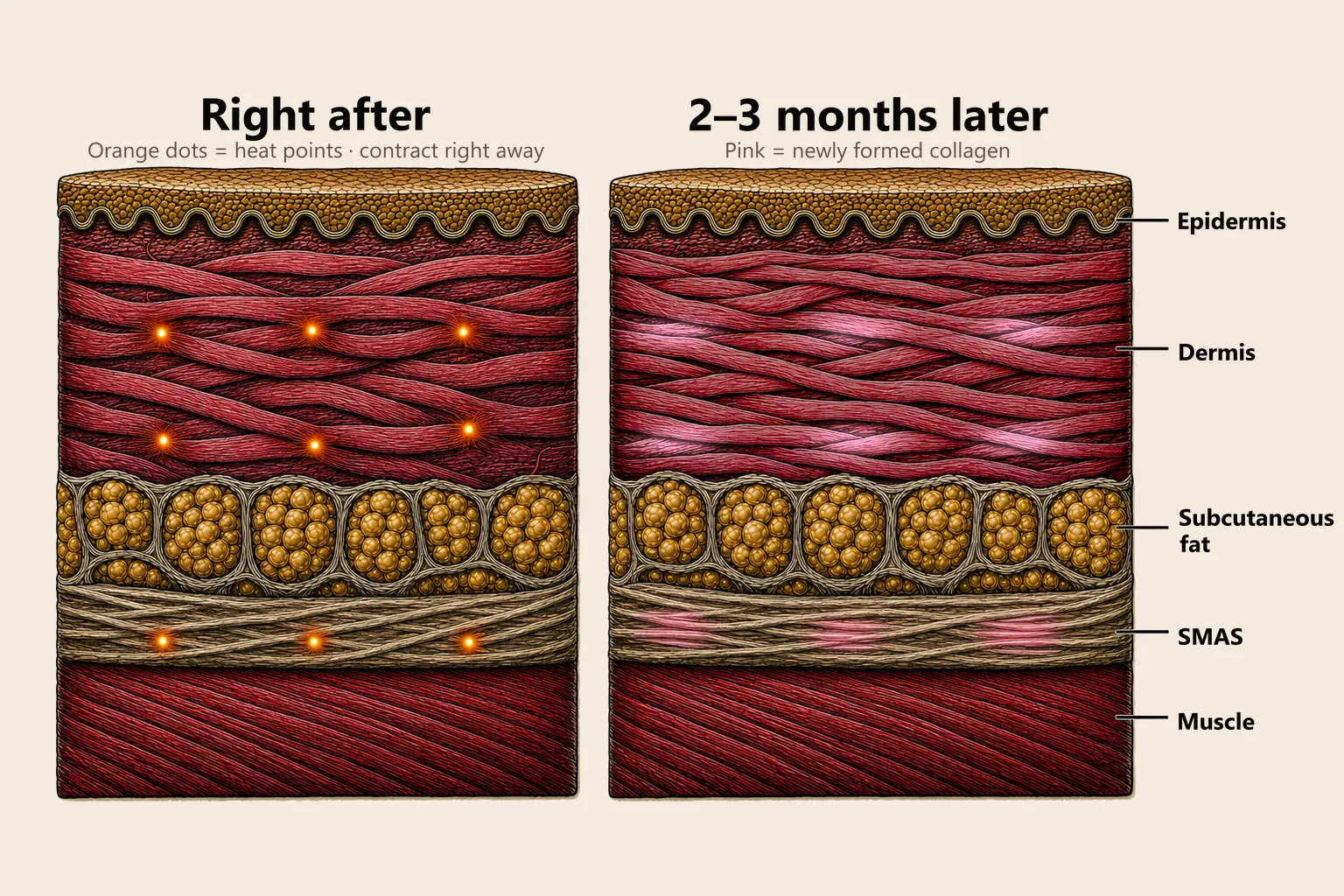
▲ Right after, the heat-point sites contract (orange); 2–3 months later, new collagen fills in around them (pink)
When to Consider It
- Your jawline has dropped and feels heavy, with jowls or sagging under the chin — it suits faces that still have a reasonable amount of fat and skin thickness
- Your brows and eye area have settled lower, making your face look droopy
- Your neck and the area under your chin have loosened
- The skin on your body has loosened — this is done with the body option (Ultherapy Prime Body), and the areas and extent are decided together after a physician examines them in person
- You're looking for a lift that leaves no wound on the skin's surface
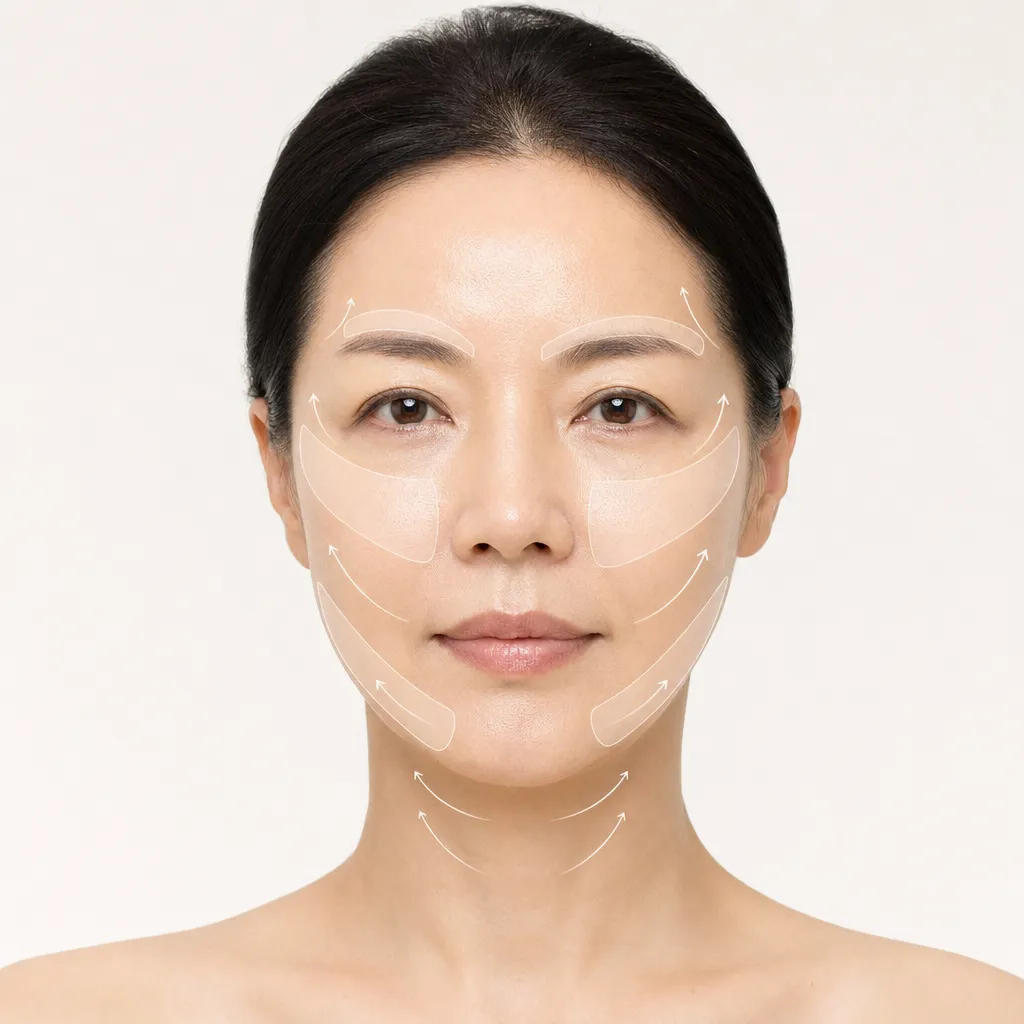
▲ Main areas of the face where sagging develops — brows, eye area, cheeks, jawline, under the chin, and neck
When a different approach may be the right fit
- The main cause of sagging is the amount of fat (a double chin or deep cheek fat) — an approach that reduces fat volume may be the right fit
- You have very little facial fat and very thin skin — we also consider an approach that heats the dermis broadly (see Limitations below for why)
Differences from Other Treatments and Limitations
| Compared approach | What they share | How they differ |
|---|---|---|
| Focused ultrasound without an imaging function, using various delivery patterns such as dots and lines | Both create heat points in the SMAS and dermis by the same principle | Ultherapy Prime has a function that shows the layers as an image. This is not a matter of better or worse but a difference in approach |
| Monopolar radiofrequency that heats the dermis broadly | Both use heat to prompt collagen renewal | Focused ultrasound delivers heat in points down to the SMAS to lift the structure, while monopolar radiofrequency heats the entire dermis across a surface to increase skin density. They work on different layers, so they are sometimes used together |
| Treatments that work on the fat layer | — | A treatment that reduces fat volume and a treatment that lifts the SMAS have different goals, and they are sometimes used together |
Limitations
- It is not a fat-reduction treatment. If the 4.5 mm focal point lands in the fat layer, fat cells can shrink and volume can decrease — this is what causes cheek hollowing (the cheeks looking sunken). It is not an intended effect but a side result that can occur, and the risk is greater when facial fat is very low and the skin is very thin.
- The imaging does not remove the risk of nerve injury. It only shows the layers; it is not a safeguard against the temporary nerve symptoms described below.
How It's Done
1. Skin assessment and consultation For the face, 3D MetaVu imaging captures your facial contours, left–right balance, and skin texture and fine lines, and we review the results together to decide on the areas and shot count. For the body, a physician examines the treatment area in person.
2. Your physician's name and a final check We let you know the name of the physician treating you, and that physician checks the condition of your skin.
3. Mapping and marking We mark the areas where the shots will go on your skin.
4. Numbing We apply numbing cream and wait 20 minutes.
5. Treatment The tip is placed on the skin, and heat points are placed at the depth set for each area.
The sensation is a sharp, tingling sting and a deep, dull ache at the moment heat reaches the SMAS. It can feel stronger in areas close to bone or where the skin is thin, such as along the jawbone, the forehead, and the cheekbones.
If pain is a concern, you can add Non-Sedation Gas Anesthesia (Air Nox) as an option — you breathe in a mix of oxygen and nitrous oxide that reduces pain and tension while you stay conscious and responsive.
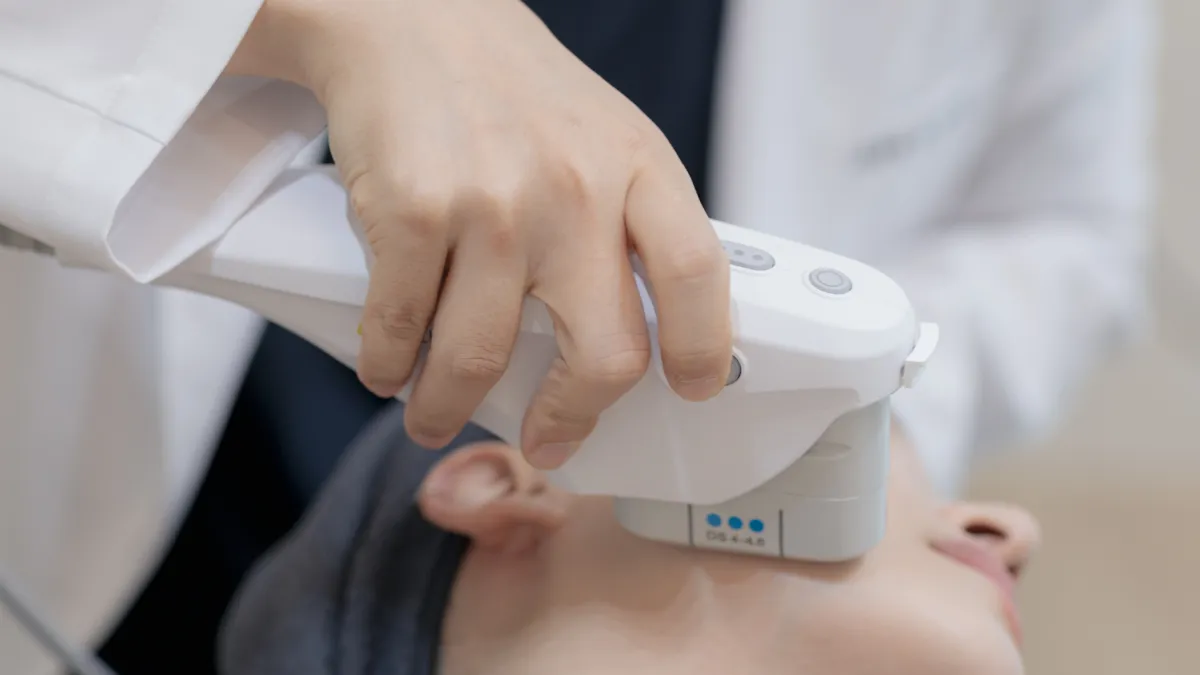
▲ Ultherapy Prime treatment in progress
Recovery, Expected Reactions, and Precautions
Recovery: Because the epidermis is not wounded, bruising and swelling tend to be minimal, but you may have temporary redness, a dull ache, and tenderness when pressed. You can usually wash your face and wear makeup the same day. Other reactions are uncommon, but everyone responds differently — if a reaction lasts longer than expected or becomes more noticeable, contact us and we'll check it with you.
Reported side effects: Along with redness, swelling, and pain, temporary nerve symptoms (such as numbness or tingling) have been reported. If symptoms continue, let the clinic know.
When we do not perform this treatment
- Pregnancy, possible pregnancy, or breastfeeding
- An implanted electronic device such as a pacemaker — the manufacturer lists this as a contraindication
When we postpone treatment
- A wound, an inflammatory lesion, or severe acne in the treatment area — following the manufacturer's criteria, we proceed once the skin has settled
What to tell us in advance
- Metal implants in the treatment area — ultrasound can bounce off a metal surface and create heat in an unintended spot, so we check their location in advance
- Other recent treatments — if you've had filler, fat grafting, a thread lift, or similar treatments, let us know at your consultation. Heat can affect volume added with filler, or grafted fat or threads, so we decide on the timing together
- Whether to have another treatment on the same day is decided together after your assessment
How PECHE Clinic Does It
We follow standards built from more than 90,000 treatments performed across the clinic. From more than 90,000 treatments performed across PECHE Clinic, we have built standards for each area and skin condition, and the same standards apply whichever PECHE physician treats you. With Ultherapy Prime, those standards determine which tip depth is used in each area and how many shots are placed there.
A physician personally reviews your assessment results before we begin. A physician personally reviews your assessment results and checks your skin once more right before treatment. This is why shot distribution differs from person to person, even with the same Ultherapy Prime treatment.
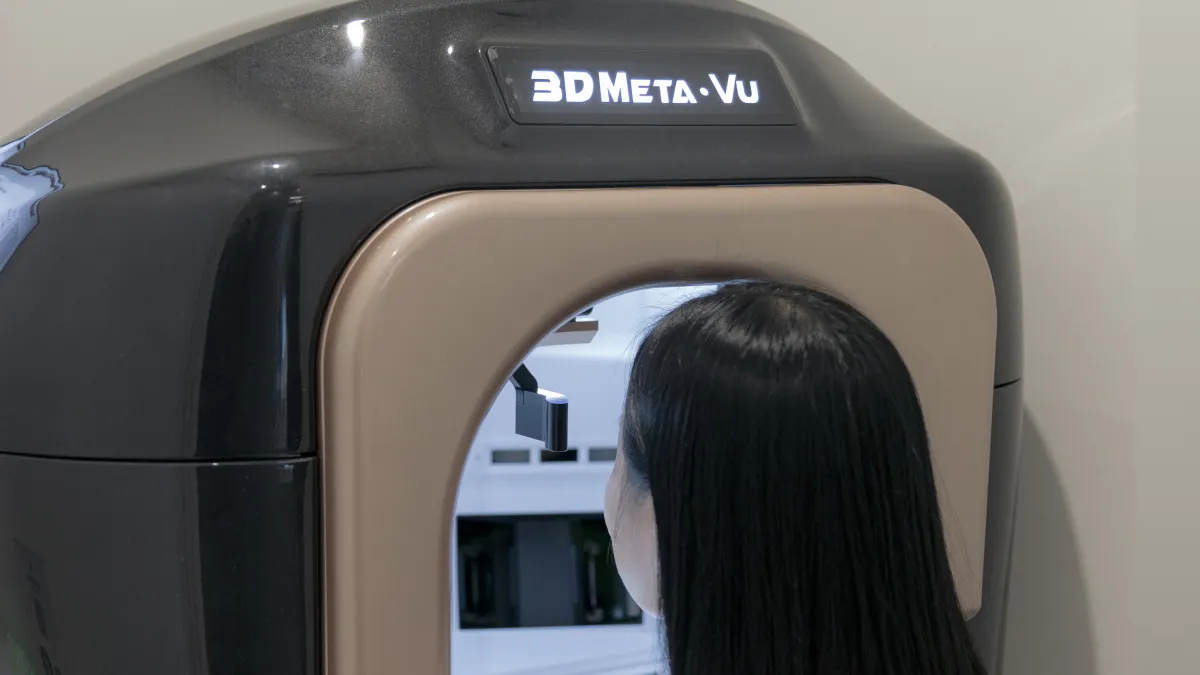
▲ We review your imaging results together
We treat pain as a safety signal, not as a gauge for how strong the energy should be. Higher energy is not automatically better; the energy is set between the amount that produces results and the amount at which side effects increase. More pain doesn't mean a bigger effect, either. Pain is a signal that an area near nerves or close to bone is being stimulated, so if you tell us you feel strong heat, we adjust the energy for that area.
We use genuine tips and keep the preparation area in view behind a full glass wall. We use only genuine tips. Ultherapy Prime tips are designed to be used only up to a set amount and cannot be refilled, and refurbished tips deliver uneven output, which carries a risk of burns and blisters. Treatment preparation takes place in an open-kitchen-style preparation area behind a full glass wall, so from the waiting area you can see the preparation process and hygiene practices for yourself.
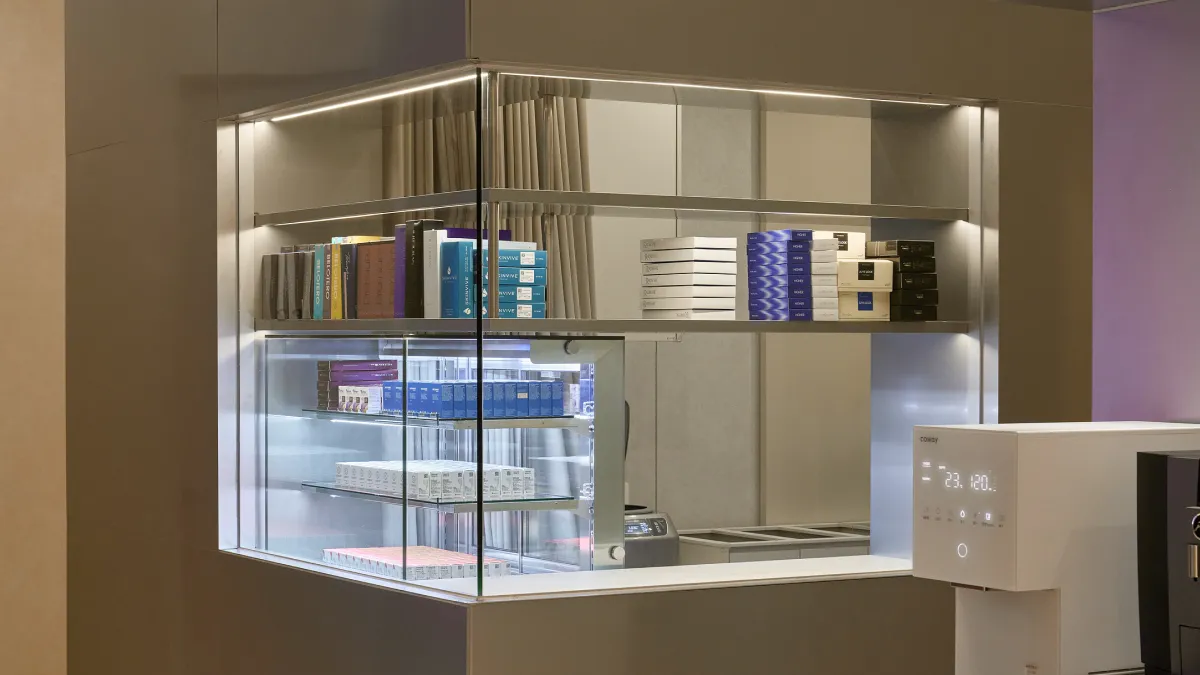
▲ The treatment preparation area, seen through the glass wall from the waiting area
We recommend only the treatments your assessment results call for. We tell you first what this treatment can do (sagging and loss of elasticity in the SMAS and dermis) and what it can't (reducing fat volume or filling in lost volume). You're welcome to come in just for a consultation and leave.
Pricing
Prices for Ultherapy Prime are published on our website for every product option. Whichever country you're visiting from and whichever channel you book through, the price is the same as the one published on our website — so there's no need to compare prices from one booking channel to another. Making sure you can come in trusting the price you checked in advance — that is the trust PECHE Clinic puts first.
For the face, Ultherapy Prime comes in 100, 300, 600, and 900 shots; for the body, Ultherapy Prime Body comes in 100, 300, 600, and 900 shots. We decide on the option you need together after your assessment.
Location and Clinic Hours
PECHE Clinic 3F, 364 Gangnam-daero, Gangnam-gu, Seoul Right outside Gangnam Station Exit 4 — the building entrance is right in front of you as you come out
Clinic Hours (Korea Standard Time, KST)
- Monday–Friday: 10:30 AM – 9:00 PM
- Saturday, Sunday, and public holidays: 10:00 AM – 6:00 PM
- No lunch break — we see patients straight through midday
FAQ
Q1. Who performs the Ultherapy Prime treatment? A: Before treatment, we let you know the name of the physician treating you, and that physician personally reviews your assessment results and the condition of your skin before starting. Tip depth and shot count follow standards built from more than 90,000 treatments performed across the clinic, so the same standards apply even if a different physician treats you.
Q2. Do you use genuine tips? A: We use only genuine tips, and from the waiting area you can see the treatment preparation process through the glass wall. The number of shots actually delivered is shown on the device screen.
Q3. Can I compare Ultherapy Prime shot counts with shot counts I've had on other devices? A: The energy delivered in one shot differs by device and tip, so shot counts can't be compared by number with those of other devices. The right number of shots is decided together by looking at the extent of sagging and the skin condition in each area.
Q4. Can Ultherapy Prime be used on the body as well as the face? A: Yes. For the body, there is a separate option, Ultherapy Prime Body (100, 300, 600, or 900 shots). It covers areas such as the arms and abdomen, which were added to the U.S. FDA clearance in 2025, and the areas and extent are decided together after a physician examines them in person.
Q5. I've had this treatment at another clinic — can I continue here? A: Yes. At your consultation, tell us when you last had it and which device and shot count were used. Results are clearest at 2–3 months, so when you had it affects the decision on when to have the next session.