Mirajet — PECHE Clinic, Gangnam Station
A liquid jet in place of a needle — cutting the tissue that holds a scar down while delivering regenerative ingredients · Scars, pores, stretch marks · Right by Gangnam Station Exit 4
Mirajet
Mirajet is a device that delivers liquid into the skin as an extremely fast stream — no needle. That stream is called a jet.
The laser itself doesn't touch your skin. An erbium-YAG laser (2940nm, a wavelength readily absorbed by water) flash-boils the water in the solution held inside the tip.
The resulting vapor pressure pushes the rest of the solution out through the nozzle — with enough force that the solution itself passes through the skin.
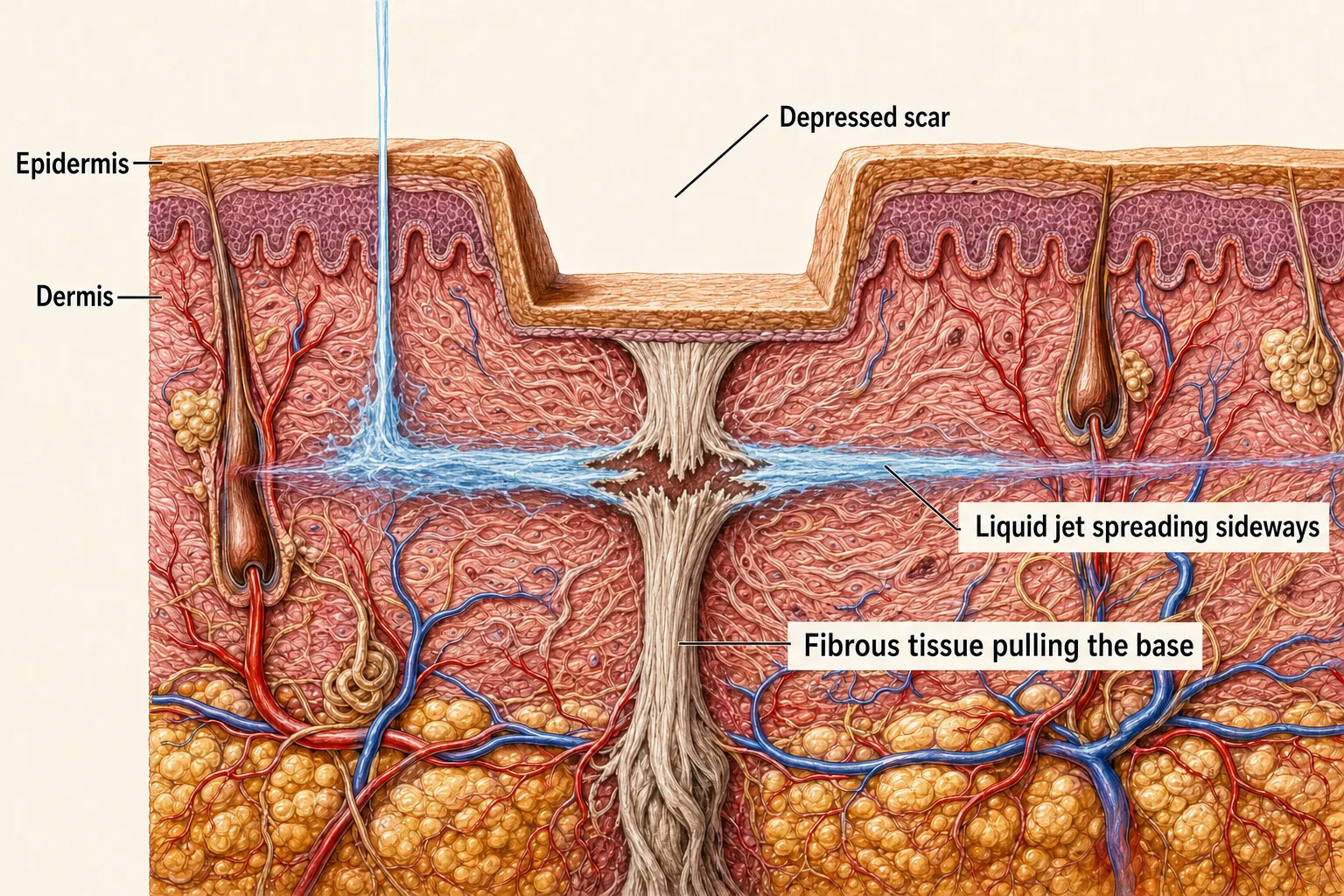
So the ingredient enters the dermis without a needle, and the stream, spreading sideways inside the skin, also carries the force to cut tissue.
▲ Past the surface, the jet spreads sideways in the dermis, cutting the tissue that pulled the scar's base down
When to Consider It
- One scar won't fill in, no matter how many treatments you've had
- A scar has angular borders and its base doesn't lift when pressed
- The texture around your pores is bumpy like orange peel
- Stretch marks from pregnancy or growth spurts make you self-conscious about what you wear
- You're looking for an approach that doesn't use needles
What the Jet Does Inside the Skin
| Action | What happens |
|---|---|
| Cutting tethered tissue | The stream spreads sideways in the dermis, cutting the hard tissue that pulled the scar's base downward |
| Ingredient delivery | Scattering into very fine particles, it spreads evenly across a broad area instead of pooling in one spot |
| Regenerative stimulus | As the skin recovers from the fine stimulation the jet leaves, new collagen is built |
Why the tethered tissue is cut first. A deeply depressed scar isn't just a sunken surface — its base is bound down by hard fibrous tissue. Left in place, it keeps pulling everything back down however much is filled from above; cutting it first is what creates the room to fill. A microneedling RF treatment that adds regenerative heat can follow the same day. The order is: inflammation control → cutting the scar free (this treatment) → regeneration → pigment last.
The jet enters at the scar's edge, not its center. The tissue holding the base is a set of vertical pillars — crossing them from the side cuts them better than pressing from above. The jet spreads sideways the moment it meets the dermis, so the direction matches. And at the center of a depressed scar the flesh is thin, leaving no room for liquid to spread — entering at the edge, where thickness remains, is what drives the jet under the scar's base.
The Three Things It Treats
| Use | Target | Areas |
|---|---|---|
| Scars and pores | Depressed scars with tethered bases · wide pores and rough texture | Face |
| Stretch marks and neck lines | Dermal collagen torn by stretching | Abdomen, thighs, and other body areas · neck |
| Ingredient delivery (Toning Mode) | The dermal layer regenerative ingredients need to reach — evenly, across a broad area | Face |
The "Mirajet Toning Mode" on the treatment list means something different from pigment-lightening laser toning. Instead of aiming hard at a single scar, it lowers the intensity and depth to spread an ingredient thin and wide through the dermis of the whole face. Ingredients whose properties don't suit delivery by this device are injected separately instead.
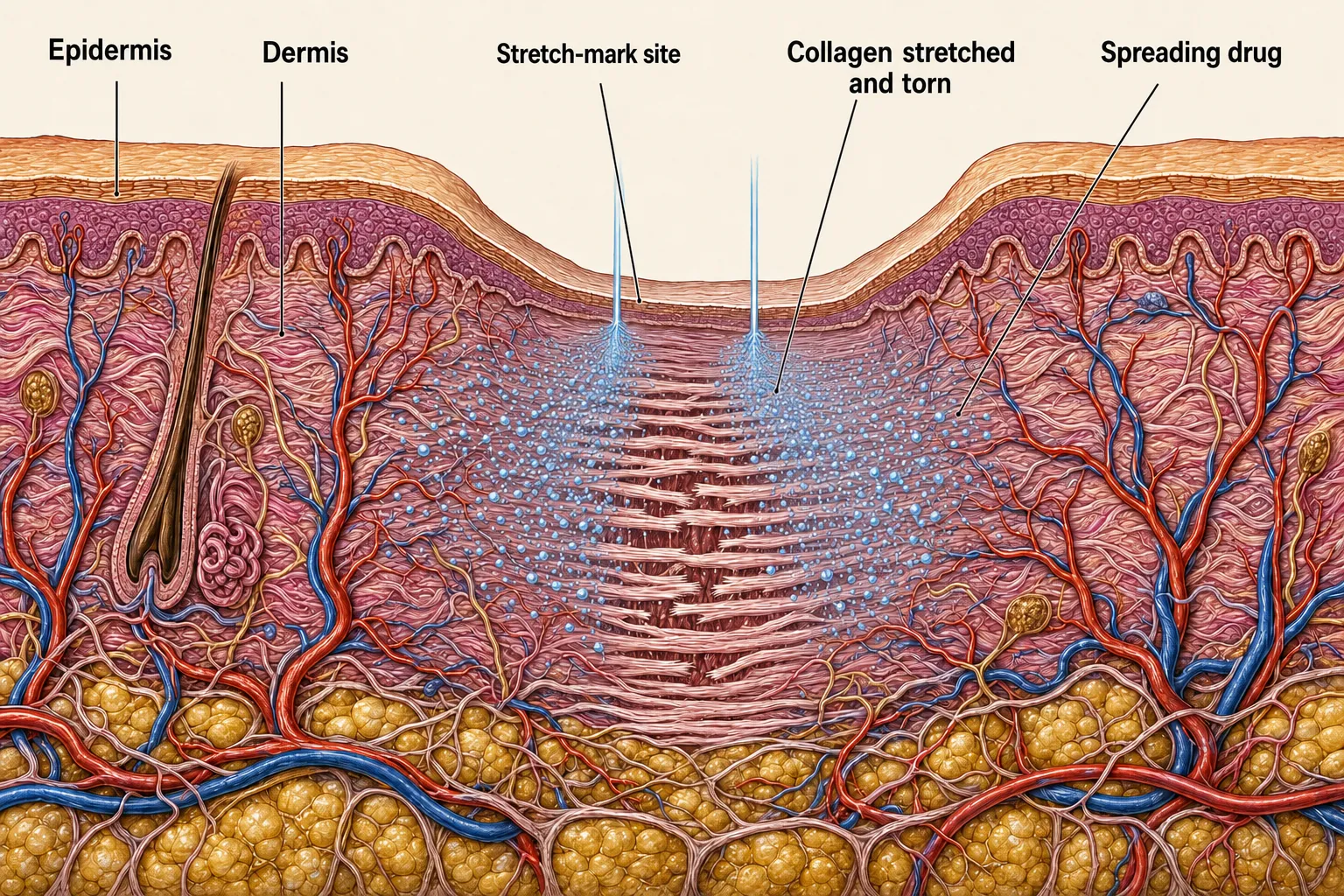
▲ A stretch mark is where dermal collagen has stretched and torn — the ingredient is spread directly into that layer
This is also why stretch marks resist fading. Treating the surface doesn't fill them — the ingredient has to reach the layer where the torn collagen lies.
How It's Done
1. Cleansing and area check The areas to treat and the scars' condition are confirmed.
2. Numbing cream Applied, then about 20 minutes of waiting.
3. Treatment Intensity is set to the area, then applied — scars one mark at a time, stretch marks along each line.
4. Soothing and guidance After soothing, we go over the care.
Results and Recovery
| Item | Details |
|---|---|
| Target | The fibrous tissue pulling a scar's base down · dermal collagen |
| How it works | Laser-built pressure fires the solution as a jet — cutting tissue, delivering the ingredient, and stimulating regeneration |
| Areas | Face (scars, pores) · neck · abdomen, thighs, and other stretch-mark areas |
| When results show | Gradually over 2–3 months — as collagen fills in where the tissue was cut free |
| Sessions | Not a single-visit treatment — planned at your assessment, by scar depth and stretch-mark range |
| Pain | No needle-prick pain, but a battering sensation, as if the fast stream strikes the skin in rapid succession · near bone — forehead, jawline — it can sting slightly |
| Pain control | Numbing cream applied and about 20 minutes' wait before starting · tell us how it feels mid-session and we adjust the intensity |
| Downtime | Bumpy raised marks and dot-like red bruises last 3–7 days, then settle |
| Aftercare | Sunscreen and moisturizer |
The ingredient delivered with it is chosen by the goal. A collagen-building ingredient (PDLLA) or a hyaluronic acid type is used. Run without an ingredient, only the cutting action is used; run with one, the material to fill the freed space goes in too.
Expected Reactions and Possible Side Effects
Common, temporary reactions — part of the normal response:
- Bumpy raised marks and dot-like red bruises at the treated area, lasting 3–7 days, then settling
Anything beyond this is uncommon. If a reaction lasts longer than expected or worsens, contact us and we'll check it with you.
What We Check Beforehand
If any of these apply to you, let us know during your consultation. We adjust the timing or lower the intensity.
- Active inflammatory acne or wounds at the treatment area — we proceed after they calm
- A keloid history (scars that heal raised)
- A condition where bleeding is slow to stop, or taking anticoagulants
- A recent peel or pigment treatment — we space it out
- A history of cold sores (herpes) — they can recur after stimulation, so tell us in advance
- Pregnancy or breastfeeding
- Any allergy to the ingredients that would go in with it
Stretch marks respond better early, while redness remains, than after they've faded white and set — the vessels are still open, so the regenerative response fires more readily.
Older, white-faded stretch marks can still be treated, but ingredients alone have limits there — so a microneedling RF treatment is sometimes run alongside, adding heat to the dermis to draw out the collagen response together.
How PECHE Clinic Does It
We start by identifying what kind of scar it is. Two depressed marks that look alike can call for different approaches, depending on whether the base is tethered. On the face, the 3D MetaVu photographs pore, texture, and line distribution; areas beyond the face, like stretch marks, are checked by direct examination.
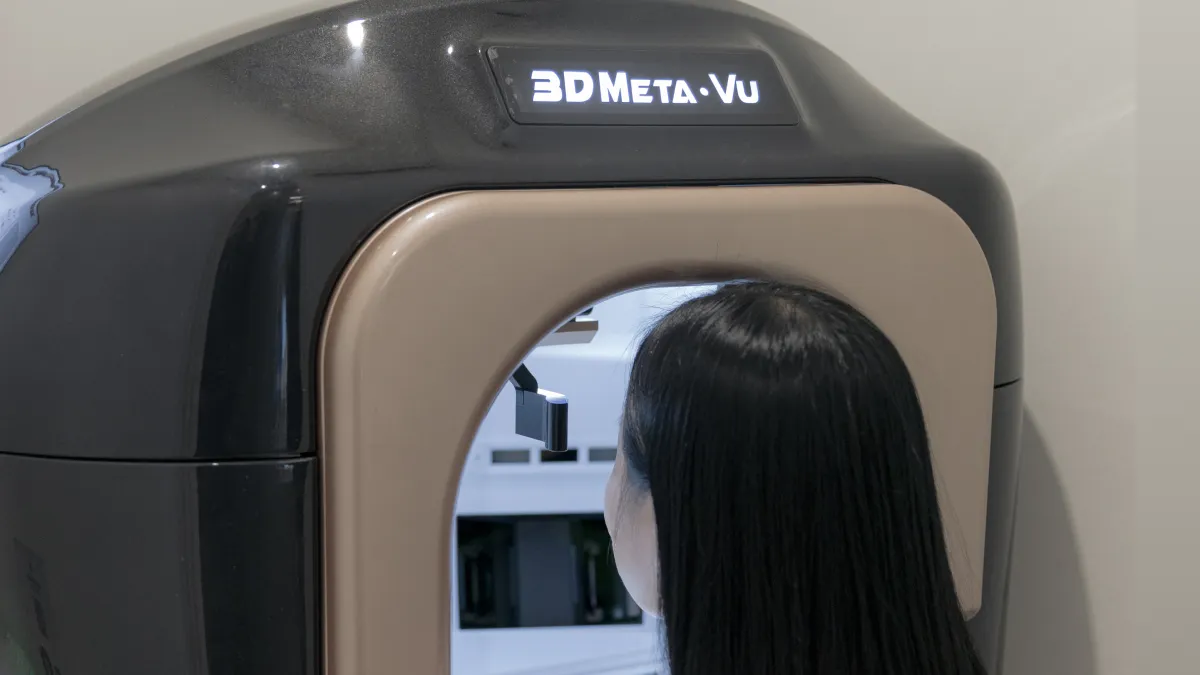
▲ Photography confirms the pore and texture distribution
Genuine ingredients only. The ingredients that go in with the jet are genuine products only, and we tell you at the consultation which ingredient is going in, and why.
The prep room is behind a glass wall, in full view. The preparation and hygiene routine is visible through the glass from the waiting area.
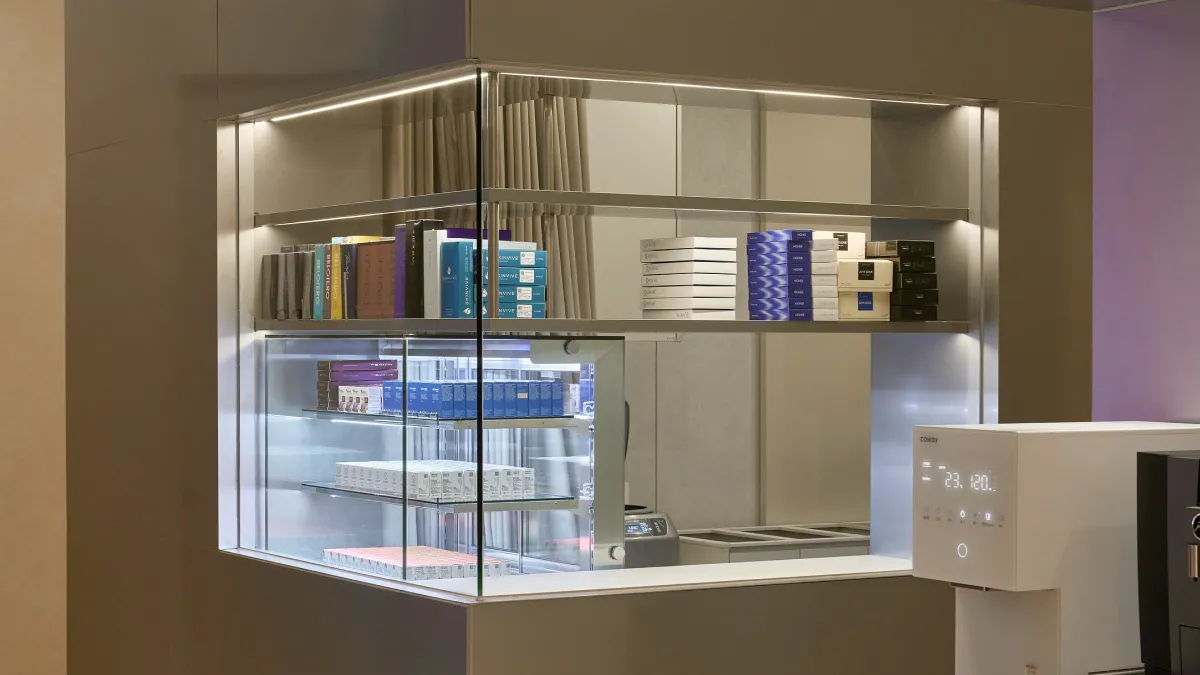
▲ The prep room, seen through the glass from the waiting area
We treat by standards built from over 90,000 treatments. Skin thickness differs by area — and face and body differ more. Intensity is set by per-area standards, not feel, so whichever physician treats you, the same standards apply.
We tell you first what it can do — and what it can't. Scars and stretch marks aren't concerns that vanish in one pass. We tell you in advance what you can realistically expect, and we don't push same-day payment or packages.
Pricing
Mirajet cost depends on the area and range, the ingredient that goes in with it, and the number of sessions. We confirm your scar or stretch-mark condition at the consultation, then give you a quote.
Location
PECHE Clinic 3F, 364 Gangnam-daero, Gangnam-gu, Seoul Right in front of Gangnam Station, Exit 4
Because this treatment is spread over several sessions, an easy trip makes it easier to keep to the schedule.
FAQ
Q1. Who performs the treatment? A: PECHE physicians who all work to the same per-area intensity standards, built from over 90,000 documented treatments. The scar's character and area set the intensity, and the standards stay the same even if your physician changes.
Q2. No needle — does it really get inside the skin? A: It does. The pressure the laser builds inside the tip fires the solution as a fast stream that passes the surface into the dermis, scattering into very fine particles that spread evenly across a broad area.
Q3. How do I know if this method fits my scar? A: Stretch the skin around the scar gently to either side — if the base doesn't come up with it, tissue is likely holding it from below. Scars like that are this method's target; for gently sloped, shallow marks, we recommend a different approach.
Q4. Do stretch marks really improve? A: A stretch mark is a structural problem — torn dermal collagen, not color — so undoing it as if it never happened is difficult. But placing regenerative ingredients into the torn layer and adding stimulus can help it improve — becoming narrower and shallower, with smoother texture.
Q5. How should I choose a clinic? A: Three things. First, whether they sort out if the scar is tethered — that judgment decides the method. Second, whether they tell you precisely which ingredient goes in with it. Third, whether the clinic is easy to reach across the spaced sessions.